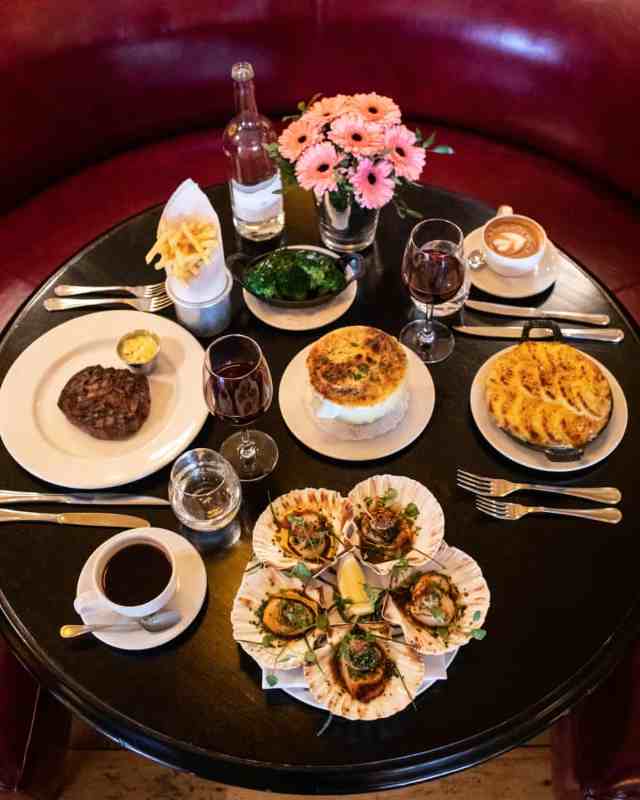
Kit: Onion soup gratinée, £9; fish pie, £19.50; broccoli £5; americano £3 Tim: Baked scallops, £24; steak frites, £27.50; flat white, £3 They shared: Carafe of Cotes du Rhone, £21; bottle of sparkling water, £4 Photograph: Antonio Olmos/The Observer.
I find the paragraph cited here interesting and amusing for its self-aware description of how the author and his interviewee, both of them writers, preen themselves competitively on their humble class origins to establish their bona fides while preparing to dine in a luxurious restaurant. Their ritual seems to involve a sort of what would be called “humble-bragging” in the States. The context is De Waal’s project to discover and publish new working-class voices in British fiction. The article includes a link to Monty Python’s Yorkshiremen sketch, which is wildly funny.
Before we’ve really sat down, De Waal has deftly established that I come from a significantly posher part of Birmingham than her and that I have a suspiciously “neutral accent”; while I have noted that she left her home city 22 years ago to live in Royal Leamington Spa, though she still says: “I live in Leamington, but I’m from Birmingham.” I see she has come in clutching several West End shopping bags and note the labels. She meanwhile trumps comprehensively my mumbled “first in family to go to university” with “left school – and home – at 16”. We both despise ourselves for doing this – we are in our 50s, after all, when will it stop? – but obviously accept it as our solemn English birthright.
(Tim Adams, “Kit de Waal: ‘Writing’s very solitary — you do it because you want to find readers’,” The Guardian, 4-14-19)
(c) 2019 JMN.









On Clarity
BBC.
As a first-year law student I, along with my peers, had to read and sort out a seeming infinitude of cases written by appellate judges whose writing skills varied widely. Navigating the dense prose of the tomes we lugged around in outsize briefcases seemed at times like slogging through a trough of fudge. I was once grilled unforgettably in class by my contracts professor for having reached the wrong conclusion about the law established by a historic case. My reading had led me to deduce the opposite of what the judge had actually decided.
I appreciate the work of Linda Greenhouse, who writes a regular column for The NYTimes about the Supreme Court and the law. Her profession is to parse what judges write, tease significance from it, and write clearly about it. In such a writer I learn from a rare stylistic slip as well as from her customary excellence.
Item (the emphasis is mine):
(Linda Greenhouse, “A Supreme Court Do-Over,” NYTimes, 4-11-19)
In general, an opinion piece demands a strong, clear wind-up. Nuance can be appropriate in the body of the article, but the reader expects no puzzles at the end. The concluding paragraph cited above strikes me as flawed.
The “that” in the first line introduces a dangling subordinate clause; it’s never completed with its own verb. The verbose interpolation introduced by the first double dash encourages this lapse. The writer loses her beginning.
The second double dash introduces a question that derailed me because of how I wanted to understand “any way”; I read the phrase initially as an equivalent of “nevertheless”; however, that reading asks for the inversion “won’t we”: “— and any way won’t we all be the poorer if that proves to be the case?” Then I realized that it also requires “any way” to be written as one word: “anyway.”
Upon another re-reading I concluded that what is meant would become clearer if it were put like this: “— and is there any way we won’t all be the poorer if that proves to be the case?”
In this manner, then, I have furnished a wooly elucidation to a wooly conclusion in the best tradition of appellate judges.
(c) 2019 JMN.