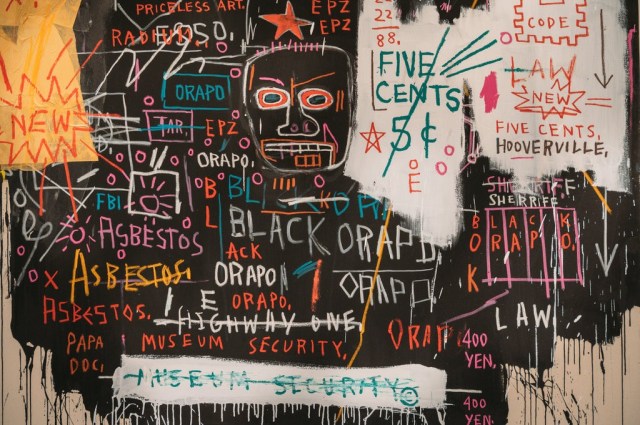
Detail of Basquiat’s text-filled “Museum Security (Broadway Meltdown),” from 1983, acrylic, oilstick and paper collage on canvas. Credit The Estate of Jean-Michel Basquiat, Licensed by Artestar, New York; via The Brant Foundation; Charlie Rubin for The New York Times.
[The Brant Foundation Art Study Center in the East Village, New York City, opens with an exhibition of nearly 70 works by Jean-Michel Basquiat created from 1980 to 1987.]
Other paintings pay homage to jazz greats like Miles Davis and Charlie Parker (Basquiat worked in a similarly improvisatory way) and handwritten text appears everywhere. Basquiat favored the cutup technique of the Beat writer William Burroughs but he also witnessed the rise of rap and hip-hop music. His words feel eerily poignant today: “debt shrine,” “per capita,” “Hooverville,” “perishable,” “black teeth,” “immortality.” … Crossed-out words also recur in his paintings and are weirdly reminiscent of the bracketing or slashing of text in deconstructionist philosophy, to emphasize the cultural and biased nature of language. Funny to realize in retrospect that Basquiat and the French philosopher Jacques Derrida were on the same page.
(Martha Schwendener, “‘Jean-Michel Basquiat’ at the Brant Shows His Bifurcated Life,” NYTimes, 3-5-19)
(c) 2019 JMN.




 EthicalDative
Defamation Nation
(NYTimes, 3-5-19)
This article is interesting for citing language of an Australian judge in ruling that a Chinese businessman was defamed by a 2015 Sydney Morning Herald article. (The article alleged bribery of a United Nations official by the businessman, who has been a major
political donor.)
It’s one thing to look up dictionary definitions of “defamation,” but another to see how a judge defines it in a real court case. The article’s author describes Australia’s defamation laws as “oppressive and notoriously complex.”
The judge in the case ruled that the offending article “used language that was ‘imprecise, ambiguous and loose, but also sensational and derisory’.” Let’s see now, where else have I
seen that sort of language recently? Oh yes. Everywhere.
(c) 2019 JMN.