“Keeping Busy”

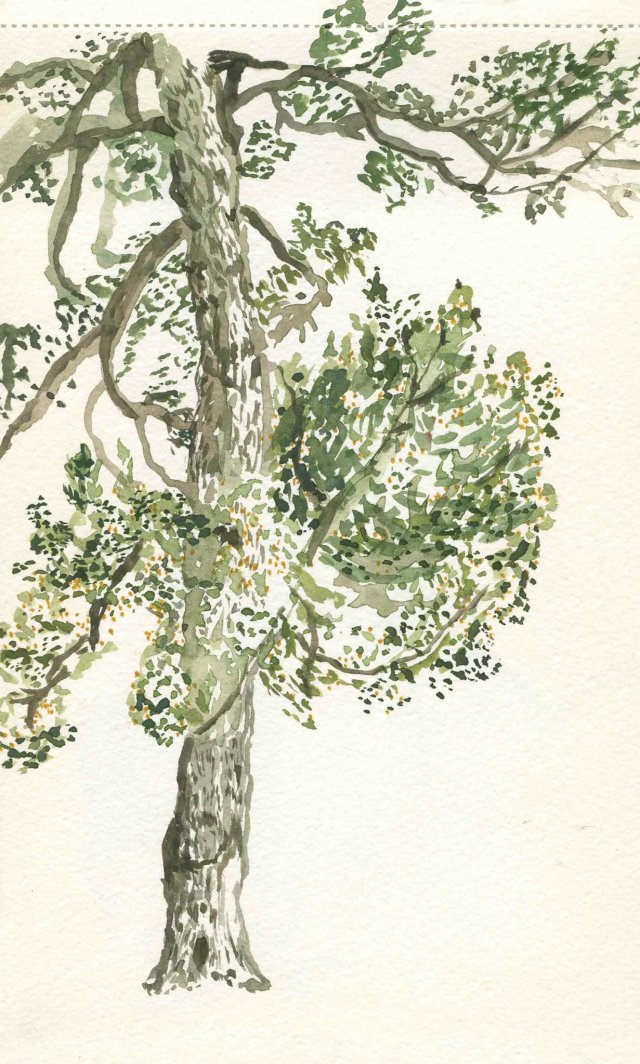
tree by sarah

I remember … what my teacher said [about a tree study]. “Your tree is beautiful, Sarah, but I don’t know what an art director is going to do with that tree.” No matter, no mind. I was on my own path… The great thing about a sketchbook is that it is for you. It’s where ideas, conscious and unconscious, form. Accidents happen, but they are happy accidents… I can’t say that I am completely happy when I draw. It’s not happiness. It’s feeling occupied, content. Something Andy Warhol said has always struck a chord in me: “I think that’s the best thing in life: keeping busy.” Once I started drawing I realized I could keep myself busy and never feel bored again.

(Sarah Williamson, “My Sketchbooks in a Stranger’s Hands,” NYTimes, 3-16-19)

(c) 2019 JMN.

Posted in Quotations | Tagged | Leave a comment

“A Girl From Somewhere Else”

I take myself too seriously, probably because I’m a human being. With our big brains and our bigger egos, we can’t help building the case to ourselves and others that we are very important creatures, when really we’re ludicrous. To be funny is to remind ourselves again and again just how ridiculous we are.

(Maeve Higgins, “My Glamorous Life as a Movie Star in Control-Top Pantyhose,” NYTimes, 3-16-19)

Higgins is the author of “Maeve in America: Essays by a Girl From Somewhere Else.”

(c) 2019 JMN.

Posted in Anthology | Leave a comment

High Cotton in Language Land

you auto be with me uploaded

[Confession: I hesitate to register enjoyment of language that happens to come from a debate whose seriousness I readily acknowledge. Brexit is beyond my purview, but I hope whatever solution is reached benefits the UK and its citizens. With that proviso I proceed on a lighter note.]

A homely old saying where I’m from is that someone “is in high cotton” when he or she experiences a stroke of good fortune or finds himself or herself in a pleasing situation that works to his or her advantage. As a blogger who keeps an eye on language and style in daily readings I am in high cotton when I encounter passages such as the following:

Mr. Cox, who speaks in the clavicle-juddering bass of an Old Testament prophet, has achieved a degree of celebrity as Mrs. May’s surrogate and protector.

(Ellen Barry, “Theresa May Finds Herself Without a Voice, or a Friend,” NYTimes, 3-12-19)

The choices facing Parliament were “unenviable,” as Mrs. May said… but coming days promised more “squeaky bum time,” a phrase several British reporters borrowed from a soccer coach who once used it to describe the way fans squirm in their seats when the action gets tense.

(Editorial, “Britain Squirms After Another ‘No’ on Brexit,” NYTimes, 3-12-19)

The phrase describing Mr. Cox’s bass voice judders my clavicles. As for squeaky bum time, now is it, assuredly, on several fronts.

(c) 2019 JMN.

Posted in Anthology, Quotations | Tagged | 2 Comments

Sports

exclamation-mark

I’ve studied at every level of American education — elementary through graduate school and law school — and have taught without distinction at most levels as well — middle school, high school, community college, and university. None of this qualifies me to sound off about how the system should work because I’m clueless; however, my interest in the topic of education leads me to echo some points from an opinion piece in The Times stemming from the admissions bribery indictments that have surfaced. Points made in the article lend support to my sense that the outsize focus on sports that’s prevalent in our schools can siphon student energies, as well as key resources, away from the academic pursuits that might ought to be the bedrock of what schools are about.

[According to research into the college admissions process]: An athlete was about 30 percentage points more likely to be admitted than a nonathlete with the same academic record… Competitive sports occupy a ridiculously large place in the admissions process… “Athletic recruiting is the biggest form of affirmative action in American higher education…,” Philip Smith, a former dean of admissions at Williams College, has said. “Recruited athletes not only enter selective colleges with weaker academic records than their classmates as a whole but…, once in college, they ‘consistently underperform academically…,’” Edward Fiske wrote in a 2001 book review for The Times.

(David Leonhardt, “End Special Treatment for Sports,” NYTimes, 3-13-19)

(c) 2019 JMN.

Posted in Quotations | Tagged | Leave a comment

“Resolving Uncertainty”

music notation

I’m trying to make the musical intervals stick in my head through associated songs, a technique I’ve only just discovered. I’m painting each interval on canvas, first the minor second,  exemplified by the theme of the movie “Jaws.”

The article excerpted below  recommends drawing pictures of things you want to remember. Uncertain about the upshot of my experiment, I’m reminded of a joke involving someone at pains to remember the means by which he meant to remember the thing, while the thing itself is perfectly remembered.

… In an arts integrated curriculum, students would sketch their vocabulary words, or learn some of the material as songs, or act out molecular motion with their bodies… The children who had learned the material in the curriculum that made use of the arts remembered more, and the effect was largest among the children who were less strong academically, the ‘lower performers.’

“Working through some creative endeavor, we’re really resolving uncertainty,” [Ronald Beghetto, a professor of educational psychology] said. “We approach the blank canvas.”

(Perri Klass, “Using Arts Education to Help Other Lessons Stick,” NYTimes, 3-4-19)

(c) 2019 JMN.

Posted in Quotations | Tagged | 9 Comments

The Agony of Deaccessioning

Indianapolis Museum of Art

Paintings line the basement storage space at The Indianapolis Museum of Art, which has graded its entire collection to help determine what art it may want to sell or transfer to another institution. Indianapolis Museum of Art at Newfields; Lyndon French for The New York Times.

This article has useful and graphic information about how and why so many art museums display so little of their collections. At first blush there is ample fodder for irony for persons possessed of the notion that art’s first purpose is to be looked at. There are,
however, extenuating circumstances and complicating factors in the dilemmas that museums face.

First, the problem: “Most museums display only a fraction of the works they own… There are thousands, if not millions, of works that are languishing in storage.” Museums are confronting “a history of voracious stockpiling and the pressure to acquire still more.”

Wealthy people bestow much swag other than pictures and sculpture on museums: doilies, clothing and costumes, accessories, home furnishings, textiles, etc. All these treasures compete for scarce exhibition space as well as ballooning resource requirements for proper preservation when not on display.

In museums’ defense, however, “… many [undisplayed works] are prints and drawings that can only sparingly be shown because of light sensitivity.” There is, too, the argument that “… preserving the best of the past [even in storage] — no matter how unpopular it may temporarily become — is the purpose of museums.” Also, — surprise! — a percentage of donated works are mediocre, “not even worth showing,” according to one museum veteran.

So, while philanthropists aren’t always experts in picking masterpieces, neither are they always modest or humble people. Many donors dictate the terms of their gifts, effectively bossing from beyond the grave in many cases. Donors of art works valued at $400 million to the Art Institute stipulated that the donation has to be on display for the next fifty years. “I got the deal of a lifetime,” one of them said.

(Robin Pogrebin, “Clean House to Survive? Museums Confront Their Crowded Basements,” NY Times, 3-10-19)

(c) 2019 JMN.
Posted in Commentary | Tagged | Leave a comment

“The Skill of Deep Watching”

exclamation-mark

This essay by Salvatore Scibona, a novelist, speaks to me for its call to transcend the outrage bait, the incitements to be condemnatory, to which we are exposed in so much discourse. His reviving of a more “capacious” meaning of “witness” as an alternative to
judgment hearkens to sage advice from religious tradition that’s honored perennially in the breach. Also, it’s refreshing to encounter a witness for the benefit, besides entertainment, of reading good literature!

We could use an alternative to judgment… I think we can find one in literature. I’m talking about stories that take an ordinary person and watch her, through hours and years, inside and out, and strive, if not for objectivity, then at least for evenhandedness. George Eliot watches characters screw up and then asks the reader not to be too hard on them. Cormac McCarthy can use a language so stripped of judgment as to appear, deceptively, unconcerned with conscience. Somewhere in between, Cheever has a remarkable ability (as Joan Didion said of people with self-respect) “to love and to remain indifferent.”

All three have the skill of deep watching. When they describe in detail a conflict that cries out for us to take a side but hold back from explicitly taking a side themselves, they are not overlooking the moral stakes. They are compelling a moral response from us that’s more challenging than approval or disapproval. Under the influence of their restraint, our conscience is engaged in a new way, as a witness.

That word has a more capacious meaning than we tend to allow it. The Oxford English Dictionary defines a witness as, among other things, “one who is or was present and is able to testify from personal observation.” It also lists an older meaning: “knowledge, understanding, wisdom.”

(Salvatore Scibona, “The Industrial Revolution of Shame,” NYTimes, 3-9-19)

(c) 2019 JMN.

Posted in Quotations | Tagged , , | 1 Comment

“Eva”

More Galleries | Tagged | 2 Comments

“Casually Disrespected Boundaries”

wally reinhardt

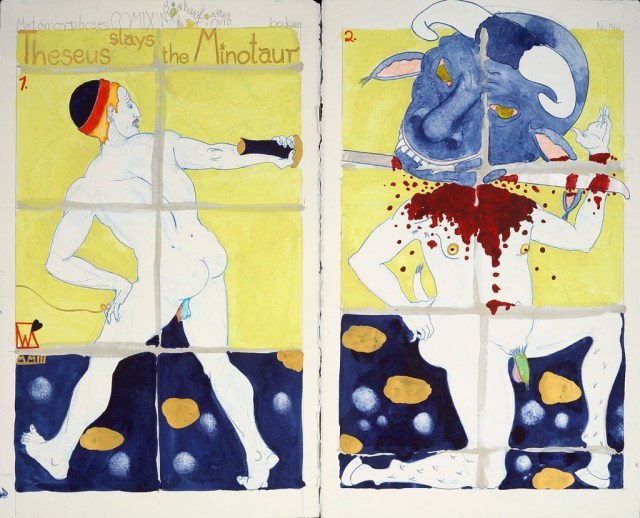
Wally Reinhardt’s “Theseus Slays the Minotaur,” from 2003, in the exhibition “Metamorphoses: Ovid According to Wally Reinhardt.” Credit via Grey Art Gallery.

While living in Rome in the 1970s, Wally Reinhardt became infatuated with Ovid’s “Metamorphoses.” I like the idea that a person with no formal background or training can disrespect boundaries while creating work that seems unstable and undependable.

“Back in New York, in 1984, Mr. Reinhardt took up art himself with no formal background or training. Using colored pencil and gouache, he began drawing his favorite Ovidian scenes, later swapping out the gouache for watercolor… His loose-jointed, naked heroes and giants stride freely across boxes’ edges, even from page to page in polyptychs, while the colors of his stagy green hills and star-dappled indigo skies often stop just shy of their outlines.

All these casually disrespected boundaries, along with Mr. Reinhardt’s whimsical draftsmanship, make the mythological world he depicts seem very unstable — exciting, undependable. In other words, it’s all pretty sexy….”

(Will Heinrich, “What to See in New York Art Galleries Right Now [Wally Reinhardt],” NYTimes, 3-6-19)

(c) 2019 JMN.

Posted in Quotations | Tagged | Leave a comment

Bernard Gilardi

Bernard Gilardi

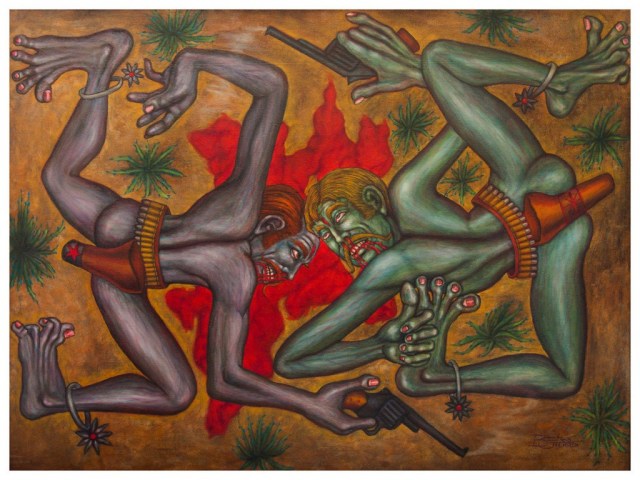
Bernard Gilardi’s “It’s a Draw,” a 1963 painting that depicts two dead, dueling men whose bodies are twisted into letter-like shapes. Credit via the Estate of Bernard Gilardi.

As an obscure, untrained, uninspired painter closeted in a shed, I get a vicarious boost reading about painters who manage to wander into visibility from the sidelines — posthumously, most often, which is not the boosting part.

“For more than 40 years, Gilardi made paintings in his Milwaukee homes, working in the attic and the basement, away from his wife and children. By day, he was a dot etcher at lithography companies; on nights and weekends, he used oil paint to conjure a playfully surreal world of bulbous, barely dressed humans cavorting with nature… Gilardi never displayed his art during his lifetime. When he died, in 2008, he left behind almost 400 paintings. His first public exhibition came two years later, at the Portrait Society Gallery in Milwaukee.”

(Jillian Steinhauer, “What to See in New York Art Galleries Right Now [Bernard Gilardi],” NYTimes, 3-6-19)

(c) 2019 JMN.

Posted in Quotations | Tagged | Leave a comment