Fretwork: Positions

(1) Positions refer to the left hand (on a right-handed guitarist). The left hand is the hand that fingers notes and chords on the fretboard.

(2) The following is from Wikipedia: In the left hand, each finger is responsible for exactly one fret. For each hand-position of four frets, the left hand is stationary while its fingers move… The ‘nth position’ means that the hand is positioned with the first finger [the Index] over the nth fret.

(3) Reminder: Conventional numbering for guitar strings is:

E = 1, B = 2, G =3, D = 4, A = 5, E = 6

(4) My homespun code for the places you put your fingertips to produce notes is SFN, “string-fret-note.” Example: ‘11F’ says, “Finger string 1 at fret 1 to produce an F.” Note: A “zero” fret means an open string — one not fretted.

(5) Here’s how the code would depict playing of a C scale in Position 1:

53C-40D-42E-43F-30G-32A-20B-21C

Notice the following:

a. String 6 (low E) is mute. (Its first C is on fret 8, which is beyond Position 1.)

b. Scale-note C launches on string 5 (the A string) at fret 3.

c. Notes D-E-F are all played on string 4 (the D string) first open, then at frets 2 and 3.

d. Notes G-A are played on string 3 (the G string) first open, then at fret 2.

e. Notes B-C (completing the octave) are played on string 2 (the B string) first open, then at fret 1.

(c) 2019 JMN.

Posted in Anthology | Tagged , | Leave a comment

Fretwork: Guitar String Numbering

(1) Conventional numbering for guitar strings is from high to low. In standard tuning the strings are numbered:

E = 1

B = 2

G = 3

D = 4

A = 5

E = 6

(2) Guitar tuning, on the other hand, is described inversely to string numbering, as follows:

6 = E

5 = A

4 = D

3 = G

2 = B

1 = E

(3) If you have the leisure and inclination, reflect for a moment on how perversely clashing these two conventions appear to be. Not to mention that, when you strum a guitar, your thumb or pick typically travels the strings from low to high, and when you look down at your instrument the low string is closest to your nose and the high string closest to your crotch, which consensus tends to recognize as a top-down orientation.

[Roger Edward Blumberg, at http://www.thecypher.com, makes a case for reversing traditional string numbering to match the tuning sequence.]

(4) With misgivings, I’ve elected to stick for the moment with the traditional goofy system for fear that it permeates extant guitar literature that I may have occasion to consult. I’m not credentialed in any way for this type of decision, but it’s necessary for what follows to state the stance.

(c) 2019 JMN.

Posted in Commentary | Tagged , | Leave a comment

“A Squeamish and Skittering Ride”

Buzzfeed

Fifteen percent of BuzzFeed’s employees, including dozens of journalists, are losing their jobs. Credit Drew Angerer/Getty Images.

I’ve toiled in this business for nearly 20 years, and even in the best of times it has been a squeamish and skittering ride, the sort of career you’d counsel your kids to avoid in favor of something less volatile and more enduring — bitcoin mining, perhaps.

(Farhad Manjoo, “Why the Latest Layoffs Are Devastating to Democracy,” NYTimes, 1-30-19)

(c) 2019 JMN.

Posted in Quotations | Tagged | Leave a comment

Beatle Haircut Forgery?

Beatles haircut forgery claim

A Man Reading (Saint Ivo?), attributed to the workshop of Rogier van der Weyden and, right, Eric Hebborn Composite: National Gallery/Rex.

National Gallery’s 1450 portrait by Rogier van der Weyden was created in the 1960s by Eric Hebborn, says art historian.
…

Wright ridicules the haircut of the figure who is reading a text that is “gobbledegook” – “an impossibility for a long inscription in that period when artists only wrote inscriptions to be read”.

(Dalya Alberge, “‘It’s a Beatle haircut’: historian claims 15th-century portrait is from the 1960s,” The Guardian, 2-2-19)

(c) 2019 JMN.

Posted in Quotations | Tagged | Leave a comment

Bauhaus

Bauhaus office of Walter Gropius

The office of Walter Gropius, the founder of the Bauhaus art and architecture school, in Weimar, Germany, the institution’s first home when it was established in 1919. The desk, armchair, sofa and ceiling lamp were originally by Gropius, the table lamp is by Wilhelm Wagenfeld and the carpet is by Benita Koch-Otte. The room was reconstructed by Gerhard Oschmann in 1999. Credit Photograph by Fabrice Fouillet. Walter Gropius, “Gropius Room,” 1922/23 © 2019 ARS, NY/VG Bild-Kunst, Bonn, Reconstruction as a “Gesamtkunstwerk” by Gerhard Oschmann 1998/99. Design of desk, armchair F51, sofa and ceiling lamp by Walter Gropius. Carpet by Benita Koch-Otte. Bethel by friendly permission of V. Bodelschwingh Foundation Bethel©. Wilhelm Wagenfeld, “Table Lamp” © 2019 ARS, NY/VG Bild-Kunst, Bonn.

For years, the roster of Bauhaus luminaries — such as Gropius, Mies, Wassily Kandinsky and Paul Klee — was seen as exclusively male; recently, the contributions (as well as marginalization) of its brilliant women designers — such as Gunta Stölzl and Anni Albers in textiles; Lotte Stam-Beese in architecture; and Ré Soupault in fashion design, photography and journalism — have been the subject of continuing scholarship. “Blaupause” (“Blueprint”), a well-received novel by Theresia Enzensberger about a female student at the Bauhaus who wants to be an architect, is coming out in English this year.

(Nikil Saval, “How Bauhaus Redefined What Design Could Do for Society,” (NYTimes Magazine, 2-4-19)

(c) 2019 JMN.

Posted in Quotations | Tagged | Leave a comment

A Quaint Plaint Spoken to the Wind

Sombrerismo is a spurious derivative coinage hatched by a cheeky blogger from the Spanish word for “hat” (sombrero). This etiquette-challenged perversion may be a sub-attribute of machismo, a term more familiar to the anglophone community. A man commits sombrerismo when he wears his hat indoors or fails to tip it when introduced to a lady. A hat is not an element of costume, except now it mostly is. It once had a purpose, serving in all weathers for shade and warmth for men castrating yearlings, riding fence, or witching for water. It was acceptable, too, for the frivolous sport of bulldogging steers, though it usually fell off the cowboy’s head as soon as he came off his horse to rassle the critter down. Dandy dudes, on the other hand, had best uncover when pounding longnecks in dusky honky-tonks while feeding the jukebox. It’s just polite.

(c) 2019 JMN.

Posted in Commentary | Tagged | 3 Comments

Jake Bugg

www.youtube.com/watch

Posted in Quotations | Tagged | Leave a comment

Sleaford Mods

www.youtube.com/watch

Posted in Quotations | Tagged | Leave a comment

The Wave Pictures

www.youtube.com/watch

Posted in Anthology, Quotations | Tagged | Leave a comment

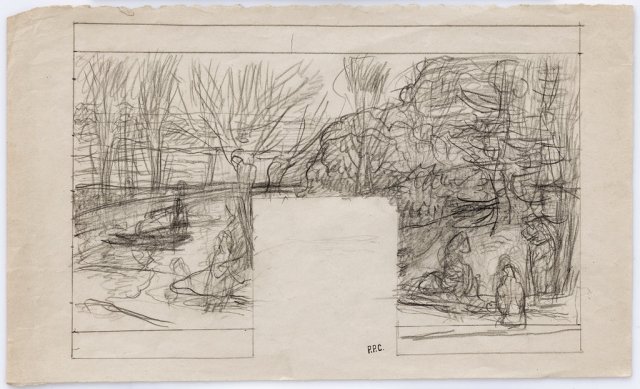
Pierre Puvis de Chavannes

Puvis’s “Study for Summer,” circa 1890-91, pencil on paper.Creditvia Michael Werner Gallery

Puvis’s “Study for Summer,” circa 1890-91, pencil on paper. Credit via Michael Werner Gallery.

He was especially admired by Seurat and Gauguin, and also Cézanne, and later, Matisse and Picasso as well as the perennially underestimated American Maurice Prendergast. In their works and that of many others, you’ll find different combinations of Puvis’s carefully calibrated compositions; flat, unmodeled figures and restrained poses; shallow landscape space; chalky unified color; and unshowy yet remarkably lively brushwork. Van Gogh called him “the master of all of us.” Unsurprisingly, Puvis’s reputation was at its height at the time of his death, in 1898.

(Roberta Smith, “A French Painter, Fallen From Fame, Gains Historical Weight,” NYTimes, 1-31-19)

(c) 2019 JMN.

Posted in Anthology, Quotations | Tagged , , | Leave a comment