
Under the Language Microscope

Francisco Gómez de Quevedo y Santibáñez Villegas, Juan van der Hamen, 17th century (Instituto Valencia de Don Juan)

Francisco Gómez de Quevedo y Santibáñez Villegas, Juan van der Hamen, 17th century (Instituto Valencia de Don Juan)

No irregularity, no solecism is too picayune to escape the insolent linguist’s busy beavering, which leads to officious palaver such as this about matters too minute to merit attention from the practical person. Even in the days before I could call myself a “former” linguist the phrase “grammatically correct” was deprecated by a certain scholarly constituency, much as the phrase “politically correct” is deprecated, or at least considered pejorative, by many today.

I tried recently to come to terms privately with what Pee Cee as a term of derision connotes, and worked my way through the following possibilities: complacent elitism, stodgy broadmindedness, stubborn tolerance of differentness, quixotic openness, naive politesse, empty etiquette observance, unexamined adherence to ritual and decorum, senseless sensitivity, queasy avoidance of vitriol and vituperation, overemphasis on the rights of others, obstinate altruism, fact-obsessed truth-seeking in the face of super-obvious opinion, and I don’t remember what else. None of it resolved the paradox of blameworthy correctness for me, so I resolved to simply set the phrase aside for now. I’m happy to do likewise for the Gee Cee phrase.

A photograph appeared in the news of a bartender printing a message on a chalkboard outside his establishment on the Mississippi coast as Hurricane Gordon approached: “Ain’t afraid of no rain.” This is a superbly expressive utterance, entirely correct for its time and place and circumstance. It draws on one of many viable dialects that are alive and well among English speakers. The old “double negative” is much maligned, but renders service that the “proper” expression doesn’t. “I can’t get no satisfaction” was a perfect lyric by the Rolling Stones to communicate young men’s frustration everywhere over lack of “girly action.” I caution my dog Bess every morning not to give way to an inopportune act of elimination in some remote reach of the house before I take her out: “Bess, don’t go do anything anywhere.” As negatives go it’s severely correct for the dialect I use, but “Don’t go do nothing nowhere” would be a linguistically acceptable alternative (though not Gee Cee).

Here’s the specimen that got me thinking about the double negative: The Voice didn’t appear to have a strong sense of identity anymore, in part because the New York that it covered — downtown, the underground, bohemia and its ephemera — didn’t exist anymore, neither in a physical sense nor as a state of mind.
(Tricia Romano, “Last Rites for the Village Voice, a Bohemian Who Stayed On Too Long,” NYTimes, 9-5-18)

I would have written “didn’t exist anymore, *either* in a physical sense *or* as a state of mind.” If the double negative isn’t a lapse, it might be justified as stylistic license to lend greater emphasis. I’m not sure that argument would have great weight in this context, though.

The second specimen that got my attention has nothing to do with the double negative: Stephen Fry and Hugh Laurie star in their third season of comedy sketches. At times eccentric, frantic and always unpredictable, Fry and Laurie are a comedic tour-de-force who push the envelope with their brand of smart, irrelevant humour, memorable characters and their fantastic musical numbers.
(Amazon Prime)

I did a double take on “irrelevant.” I’ve enjoyed several seasons of these wonderful sketches, and they’re eminently relevant for me. The person who puffed the series may have intended “irreverent.” It’s a fun slip.

[Copyright (c) 2018 James Mansfield Nichols. All rights reserved.]
Posted in Anthology | 7 Comments

Grandma Moses

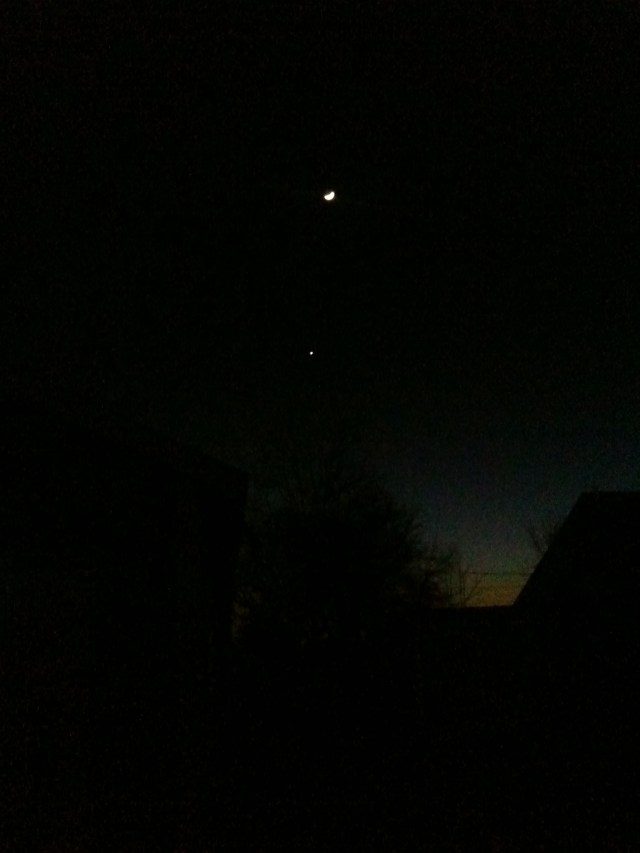
Dark Sky, JMN.

Dark Sky. Photo, JMN.

I like to paint something that leads me on and on in to the unknown something that I want to see away on beyond. 
(Anna Mary Robertson Moses, from her autobiography, quoted in the NYTimes “Friday Briefing,” 9-7-18)

[Copyright (c) 2018 James Mansfield Nichols. All rights reserved.]

Posted in Quotations | Tagged | Leave a comment

The Power of Writing

Lina Khans writing has rocked the antitrust establishment — and made her an unlikely celebrity in Washington policy circles.Credit Brandon Thibodeaux for The New York Times

Lina Khan’s writing has rocked the antitrust establishment — and made her an unlikely celebrity in Washington policy circles. Credit Brandon Thibodeaux for The New York Times

It’s so much easier to teach public policy to people who already know how to write than teach writing to public policy experts.
(Barry Lynn, quoted by David Streitfeld, “Amazon’s Antitrust Antagonist Has a Breakthrough Idea,” NYTimes, 9-7-18)

[Copyright (c) 2018 James Mansfield Nichols. All rights reserved.]
Posted in Anthology, Quotations | Tagged | Leave a comment

“A Prayer for My Daughter” (9)

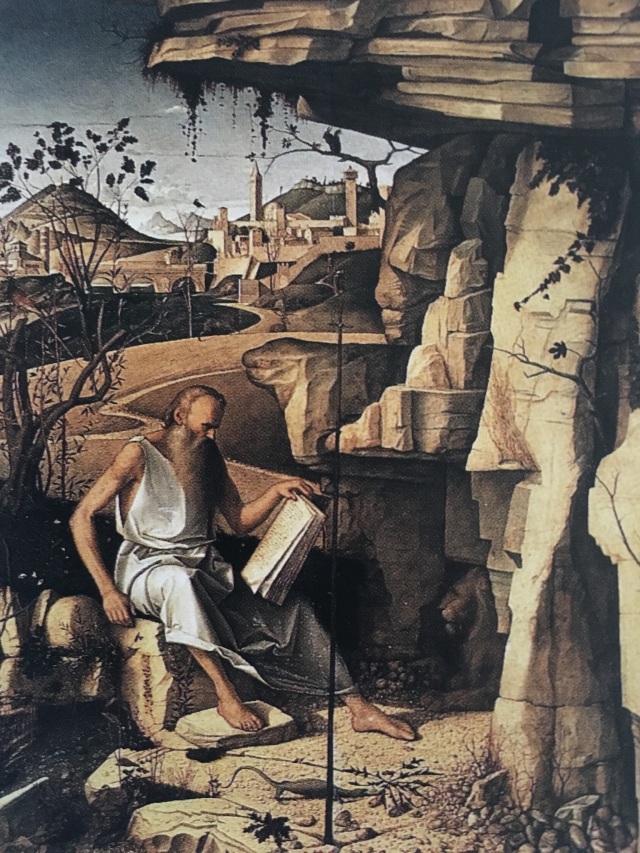
St Jerome, patron saint of translators, by Bellini

Saint Jerome, patron saint of translators, by Bellini

A Prayer for My Daughter by W. B. Yeats
(Spanish translation by James Mansfield Nichols)

https://www.poetryfoundation.org/poetrymagazine/poems/14635/a-prayer-for-my-daughter

A Prayer for My Daughter (9)

Considering that, all hatred driven hence,
The soul recovers radical innocence
And learns at last that it is self-delighting,
Self-appeasing, self-affrighting,
And that its own sweet will is heaven’s will,
She can, though every face should scowl
And every windy quarter howl
Or every bellows burst, be happy still.

Una Oración para mi Hija (9)

Considerando que, ahuyentado todo el odio,
Recobra el alma la inocencia radical
Y aprende por fin que deleita a sí misma,
A sí misma apacigua, a sí misma asusta,
Y que su propia voluntad dulce es la del cielo,
Ella puede, aunque toda cara frunza el ceño
Y toda zona ventosa aúlle
O todo fuelle reviente, ser feliz.

[Copyright (c) 2018 James Mansfield Nichols. All rights reserved.]
Posted in Anthology | Tagged , | Leave a comment

There Are No “Simple” Truths

By labeling what was essentially an opinion as a “truth” I’ve fallen into a hole I try to skirt as much as I can. Better to have said, “I agree” that knowledge is better than ignorance, leaving truth out of it.

My mother was fond of pointing out that Thomas Gray didn’t write “Ignorance is bliss.” He wrote “Where ignorance is bliss, / ‘Tis folly to be wise.” There’s a rider attached to the proposition. I would get no joy from knowing when I’m going to die, for example. On the other hand, where government is concerned, knowledge trumps ignorance in the sense that the fewer secrets kept in high places for no good reason the better. Again, an opinion.

Gun fans compare firearms to pencils: Guns don’t *kill* any more than pencils *misspell*. I question the logic, but maybe it’s apt for knowledge, too: Nuclear physics didn’t build the atomic bomb then drop it on Japan, people did. A verb cropping up in opinion pieces is “weaponize.” It’s used as best I can see to describe the act of turning something that’s neutral or benign, intrinsically not a weapon, into one. This is where the guns-to-pencils analogy gives me pause: A gun, whether used for sport or homicide, is closer to being a weapon than a pencil is. More guns than pencils have been used in combat. However, a pencil, like a hatpin or passenger liner, can literally be “weaponized.”

So can the Internet. Seeking knowledge on the Internet is like supping with the devil — best done with a long spoon. The binary backbone of cyberspace supports much true-false, yes-no, good-bad, we-they, black-white dichotomizing. Seeker beware. Still, I can refresh my grasp of Manichaeism with a quick Wiki-dip, and have done so because as I’ve pondered this post I’ve kept thinking that somehow an allusion to Manichaeism is apposite. Wiki-erudition can be a mile wide and an inch deep, but I wouldn’t want Wikipedia to go away.

The same with Google. It lets a teacher unmask a student’s cannibalized essay text by merely typing a few words from it. That’s a powerful sleuth-tool, though it’s no less vexing that the same tool also facilitates the smash-and-grab plagiarism that teachers have to cope with in the first place.

It feels odd in a way, but also timely, to ask oneself: When does what’s “factual” overlap, if ever, with what’s “true?” Are fact and truth ever synonymous? I suppose the answer depends on whether you ask a scientist, a lawyer, a theologian, or the Internet.

[Copyright (c) 2018 James Mansfield Nichols. All rights reserved.]
Posted in Commentary, Quotations | Tagged | 3 Comments

Let’s help the monarchs

nyti.ms/2NFOh7r

Posted in Commentary | Tagged | Leave a comment

Correctness: The Cee Without the Pee

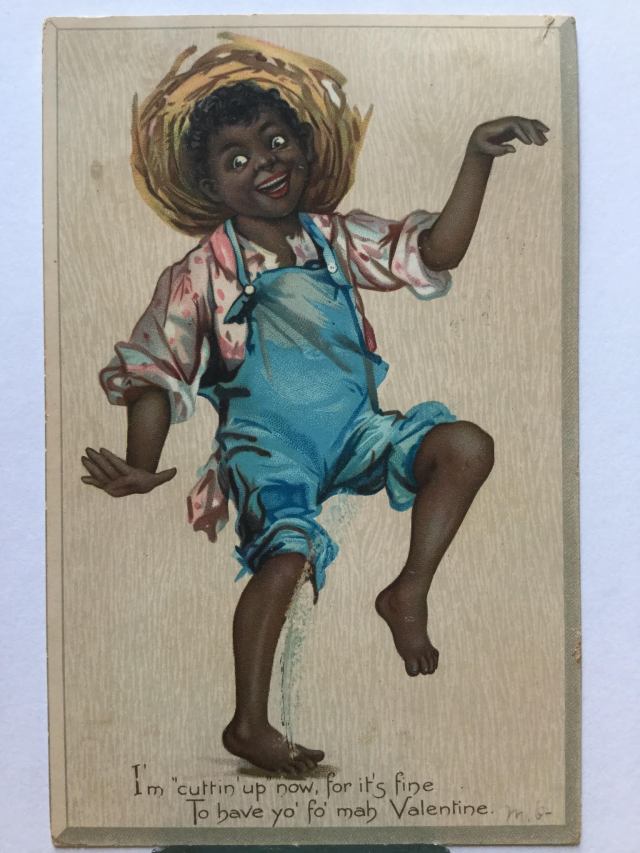
Postcard from my great grandmother's collection. Postmarked 1907. Raphael Tuck & Sons, Valentine Post Cards, Series 108, Art Publishers ot Their Majesties the King & Queen.

Postcard from my great grandmother’s collection. Postmarked 1907. Raphael Tuck & Sons, Valentine Post Cards, Series 108, Art Publishers of Their Majesties the King & Queen.

I’ve thought about my understanding of the phrase “politically correct” and concluded that fathoming its semantic range is above my pay grade. My way forward is to drop “politically” and fasten myself to the “correct” part. The Golden Rule is full of correctness in my understanding. The lex talionis is not.

We may be prone these days to impute malice where none is intended, or invent it where none exists. I don’t know who’s leading that charge in social media, but outrage doesn’t undo the mischief, as my colleague points out.

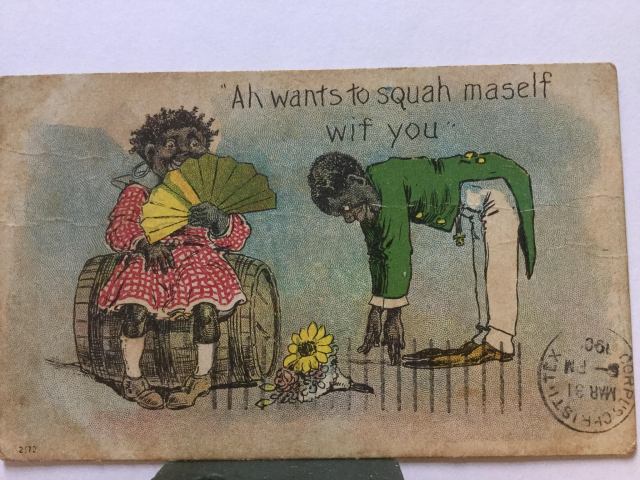
Postcard from my great grandmother's collection. Postmarked 1909.

Postcard from my great grandmother’s collection. Postmarked 1909.

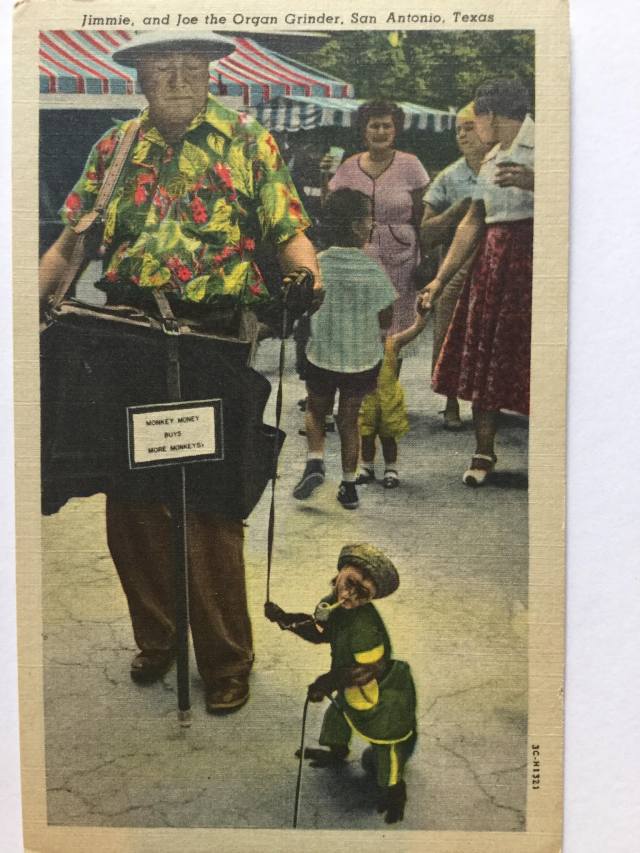
My dad was born into Depression-era rural America, a kind man but also a product of his culture. I heard antiquated slang for African-Americans pass his lips anecdotally, but never hurtfully or in the hearing of someone it might reference. Those tropes were latent in his discourse, embedded by place and time, but he evolved. He would have been repelled by implied or overt comparison of black people to apes or monkeys.

I’m afraid such nonsense continues to crop up stubbornly in our place and time. One-hundred-fifty years after Appomattox we still have room to grow in correctness.

Postcard from my great grandmother's collection. Unstamped. San Antonio, Home of the Alamo, Gulf Breezes and Sunshine. Weiner News Company, San Antonio, Texas.

Postcard from my great grandmother’s collection. Unstamped. “San Antonio, Home of the Alamo, Gulf Breezes and Sunshine.” Weiner News Company, San Antonio, Texas.

[Copyright (c) 2018 James Mansfield Nichols. All rights reserved.]
Posted in Commentary | Tagged | Leave a comment

“A Prayer for My Daughter” (8)

St Jerome, patron saint of translators, by Bellini

Saint Jerome, patron saint of translators, by Bellini

A Prayer for My Daughter by W.B. Yeats
(Spanish translation by James Mansfield Nichols)

https://www.poetryfoundation.org/poetrymagazine/poems/14635/a-prayer-for-my-daughter

A Prayer for My Daughter (8)

An intellectual hatred is the worst,
So let her think opinions are accursed.
Have I not seen the loveliest woman born
Out of the mouth of Plenty’s horn,
Because of her opinionated mind
Barter that horn and every good
By quiet natures understood
For an old bellows full of angry wind?

Una Oracion para mi Hija (8)

Un odio intelectual es el peor,
De modo que ella tenga las opiniones por condenadas.
¿No he visto a la mujer más bella nacida
De la boca del Cuerno de Abundancia,
A causa de su mente porfiada
Trocar aquel cuerno y todo bien
Que los seres serenos perciben
Por un fuelle viejo lleno de viento colérico?

[Copyright (c) 2018 James Mansfield Nichols. All rights reserved.]
Posted in Anthology | Tagged , | Leave a comment

“A Prayer for My Daughter” (7)

St Jerome, patron saint of translators, by Bellini

Saint Jerome, patron saint of translators, by Bellini

A Prayer for My Daughter by W.B. Yeats
(Spanish translation by James Mansfield Nichols)

https://www.poetryfoundation.org/poetrymagazine/poems/14635/a-prayer-for-my-daughter

A Prayer for My Daughter (7)

My mind, because the minds that I have loved,
The sort of beauty that I have approved,
Prosper but little, has dried up of late,
Yet knows that to be choked with hate
May well be of all evil chances chief.
If there’s no hatred in a mind
Assault and battery of the wind
Can never tear the linnet from the leaf.

Una Oración para mi Hija (7)

Mi mente, porque las mentes que he querido,
El tipo de belleza que he aprobado,
Prosperan poco, se ha secado últimamente,
Y sin embargo sabe que el estar ahogado de odio
Puede muy bien ser de toda suerte mala la peor.
Si no existe odio en una mente
La agresión con lesiones del viento
Nunca logrará arrancar el pardillo de la hoja.

[Copyright (c) 2018 James Mansfield Nichols. All rights reserved.]

Posted in Anthology | Tagged , | Leave a comment

Over and Off

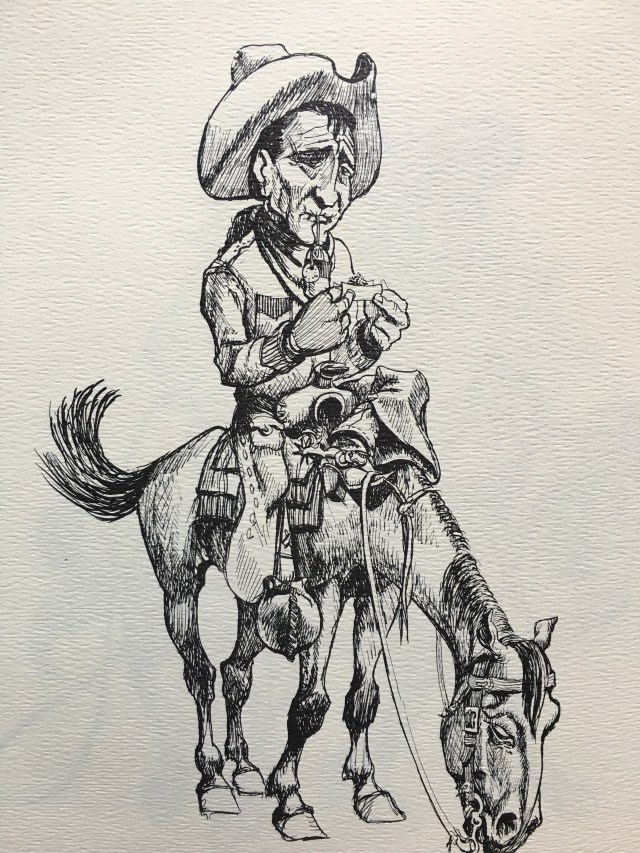
Tom Jones Drawing, Cowboy and Bull Durham

Tom Jones Drawing, Cowboy and Bull Durham.

This tag line follows an article appearing on one of the online news aggregator sites:

To jack in to my brain and get more on the latest in science, tech and innovation, follow me here on *** as well as on Twitter @***.

Thank you, kind sir.

Jacking off, um, out for now….

Yours truly,

[Copyright (c) 2018 James Mansfield Nichols. All rights reserved.]

Posted in Commentary | Tagged | Leave a comment