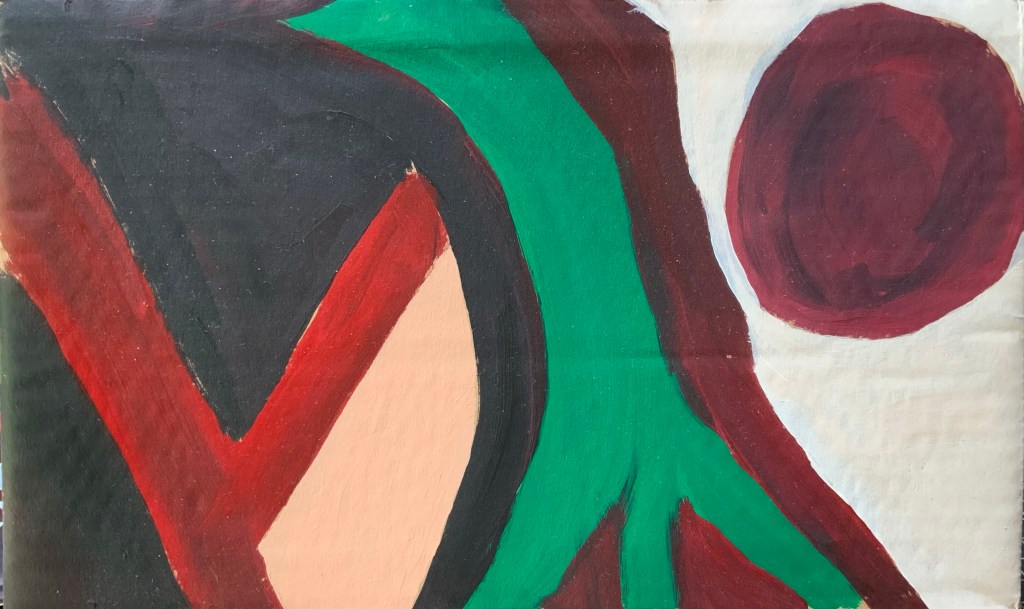
“Payasada.” Oil on canvas, 16 x 24 in. (JMN 2023).
The pattern of the nonsequi-ku first broached here is rendered more ticklish per the suggestion of OutsideAuthority: If anything, wondering if it’s a little too easy. Can you make the rules more complex?!
The title now is vaguely anapestic. The cinquain alternates frisky trochees with ambling iambs. The C-line goes rogue and gets sextametrish.
Here’s the refurbished model and prototype:
IN THE STILL OF THE CLAN THERE’S A DROP OF HOOCH LEFT FOR THE JUG
Rampant pandemonium in the boondocks Implies Confucius has not sold his views. Ramaswamy peddles goobers in the zone now, Dispensing joy to sheeple in his flocks, Ripped in camo, toting cocked pew-pews.
On the back of a plate that he gave to his mentor in 1961, the artist engraved a dedication: “For Suzanne Ramié. Her faithful subject. Picasso. Her student.” Guided by a woman in the south of France, Picasso had made his choice: the south over the north, the provinces over Paris, the craftsmen over the Académie, democratic mass production over the cult of the unique work. (Annie Cohen-Solal, Picasso the Foreigner, translated from the French by Sam Taylor)
Au revers d’une assiette qu’il offrit en 1961 à celle qui lui avait enseigné ses techniques, l’artiste grave une dédicace: <<Pour Suzanne Ramié. Son fidèle sujet. Picasso. Son élève>>. Cornaqué par une femme dan le sud de la France, Picasso a donc choisi: désormais ce sera le Sud contre le Nord, la province contre Paris, les artisans contre l’Académie des beaux-arts, l’édition démocratique contre la religion de l’oeuvre unique. (Annie Cohen-Solal, Un étranger nommé Picasso)
The blog Pacific Paratrooper makes a gusty tribute to first sergeants part of a celebration of “the dark, glistening jump boots” that were the proudly maintained trademark of WWII era paratroopers.
I’ve created a verse form I call the nonsequi-ku. It consists of a title over a cinquain.
The title must be in trochaic pentameter, and must cast only spectral light on the burden of the cinquain.
The cinquain must be in iambic pentameter rhyming ABCAB. Its thrust is to infuse a vacant gist with a wry slant on a goof, leaving the reader overflown but giddy with emoji.
Here’s the model and prototype for the nonsequi-ku:
BUSTY COUGAR’S HOREHOUND GUMDROP BUCKET
A fallow gesture is where you have inched up to a stranger, murmured howdy do, and told him that his last name is misspelt. You won’t believe — he’ll look as if you’ve drenched his facial hair in high fructose corn goo.
One stumbles upon insight gold. Here’s a line from the title poem of Egyptian poet Iman Mersal’s book The Threshold:
One long-serving intellectual screamed at his friend / When I’m talking about democracy / you shut the hell up.
It’s quoted here in the blog ArabLit & ArabLit Quarterly. The book’s translator from Arabic to English is Robyn Creswell. As wicked captures do, Mersal’s verse struck my funny bone straight off the bat, then triggered a spate of joyful obscenities.
Contagious rue notches nicely with the spirit of commentary by two academics from Stanford’s School of Humanities and Sciences:
In the absence of civic education, it is not surprising that universities are at the epicenter of debates over free speech and its proper exercise. Free speech is hard work. The basic assumptions and attitudes necessary for cultivating free speech do not come to us naturally. Listening to people with whom you disagree can be unpleasant.. Disagreement is in the nature of democracies. (Debra Satz and Dan Edelstein, “By Abandoning Civics, Colleges Helped Create the Culture Wars,” New York Times, 9-3-23)
In another feat of stumbling one hears Christopher Hitchens relate that Samuel Johnson, renowned English lexicographer, was congratulated by a group of ladies for not including any indecent or obscene words in his famous dictionary. Johnson replied, “Ladies, I congratulate you on your ability to look them up.” The Hitchens talk is linked to here in a post titled “Free Speech” by fellow blogger Peter Robinson.
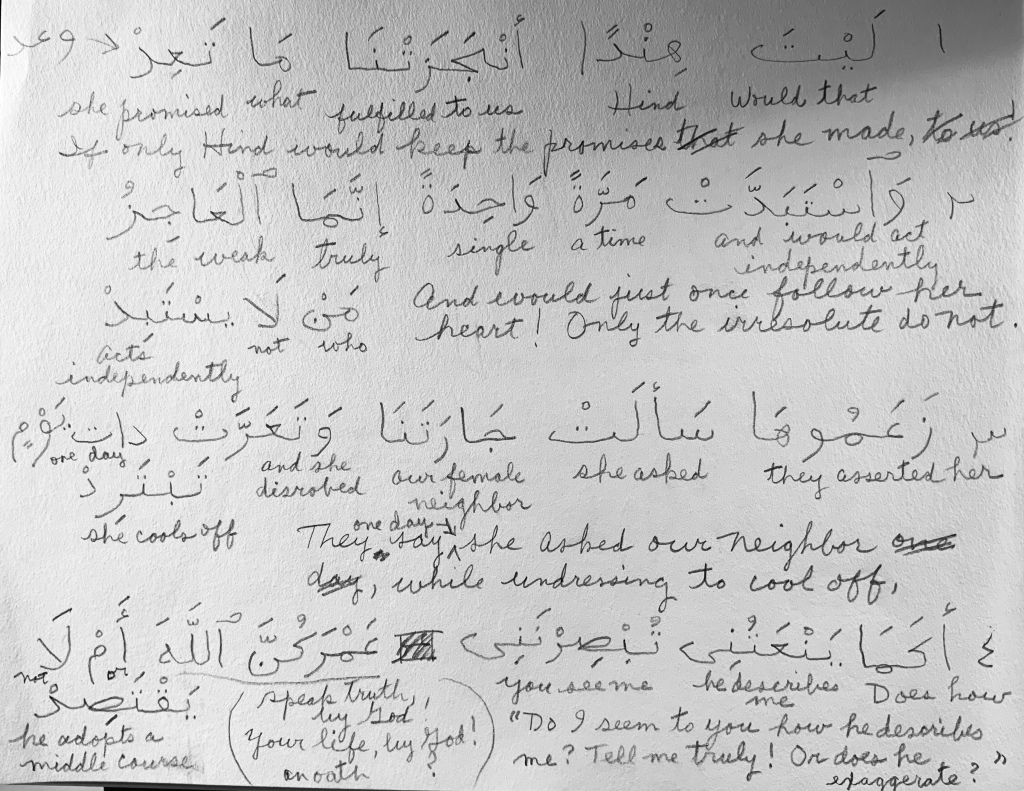
^Umar ibn Abī Rabī^a, son of a wealthy merchant of Mecca, lived ca. 643-719 A.D. His legend is that of a womanizer, his verses said to be “the greatest crime ever committed against God.”
1 If only Hind would keep her word and heal our souls of what they suffer, 2 If just once she’d show some independence. Those who cannot do so are the weak! 3 They say she asked our women neighbors one day as she stripped to bathe: 4 “Do you make me out as he sees me — speak truth, by God! — or is he an excessive fool?”
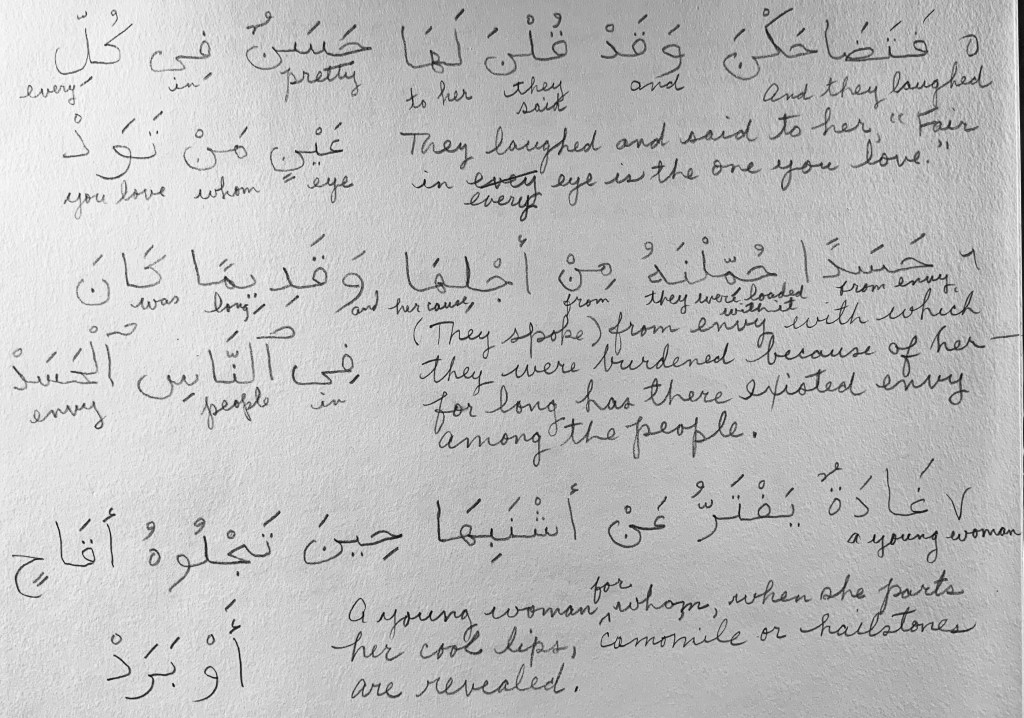
5 They laughed together and said to her, “Ravishing in every eye is the one you love!” 6 It was from envy which they bore on her account — long has such envy dwelt in folk — 7 For a woman who discloses camomile or hailstones when she parts cool lips,
8 With eyes whose glance is starkly black on white, her neck a slender suppleness; 9 A tender presence, cool in the dog days when summer’s climax blazes; 10 Warm in the winter place, a nighttime blanket for a young man gripped by cold.
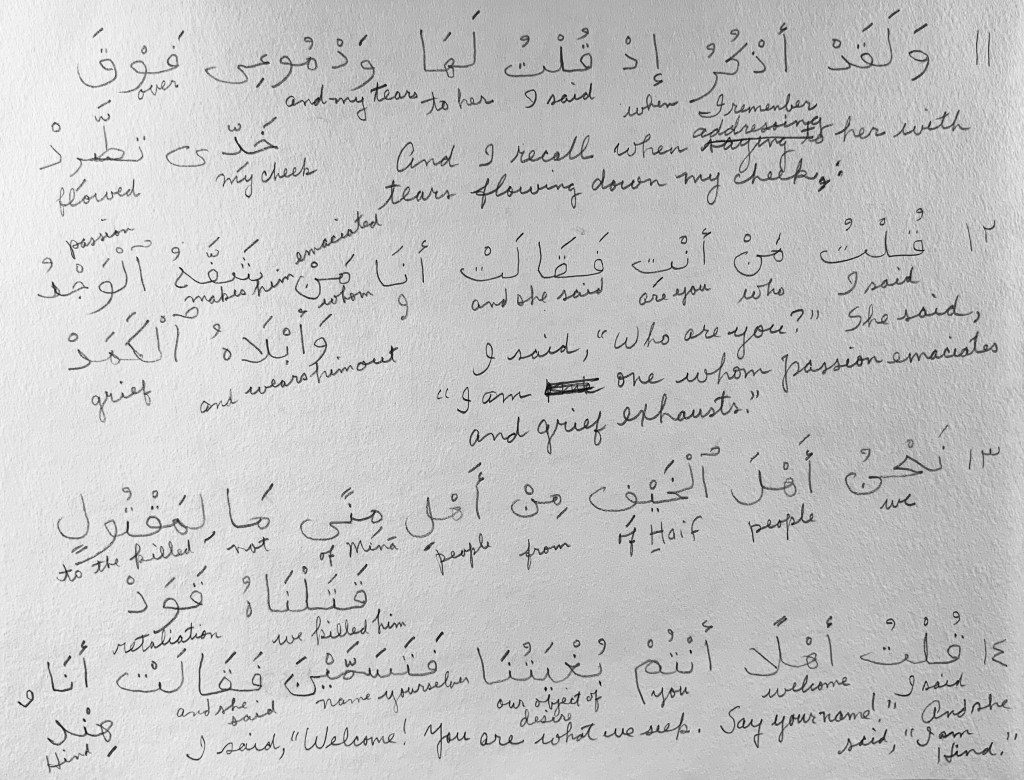
11 I remember speaking to her with tears flowing down my cheek, 12 Saying, “Who are you?”; she replying, “One whom passion renders gaunt and grief exhausts. 13 We are the people of al-Haif, from those of Minā; for whom we kill there’s no retaliation.” [See note.] 14 I said, “Welcome! You are the object of our desire. Say your name!” She said, “I am Hind.
15 My heart is wrecked (she said), for it enwraps a straight spear-shaft flung unerringly, clad in sumptuous cloth.” [See note.] 16 “Truly your people are neighbors to us; we and they are a single thing!” 17 They told me that she had spit on knots for me. How excellent are those knots! [See note.] 18 Every time I said to her, “When can we meet?” Hind laughed and would reply, “After tomorrow!”
Notes 13 Al-Haif and Minā play an important role in the Mecca Pilgrimage. “Al-Khaif is the summit of Minā near Mecca… ‘All Minā is a place of sacrifice,’ so that the lover ‘slain’ there by the beauty of the beloved is to be accounted a sacrifice and therefore not covered by the laws of retaliation.” (Arberry, p. 42) 15 Hind compares her suitor to a naturally straight spear-shaft [ṣa^daẗ(an)] which travels a true path [taṭṭarid], dressed in luxurious cloth [fī sābirīy(in)]. 17 Arberry’s note cites the practice of sorcery as “blowing on knots.” Dozy (Supplément aux Dictionnaires Arabes, ii, 694) says the verb [nafaṯa] should be translated cracher (spit), not souffler (blow), or for greater clarity, souffler en crachant (blow while spitting). Precision is all, mes amis!
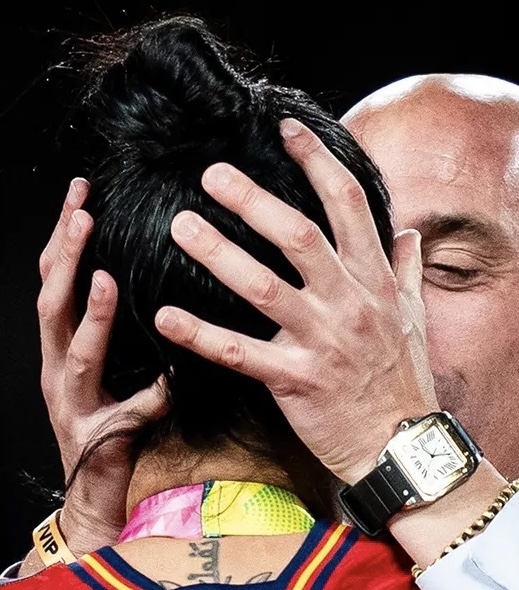
The image discloses how Jennifer Hermoso forced Rubiales to grasp her head firmly in his tiny hands while she commited horrid buccal assault on the poor fellow.
*”A sturdy caballero is Master Hotlips — Or no longer?” (pace Quevedo).
Mr. Rubiales was shown on video after the World Cup final in Sydney on Aug. 20 kissing one of the team’s star players, Jennifer Hermoso. Although he apologized the day after, he took a defiant stand later in the week, saying Ms. Hermoso had lifted him off his feet and “moved me close to her body,” accusing his critics of “false feminism” and saying he was the victim of “social assassination.”
(Rachel Chaundler and Jasor Horowitz, “Spanish Prosecutors Open Inquiry Into Soccer Official Who Kissed Player,” New York Times, 8-28-23)
“Cubism seeks to destroy by designed disorder… Dadaism aims to destroy by ridicule… Abstractionism aims to destroy by the creation of brainstorms.” (Republican Congressman George Dondero in speech to the House of Representatives, August 16, 1949)
Three years later, Dondero told Congress that modern art was nothing other than a “conspiracy by Moscow to spread Communism” in his country. It’s no surprise, then, that the FBI files on Picasso include a document market “SECRET” that features Dondero’s wild accusations. The congressman rages against “so-called modern art” which “contains all the isms of depravity, decadence and destruction.”
(Annie Cohen-Solal, Picasso the Foreigner, translated from the French by Sam Taylor, 2021)
“How do you expect me to paint a portrait of Stalin?” he asked, irritated. “First of all, I’ve never seen him, and I don’t remember what he looks like, other than the fact that he wears a uniform with lots of big buttons on the front, and a cap, and he has a big moustache.” (Pablo Picasso, quoted by Françoise Gilot)
<<Comment voulez-vous que je fasse un portrait de Staline?>> demanda-t-il avec irritation. <<D’abord, je ne l’ai jamais vu, et je ne me rappelle pas à quoi il ressemble, si ce n’est qu’il a un uniforme plein de gros boutons devant, une casquette, et une grande moustache.>> (Pablo Picasso cité par Françoise Gilot)
From Annie Cohen-Solal, Un étranger nommé Picasso, translated from the French by Sam Taylor as Picasso the Foreigner: An Artist in France, 1900–1973.
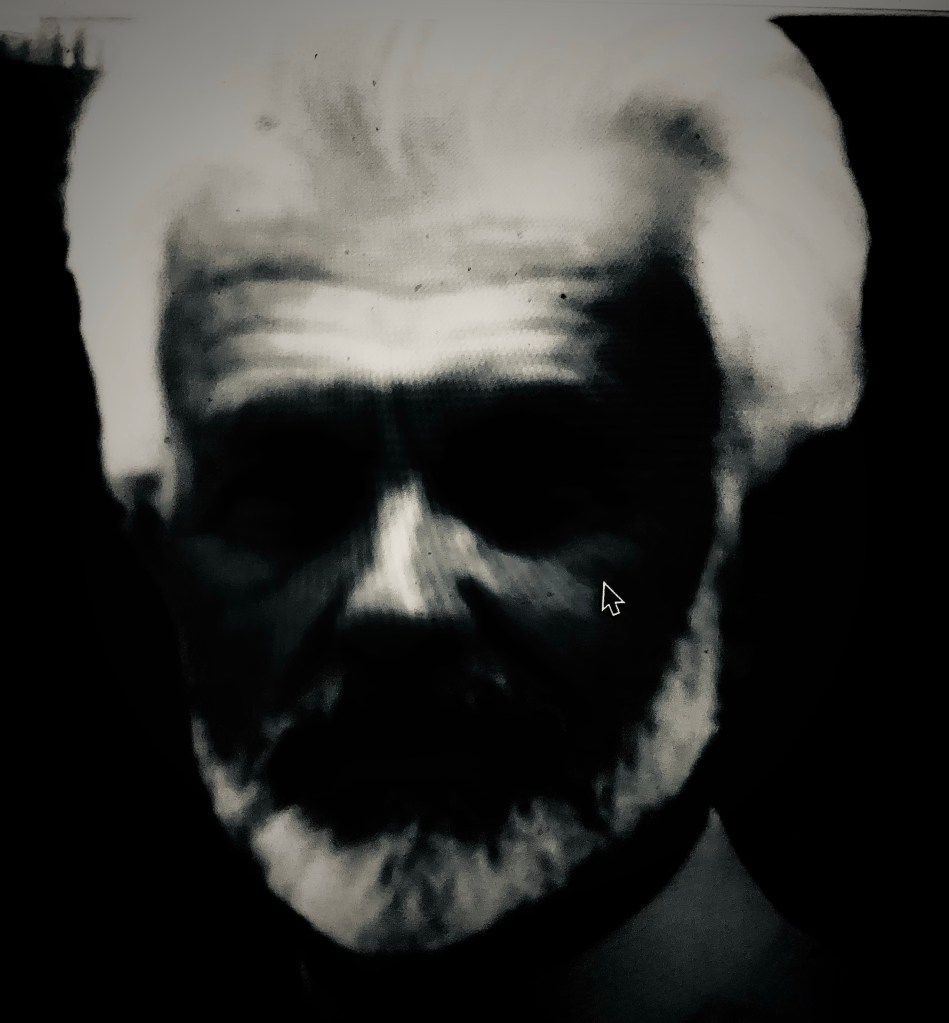
I’m keeping an eye on the confected pixel pixie spawned by a whoring AI chatbot that we met not long ago here in EthicalDative.
The entity has morphed from this nugatory skidmark…
… into this spavined dreamboat:
This particular ad campaign gets my goat for no obvious reason. I’ve kicked a second dyspeptic yawp about it into the long grass for weeks now, uncertain whether or not posting it would throw me into a bad light. Who wants to read a blip-load of bile, after all?
Let’s bid the gnomechuck adieu and make way for positivity, shall we? India has landed on the moon.









 EthicalDative
‘Free Speech Is Hard Work’
One stumbles upon insight gold. Here’s a line from the title poem of Egyptian poet Iman Mersal’s book The Threshold:
One long-serving intellectual screamed at his friend / When I’m talking about democracy / you shut the hell up.
It’s quoted here in the blog ArabLit & ArabLit Quarterly. The book’s translator from Arabic to English is Robyn Creswell. As wicked captures do, Mersal’s verse struck my funny bone straight off the bat, then triggered a spate of joyful obscenities.
Contagious rue notches nicely with the spirit of commentary by two academics from Stanford’s School of Humanities and Sciences:
In the absence of civic education, it is not surprising that universities are at the epicenter of debates over free speech and its proper exercise. Free speech is hard work. The basic assumptions and attitudes necessary for cultivating free speech do not come to us naturally. Listening to people with whom you disagree can be unpleasant.. Disagreement is in the nature of democracies.
(Debra Satz and Dan Edelstein, “By Abandoning Civics, Colleges Helped Create the Culture Wars,” New York Times, 9-3-23)
In another feat of stumbling one hears Christopher Hitchens relate that Samuel Johnson, renowned English lexicographer, was congratulated by a group of ladies for not including any indecent or obscene words in his famous dictionary. Johnson replied, “Ladies, I congratulate you on your ability to look them up.” The Hitchens talk is linked to here in a post titled “Free Speech” by fellow blogger Peter Robinson.
(c) 2023 JMN — EthicalDative. All rights reserved