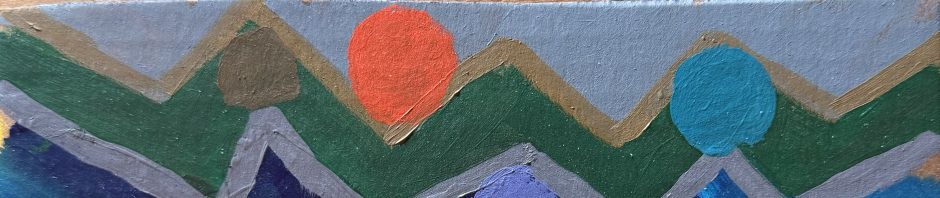
[Untitled painting from 2016]… Mullen’s work is on view at the Museum of Modern Art. Credit… Marlon Mullen; via Museum of Modern Art, New York. [New York Times caption and illustration]
“I think he feels understood through his painting, and that gives him a way to talk to the world.”
(The artist’s sister)
I feel an uncanny affinity with Marlon Mullen’s ceremony of preparation! A colleague and I have lately ruminated on how a style of painting which we admire can verge gloriously on the cartoonesque. Just as, I would add, cartooning is itself a glorious art form.
Before Marlon Mullen begins a painting, he likes to tidy his work space. He’ll pre-mix his paints — Golden acrylics in recycled pots — and lay out his brushes and canvas on his table. Often, he’ll empty the studio’s trash cans.
Mullen saw Van Gogh’s 1889 painting “The Starry Night” on a visit to MoMA early this year. When he reproduced the painting, he worked from the cover of a catalog curators had sent him, including the book’s spine information along the left-hand edge of his canvas. Credit… Marlon Mullen; NIAD Art Center and Adams and Ollman, via Museum of Modern Art, New York. [New York Times caption and illustration]
The pictures for which Mullen is best known are based on covers of art magazines like Art in America and Artforum, abstracting both image and text into mosaics of solid color… “Sometimes Marlon prioritizes something when making an image that I would consider a minor detail.” That could be a bar code — a bugbear to graphic designers that Mullen appears to celebrate — or an object’s shadow.
[Painting from 2024]… Credit… Marlon Mullen; NIAD Art Center and Adams and Ollman, via Museum of Modern Art, New York[New York Times caption and illustration]
Mullen has lately begun to attend to the sides of his canvases as well as their fronts, copying text from magazines’ spines and thus highlighting his pictures’ status as objects, rather than as flat canvases.
(Jonathan Griffin, “With This MoMA Artist, the Painting Does the Talking,” 12-16-24)
The fellowship is festive. Rectified canticles boom from the sanctum, Would you believe?
… Marching as to war, All the pardoned felons Going on before…
Rigor mortified, the righteous Stiff-arm the anxious, The walking doomed. Worm meat. All told in the scriptures: They will go poof. Straight to hell. Burnt alive. No end to it. Amen.
To the heavenly fathered Of the requisite persuasion (Ideally Caucasian), Perfumed satins, spangled britches, Penthouse accommodation, Aryan hosannas, aurean swag, Fairway and beachfront nation.
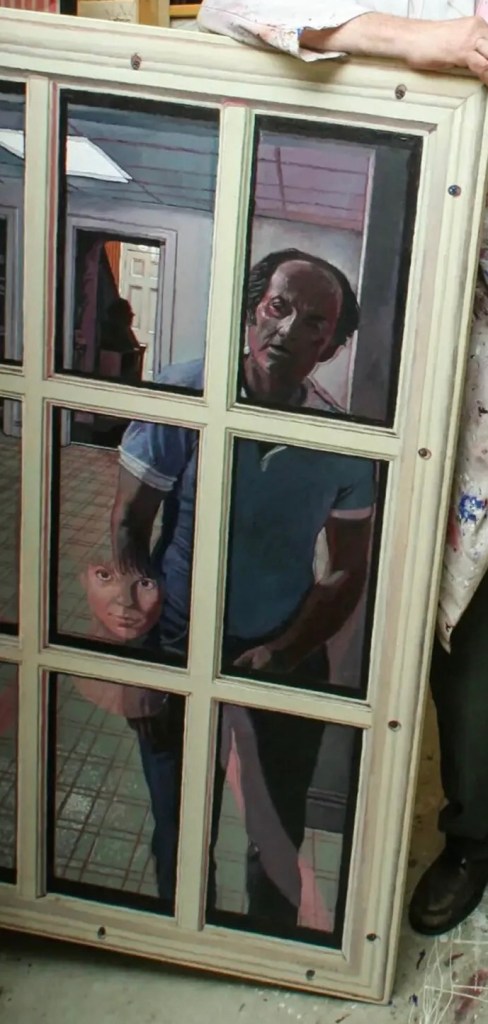
[Detail] Mr. Leipzig in 2010 in his home studio with his painting “Francesca at the Door,” depicting his younger self and his daughter. Credit… Susan Smith & Gallery Henoch. [New York Times caption and illustration]
The acrylic canvases of Mel Leipzig, a painter christened by Peter Schjeldahl as the “Chekhov of Trenton,” reach me as analogs to the loudest arena-rock virtuoso guitar hero solos you can think of. They are an ostentation of look-what-I-can-do. They blow your skirt up over your head if you’re wearing one. That’s a mixed bag and stirs up the cliché phrased as embarrassment of riches.
“Creativity is very life-giving. Van Gogh would have shot himself a lot earlier had he not been an artist.”
(Mel Leipzig)
Yes, and Van Gogh arrived at a luminously generalized mode of depiction, as well, which may have helped him cope for longer.
May Mr. Leipzig rest in peace. He was clearly a master of his métiér. These are general thoughts about his art not meant disrespectfully. Is it fair to think of the style of painting he consummately unleashed as more re-creation than creation? Is that a distinction without a difference? (I love that phrase.)
I’ve done something underhanded, and put here only detail from his paintings. See them in full in the article, it’s worth a visit. Leipzig had a long, productive life (dead at 90), and said some really interesting things.
[Detail] Mr. Leipzig was so devoted to verisimilitude that his favorite work was a 1991 acrylic on canvas view of his son, Joshua, sitting insouciantly in a bedroom festooned with graffiti and dirty laundry while three musician friends sprawl on the floor. Credit… via Gallery Henoch [New York Times caption and illustration]
[He said] his art had to feature a person, “no matter what the painting is about… The main thing that interests me is not just the figure… It’s the way the figure related to the background… It’s mainly the composition of the painting that really excites me, but I must have a person. It’s an essential part of my being.”
[Detail] Mr. Leipzig’s 1996 painting “Joshua’s Tattoos,” a portrait of his son. His work contained what an art critic called “an almost hallucinogenic intensity of detail.” Credit… via Leipzig Family. [New York Times caption and illustration]
When I thought I’d become a poet my head was as empty as a young male’s under-developed frontal lobe can be. In hindsight I can see it now. It was hiding in plain sight, the poetry, waiting for me to catch up decades later.
Three Catalan workmen, a slab of membrillo, a crusty loaf of bread, a jug of vino blanco del país. Me, my Spanish fiancée and her parents on excursion to the monastery of Montserrat. The workmen sat near our outdoor cafe table chowing down, savoring a simple merienda in each other’s company. I followed their motions, registered their patter, with no conscious interest. The tableau they embodied was etching itself unawares onto whatever surface I retrieve it from now.
I’m wary of appeals to encoded symbolism, gestures towards nebulous profundities, which stud a certain strain of discourse around poetry. Precise detail speaks louder. The cracked yellow handle of the little knife one man used to cut the guava paste he smeared on his hunk of bread. How he wiped its blade on his trouser leg before passing it to the next man. The ceremonious flourish with which they poured rounds into their drained glasses. Their laughter eliciting a prim cluck from my mother-in-law to be.
Wiry laborers at rest, scarfing their fare hungrily, with zest inhabiting their moment fully as I eyed them sidelong from mine. I was constructing the poetry from it subliminally; didn’t know it at the time, much less how to write it. Still don’t. It’s not that it’s too late now; it’s that it’s always too late. At that very dawning, and perhaps when you find someone to love, is when poetry starts to make sense, if ever.
“… They ain’t necessarily so,” goes the song in Gershwin’s Porgy and Bess.
“If we could stop coming at the Bible postured as though we’re the ones that own it… to prop up, whether it’s theologies, whatever makes us comfortable, whatever makes us powerful, whatever gives us influence…”
These are excerpts from Marty Solomon’s remarks made on a podcast.
… It doesn’t matter if we’re a PhD theologian, if we’re a believer or not a believer, if we claim to speak for God or don’t know anything. Anybody that comes to the scripture… should come to it knowing this book is meaning to provoke us, transform us, confront us, teach us something new… If we would read the Bible that way, we would quit using it to justify nonsense… It should all be making me a more loving, more whole, more self-reflective person… If we were truly coming to the Bible with an authentic “I’m here to be changed,” I can’t imagine that the fruit would be what we’re seeing today.
While Shakespeare’s plays must have stemmed from some personal experience, they take the “thousand natural shocks that flesh is heir to” and, through an act of artistic creation, fashion them into something endlessly inspiring and strange.
Inspiring and strange. The “strange” part looms large in contemplation of poetry. Azurea20 brings the inspiring in her short poem “Déjalo” (“Leave It”). Here’s my reading:
First it says, “Throw away the poem (Tira el poema).” There follow three instances of the stressed (accented) qué used in Spanish for interrogatives and exclamations:
qué no arde qué no camina qué se ha perdido.
At first I wanted to read it as “Tira el poema que no arda, que no camine, que se haya perdido.” But there are those accents, plus the verbs are in indicative mood in the poem, subjunctive only in my head. Ay, there’s the rub. This is where it brings the strangeness. It’s not a screening statement, which the moody subjunctive would convey.
Three questions standardly posed with ¿por qué? are implied by the stressed qué: “Why, why, why?” I haven’t seen this strategem before, but all’s fair in war and poetry. The answering verbs in indicative mood state fact, not desideratum, doubt or conjecture: “It doesn’t burn, it doesn’t walk, it has gotten lost.”
— “¡Maté a un hostelero! — ¿Por qué? ¿Cuándo? ¿Dónde? ¿Cómo? — Porque cuando donde como sirven mal, ¡me desespero!”
(I forget which Spanish play this is from)
Then she says, “Leave the poem which…” followed by a descriptive, subordinate clause introduced with the unaccented conjunction que. The poem marked for leaving in the record, bequeathed to readers, allowed to persist, is the one “which roams full of horror through the abandoned factories and through the wounded suburbs.”
Here again, stuck in the wrong mood, I had longed for Deja al poema que vague…, posed as a standard to achieve, but Azurea20 is jolting me into a non-kneejerk mindset. The poet locates signification where difficulty and deprivation abide.
Here’s a telling detail: The second main verb, deja (“leave”) is linked to its direct object (poema) with the “personalizing” preposition a (combined with the definite article el it produces al). It’s a treatment reserved for objects which are human and, sometimes, for individualized animals such as pets. The enduring poem is granted the status of a living entity, in contrast to the one that should remain a dead letter in the poet’s notebook. The three-word conclusion, emphatically italicized and lineated, drives the distinction home:
Deja al poema.
Leave. The. Poem.
That’s how the signals reach me, and such is my intrepid hypothesis. If my receiver’s wonky, I own that, too. Dare large, fall hard, and leave a beautiful memory.
“Boundless extension of torment, incredible intensity of suffering, unceasing variety of torture. This is what the Divine Majesty, so outraged by sinners, demands.”
(From “Portrait of the Artist as a Young Man” by James Joyce)
I’ve been hearing a milestone of modernist prose, if my memory of literary labels doesn’t fail me. “Portrait of the Artist as a Young Man” is a Socratic tango in which Lust and Guilt swoop partnering in protracted turns about the dance floors of Stephen Daedalus’s excitable young mind. Extended rants about the damnable carnality of dirty boys obsessed with virgins make you want to run screaming from every church you pass. Colin Farrell voices all of it wickedly on Audible, as a good actor can.
At times the reader experiences the stream of consciousness by portage, hoisting canoe on shoulder and trudging past roiled, gurgling waters. They would’ve had him spinning directionless had he tried to paddle them. He puts into the river again when it has a narrative flow that may carry him to his longed for destination, indeed, to any destination.
Isn’t modernism where most of what goes on is in the character’s head, faithfully interrupted by pointillistic sensory and ambient detail? Snatches of dialogue ensue? A person chews a fig for forty pages, picking his teeth with a match at intervals? Examines a picked seed before flicking it away? The itinerant personae speak in tongues, deal one another rhetorical blows hugger mugger, smack each other colorfully about the chops? The verbal sparring and inflamed revery is the action, not so? Framed by the walking, smelling and staring?
Libido, license, repression, weightlessness, torment, intellect, beauty and filth. Most of all, words! Torrents of them.
I thrilled near the climax to hear the Joycean “silence, exile and cunning” phrase. It has clung to me as a meaty mantra. The ending crafted by this artificer, voluble poet who writes in page breaks, is a wonderful beginning, the more so for seeming remote at times — the ending, I mean, not the poet. He’s in the room and then some.
In a neighboring town I glimpsed a lone cow in a chute back of a meat processing plant. She was staring fixedly at something unidentified off to my right, heedless of my passing. Only one outcome was left for her.
A “meat processing plant” is a slaughter house. She was in her last hours. Was she afraid? Did she have any inkling of what came next? What was it that had captured her attention? She was so still, staring. What kind of conscience lights the bovine brain? Can anyone know? When had she last been given any food or water? It didn’t matter, did it. She was worth no further investment by anyone. She was meat now, just not dead yet.
In this nation under God, condemned humans can choose whether to be shot, poisoned or electrocuted. How do we kill what we butcher?
There’s been very little beef in my present. There’s none in my future. Adios, Whataburger. I can’t get her out of my head. This jolly season bearing down on us like a toy train driven by Goofy: I”m thinking of celebrating it with some fasting and meditation. Bean soup. Piece of fruit.
“Interdependence is no longer our choice… It is our condition. We will either build healthy interdependencies and rise together or suffer through unhealthy interdependencies and fall together.”
Picture a man who engenders a lovely daughter. In the fullness of time he is party to the bestowing of this daughter upon a deserving partner with her full consent.
The rhetoric of the ceremony lets the daughter’s partner think she is subservient. When he’s cold he nestles against her. When he’s horny he copulates with her. When he’s hungry he demands meals from her. When not mothering children she dances for his entertainment.
The father sees his daughter reduced to a shadow of herself. He confronts the partner to whom he entrusted her and says:
You didn’t read the covenant carefully. Heed this wisdom: A good man returns the tool sharper than when he borrowed it. You received into your care this being unique in the entire universe so far as you know. Your welfare was contingent upon your putting yourself in her service, exalting and nurturing her in exchange for her support. Instead you’ve wasted and abused her. I’m afraid you’ve made your Hell. Now lie in it, fool.
THE BALLAD OF ANGUS BURDOO Gather round me, children, let me tattle you a tale ‘Bout the grandest gob of guff you’ll ever see. Buy twenty of the suckers, get the second one for free, And we’ll gambol ’til we’re silly in the dale.
Listen up, my brothers, let me say it loud and clear: Rosin up the bow and lick a toad. There’s stories I could tell you as would make your ears explode, And we’ll perish all together, never fear.




 EthicalDative
Marlon Mullen Talks With Paint
[Untitled painting from 2016]… Mullen’s work is on view at the Museum of Modern Art. Credit… Marlon Mullen; via Museum of Modern Art, New York. [New York Times caption and illustration]
I feel an uncanny affinity with Marlon Mullen’s ceremony of preparation! A colleague and I have lately ruminated on how a style of painting which we admire can verge gloriously on the cartoonesque. Just as, I would add, cartooning is itself a glorious art form.
Before Marlon Mullen begins a painting, he likes to tidy his work space. He’ll pre-mix his paints — Golden acrylics in recycled pots — and lay out his brushes and canvas on his table. Often, he’ll empty the studio’s trash cans.
Mullen saw Van Gogh’s 1889 painting “The Starry Night” on a visit to MoMA early this year. When he reproduced the painting, he worked from the cover of a catalog curators had sent him, including the book’s spine information along the left-hand edge of his canvas. Credit… Marlon Mullen; NIAD Art Center and Adams and Ollman, via Museum of Modern Art, New York. [New York Times caption and illustration]
The pictures for which Mullen is best known are based on covers of art magazines like Art in America and Artforum, abstracting both image and text into mosaics of solid color… “Sometimes Marlon prioritizes something when making an image that I would consider a minor detail.” That could be a bar code — a bugbear to graphic designers that Mullen appears to celebrate — or an object’s shadow.
[Painting from 2024]… Credit… Marlon Mullen; NIAD Art Center and Adams and Ollman, via Museum of Modern Art, New York[New York Times caption and illustration]
Mullen has lately begun to attend to the sides of his canvases as well as their fronts, copying text from magazines’ spines and thus highlighting his pictures’ status as objects, rather than as flat canvases.
(Jonathan Griffin, “With This MoMA Artist, the Painting Does the Talking,” 12-16-24)
(c) 2025 JMN — EthicalDative. All rights reserved