
James Grashow’s “The Cathedral” is a five-foot-tall wood sculpture of Jesus Christ bearing a cathedral on his back while sinister creatures — many of them demons — flock around his feet. Credit… Bryan Haeffele. [New York Times caption and illustration]
James Grashow’s sculpture “The Cathedral” emblemizes poignantly for me how splendiferous churchiness weighs on the spirit of its namesake. But that’s an aside. What I like most is his enthusiasm for cardboard.
Grashow can wax poetic about the wonders of cardboard. “The great thing about cardboard is it’s mistake proof,” he said. Because “it knows it’s going to be trash,” it is “grateful to have the opportunity to become something more.”
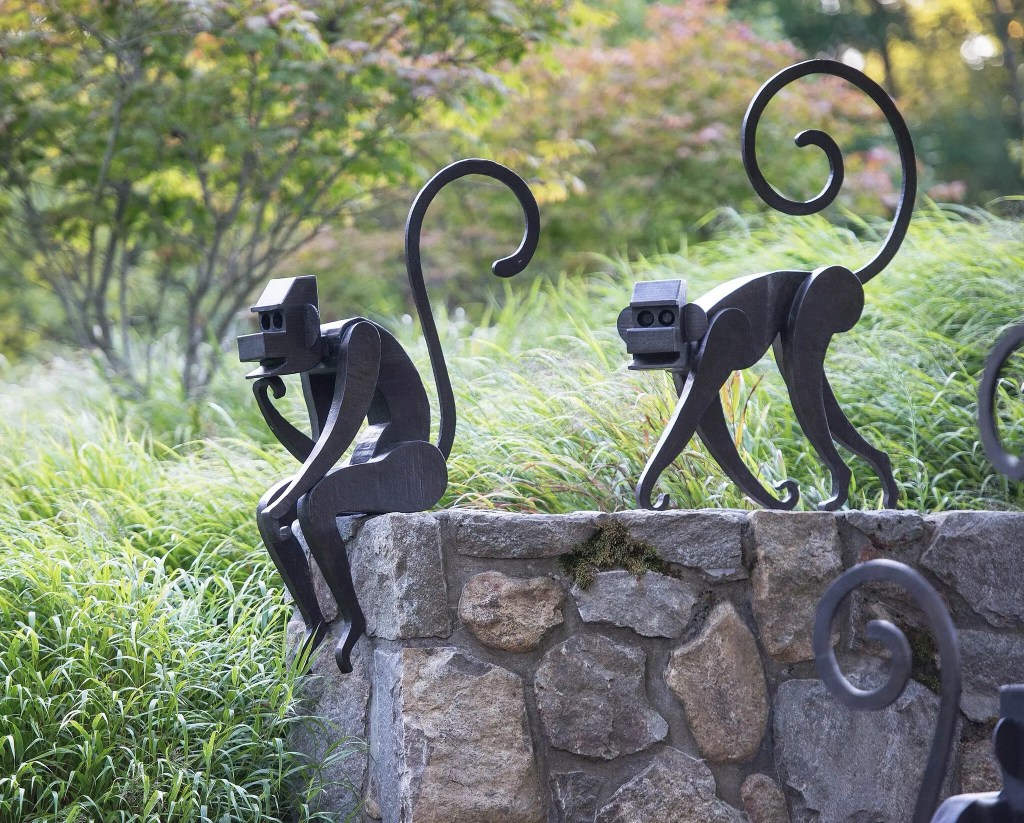
A few of Grashow’s monkeys, which he sculpted from cardboard and then cast in bronze.l.. Credit… Bryan Haeffele. [New York Times caption and illustration]
“Beginnings are the most difficult,” he said. “Being in the process in the middle of the project is phenomenal.” He likened his creative experience to an enormous spiral. “The first steps are unbelievably sluggish, but as it quickens and the vortex keeps spinning around, you can’t wait to get up in the morning and approach the work.”

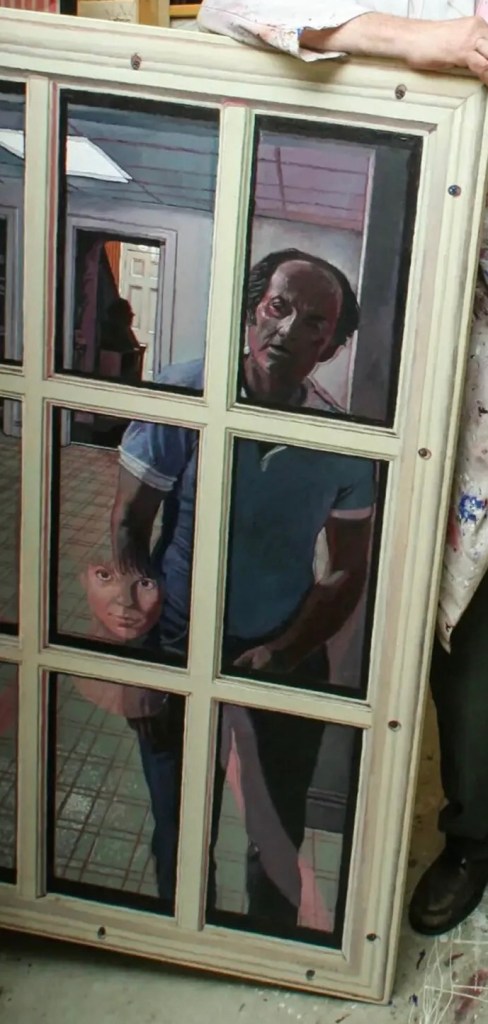
Grashow in his work space that is featured in the documentary “Jimmy & the Demons,” which follows his quest to complete “The Cathedral.” Credit…Jennifer Wastrom. [New York Times caption and illustration]
(George Gene Gustines, “James Grashow Documentary Focuses on Life, Death and ‘The Cathedral,’” New York Times, 6-1-2025)
(c) 2025 JMN — EthicalDative. All rights reserved






 EthicalDative
Writing Not Sterling, But Some Nice Painting
Aubrey Williams: Maya Series Chac Mool II. Photograph: Jonathan Greet/© Estate of Aubrey Williams/ Jonathan Greet. [Guardian caption and illustratiion]
When I saved this Guardian article about painter Aubrey Williams (new to me) back in May, the write-up about him must have irritated me, because I made this note:
The least interesting art journalism is that which marinates in detail about the artist. The painting should do the talking; technique and studio practice are relevant. The rest is art journalism — put it in a book or something.
Yes, I repeated “art journalism.” Clumsy and circular, but stet.
Aubrey Williams: Sun and Earth IV 1963. Photograph: © Estate of Aubrey Williams/ Jonathan Greet. [Guardian caption and illustration]
Re-reading the article now I find this part interesting:
He initially came to Britain to study agricultural engineering at Leicester University, and his interests in ecological matters and the ancient cultures of the Mayan, Aztec and Olmec cultures [sic] was [sic] a regular feature in his art.
Still, irritation persists. The journalist wrote “cultures… of the cultures” and “interests… was.”
Shostakovich Quartet No 5 Opus 92 – Aubrey Williams. Photograph: © Estate of Aubrey Williams/ Jonathan Greet. [Guardian caption and illustration]
(Lanre Bakare, “‘Ahead of his time’: Guyanese artist gets London show amid reappraisal,” The Guardian, 5-19-25)
(c) 2025 JMN — EthicalDative. All rights reserved