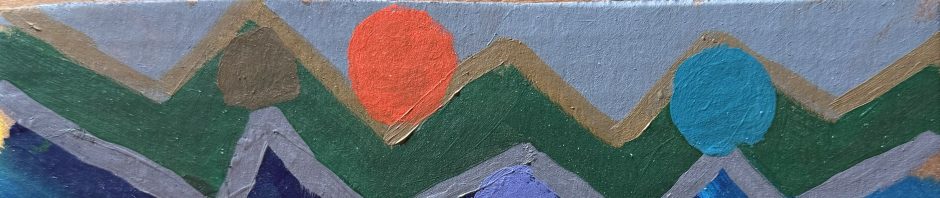
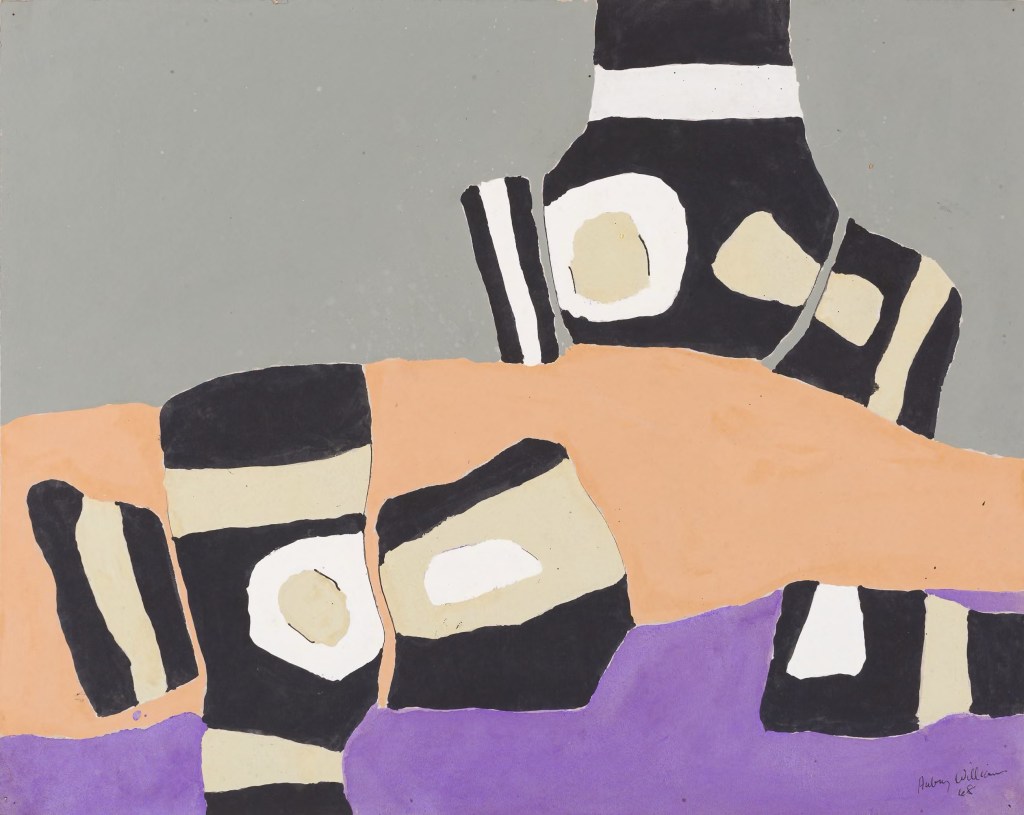
Aubrey Williams: Maya Series Chac Mool II. Photograph: Jonathan Greet/© Estate of Aubrey Williams/ Jonathan Greet. [Guardian caption and illustratiion]
When I saved this Guardian article about painter Aubrey Williams (new to me) back in May, the write-up about him must have irritated me, because I made this note:
The least interesting art journalism is that which marinates in detail about the artist. The painting should do the talking; technique and studio practice are relevant. The rest is art journalism — put it in a book or something.
Yes, I repeated “art journalism.” Clumsy and circular, but stet.
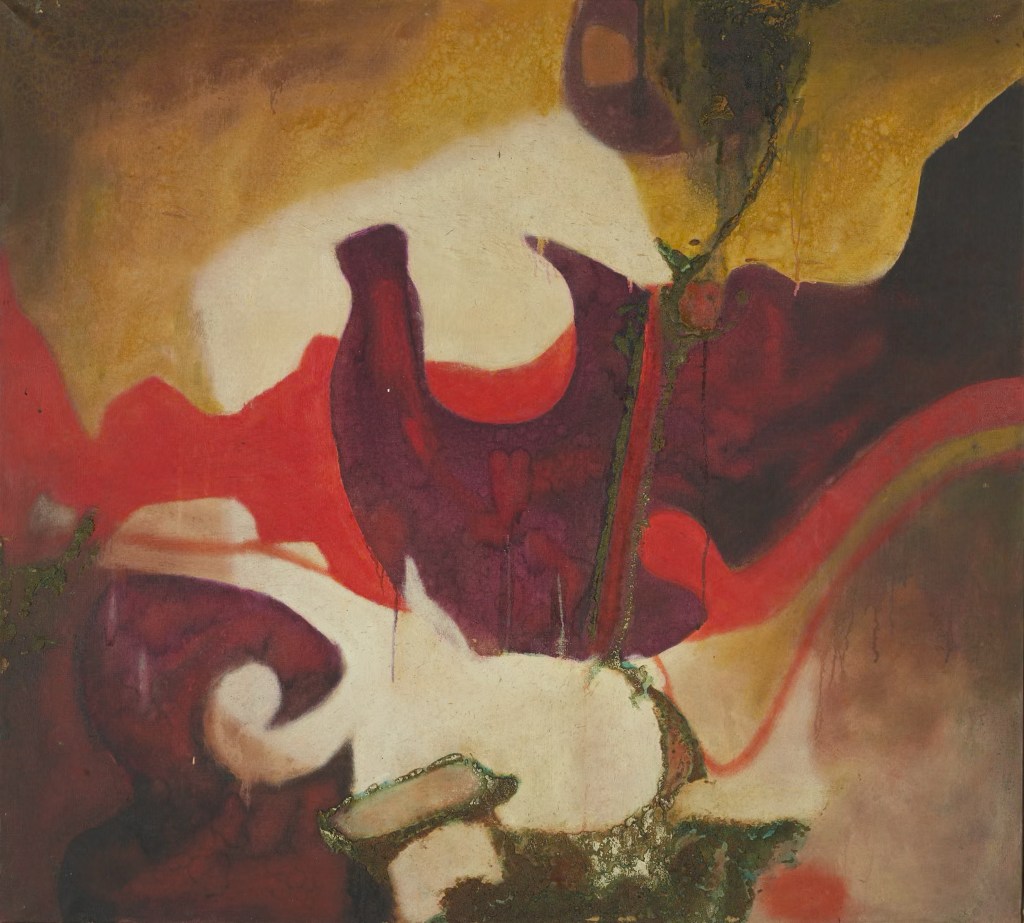
Aubrey Williams: Sun and Earth IV 1963. Photograph: © Estate of Aubrey Williams/ Jonathan Greet. [Guardian caption and illustration]
Re-reading the article now I find this part interesting:
He initially came to Britain to study agricultural engineering at Leicester University, and his interests in ecological matters and the ancient cultures of the Mayan, Aztec and Olmec cultures [sic] was [sic] a regular feature in his art.
Still, irritation persists. The journalist wrote “cultures… of the cultures” and “interests… was.”
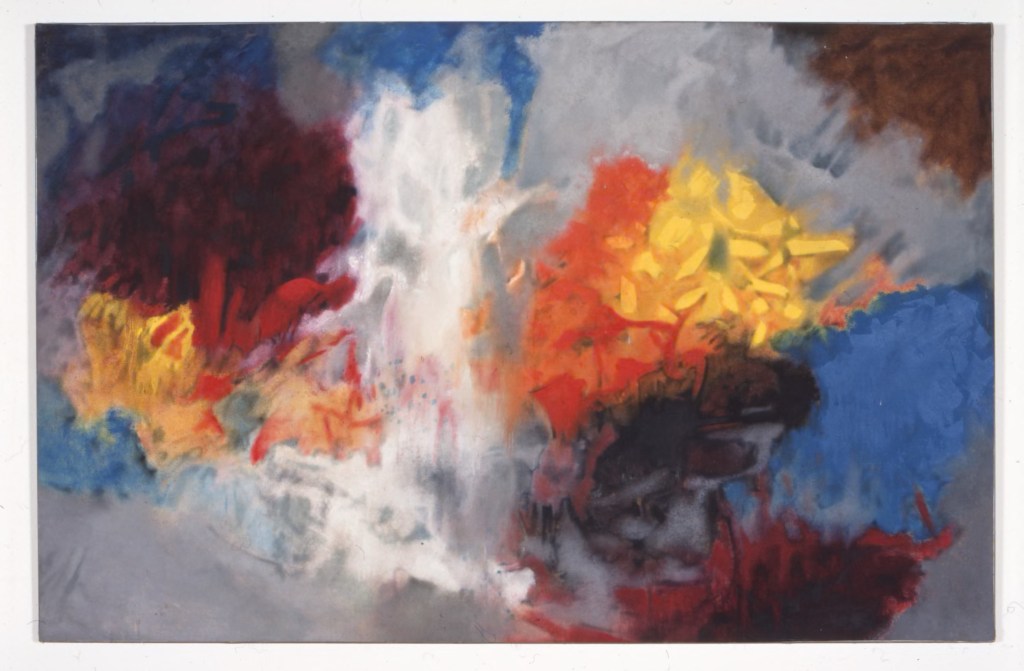
Shostakovich Quartet No 5 Opus 92 – Aubrey Williams. Photograph: © Estate of Aubrey Williams/ Jonathan Greet. [Guardian caption and illustration]
(Lanre Bakare, “‘Ahead of his time’: Guyanese artist gets London show amid reappraisal,” The Guardian, 5-19-25)
(c) 2025 JMN — EthicalDative. All rights reserved







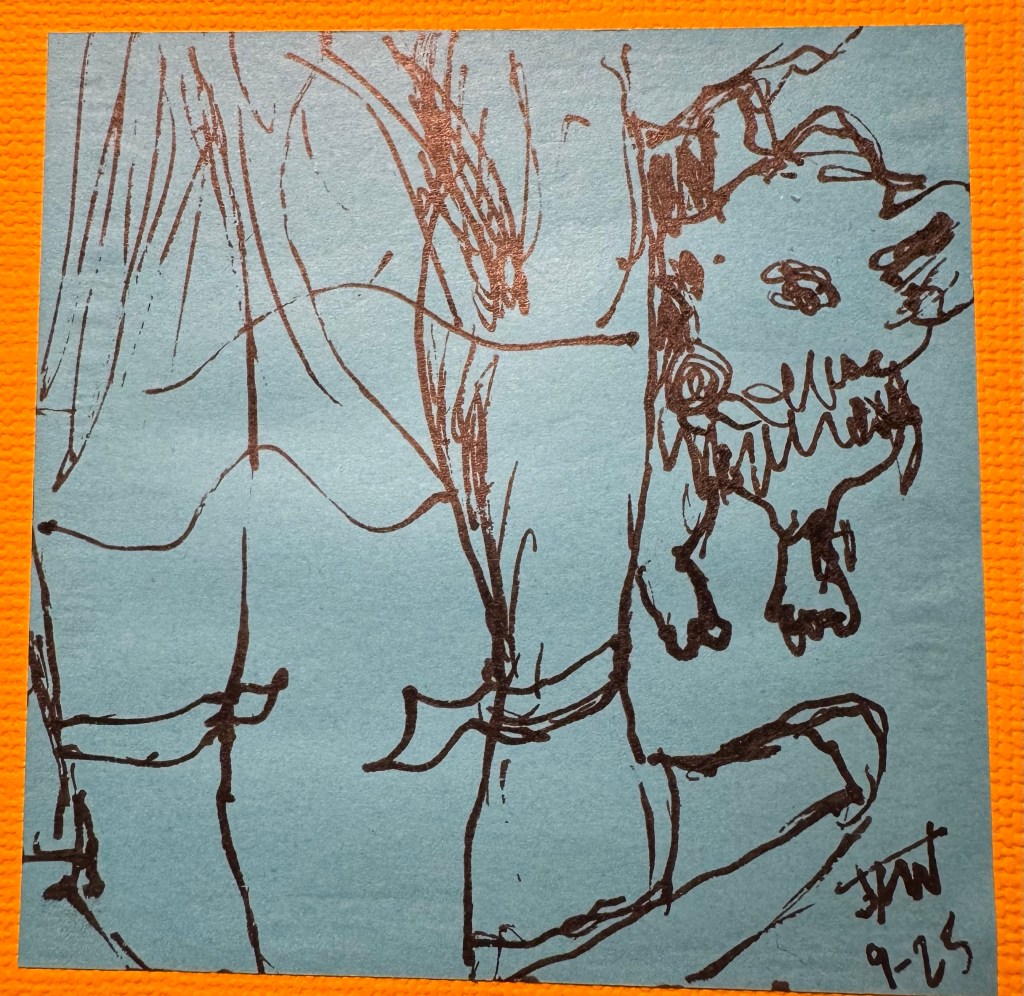


‘Earrings for a Giraffe’
“Dance is joy, longing, crying, laughing, everything,” Asawa wrote. She translated this spirit into paintings and drawings of dancers — floating abstracted figure-eight forms. Credit… Ian C. Bates for The New York Times. [New York Times caption and illustration]
In 1948, American artist Ruth Asawa (d. 2013, age 87) took classes at Black Mountain College in North Carolina with the dancer Merce Cunningham. Her mentor there was the architect Buckminster Fuller.
Ruth Asawa (second from left) with visitors to her 1973 retrospective at the San Francisco Museum of Art (now SFMOMA). Her looped-wire forms made of pliable copper, brass or steel resembled her early drawings of dancers, floating abstracted figure-eight forms, nipped at the center with spherical heads and bodies. Credit… Laurence Cuneo. [New York Times caption and illustration]
She used a knit stitch by hand, which she learned from a local wire-basket maker on a 1947 trip to Mexico, to draw in space and define volumes with a continuous line of pliable copper, brass or steel.
Ruth Asawa, “Untitled (S.046a-d, Hanging Group of Four, Two-Lobed Forms),” 1961. “We made endless hourglass figures that I now see as the forms within the forms in my crocheted wire sculptures,” she said of her youthful drawings in the dirt. Credit… Ian C. Bates for The New York Times. [New York Times caption and illustration]
Asawa maintained that artists weren’t special; they were just ordinary people who could “take ordinary things and make them special,” she said. “I always had my studio in my house because I wanted my children to understand what I do and I wanted to be there if they needed me — or a peanut butter sandwich.”
Asawa’s “Untitled (PF.293, Bouquet from Anni Albers)” is ink on paper from the early 1990s. Credit… Ruth Asawa Lanier, Inc./David Zwirner; via Christie’s. [New York Times caption and illustration]
(Hilarie M. Sheets, “Ruth Asawa’s Astonishing Universe Began at Her Door,” New York Times, 4-4-25)
(c) 2025 JMN — EthicalDative. All rights reserved