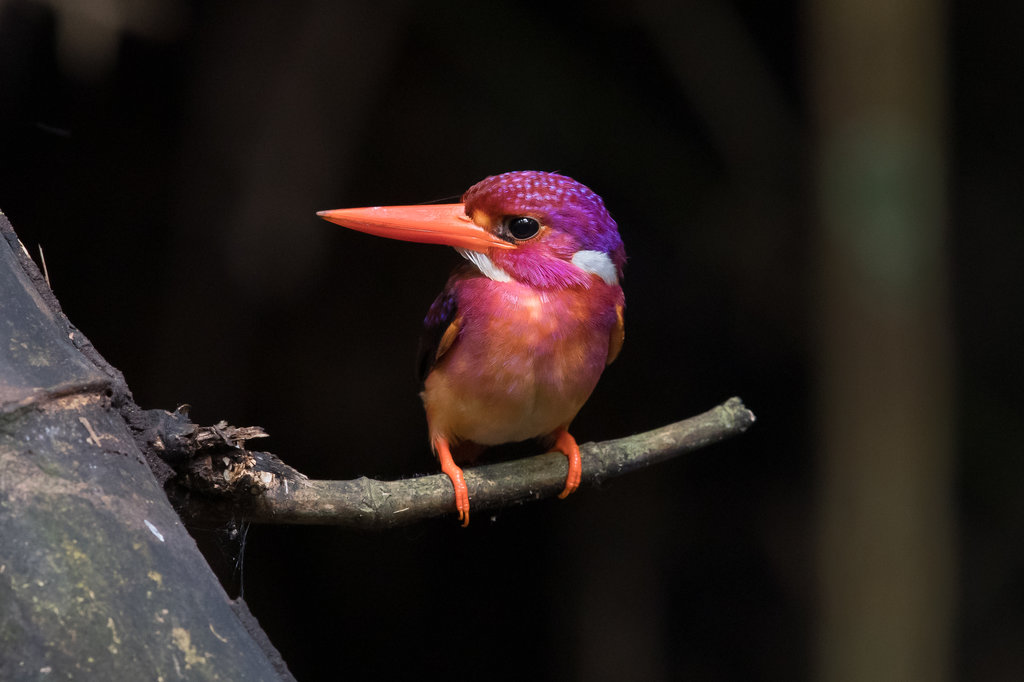
A friend likes birds and will see this. I like them too. This amazing bird will brighten the day of all of us who like birds. It impresses me how its young simply “rocket away” from the nest when ready to fly

… The South Philippine dwarf kingfisher is particularly hard to spot. “It perches quietly and darts invisibly from perch to perch,” Dr. Kennedy’s bird guide warns.
And as Dr. De Leon’s group soon found, the fledgling is even sneakier. While birds of other species often stay close to their nests while learning to fly, the young kingfishers rocket away. “Even if we’re watching them closely, they just disappear,” he said.
(Cara Giaimo, “How an Eye Surgeon Got a Picture of This Rare Pastel Bird,” NYTimes, 4-3-20)
Addendum: I read the article and jotted the above note on April 3. Today, April 5, my friend sends news of birds that are common in that country, and inquires as to birds common in mine. The state bird where I live is the mockingbird. It has a longish tail, drab coloring, a reputation for being peevish and for appropriating the abandoned nests of other birds for its own. There’s a hoary song called “Mockingbird Lane” whose title is all I know of it. We have hummingbirds, who are thrilling when they appear making free of the jatropha blooms. The mourning dove is a built-in bird here; its coo sounds halfhearted, resigned. A roadrunner lived near me once; he or she was a treat to behold and, true to form, never left the ground before diving into the bushes. There was a solitary owl nearby, the only one I’ve ever seen in the flesh. In Waco at springtime birds I called blackbirds literally — and I mean “literally” in a literal sense here, not as a bogus elative — blackened the sky in their swarms, and perched in ranks of thousands along telephone lines all over town. I’ve heard the honkings of geese passing over towards their southern roosting in the fall. Sparrows are ubiquitous. There’s a bird here called a jackdaw, which may be another name for that blackbird. I’m afraid I’m not equipped to distinguish birds that are black from black birds. There are robins and cardinals. And then there’s a “redbird.” Is that the cardinal?There are seagulls on the nearby coast; and in the fields there’s a long-legged white bird that hangs about herds of cattle and feeds off seeds in their droppings. I’ve always called them “dookie birds,” not the scientific name, I’m sure. There’s a preserve nearby that has been devoted forever to trying to keep whooping cranes extant. There are quail, though I never see them. There is a whitewing season, a kind of dove, I think, during which men go out and shoot masses of them. There’s also a duck season, so there are wild ducks to be shot. There’s a long tradition of baiting turkeys and deer with grain from feeders, and hiding in special blinds to shoot them. Called hunting.
(c) 2020 JMN







 EthicalDative
If There’s a Heaven, It’s Parody
Your neologismic servant, a spastic parodic — or is it “parodian” —, speaks his title. For one crowning moment, the Gray Lady really was “fake news.” An October surprise, so to speak.
In September 1978, a strike by pressmen had shut down New York’s major newspapers. In the resulting vacuum, a “living room full of New York writers… wrote, designed and distributed a satirical replica of The New York Times.”
In one parody column, the writer, walking past a pile of skulls to interview Genghis Khan, praised his ability to “get things done.” It took a “six-month investigation by a team of 35 Not The Times reporters” to determine that cocaine “appears popular.”
“The first person I called was the New Yorker writer Veronica Geng…. She came over and handed me the piece on the front page, ‘Carter Forestalls Efforts to Defuse Discord Policy.’” (Rusty Unger)
“I wrote the James Reston column. It wasn’t entirely about him, but it was about [the foreign correspondent and columnist] Cy Sulzberger and people like that who have this rather elevated view of the world, and were always meeting with princes and presidents, and giving the authoritative word on what’s going on.” (Frances FitzGerald)
“There was an air of secrecy about my involvement. I’m sure I told my parents, but not many other people. There was a great fear that The Times was going to hate this, and they would go off on some Trumpian purge of employees who’d had anything to do with it.” (Steven Crist)
“Nobody was being paid and nobody was going to get credit, and there was never a better atmosphere of creativity and freedom and camaraderie. Where are you going to find those parameters again?” (Rusty Unger)
(Alex Traub, “When All the Zingers Were Fit to Print,” NYTimes, 4-1-20)
(c) 2020 JMN