“The Self-Defeating Rage of the Old”

edgerton

Shonagh Rae.

The young people of England, like those in the rest of Britain, … understand we need liberation from the practices of Westminster and Whitehall, not Brussels, and from the self-defeating rage of the old.

David Edgerton, a British historian, writes: “The ‘United Kingdom’ is neither ancient nor stable.”

After 1945, “Britain” — a national United Kingdom — was one of many post-imperial constructions that emerged from the ashes of the British Empire… This national United Kingdom was broken up economically starting in the 1970s by the closely related processes of globalization and deepening economic integration with Europe.

Edgerton argues that the U.K.’s dissolution, which may be likelier after Brexit, could ultimately be beneficial for each country — Northern Ireland, Scotland, Wales and England.

Despite its being the dominant nation in the United Kingdom, the arrangement hasn’t been good for [England]. It doesn’t have a sense of itself as a nation to be transformed and is divided between the vibrant, youthful and pro-European big cities — especially London — and the aging, stagnating and anti-European rest of the country.

(David Edgerton, “Boris Johnson Might Break Up the U.K. That’s a Good Thing,” NYTimes, 1-10-20)

This is my first encounter with a somewhat positive vision of a conceived post-U.K. future.

(c) 2020 JMN

Posted in Commentary | Tagged , | 1 Comment

Feminized Heroes

Images of historic persons have been depicted recently in novel ways by artists in Mexico and in Canada. Both cases have a gender-fluid slant; the contrast in public reaction in each country is notable.

zapata

The work is part of an exhibit about Zapata in one of Mexico City’s premiere arts venues, the Fine Arts Palace. Photograph: Eduardo Verdugo/AP.

Emiliano Zapata, betrayed and killed in 1919, was a hero of the Mexican Revolution, an advocate for landless peasants. Artist Fabián Cháirez depicts a naked Zapata astride a white horse, wearing high heels “while his lips pout beneath his distinctive curved moustache.” His sombrero is pink.

This isn’t freedom of expression, it is debauchery! It’s degrading. They can’t exhibit our history that way,” fumed Antonio Medrano, a spokesman for the protesters. “They can’t permit this kind of mockery.”

“… We are not going to allow this,” said Jorge Zapata Gonzalez. “For us as relatives, this denigrates the figure of our general – depicting him as gay.”
(David Agren, “Nude portrait of Emiliano Zapata in high heels sparks fury in Mexico,” theguardian.com, 12-11-19)

Fabián Cháirez said he had the idea for the painting after noticing that in most representations “Zapata’s masculinity is glorified. There are some people who experience discomfort from bodies that don’t obey the rules. In this case, where is the offence? They [the protesters] see an offence because Zapata is feminised,” he said.
(“Protesters storm museum over naked Zapata painting, http://www.bbc.co.uk, 12-11-19)

Meanwhile, the Metropolitan Museum of Art exhibits without incident the paintings of Canadian artist Kent Monkman, 54, “one of Canada’s best-known contemporary artists.” Monkman is of mixed Cree and Irish heritage.

monkman

In Mr. Monkman’s paintings, Indigenous people are mostly proactive figures shaping the world around them. Miss Chief Eagle Testickle, in heels, provides a rescuing hand in “Welcoming the Newcomers.” His sources include Courbet and Titian. Credit…Kent Monkman.

His paintings, done in a crisply realistic, highly detailed, somewhat cut-and-paste illustrational style, are far from grim. In many of them, humor and erotic, usually homoerotic, fantasy have an important role. So does the image of the artist himself in the guise of his alter ego, a buff, cross-dressing, gender-fluid tribal leader named Miss Chief Eagle Testickle.
(Holland Carter, “A Cree Artist Redraws HIstory,” NYTimes, 12-19-19)

It’s hard not to see some fun being had in the work of both painters, and to share in it.

(c) 2019 JMN

Posted in Commentary | Tagged , , , , | 1 Comment

Relative Generality

writing plume

When you reach a fork in the road
Pick it up like Einstein thought in nineteen-oh-seven
At his business of therefore’s that

People in free fall do not feel their own weight
Equals floating in gravity-free space
So no work force of gravity in either state and

Resting in gravity feels like one G of acceleration
And the feel of both is the same so
Both must have the same cause and therefore

Big-like-Earth things curve space and time and
Gravity, where the curve is — there! — itself arises
And — there! — acceleration feels like resting and

Light-beams acceleration bends in spaceships also
Mass bends like sun-bent starlight lends a cosmic lens on
That! — what the same thing causes.

(c) 2019 JMN

Posted in Anthology | Tagged | Leave a comment

Dream

Glass mountains

Glass Mountains, West Texas

I once said to my dad in a dream, “What did you think? That you fucked my mother and got an idiot?”

I was cooking an elaborate turkey stuffing in my mother’s kitchen to celebrate for the umpteenth time their hoary divorce. Perhaps I had opened the oven door once, twice, or thrice to check on my concoction.

He admonished me that each time I opened the oven door I was letting heat escape, which inhibited the cooking process. I wanted to tell him that even in middle age I understood escaped heat, but I needed to see how my stuffing was doing.

So I said it in a dream years after he died.

That I can conceive of talking to him like that hurts me in a sense. I wonder if it does him also? Such language would have fetched me a licking as a kid.

He’s a crock of ashes in a shallow hole in West Texas now. Can he hear me tell him I was offended? Religion only knows what the dead hear.

(c) 2019 JMN

Posted in Commentary | Tagged | Leave a comment

Hard to Handle

More Galleries | Tagged | Leave a comment

The Eye in Love

eye in love

Adèle Haenel as Héloïse, right, and Noémie Merlant as Marianne in “Portrait of a Lady on Fire,” a film directed by Céline Sciamma. Credit…Neon.

This review treats several films about gay female love. The reviewer is a film maker. Noteworthy for me is her emphasis on the ocular dimension of romantic attraction. The use of “one’s self” instead of “oneself” for the reflexive pronoun is distinctive.

[The] initial deception is conveyed through the intent, searching looks Marianne casts toward Héloïse and the curious, wary glances Héloïse returns to her… To flirt as a queer person is to immerse one’s self in the act of looking and being looked at… The woman who is being looked at must look back at the woman looking at her for any real connection to take place. And the look she gives has to be one that communicates not only pleasure in being looked at, but pleasure in what she sees… The light in their eyes during stolen moments alone together… “Rafiki” captures the electric stares and ensuing relationship between a young couple… The couples in each of these films are forced by circumstance to engage in romance covertly, yet what comes through in the performances is the pleasure of being — truly — seen.

Also of note in a head-scratching way is the treatment of “Rafiki” by the authorities:

… The Kenya Film Classification Board banned the film because of its “clear intent to promote lesbianism in Kenya contrary to the law” — in May, the nation’s high court upheld laws criminalizing gay sex — though the ban was temporarily lifted last year so that it would be eligible for an Academy Award.

(Ren Jender, “‘Portrait of a Lady on Fire’ Understands Queer Desire,” NYTimes, 12-9-2019)

(c) 2019 JMN

Posted in Commentary | Tagged , , | Leave a comment

Gallimaufry

Adverbs Ahead

Confused Jumble Ahead

Inauthentical Inadvertency
Twitter and Facebook took down numerous accounts internationally for “coordinated inauthentic behavior.” Twitter disclosed that “email addresses and phone numbers uploaded by users to meet its security requirements may have been ‘inadvertently’ used for advertising purposes.”

Trumpical Subjunctivity
“We might wish, at times, that Mr. Trump were a little less juvenile, or insensitive, or hypersensitive; but we might also wish that every president achieves [bolding added] perfection.” [Wishes are subjunctive. Write achieve.]

Sayable Nameness
Ta-Nehisi Coates is pronounced tah-nuh-HAH-see kotes.
Ntozake Shange is pronounced intoo-ZAH-kee SHAN-gay.

Parenthetical Divinity
A suit filed by a former Miami TV reporter alleges age discrimination. The reporter says that when she complained to the HR director she was told: “’We must rely on the man upstairs’ (God) for help.”

Visionary Wonkery
… Wonkery, a vision of competence and expertise… in which there are assumed to be “correct answers” to policy dilemmas that a disinterested observer could acknowledge and the right technocrat achieve.

Blokey Naughtiness
[Lunch at Sweetings, London] It’s quite City, quite blokey… The food was better than I thought it was going to be… The haddock and egg was perfect. A nice bit of frozen peas on the side – I love frozen peas. Then we had sticky toffee pudding and custard, and then Welsh rarebit with a bit of poire William… It was one of those early midweek, naughty lunches, when you’re in high spirits right from the off.

SOURCES
Davey Alba, “Twitter Suspends Account of Former Advisor to Crown Prince,” NYTimes, 9-20-19.
Reuters, “Twitter Stock Plunges After Earnings Are Worse Than Expected,” NYTimes, 10-24-19.
Robert J. Shiller, “How Lying and Mistrust Could Hurt the American Economy,” NYTimes, 11-8-19.
Philip Terzian, “Trump’s Rhetoric Has Its Precedents,” 12-9-19.
Meg James, “‘Mocked’ by her bosses, award-winning CBS TV reporter was fired. Then she sued,” Los Angeles Times, 12-8-19.
Ross Douthat, “Exhausted With the Experts,” NYTimes, 12-7-19.
Killian Fox, Holly O’Neill, and Molly Tait-Hyland, “‘Utterly delicious’: top chefs on the best thing they ate in 2019,” theguardian.com, 12-8-19.

(c) 2019 JMN

Posted in Anthology, Commentary | Tagged | Leave a comment

The Macaroni Line

edna1

Carter Johnston for The New York Times.

This article is about how a small Texas town near me survived losing its Walmart store. I like it for its local history and photographs. Edna is “a community of about 5,700 people surrounded by rice fields, ranches and grassland.” It’s 28 miles from Victoria north on Highway 59.

A downtown theater glows with rainbow lights, and the tower on top of the building spells out the city’s name high above a ticket booth covered in cobwebs. The theater has not shown movies regularly for years, though its new owner has told residents that he plans to start screenings soon.

edna2

“It was like getting hit by a bomb,” Joe Hermes, a former mayor of Edna, said of learning Walmart was leaving. Credit…Carter Johnston for The New York Times.

The town was founded in 1882 and named after the daughter of an Italian count, who came to Texas to build a railroad stretching from Mexico to New York. Two nearby towns are named after the count’s other daughters, Inez and Louise.

edna3

Edna is roughly 100 miles from Houston. Credit…Carter Johnston for The New York Times.

The count imported hundreds of Italian laborers and fed them, according to a history of Jackson County, largely with macaroni. The railroad was nicknamed the Macaroni line. But the count left the railroad after laying only about 90 miles of track.

edna4

Landing at the Jackson County Airport in Edna. Credit…Carter Johnston for The New York Times.

edna5

Sales tax revenue has dipped only slightly since Walmart left. Credit…Carter Johnston for The New York Times.

(Michael Corkery, “The Town That Lost Its Walmart,” NYTimes, 12-24-19)

(c) 2019 JMN

Posted in Commentary | Tagged , , | Leave a comment

Horseback Love

austen

… The queen’s addresses tend to be broad, anodyne and even a little opaque.

“The problem with Yorkie [the Duke of York] is he can be very arrogant and petulant. I think that’s down to insecurity.” [Former palace official]

Two lines of admiration converge in these disparate quotes.

The fan of opacity can’t help but keep an ear to the palace, whose relentless scentlessness trumps unstinting reek belched elsewhere.

The queen is to say [in her Christmas message] that “small steps taken in faith and in hope can overcome long-held differences and deep-seated divisions… The path, of course, is not always smooth, and may at times this year have felt quite bumpy….”

The queen termed 1992 “annus horribilis”; 2018 was “busy”; 2019 ends “bumpy.”

The rhetoric of Elizabeth Alexandra Mary Windsor, moreover, is physical as well as verbal. Her Majesty saddled up just recently to support her insecure youngest [the Duke of York].

On Friday, the Queen was spotted horse riding with Prince Andrew in the grounds of Windsor in what one royal expert said was an apparent show of support to her second son.“He’s been through the ringer… It’s probably giving a message that whatever he’s done, he’s still my son, he’s still a member of the royal family.” [Ingrid Seward, editor-in-chief of Majesty magazine]

Few nonagenarians can sit a horse. Fewer still are queens.

SOURCES
Lliana Magra, “Queen’s Christmas Message Acknowledges a ‘Bumpy’ Year for U.K.,” NYTimes, 12-24-19.
Stephen Bates, “Prince Andrew’s fall from grace brings uncertain times for the monarchy,” theguardian.com, 11-22-19.

(c) 2019 JMN

Posted in Anthology, Commentary | Tagged , , | Leave a comment

Degas: Opéra Superfan

degas1

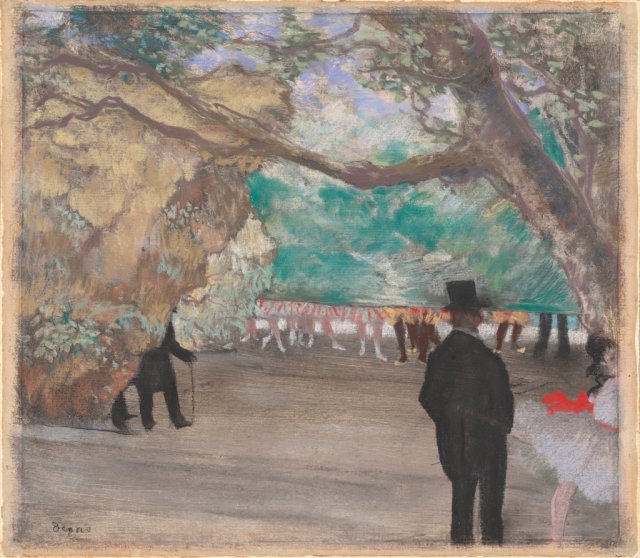
“Degas at the Opéra,” in Paris now and Washington in March, reveals the leering intensity rather than the sentimentality in Degas’s ballet and opera pictures. Credit…The National Gallery of Art.

This painter who “didn’t like women,” in van Gogh’s estimation, found at the Opéra [de Paris] an arena of desire and depredation that he could translate into pure form — beautiful and stifling, modern and cold. This is the truth about superfans: they smother what they love.

Jason Farago writes about the louche milieu that spawned images of dancers that are now “schmaltzy stalwarts of dorm-room posters.”

In the year 1885 alone, Degas went 55 times to the still-new Palais Garnier. He saw one opera… at least 37 times… In late 19th-century Paris, opera was a social spectacle that made it an ideal subject for a painter of modern life… Degas went as often as he could afford it… He trained his eye on both the stage and the audience…

degas2

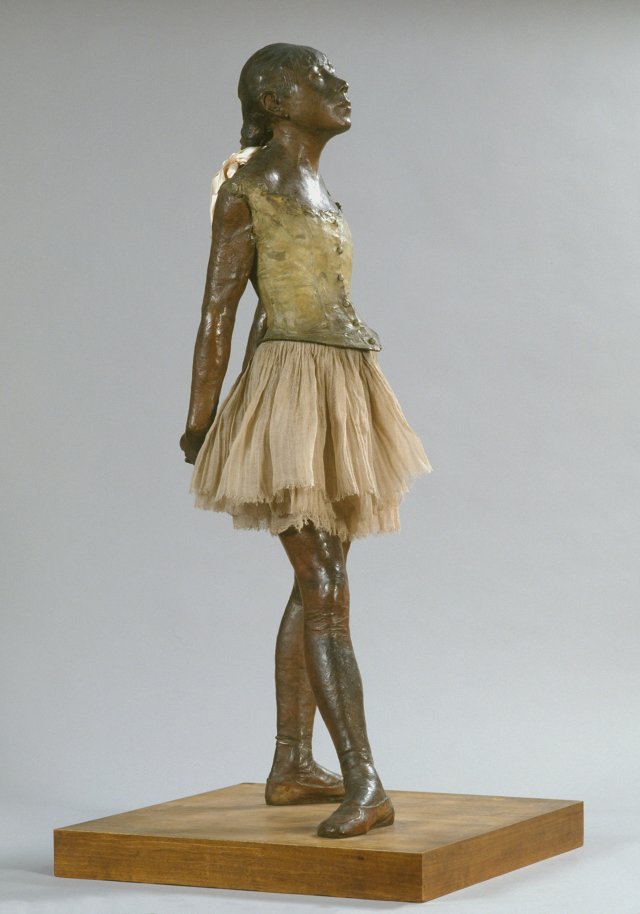
Marie van Goethem, the model for Degas’s “Little Dancer Aged Fourteen,” was an example of the shaky social status of 19th-century dancers. Credit…RMN-Grand Palais; Musée d’Orsay; René-Gabriel Ojeda.

Belgian-born Marie van Goethem was the model for Degas’s statue “Little Dancer Aged Fourteen.”

Instead of capturing her mid-plié, Degas chose to sculpt her standing in the awkward fourth position, feet perpendicular to the torso and pointing in opposite directions. He gave her a sharp jaw and a forehead like a ski slope. To her body he affixed a real tutu, and real human hair… “Why is she so ugly?” wrote the critic for Le Temps…

degas3

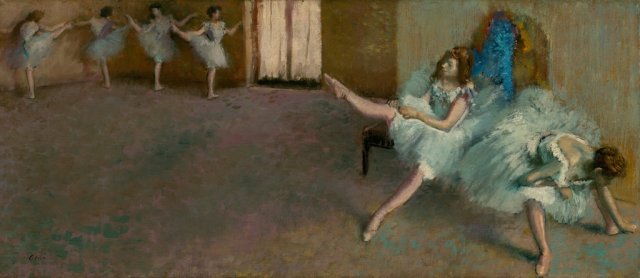
Degas’s dancers appear more often like possessions than fellow artists. They are working girls, bent over, tying their slippers, slumped in the corner. Credit…National Gallery of Art.

… In Degas’s… superficially sunnier pastels, the dancers… are working girls, bent over, tying their slippers, slumped in the corner — rarely elegant, and always being watched… Degas was an intense misogynist, and the formal innovations of his art went together with an avaricious [?] focus on control… “I have perhaps,” he once confessed, “too often considered woman as an animal.”

(Jason Farago, “Degas: A Superfan at the Opera, Where Art Tips Into Obsession,” NYTimes, 11-15-19)

(c) 2019 JMN

Posted in Commentary | Tagged , , , | Leave a comment