
Tools.
WARNING
A long and wonkish post. Probably not your cup of tea.
BACKGROUND
I strove for years to read Arabic. I’ve largely lost what knack I attained. A recent brush with the language brought back how daunting it can be. For my own amusement I revisit my flustered campaign to be an “Arabist.”
TRANSLITERATION
I will use my eccentric transliteration for Arabic words, not the official one, which demands exotic characters from the International Phonetic Alphabet.
ROOTS
To look up an Arabic word in the dictionary you must analyze what its “root” consonants are. Typically there are three; sometimes two; rarely four. You look up the root to get at the word.
VOWELS
Arabic has three short unwritten vowels: ‘a’, ‘i’, ‘u’. Their lengthened forms ARE written. I represent them thus: ‘aa’, ‘ii’, ‘uu’.
WEAK CONSONANTS
The long vowels double as “weak” consonants. “Alif” looks like a capital sans-serif ‘i’. Crowned with a diacritic called “hamza” it’s a glottal stop (I use an apostrophe for it) voiced with any one of the three vowels. Think “asp-eek-oof.”
For weak consonant’Y’ think “yap-yeast-youth.”
For weak consonant ‘W’ think “wacky-weevil-woo.”
FIRST WORD
Here’s the first word of the mystery sentence we’ll attack:

KH-w-n-(t)
Discard the ‘(t)’. It’s a feminine noun ending. The ‘w’ is suspect, could be a lengthened vowel. Let’s hope it’s a root consonant and look up KH-w-n in our dictionary. We find there is such a root, which revolves around the semantic range of treachery. Now we must scan the derivations from this root to find the word that appears in our text. We come upon this sequence:

KHaa’in(un)
This is the present participle of the first derived verb form (there are 10 common derived verb forms). My Hans Wehr dictionary lists the following meanings: disloyal, faithless, false, unreliable, traitorous, treacherous, perfidious; traitor. Now, this doesn’t look exactly like our word, you are thinking, and you’re correct. Note, however, that our present participle has two “broken” (non-regular) plurals:

KHuwwaan (first broken plural of KHaa’in)
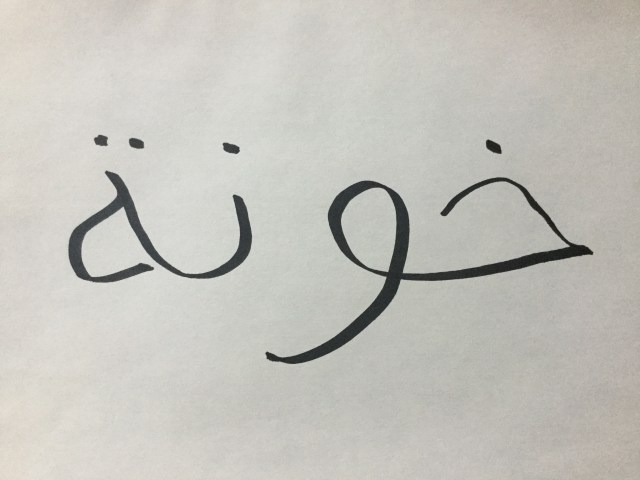
Khawana(t) (second broken plural of KHaa’in)
And in the second broken plural we see it. That could be our word! We’ll peg with the meaning traitors so as to keep it in our head. Without more context we can’t be sure of anything yet. It’s rare in Arabic for there to be a single morphological analysis on which to hang one’s hat. But we’re ready to continue our sleuthing on the second word!
(c) 2019 JMN







 EthicalDative
Do NOT Surprise Your Mom
“Ewan Palmer, “Mother Shoots Daughter After She Came Home From College to Surprise Her,” Newsweek, 9-4-19)
The concept of waking up the household to issue a “getting drink of water” announcement has zany appeal. The same protocol would apply to toilet visits and midnight refrigerator raids. Sleepwalkers beware, however! (The daughter was shot in the arm and is recovering.)
(c) 2019 JMN