Quote This?

music staff

JMN. The start of a painting of the musical modes — Ionic, Phrygian, etc. Painted the foreground first. Poor planning.

A kind observer from somewhere remarked that I had a fair amount of original content on my blog, and asked if I coped with plagiarism or copyright violation, saying he or she was seeing his or her own content cropping up elsewhere on the internet. I paraphrase the comment, because I now can’t locate it. It ghosted partially on my screen until I unlocked, but does not show up on WordPress, which is where I assumed it had originated. I pierce the bloggery veil now for a disquieting moment to address this unexpected but interesting question.

They say imitation is the sincerest form of flattery, and I suppose plagiarism is similar. The only reason someone might steal my thunder, it seems to me, is because I’ve said something either so useful or so unforgettable — or so potentially lucrative? — that he, she, or “it” corporately, wishes to be remembered for it in my stead. Gosh, thank you, would be my first thought, but I’m hard pressed to imagine any such scenario being the case — self-deprecation is one of my sincerest poses.

I experience EthicalDative mostly as an echo of my inner voice woolgathering in one way or another, ignored by the many, noticed by the few. Little or nothing I post can be more memorable or creative than the vast universe of good content blogged elsewhere.

I’m unaware of my effusions being appropriated with or without attribution. How does one know? In the age of Kardashian many people (and perhaps I’m included) cut and paste much of their very lives to and from the Internet. How do they even know when they’re speaking in their own voice and not someone else’s, or snapping their own face in the selfie and not one bestowed by a YouTube makeup guru?

I restarted this WordPress blog from three primitive antecedents on other platforms. In doing so I read an article that recommended copyrighting each post as a matter of course. I took it to heart and have mechanically followed that practice, though it feels pretentious most of the time. But the article also mentioned the necessity to periodically register your content with the appropriate agency for a small fee, which I have not done.

Failing said registration, and even with it, my understanding is that your avenues of recourse, should you get stepped on copyright-wise, are few and puny for the most part — the equivalent of saying “Please stop doing that!” — unless you have a walloping war-chest of ready money to burn on lawyers, and an endless supply of life to fritter away in lawsuits. I’ve neither. My only defense from theft is ethics, which is to say, I’m naked to the wind.

(c) 2019 JMN

Posted in Commentary | Tagged , , , , , , | Leave a comment

Guide by the Perplexed — Crossed Eyes, Dotted Tees

gris guitar

Juan Gris, “Guitare sur une table,” from 1916, at Helly Nahmad. Credit via Helly Nahmad Gallery.

Yea, though I walk through the shadow of the cloud of unknowing, I shall fear no malaise, for thy clef and thy stave, they comfort me.

I pause from the demented abstraction of this serialized soliloquy, this goofy guide, to reflect that what it is, actually, is praying — a beseeching of the Inner Power enfolded in the gray matter to grant me long musical life during which to unfuddle prior musical life.

It’s a form of prostration unseemly in better calibrated souls. It grovels for enlightenment in a manner similar to the ostentatious self-abasement of flagellating zealots in olden times.

It’s a quest for absolution from the sin of blind adherence to finger-fucking the fretboard in lieu of understanding the fretboard and melding with it in brain-sourced rites of hard discipline.

It’s an act of penance over having fallen for pusillanimous, bankrupt, complacent teachers who catered to delusions of chumps like me: “Sweet Home Alabama” was at our fingertips if we fingered just so, they purred.

It’s a striving to pay the same attention to fretboard position that we pay to not falling over when we walk — little or none. O Inner Power, let me swoop irreflexively, unerringly, to the note at 3-10F or 5-5D. Guide my finger.

It’s hapless effrontery, whether relieved or not with silliness like this. The truth is that, to the passerby, these mantric soundings towards a contrived musicology are as dry as dust, like Judges or the Book of Numbers.

To be sure, I don’t know what the praying does for me, but it does something. It steadies me. In the pregnant nocturnal silences I’m like, Musician, guide thyself, or whatever.

And there you have it. It’s time to see how naturally occurring diatonic semitones (NODS) can expand indwelling fretboard awareness — coming next.

(c) 2019 JMN
Posted in Anthology | Tagged , , , , , , , , , , | Leave a comment

Hard to Live With

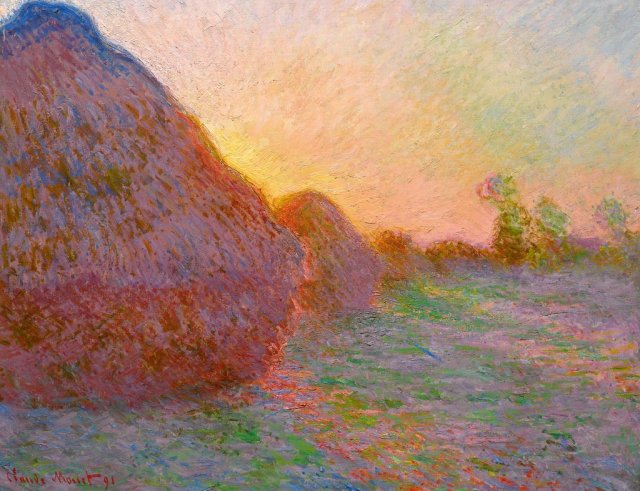
monet meules

This work from Claude Monet’s “Meules” (“Grainstacks”) series set an auction high for any work by an Impressionist painter, according to Sotheby’s, which handled the $110.7 million sale. Credit via Sotheby’s.

Claude Monet’s series paintings are among the few true trophies that can generate real excitement at auctions… “They’re so evocative, so romantic and so easy to live with,” Offer Waterman, a London-based dealer, said. “That was the best of the series… It was an amazing painting. And you just can’t get them.”

“The longer you spend buying it, the longer you’ll spend enjoying it,” quipped Harry Dalmeny, the auctioneer… as he urged the bidders on.

(Scott Reyburn, “A Monet Sells for $110.7 Million, an Auction High for an Impressionist Work,” NYTimes, 5-14-19)

Well, yes, you can get a true trophy in a frenzy of real excitement if you’re filthy rich.

Monet did only (!) 25 of these “Meules” paintings in 1890 and 1891 in the fields next to his home in Giverny. I like to think he would spin in his grave at knowing that the fruit of his honest labor is being retailed at astronomical sums of filthy lucre by cynical
auctioneers in a philistine micro-bubble of obscene wealth peopled by a handful of hedge fund managers, petroleum potentates, and their ilk.

I join Claude in finding it disheartenening, dispiriting, discouraging, demoralizing, debasing, disgusting, and denaturing to lose perfectly decent art to gilded closets.

(c) 2019 JMN

Posted in Anthology, Commentary | Tagged , , , , , , | Leave a comment

Guide by the Perplexed — Consolidation

gris guitar

Juan Gris, “Guitare sur une table,” from 1916, at Helly Nahmad. Credit via Helly Nahmad Gallery.

The OO states uncover a consistency that helps learn what 8 natural notes are produced at 12 fret-based coordinates.

Let’s use a notation specifying string-fret, then note.

Example: “1-7B.”

In the example, the initial digit (‘1’) designates string 1. The next digit (‘7’) designates fret 7. The letter (‘B’) designates the note produced — note B. Thus, the symbol “1-7B” says “string 1 at fret 7 is a B.”

OOF state occurs as follows:1-0E, 1-7B, 2-8G, 3-7D, 4-7A, 5-7E, 6-0E.
OOP state occurs as follows: 6-0E, 6-5A, 5-5D, 4-5G, 3-4B, 2-5E, 1-0E.

And there you have it. It’s time to cross some eyes and dot some tees — coming next.

(c) 2019 JMN

Posted in Anthology | Tagged , | Leave a comment

Parting Looks — Buck Schiwetz

Edward Muegge “Buck” Schiwetz (1898-1984), born in Cuero, Texas. (c) 2019 JMN

More Galleries | Tagged , , , , , , | Leave a comment

Guide by the Perplexed — Restatement

gris guitar

Juan Gris, “Guitare sur une table,” from 1916, at Helly Nahmad. Credit via Helly Nahmad Gallery.

Here we restate and complement our OO schemes as follows:

Octave-of-Following (OOF)

*E-string-1 at Fret-0 is an E-note with OOF state re E-string-6
E-string-1 at Fret-7 is a B-note with OOF state re B-string-2
B-string-2 at Fret-8 is a G-note with OOF state re G-string-3
G-string-3 at Fret-7 is a D-note with OOF state re D-string-4
D-string-4 at Fret-7 is an A-note with OOF state re A-string-5
A-string-5 at Fret-7 is an E-note with OOF state re E-string-6
*E-string-6 at Fret-0 is an E-note with OOP state re E-string-1

Octave-of-Preceding (OOP)

*E-string-6 at Fret-0 is an E-note with OOP state re E-string-1
E-string-6 at Fret-5 is an A-note with OOP state re A-string-5
A-string-5 at Fret-5 is a D-note with OOP state re D-string-4
D-string-4 at Fret-5 is a G-note with OOP state re G-string-3
G-string-3 at Fret-4 is a B-note with OOP state re B-string-2
B-string-2 at Fret-5 is an E-note with OOP state re E-string-1
*E-string-1 at Fret-0 is an E-note with OOF state re E-string-6

*Fret-0 means the string is open — no fret is fingered. These additions make explicit that strings 1 and 6 are tuned to the same note — an E — one octave apart.

And there you have it. It’s time to consolidate the cognitive handhold on the fretboard that we’ve gained so far — coming next.

(c) 2019 JMN

Posted in Anthology | Tagged , | Leave a comment

Rust in Peace

decay11

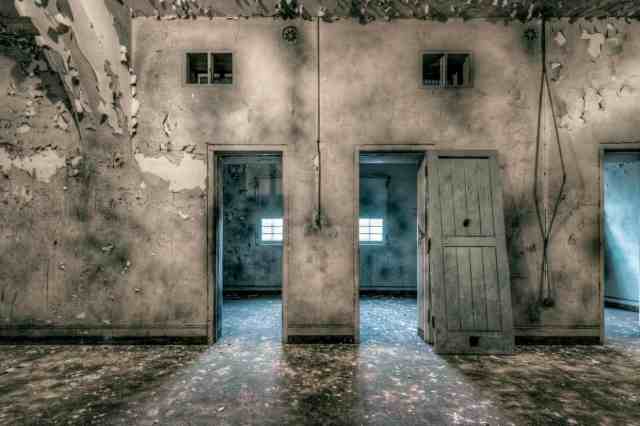
White Bay’s turbine hall [Australia].

There’s this sense of wonder you get when looking at abandoned buildings. You try to imagine what these spaces were like when they were filled with busy workers trying to meet production targets. And why did they close?

(Brett Patman, “Beauty in ruins: the wonder of abandoned buildings — a photo essay,” The Guardian, 5-11-19)

decay3

Kandos cement works [Australia].

The spectacle of decay and decrepitude on an industrial scale is somehow stirring.

decay4

Women’s wards at Callan Park [Australia].

The so-called advances in how we make buildings seem to be matched by an acceleration of the rate at which they disintegrate.

decay9

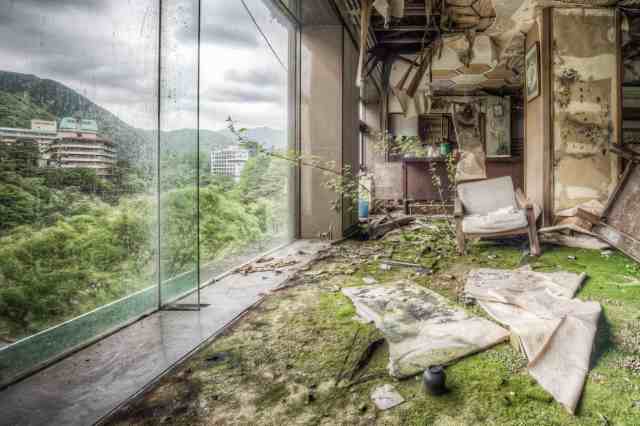
The lounge of the Kinugawa Kan Hotel [Australia].

decay10

A former snack bar in Yubari [Australia].

It’s hard to imagine anything erected today standing — like a Roman bridge — a thousand years from now.

stans5

Residential building, 1980s, Chkalovsk, Tajikistan. Photograph: Stefano Perego.

However, …

stans6

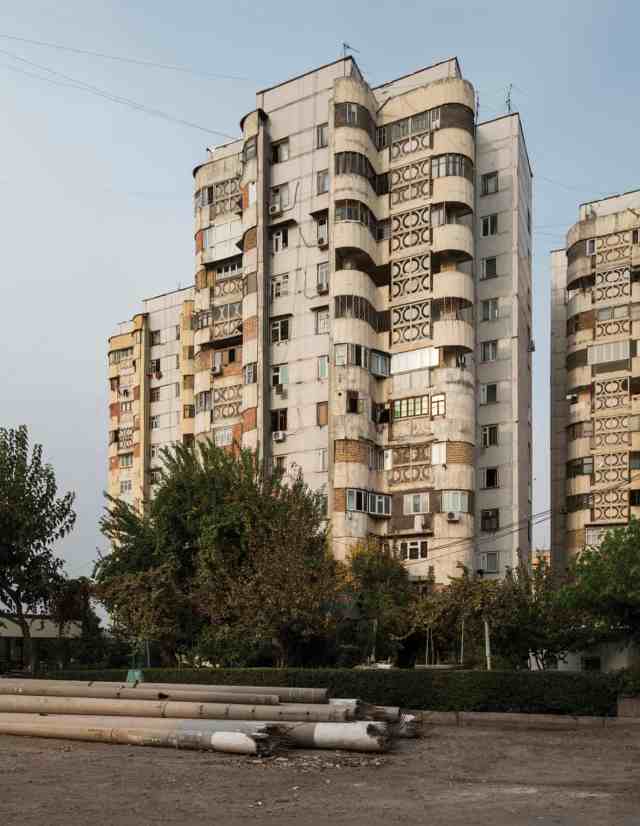
Residential building, 1980s, Tashkent, Uzbekistan Photograph: Stefano Perego.

… toxic, putrefying, oxidized, infested, cankerous, crumbling, melancholy, five-star has-beens…

stans4

Aul housing complex, 1986, Almaty, Kazakhstan. Architects: B. Voronin, L. Andreyeva, Y. Ratushny, V. Lepeshov, V. Vi. Photograph: Stefano Perego.

… are fertile ground for art and piety,…

stans1

Residential building, 1984, Dushanbe, Tajikistan. E. Yerzovsky. Photograph Roberto Conte.

… which spring from death anyway.

stans8

Residential building, 1980s. Tashkent, Uzbekistan. Photograph: Stefano Perego.

(Roberto Conte and Stefano Perego, “When Soviets met Stans: the tower blocks of central Asia — in pictures,” The Guardian, 5-3-19.

(c) 2019 JMN

Posted in Commentary | Tagged , , , , , , , | 2 Comments

Parting Looks

This inadvertently comical drawing by Harold J. Nichols (1924-2013) has a vigor and intensity that I find seductive. It has the top-of-head deficit common amongst us untrained drawers. The brain fools the eye somehow. I think it discounts what’s above … Continue reading

More Galleries | Tagged , , | Leave a comment

Guide by the Perplexed — Denial

gris guitar

Juan Gris, “Guitare sur une table,” from 1916, at Helly Nahmad. Credit via Helly Nahmad Gallery.

I did not err in an earlier post; the post simply misspoke itself. Derived Octave-of-Following (DOOF) state was announced as coming next. The post should have intended to say: “Octave-of-Preceding (OOP) state — coming next.”

Octave-of-Preceding (OOP) state is the state in which a fretted note is the octave of the preceding open string.

This is true:

E-string-6 at Fret-5 is an A-note with OOP state re A-string-5

A-string-5 at Fret-5 is a D-note with OOP state re D-string-4

D-string-4 at Fret-5 is a G-note with OOP state re G-string-3

*G-string-3 at Fret-4 is a B-note with OOP state re B-string-2

B-string-2 at Fret-5 is an E-note with OOP state re E-string-1

*OOP state occurs at Fret-5 often enough to be useful for raising note consciousness. The exception is on G-string-3. The interval between G-string-3 and B-string-2 is the only interval that isn’t a Perfect-Fourth; it’s a Major-Third. Therefore, OOP state is a half-step lower at Fret-4.

And there you have it. It’s time for a summary of what we’ve learned so far — coming next.

(c) 2019 JMN

Posted in Anthology | Tagged , | Leave a comment

Guide by the Perplexed

gris guitar

Juan Gris, “Guitare sur une table,” from 1916, at Helly Nahmad. Credit via Helly Nahmad Gallery.

Octave-of-Following (OOF) state is the state in which a fretted note is the octave of the following open string.

This is true:

E-string-1 at Fret-7 is a B-note with OOF state re B-string-2

*B-string-2 at Fret-8 is a G-note with OOF state re G-string-3

G-string-3 at Fret-7 is a D-note with OOF state re D-string-4

D-string-4 at Fret-7 is an A-note with OOF state re A-string-5

A-string-5 at Fret-7 is an E-note with OOF state re E-string-6

*OOF state occurs at Fret-7 often enough to be useful for raising note consciousness. The exception is on B-string-2. The interval between G-string-3 and B-string-2 is the only interval that isn’t a Perfect-Fourth; it’s a Major-Third. Therefore, OOF state is a half-step higher at Fret-8.

And there you have it. It’s time now for Derived Octave-of-Following (DOOF) state — coming next.

(c) 2019 JMN

Posted in Anthology | Tagged , | Leave a comment