Some Fizz for ‘Fissile’

“That’s Alex Jones’s M.O.,” Owens said of the deposition. “To flood any topic with confusion and doubt so no one can grab onto anything.”

But under oath, Mr. Jones’s tactics fissile.

(Charlie Warzel, “Why Courtrooms Are Kryptonite for Alex Jones,” NYTimes, 3-31-19)

“Fissile,” where I’d have written “fizzle,” caught my eye in this article. With its meaning of “easily split” (chiefly of rock), it’s an interesting alternative in the context. It would need a verb, however: “are fissile” or “prove fissile,” perhaps.

The slips I most appreciate are the ones that are almost too plausible to dismiss.

(c) 2019 JMN.

Posted in Commentary | Tagged | Leave a comment

Stubborn Repetition

james harden beard

“Homage to Wassily Kandinsky, author of first purely abstract painting.” Credit Filip Peraić.

In my own modest easel practice I’m trying to psych myself into painting a subject more than once. Artists I admire do it. Real artists. They dwell and go deep; obsess, in a good way. I’m afraid I have a tendency just to skate over surfaces, then move on. I got a kick out of this article about Filip Peraić, who goes deep on one athlete’s profile.

Filip Peraić needed a career boost. He found one by drawing Harden, the Houston Rockets guard, in profile over and over and over again.

“I like repetition, and I’m a bit stubborn,” he said when asked how he could keep coming back to the same image. “When I made a couple of them I thought, ‘This is really interesting.’ It’s a challenge for me.”

james harden beard again

Filip Peraić.

(Benjamin Hoffman, “What Better Muse Than James Harden’s Beard?” NYTimes, 3-27-19)

(c) 2019 JMN.

Posted in Quotations | Tagged | 3 Comments

Dyspeptic Rumination

exclamation-mark

A French aphorism says, “Plus ça change, plus c’est la même chose”: “the more it changes, the more it’s the same thing.” It’s sometimes paraphrased in English as, “The more things change, the more they stay the same.”

My comments, which are petulant and bombastic, arise from an article published by Bénédicte de Montlaur (“Do You Speak My Language? You Should,” NYTimes, 3-26-19.) She is the cultural counselor of the French Embassy in the United States.

It may come as no surprise that data cited by Mme de Montlaur show that from 2013 to 2016 U.S. colleges cut 651 foreign language programs. In America, 20 percent of K-12 students study a foreign language, while in Europe an average of 92 percent do so. Only 10 states impose a foreign language requirement for high school graduation.

The road to Erewhon is a deeply rutted thoroughfare pockmarked with plangent whimpers that someone “needs to” (or “should”) do something about dire situations such as this.

Government spending on foreign-language education… needs to increase. More states need to enforce… Colleges need to recognize… Parents, students and teachers need to lobby…

… Knowing a foreign language is becoming ever more essential.

There’s no reason to doubt the passion and sincerity behind such cries. It’s only that they’re like scolding the waves for lapping the shore. American indifference, even hostility, to foreign languages runs deep. Ever since I can remember, they have been shambling stubbornly — along with music and art — into the education ditches lined already with twitching corpses of other things deemed “crucial” that pedagoguery has knifed.

As if on cue, the effluvium of “holistic education” wafts into the discussion.

… There is a move toward holistic language education, based on the notion that learning a language should be grounded in the real, everyday use of that language.

Grounding language learning in “real, everyday use” is just another way to describe good teaching technique. Educational holism, however, goes further by positing that second-language study is made relevant if it can be “tied to its application in… other fields of study.” One university has programs “aimed at developing language skills that allow [students] to work more effectively in, and to be more attractive to, international companies and organizations.” Another university offers a program “ ‘for students looking to become truly global engineers,’ which combines a foreign language degree with one in engineering.”

Holism, it seems to me, reflects how our culture frowns persistently on forms of learning that don’t promise to serve a practical end. I’m a foreign language major who fled from the
academic career I thought I was prepared for into the provinces of business and technology. I was fortunate, perhaps, to inhabit a moment when such a transition could still be made. I wasn’t formally credentialed to do the work I ended up doing, but my knowledge of languages got me in the door. I suppose I sing willy-nilly in the choir to which Mme de Montlaur is preaching. My dirty secret is that the only reason I studied those languages in the first place is because I liked them and wanted to live abroad.

At a conference on machine translation in New Orleans I dusted off my French to exchange small talk with an engineer from Lyons. On impulse I declaimed a French sonnet I learned in college: “El Desdichado” by Gérard de Nerval. The engineer nodded appreciatively and, switching to perfect English, said, “You left this out, monsieur.” He then recited two lines from the poem that I had omitted, having forgotten them long ago. That a foreigner spoke my native language I took for granted, as Americans do. What impressed me was that an engineer knew by heart a 19th-century French poem with a Spanish title penned by an eccentric suicide. I still believe the “essential” purpose of learning any language is to court surprises and support conversations outside the hive. The rest is just work.

(c) 2019 JMN.
Posted in Commentary | Tagged | Leave a comment

Cartoon Transfer Technique

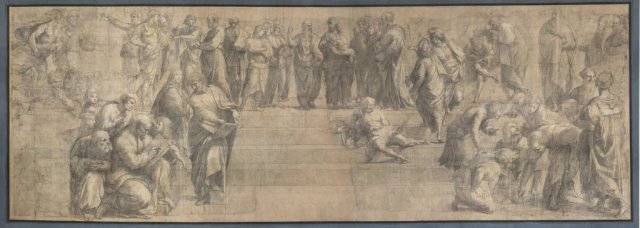
raphael cartoon

The preparatory cartoon for Raphael’s fresco “The School of Athens,” a full-scale drawing used to transfer the image to a wall in the Vatican, has undergone a four-year restoration. Credit Veneranda Biblioteca Ambrosiana, via Mondadori Portfolio.

The article is about Raphael’s preparatory cartoon for his fresco “The School of Athens” in the Vatican. What caught my eye in particular was mention of the method used to transfer the image to the walls.

Its value must have been evident to Raphael’s contemporaries, and rather than use the cartoon itself for the fresco, a copy was used and the original was preserved. That copy was destroyed through use when the outlines of the figures and details were pricked with pins, and the cartoon was dabbed with a cloth bag containing charcoal powder to transfer the image to the walls.

(Elisabetta Povoledo, “How Did Raphael Do It? To Find Out, Get Up Close,” NYTimes, 3-26-19)

(c) 2019 JMN.

Posted in Anthology, Quotations | Tagged | Leave a comment

Scott Walker (1943-2019)

scott walker

Mr. Walker performing on television in an undated photo. After leaving the Walker Brothers in 1967, he began a solo career that became a rejection of his rock-star phase, eventually retreating into the studio to create avant-garde music that was hard to categorize. Credit David Redfern/Redferns.

As a latecomer to Scott Walker’s music I’ve only scratched its surface. The admiration other artists have expressed for his solo work makes me want to hear more. I want to appreciate the zone of listening that stretches from the incomprehensible vocal painting embraced by David Bowie to the synesthesia imparting neither comfort nor ease celebrated by Einear McBride.

“I like the way he can paint a picture with what he says… I had no idea what he was singing about. And I didn’t care.” [David Bowie, 2007]

“I have a very nightmarish imagination… I’ve had bad dreams all my life. Everything in my life is big, it’s out of proportion.” [Scott Walker]

“… He is doing the most conventional pop music I ever heard. He is just doing it as if he was observing it from outer space and then trying to tell you what he saw as an alien.” [Howard Kaylan, founding member of The Turtles]

“Walker’s work, as [James] Joyce’s before it, is a complex synesthesia of thought, feeling, the doings of the physical world and the weight of foreign objects slowly ground together down into diamond… This is not art for the passive. It does not impart comfort or ease.” [Eimear McBride, Irish novelist]

(Richard Sandomir, “Scott Walker, Pop Singer Who Turned Experimental, Dies at 76,” NYTimes,
3-26-19)

(c) 2019 JMN.

Posted in Quotations | Tagged , | Leave a comment

Van Gogh in London

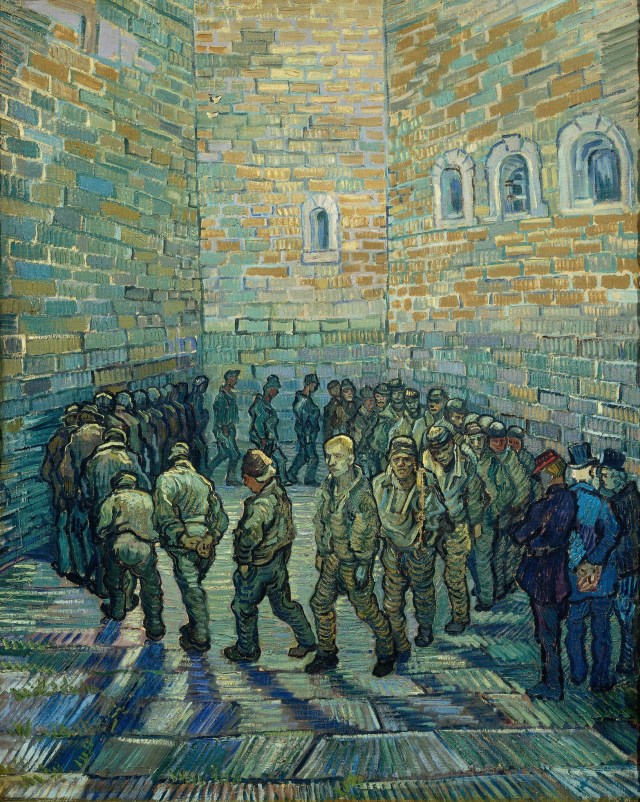
van gogh prisoners exercising

Van Gogh’s “Prisoners Exercising” from 1890 is based on an engraving of inmates in Newgate Prison in London by Gustave Doré. Van Gogh painted the work while being treated for mental illness in Saint-Rémy, France. Credit The Pushkin State Museum of Fine Arts, Moscow.

A new exhibition at Tate Britain, “Van Gogh and Britain,” opens March 27, 2019. This article causes me to think somewhat differently about van Gogh. Of several good illustrations it contains, I chose the painting reproduced here because I’ve never seen it, and it’s unlike much of his work that I have seen.

“Looking at his work through his relationship with Britain brings into the foreground his amazing intellectual curiosity,” said Carol Jacobi, the lead curator of the show.

“He read very widely: literature as well as popular science. If you carefully study his work, the image arises of a man who carefully thinks about his works and prepares.” [Sjraar van Heugten, van Gogh art historian]

“Things are going well for me here,” [van Gogh] wrote to Theo from London in January 1874. “I have a wonderful home and it’s a great pleasure for me to observe London and the English way of life and the English themselves, and I also have nature and art and poetry, and if that isn’t enough, what is?”

(Nina Siegal, “Van Gogh the Wild Man? Try Van Gogh the Suburban Professional,” NYTimes, 3- 26-19)

(c) 2019 JMN.

Posted in Anthology, Quotations | Tagged | 2 Comments

To ‘E’ or Not to ‘E’

punctuation colorful BBC

BBC.

A silly title, yes.

I get pleasure from reflecting on minutiae of language — syntax, spelling, grammar, etymology, what have you. Language is part of “what makes us us,” to borrow Jacinda Ardern’s clarion phrase. It’s worth talking about. If I question a particular usage, it’s in a spirit of friendly inquiry, not derision.

Nevertheless, against all odds, the real heart of a college education — the bond borne of shared intellectual exploration between teachers and curious students, between curious students and each other — remains intact, if only in pockets of campus life, at every state university I know.

(Margaret Renkl, “Let’s Hear It for State U.,” NYTimes, 3-25-19)

“Born” instead of “borne,” perhaps?

If I had the pleasure of meeting Margaret Renkl, a distinguished columnist whose work I read frequently, I would simply thank her (or her editor) for the opportunity to ponder a possible slip that’s inspiringly minute.

(c) 2019 JMN.

Posted in Commentary, Quotations | Tagged | Leave a comment

“You Invent Your Own Game”

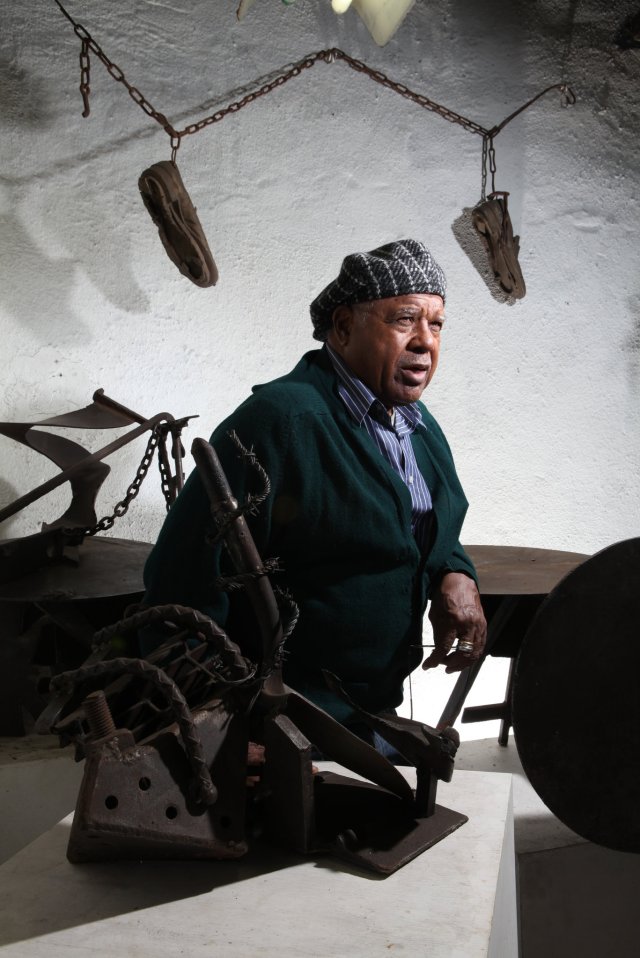
melvin edwards

The sculptor Melvin Edwards at his studio in Plainfield, N.J., with “Nigba Lailai (The Past),” from 1979. Credit Melvin Edwards/Artists Rights Society (ARS), New York; Chester Higgins Jr./The New York Times.

Older artists profiled in this article are achieving belated critical and financial success after laboring in obscurity for much of their careers. In her title the author makes the artists’ ethnicity explicit, providing good context for the categorization, and it’s enough
said. Many don’t wish their art to be filtered through “the lens of identity.”

lorraine ogrady

“Lorraine O’Grady: Cutting Out CONYT,” was an exhibition of her work using cut-out type from The New York Times. Credit Lorraine O’Grady/Artists Rights Society (ARS), New York; via Alexander Gray Associates.

Artists mentioned are: McArthur Binion, Howardena Pindell, Melvin Edwards, Lorraine O’Grady, Frank Bowling, Sam Gilliam, Barkley Hendricks, Jack Whitten, Mark Bradford, Charles Gaines, William T. Williams, Barbara Chase-Riboud, and Kerry James Marshall.

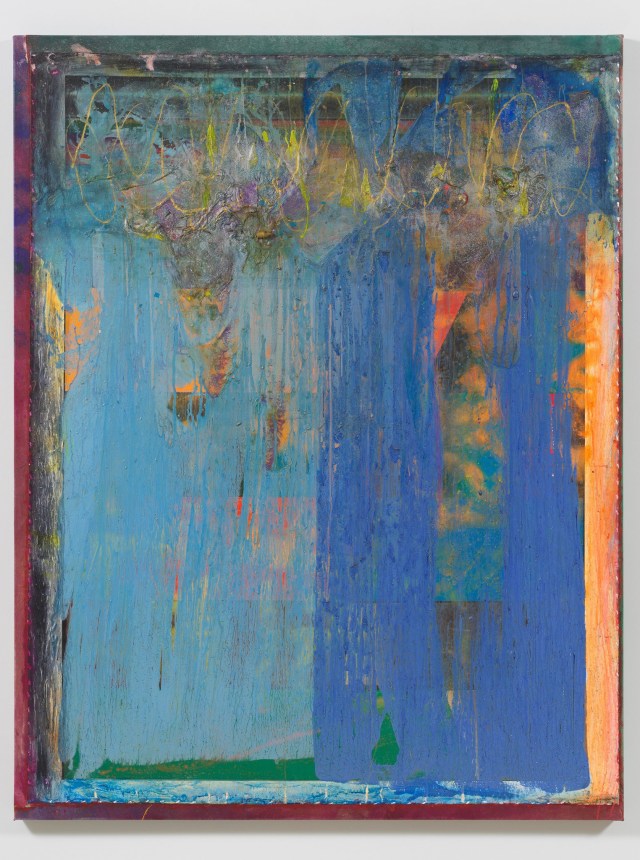
frank bowling two blues

Last year Frank Bowling, 85, created “Two Blues,” acrylic and mixed media on collaged and printed canvas. Credit Frank Bowling/Artists Rights Society (ARS), New York; DACS, London; via Alexander Gray Associates; Hales Gallery.

I particularly savored Melvin Edwards’s pithy remarks:

“You invent your own game — and then you push it forward,” said Mr. Edwards, who taught at Rutgers for 30 years. “It’s about time the art world caught up.”

He is philosophical about all the new attention.

“Some is serious, some is fickle and some is not at all positive — you just have to find your way through it,” he said.

(Hilarie M. Sheets, “Discovered After 70, Black Artists Find Success, Too, Has Its Price,” NYTimes, 3-23-19)

(c) 2019 JMN.

Posted in Anthology, Quotations | Tagged , , | 1 Comment

W. S. Merwin (1927-2019)

ws merwin in trees

W.S. Merwin at the Merwin Conservancy on the northeast coast of Maui in 2010. Credit Tom Sewell for The New York Times.

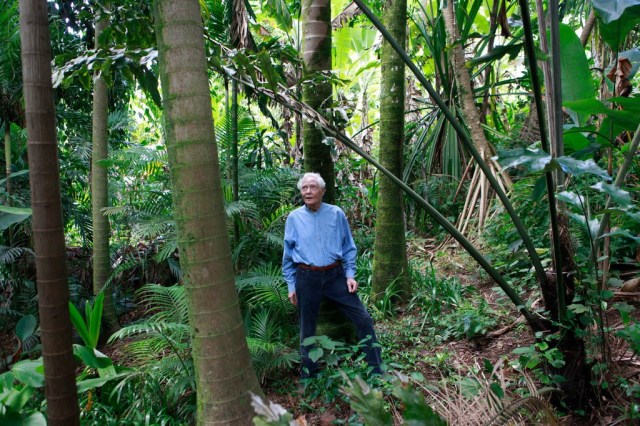
This tribute to W. S. Merwin is by Dr. A. Hope Jahren, a geobiologist who is author of the memoir “Lab Girl” and a professor at the University of Oslo. My own experience of Merwin has been mostly through his elegant work as a translator.

“On the last day of the world, I would want to plant a tree,” is an oft-quoted line from Mr. Merwin’s poem, “Place.”

Mr. Merwin, who died last week at age 91, and his wife Paula, transformed the [Peahi Valley on Maui]. They built the Merwin Conservancy: 19 protected acres, an island within an island. The land was a dumping ground in 1977, little more than a rash of grassy boils festering in the exhausted soil. That same year, Mr. Merwin planted a sapling in the blight, then got up the next day and planted another one. The day after he did the same, and the day after that also. His trees made soil, and the soil made more trees. He planted a tree every day on that land for years, until his friends took over the planting under his direction.

(A. Hope Jahren, “The Poet Who Planted Trees,” NYTimes, 3-19-19)

(c) 2019 JMN.

Posted in Anthology, Quotations | Tagged , | 4 Comments

“Aroha, Manaakitanga”

exclamation-mark

Masha Gessen’s article is unusually affecting for me at a time when I feel enervated by tinyness in my own country. The article is a sensible and sensitive appreciation of conduct that betokens great — I would say towering — stature on the part of New Zealand’s leader. I’m having trouble not quoting more passages from it, but as usual I try to focus here on language and its power — “all that makes us us.”

Addressing the families of the victims, [Jacinda Ardern] said, “We cannot know your grief, but we can walk with you at every stage. We can and we will surround you with aroha, manaakitanga, and all that makes us us.” She used Maori words that mean kindness, compassion, generosity… It was the absence that was notable in Ardern’s speech: the absence of a rhetorical pivot from “us” to “them,” the enemy.

(Masha Gessen, “Jacinda Ardern Has Rewritten the Script for How a Nation Grieves After a Terrorist Attack,” The New Yorker, 3-22-19)

(c) 2019 JMN.

Posted in Anthology, Quotations | Tagged | 1 Comment