“Ars longa, vittles brevis”

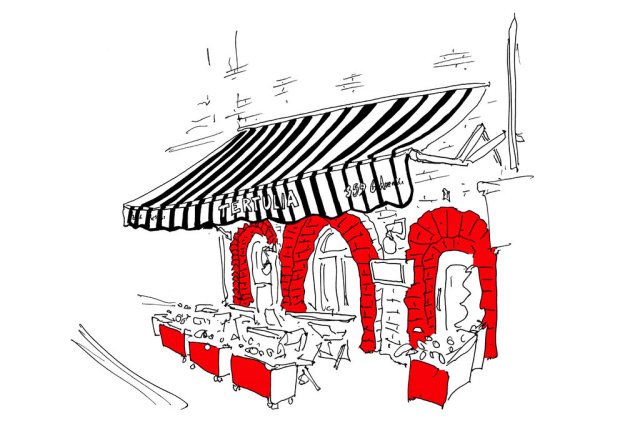
nyrestaurants 1

John Donohue.


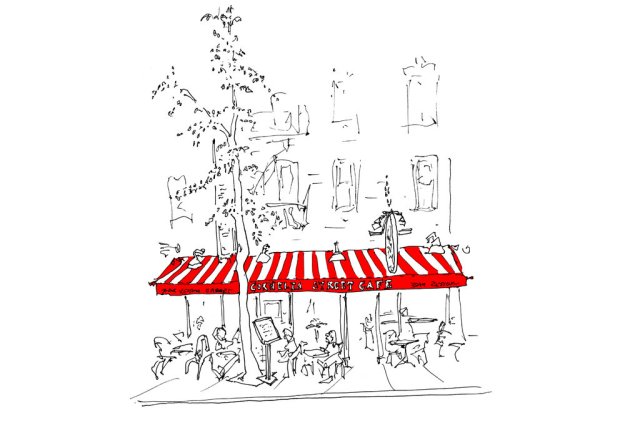
“My goal is to keep drawing forever, to get to all the restaurants in New York,” [John Donohue] said. It’s a silly goal, perhaps, but what goal isn’t? It’s cheap, it gets him outside (as opposed to eating in restaurants, which is expensive and mostly indoors) and provides one way of knowing this unknowable city.

nyrestaurants 2

John Donohue.

And as the restaurants come and go, even the most fleeting pen lines linger as proof of what once existed. As Hippocrates said, ars longa, vittles brevis.

John Leland, “He Wants to Draw All the Restaurants in New York City,” NYTimes, 3-22-19)

(c) 2019 JMN.

Posted in Anthology, Quotations | Tagged , | Leave a comment

Trompe L’oeil

“Painting objects and people as they actually appear….” (Andrew Ferren, “A 7-Hour, 6-Mile, Round-the-Museum Tour of the Prado,” NYTimes, 3-18-19) The phrase encapsulates my former goal: To paint something accurately, yet somehow enhanced: A simplistic, naive and ambiguous goal all … Continue reading

More Galleries | Tagged | Leave a comment

Embrace-Aversive

andy warhol mustard race riot

A detail of “Mustard Race Riot,” … Credit The Andy Warhol Foundation for the Visual Arts, Inc./Artists Rights Society (ARS), New York; Rebecca Smeyne for The New York Times.

Do I love this painting? Love is not a word I would use to describe my regard for Warhol, which is high. He and his art are too trouble-makingly elusive and embrace-aversive for that. But this is true of some of the best history painters over the centuries — Goya, Géricault, Turner — and a history painter is what Warhol is. It’s a tough job, but every era in every culture needs someone to do it.

(Holland Cotter, “Warhol at the Whitney: Why This One Work Is So Stirring,” NYTimes, 3-21- 19)

(c) 2019 JMN.

Posted in Anthology, Quotations | Tagged , | 4 Comments

How Things Actually Appear

Prado

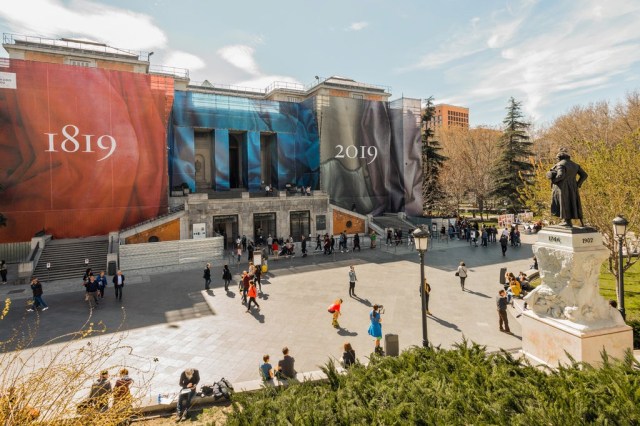
The stately neoclassical building that houses the Prado will be unwrapped later this year. Credit Emilio Parra Doiztua for The New York Times.

Artists of the Spanish “golden age” in the 17th century seemed to delight in manipulating paint on the canvas to create dazzlingly realistic effects, such as the light shimmering on silk gowns in Velázquez’s “Las Meninas,” or the churning clouds in the apricot-and-lavender skies of El Greco. Spanish ‘naturalism’ — painting objects and people as they actually appear [my emphasis] — can have a deeper emotional impact, as seen in the candor and humanity of Velázquez’s portraits of buffoons….

(Andrew Ferren, “A 7-Hour, 6-Mile, Round-the-Museum Tour of the Prado,” NYTimes, 3-18-19)

How things “actually appear” is elusive. I don’t see correctly. My sketches for painting are labored, with much overriding of mistaken perception. The painting phase involves much mixing and discarding of pigment that looked right until it touched the canvas. I don’t want to paint this way, but I have to.

It’s not just me. Our brains foist perceptual baggage onto us. Some people overcome the handicap. Most art I admire goes beyond naturalism. It lights me up with a devil-may-care attitude. I like to imagine that even a so-called realistic painting is really an infinitude of tiny abstractions rendered and assembled just so.

(c) 2019 JMN.

Posted in Anthology, Commentary | Tagged | 1 Comment

“That’s not quite right”: Sociodicy

Nicholas Christakis

“The bright side has been denied the attention it deserves,” writes Nicholas Christakis. Credit Demetrius Freeman for The New York Times.

How a target of students’ ire came to write a book about humanity’s transcendent goodness.

To accept this belief that human beings are evil or violent or selfish or overly tribal is a kind of moral and intellectual laziness,” [Nicholas Christakis] told me. It also excuses that destructiveness. “The way to repair our torn social fabric is to say: Wait a minute, that’s not quite right.”

He mentioned theodicy, which endeavors to vindicate God’s existence despite so much suffering. “Blueprint [Christakis’s new book],” he said, is sociodicy: It tries “to vindicate society despites its failures.”

(Frank Bruni, “A ‘Disgusting’ Yale Professor Moves On,” NYTimes, 3-19-19)

(“After the din died down,” Yale awarded Christakis the Sterling Professorship, the school’s highest faculty honor.)

(c) 2019 JMN.

Posted in Anthology, Quotations | Tagged | Leave a comment

“Something You Did in Latin”

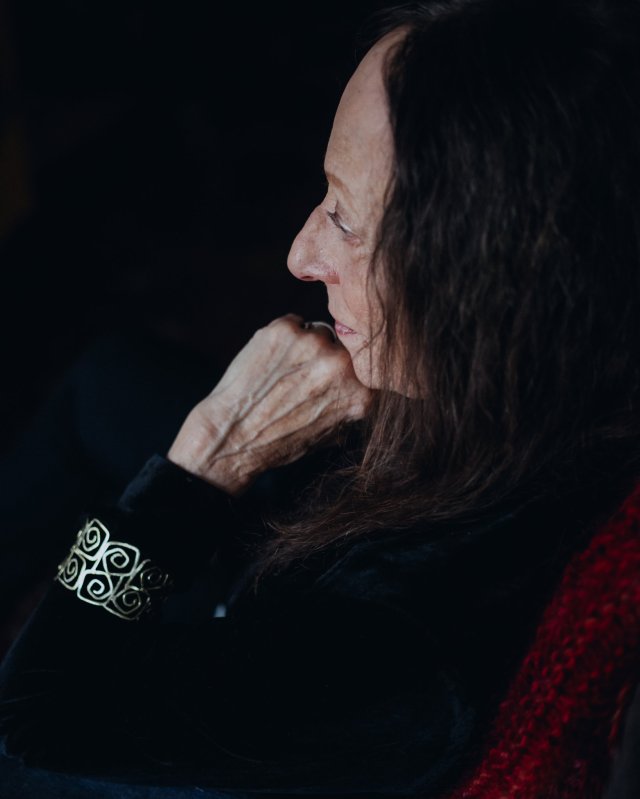
Carol Gilligan

Sasha Arutyunova for The New York Times.

Carol Gilligan is the author of “In a Different Voice: Psychological Theory and Women’s Development,” published in 1982. The widely disseminated book “made her an academic celebrity.” She and Naomi Snider have recently co-authored “Why Does Patriarchy Persist?” The quotations are from an article about a talk Gilligan and Snider gave at the Strand bookstore in New York City on January 31, 2019.

While other academics and conservative thinkers were tying themselves in knots over Dr. Gilligan’s work, Harvard anointed her as its first gender studies professor. “When I got there,” she said, “I thought gender was something you did in Latin.”

At the Strand event, the last question of the evening came from a teenage girl. What advice would Dr. Gilligan give to young girls who want to resist or protest, she said, “but don’t want to be labeled ‘nasty or angry women?’”
“Well, you are going to be labeled,” was Dr. Gilligan’s answer. “The question is, ‘What is your response?’”

(Penelope Green, “Carefully Smash the Patriarchy,” NYTimes, 3-18-19)

(c) 2019 JMN.

Posted in Anthology, Quotations | Tagged | Leave a comment

Overseas Research

There’s a fun flub in the paragraph quoted below. A spellchecker would not have caught it, of course. Syntax-monitoring software might have. I’m not sure software that capable exists, however. It’s a reminder that good journalism is produced by humans. To err is human….

Where does this go? Leaders across the region are learning that they “can’t rely on 20th-century tools to keep the populations quiet any longer,” remarked Marwan Muasher, the former foreign minister of Jordan, who now overseas research on the Middle East at the Carnegie Endowment for International Peace. The Arab Spring uprisings in 2011 “broke the fear taboo in many Arab countries, and the collapse in oil prices since 2014 has broken the money bargain.” Citizens now declare: If you can’t guarantee me a government job, I get to say whatever I want.

(Thomas L. Friedman, “Beware the Mideast’s Falling Pillars,” NYTimes, 3-19-19)

(c) 2019 JMN.

Posted in Quotations | Tagged | 1 Comment

Vivian Browne

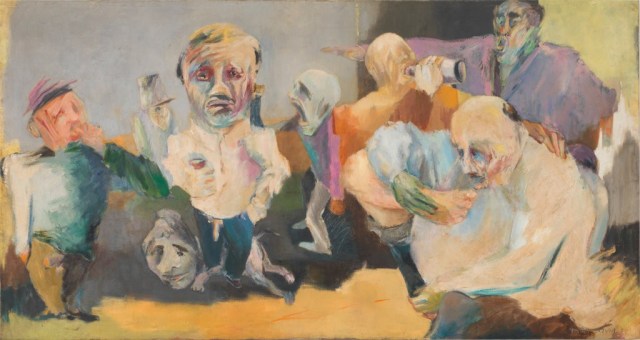
vivian browne little men

“Seven Deadly Sins” (circa 1968), the pièce de résistance of Vivian Browne’s show at Ryan Lee. Credit via Ryan Lee Gallery and Adobe Krow Archives.

In 1965, the artist, educator, and activist Vivian Browne (1929-1993) began a series titled Little Men. Considered her first major body of work, it consists of oil and acrylic paintings of white-collar middle-aged white men… They’re dressed in button-down shirts and ties, but they don’t act professionally; instead the men suck their fingers, touch themselves, dance and wail… She saw firsthand how such white men were powerful, common and utterly unexceptional. She knew they represented a societal problem beyond themselves. And she took up parody and painting to give it a form.

(Jillian Steinhauer, “New York Galleries: What to See Right Now [‘Vivian Browne’],” NYTimes, 3-14-19)

On the verge of posting this look at an appreciation of Vivian Browne’s work, I felt I should give Ms. Steinhauer’s commentary more air because something was bothering me. Here’s the commentary:

Ms. Browne’s work can look sketch-like, but it is carefully considered. As a member of the Black Emergency Cultural Coalition and the black women artists’ collective Where We At, she saw firsthand how such white men were powerful, common and utterly unexceptional. She knew they represented a societal problem beyond themselves. And she took up parody and painting to give it a form. It’s remarkable just how current this 50-year-old series feels today, as we continue to contend with “little men” who insist loudly that they are big.

Stylistically, I would have avoided using the term “pièce de résistance” (see caption above). It exudes an effete vibe, in my view, but that’s trivial. As to what Ms. Browne “saw firsthand,” what she “knew,” and why “she took up parody and painting,” I would like to have heard more of Ms. Browne’s own words in the matter.

But I agree that we white men are a huge problem in the world.

(c) 2019 JMN.
Posted in Anthology, Commentary, Quotations | Tagged , | Leave a comment

Yes, It’s in Focus, I Think

korea society

Suh Seung Won’s “Simultaneity 17-601” (2017), an acrylic on canvas. Credit Suh Seung Won.

Suh Seung Won, a pioneer of the process-based Korean painting movement known as Dansaekhwa, or monochrome, started out with hard-edge, translucent rhombuses that evoke unreal architectural spaces. In the large-scale recent canvases comprising most of “Suh Seung Won: Simultaneity” at the Korea Society, those rhombuses have become overlapping bursts of diaphanous yellow and pink. They’re too square to read as clouds, despite the unmistakable glints of blue peeking through, so the mood remains otherworldly.

(Will Heinrich, “The Buddhas, Gods and Emperors of Asia Week New York [‘The Korea Society’],” NYTimes, 3-14-19)

(c) 2019 JMN.

Posted in Commentary, Quotations | Tagged | Leave a comment

“The Birth of the World”

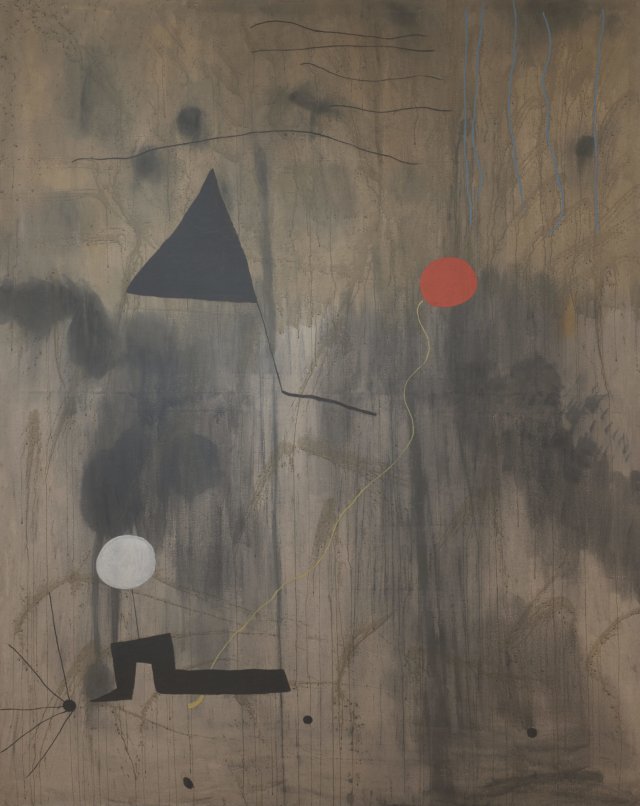
birth of the world by miro

Miró’s “The Birth of the World,” from 1925. Credit Successió Miró/Artists Rights Society (ARS), New York/ADAGP, Paris; The Museum of Modern Art.

The artist André Masson once likened this large (8-by-6½ feet) canvas [“The Birth of the World” by Joan Miró] in its radicalness to Picasso’s “Les Demoiselles d’Avignon” of 1907. It is still startling that the two are only 18 years apart. But while “Demoiselles” enabled Cubism, which spread through Europe and beyond in a matter of years, “The Birth of the World” went almost immediately underground; it was too far ahead of its time to have an immediate effect. Its thin veils, splatters and rivulets of gray, ocher and blue wash and horizon-free space would find little echo outside of Miró’s work until around 1950, with the pouring techniques of Jackson Pollock and Helen Frankenthaler.

(Roberta Smith, “Miró’s Greatness? It Was There From the Start,” NYTimes, 3-14-19)

(c) 2019 JMN.

Posted in Anthology, Quotations | Tagged | Leave a comment