1987: Andrew

Andy1

Andy1

[Dear Mother,]

E*** was with Andrew at Albertson’s the other day and told me that every time they announced some instore special over the intercom Andrew would holler, “OK!” She looked at him and said, “They’re not talking to you, baby!” She said his expression seemed to say, “How could they possibly not be talking to me?”

When you address him saying, “Andrew!” He almost infallibly answers, “Yes?” Here’s a little ritual dialogue that we’re all playing on him these days. He rises to the bait almost every time:

“Andrew!”
“Yes?”
“Do you need a kiss?”
“No!”
“Andrew!”
“Yes?”
“Do you need a hug?”
“No!”
“Andrew!”
“Yes?”
“What DO you need?”

The answer here varies. It usually ends with him getting hugged and kissed and tickled.

His cussword is “dummy!” He hurls the epithet with such vigor it sounds like “dammit!” E*** sometimes loses patience when she’s been called “dummy!” a dozen times and pops him on the butt. He succumbs to a tragic fit of tears for about 30 seconds, then miraculously pulls himself together and presses on to chase the cat or browse in the garbage can.

(c) 2018 JMN.

Posted in Anthology | Tagged | Leave a comment

1987: High-Tech Verse and Allergies

img_0245

[Dear Mother,]

Charles B*** asked me to co-edit an anthology of high-tech verse which he has been commissioned to do by his publisher…. I’ve thought fairly seriously about it, but am thinking of passing it up in favor of things more computer-oriented, just to economize effort. It’s tempting to be drawn into something “literary” again, but doing so is usually the equivalent of working for free, and that’s no longer attractive.

Our general health is mediocre; everyone wakes up and hawks sputum for the first hour. It seems to be a Victoria-wide phenomenon; our air is loaded with dirt and pollen, which induces chronic reactions on the part of the respiratory system, which in turn causes everyone to strangle in phlegm. Sore throat for weeks on end goes with it all. Contrary to what the Chamber of Commerce may trumpet, this is emphatically not God’s country. Several doctors have said we’re the allergy capital of the country. We had occasion to take Andrew to Bobby O*** several weeks ago; he was covering for McC***, who has a large cattle operation and was out of town selling prize bulls somewhere. I graduated from high school with O*** and remember him at least from Crain. We still don’t have a satisfactory physician. McC*** is arrogant and moody. E*** has said several times that it tires and unnerves her to be exposed to his alternations of mood.

(c) 2018 JMN.

Posted in Anthology | Tagged | Leave a comment

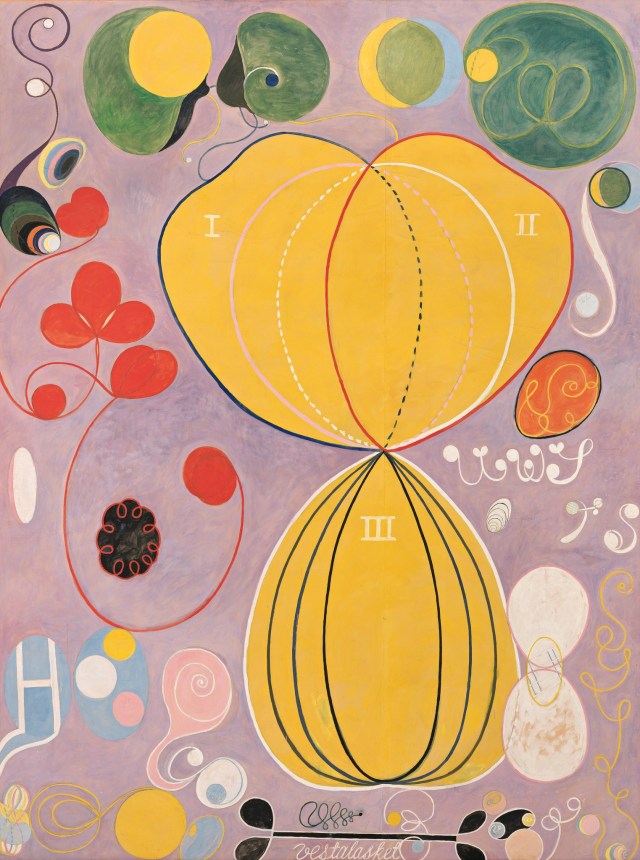
Hilma af Klint (1862-1944)

Hilma af Klint

“The Ten Largest, No. 7, Adulthood” (1907). Credit The Hilma af Klint Foundation, Stockholm.

The idea that a woman got there first, and with such style, is beyond thrilling. Yes, I know art is not a competition; every artist’s “there” is a different place. Abstraction is a pre-existing condition, found in all cultures. But still: af Klint’s “there” seems so radical, so unlike anything else going on at the time. Her paintings definitively explode the notion of modernist abstraction as a male project. Despite several decades during which modernism’s history has been expanded and diversified, there is something towering about the emergence of af Klint, which really began in earnest in the 1980s. (She knew she was ahead of her time, and stipulated that her work not be exhibited until 20 years after her death — but it took even longer.)

(Roberta Smith, “‘Hilma Who?’ No More,” NYTimes, 10-12-18)

(c) 2018 JMN.

Posted in Quotations | Tagged | Leave a comment

“Whereabouts”

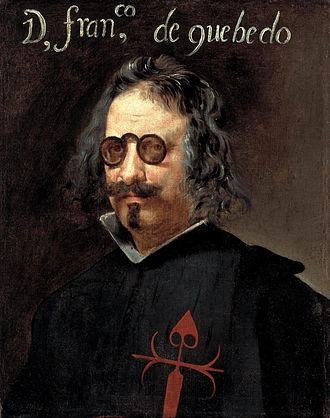
Francisco Gómez de Quevedo y Santibáñez Villegas, Juan van der Hamen, 17th century (Instituto Valencia de Don Juan)

Francisco Gómez de Quevedo y Santibáñez Villegas, Juan van der Hamen, 17th century (Instituto Valencia de Don Juan)

Quite a few readers wrote to us last week to take issue with this sentence at the end of a briefing: “His whereabouts is unknown.”

Surely, they wrote, it should be “whereabouts are.”

Well, yes and no.

Times editors consult an in-house style guide for grammar and spelling questions like this. And the entry for “whereabouts” tells us to “construe it as a singular.”

But why?

While “whereabouts” is commonly used as a noun, it began as an adverb (“Whereabouts are you from?”). That means the “s” at the end is an adverbial suffix — think of “always” or “besides” — and not an indicator of a plural noun.

Historically, “whereabouts” has been considered both singular and plural when used as a noun, though in recent years the plural has been winning out.

Philip Corbett, our top editor for standards, said that in cases of two acceptable usages, the Times stylebook often specifies one, and sometimes the more traditional one.

“At some point,” he said, “we may have to consider whether to change our stylebook guidance, if only to avoid distracting readers who may believe that the singular usage is wrong.”

(Jennifer Jett, “…Back Story,” NYTimes, 10-12-18)

(c) 2018 JMN.

Posted in Anthology, Quotations | Tagged | Leave a comment

1987: Coping with Technicalese

[Dear Mother,]

I’ve spent the afternoon coping with IBM technicalese in the form of new product announcements… Here’s the block of turgid prose for your enjoyment:

Highlights

Allows IBM Personal System/2, attached to a Local Area Network to communicate with Asynchronous Host Computers, including the IBM PC-RT, other Asynchronous Devices, and transfer files with off NET connected IBM Personal System/2. IBM 3101, 3162, 3163, 3164 Asynchronous Terminals, other Asynchronous Terminals and IBM Personal Computers/System/2, communications adapter connected, can communicate with Asynchronous Hosts, other Asynchronous Devices, and IBM 7171s for Protocol Conversion for access to IBM Hosts. Local Area Network attached or Communication Adapter connected terminals can use the modem resource sharing capability of the Server to dial off-network to Asynchronous Devices, including Information Providers.

The product “highlighted” falls under the computer category of “Communications,” or computers talking to each other. Although for the layman they may be bewildering, it’s not the technical terms themselves that muddy this kind of writing, it’s the basics of writing itself: punctuation, word order, noun-modifier relationships, clause structure, coordination and subordination, etc. Although it’s not apparent here, the industry “literature” also commits egregious abuse of acronyms. One that comes to mind is “RAS,” for “Reliability, Availability and Serviceability.” How’s your RAS? One of the market channels is through VARS and VADS (Value Added Retailers, Value Added Dealers). And so on and so on. I have to fight the urge from time to time to do a heavy-handed parody of the phenomenon. It’s a pleasant way to waste some time. I’ll end here to get back to reading Product Announcements.

(c) 2018 JMN.

Posted in Anthology | Leave a comment

1987: “A Fable”

For C*** and H***

Bamboo blinds gentle the noonday, coastal sun. A Gulf breeze licks the south-east corner of Casa Ramico’s.

I take my usual table, nodding at the busboys who greet me deferentially. Eulalia brings me water and a menu. Her walk reminds me of Johnson grass in April. Her eyes remind me of huisache bloom mirrored in an unrippled tank at sundown on eight sections of Brewster County cattle land.

I order the daily special with onions and iced tea. A plate of hot corn chips and con queso materializes on my table. I reach for a bottle of green salsa redolent with freshly crushed cumin. The salsa has the purposeful kick of a single-shot four-ten. Remembering a field of whitewing near Crystal City a few years back, I irrigate the con queso with several generous squeezes of the salsa bottle.

Eulalia brings me sun-brewed tea with a wedge of lemon grown west of Mercedes. I tear the end off a pink envelope and sprinkle a powder of aspartame over the distilled ice cubes.

The speakers vibrate softly with the strains of a nortena. I take a deep draught of tangy tea and wink at Ramiro when he peers merrily from the kitchen. I know his abuelita is pounding the corn for my taco tortilla in the ancient family molcajete.

Three draughts later my special arrives. I knife a dollop of Country Crock onto a flour tortilla. I roll the tortilla into a tight cylinder, angling one end skyward, and dredge a load of refried beans onto the opposite tip. Chewing with closed eyes, I remember what Papa wrote while fishing off the Havana coast: “It was good.”

I turn to the enchilada swimming in a pool of homemade chili. Forked, it extrudes a golden lava of Longhorn cheese. I half it in three bites. Bedded on a mound of Spanish rice, the taco is a cornucopia of grass-fed beef and garden tomatoes. I spoon guacamole into the taco’s cleft. As it cracks between my teeth, a fallout of hand-picked lettuce hits the rice. The steamy revel of Toltec chilis and fresh coriander reminds me of the wetbacks who fried prickly pear over an open fire on Granddaddy’s ranch while I played mumbledypeg as a boy.

Eulalia comes to refresh my tea.

“You know what? I say, “It doesn’t get any better than this.”

The truth hits home. Eulalia’s eyes glisten for a moment.

“No, Ernesto, it doesn’t.”

(c) 2018 JMN.
Posted in Anthology | Leave a comment

1987: Twain: Tells a Lot

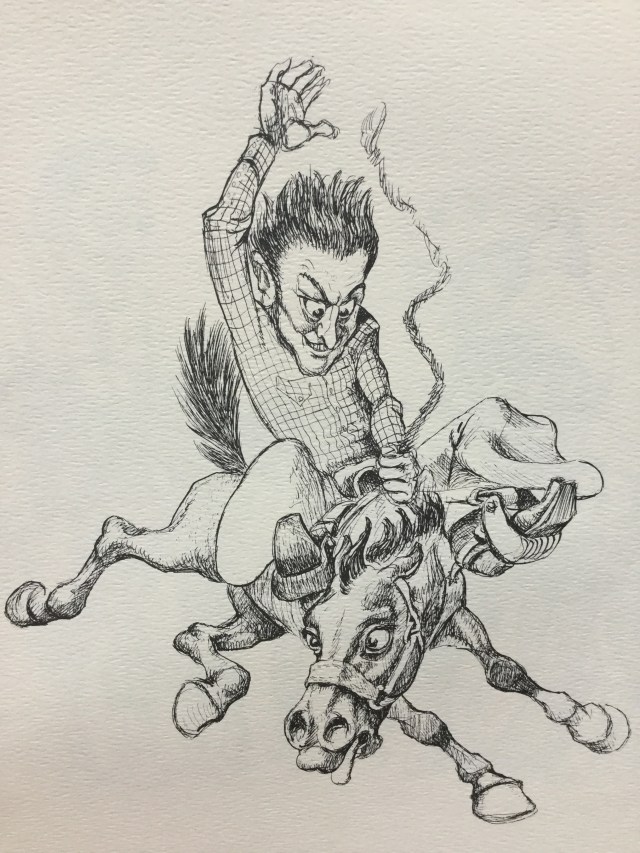
Mark Twain. HJN, drawing.

Mark Twain. HJN, drawing.

[Dear Mother,]

Another anecdote that tells a lot about the man is when he was allowed, with great reluctance on Clara’s part [one of Twain’s daughters], to attend a recital that she did manage to give. He was placed on the third row and ordered not to call attention to himself. When the recital was over he got on stage and gave a 20-minute speech. The next day, 75 of the 80 lines that the local newspaper devoted to Clara’s recital dealt with Mark Twain’s speech. No wonder he made the girls sick.

I hope you enjoy these snippets as much as I do. I guess sometimes sharing your readings is as dangerous as sharing your dreams. Have you ever been that interested in other people’s accounts of their dreams? I rarely have, unless it’s swapping common dreams, in which case you are trading information with someone else about your own dream life. To me the saddest and most incriminating side of Clemens’s behavior was toward Jean, the younger, epileptic daughter. She understood him and loved him more than Clara, but he relegated her to the margins of his life and couldn’t shoulder any real responsibility for her nor confront the implications of her illness. She was the only one of the women, apparently, with a real illness, yet comes across as the least morbid and hypochondriacal of them.

(c) 2018 JMN.

Posted in Anthology | Tagged | 4 Comments

Barbara Kingsolver

Barbara Kingsolver

Barbara Kingsolver at home in Virginia. Photograph: Jessica Tezak for the Guardian.

“I’m in a really unusual position,” she says, “because I work as a literary writer. I work at the level of the sentence, at the level of the image, the metaphor, the theme, but I also have this commitment to accessibility, which I suppose comes from the fact I grew up here. It’s the same reason I sent my kids to public schools: I want to belong to people. I don’t want to be above them. So I would really like anyone who can read to be able to read my novels and I would like to give them a reason to turn every page.”

(Lidija Haas, “Barbara Kingsolver: ‘It feels as though we’re living through the end of the world,’” The Guardian, 10-8-18)

(c) 2018 JMN.

Posted in Quotations | Tagged | 3 Comments

Julia Dixit

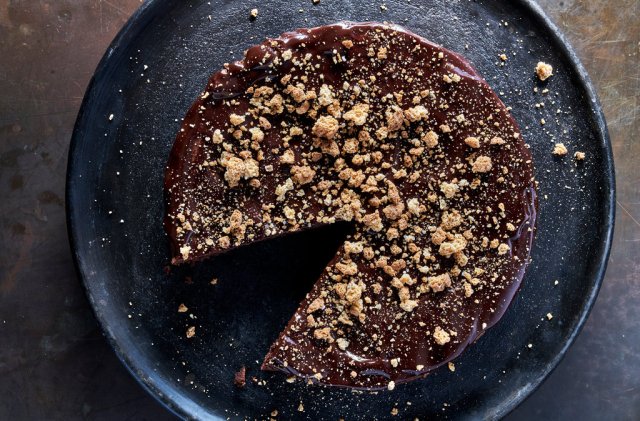
Julia Child cake

It might be mistaken for a brownie, if not for its powerful, sophisticated flavor. Credit Gentl and Hyers for The New York Times. Food stylist: Maggie Ruggiero. Prop stylist: Rebecca Bartoshesky.

Our project must be serious. This is not for fluffies!
— Julia Child

(Dorie Greenspan, “A Cake Fit for Julia Child,” NYTimes, 10-10-18)

(c) 2018 JMN.

Posted in Quotations | Tagged | Leave a comment

“A Weaver Who Changed Art”

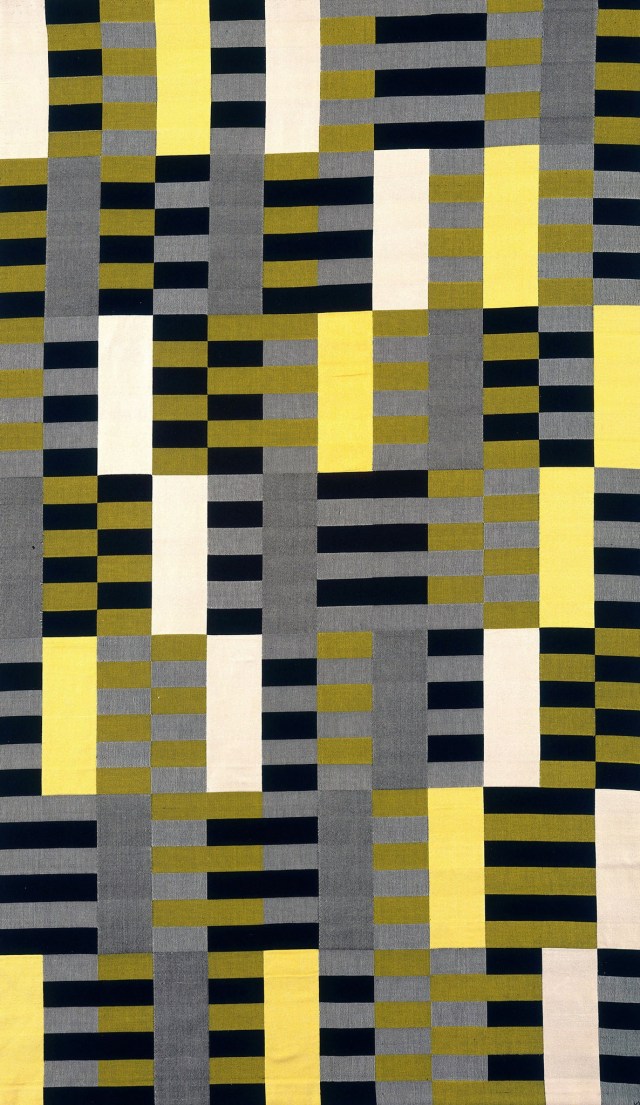
Anni Albers wall hanging

An Anni Albers wall hanging from 1926. Credit2018 The Josef and Anni Albers Foundation/Artists Rights Society (ARS), New York, via DACS, London.

“[Anni Albers] could’ve done painting later on, but she immersed herself in thread: Anni was a great person for working with limitations,” [Nicholas Fox] Weber said. “She used thread to make abstract art. Her best wall hangings from the Bauhaus and the rest of her weaving life are as great, and very similar to, work by Klee or Mondrian. They’re pure abstractions: It’s only the medium that’s different.”

(Farah Nayeri, “At Tate Modern, An Anni Albers Retrospective,” NYTimes, 10-10-18)

(c) 2018 JMN.

Posted in Quotations | Tagged , | Leave a comment