
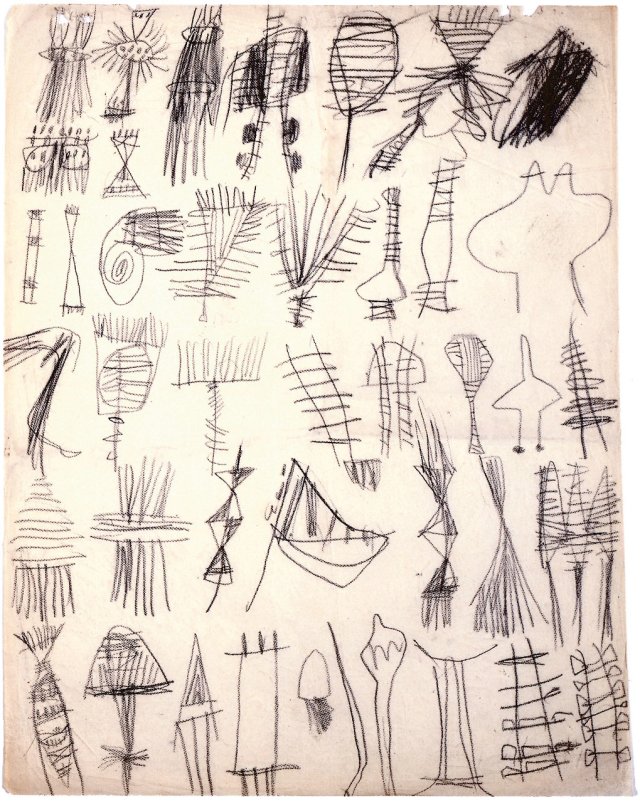
A page from one of Twombly’s North African sketchbooks, a kind of first draft of the artist’s later painting career. Credit Cy Twombly, “Untitled (North African Sketchbook),” 1953, private collection, N.Y., © Cy Twombly Foundation.
Challenged to create work that could travel back to the States, Twombly created a series of wall hangings made from brightly colored fabrics. None of these works survive today, but in pictures of them, it is clear how Twombly is attempting to bring the drawings in his sketchbook to life on the wall. Rauschenberg’s work is messier, more chaotic, his “Scatole Personali” the detritus of a mind in the midst of thought, cluttered with photographs and arranged found objects from ram’s horns to pebbles. Later, in his career-defining “Combines,” which he began constructing in 1954, Rauschenberg would return to this kind of chaos; his works from his time with Twombly are a kind of disheveled, vibrant first draft.
(Tom Delavan, “How an Eight-Month Trip Shifted the Course of Art History,” NYTimes, 10-21-18)
(c) 2018 JMN.





 EthicalDative
Understanding Lyrics
Jakob Dylan, from his Facebook page.
My sister told me I had to listen to “One Headlight” by Jakob Dylan and The Wallflowers. A friend had introduced her to the song. “Before you hear it,” she said, “I just want to say, you’re going to find that the drums are crisp.” She gave plosive emphasis to the ‘p.’
I listened to the song and liked it: a steady, upbeat tempo (crisp), pleasing melody and chorus, a thrilling chord change or modulation midway — however you say it musically — all things I respond to readily as an unschooled listener. The son’s voice reminded me of the father’s. I nodded approvingly when the song finished, thinking of adding it to my pop playlist.
Only then did I reflect that I hadn’t understood a word of the lyrics of this wildly successful song. “Did you understand any of the words?” I asked my sister. “I think I picked up ‘Cinderella,’” she said. That was all, and she had listened to “One Headlight” several times.
I ponder with fascination what seems to be an evolution in pop (and folk) music away from understandable lyrics to ones that are not (for me at least). I can understand the Beatles’s lyrics; can’t understand Robert Plant’s. I can understand Paul Simon’s lyrics; Elton John’s not so much. It’s maddeningly difficult for me to follow what Sarah Jarosz is saying — her words get trapped somewhere in her nasal recesses, falling shy of her tongue, palate and lips; Suzanne Vega is clearer. Listen to “The Wanderer” sung by Dion in the dark ages, then by Status Quo later.
Frankly, the lyrics of a great percentage of pop music simply get past me. One working theory of mine is that instrumentation or accompaniment — call it what you will — simply overwhelms the vocals. It’s largely a matter of volume. The singing is backgrounded, inverting an earlier relationship. Also, singing legibly use to involve a certain exaggerated articulation, unnatural in conversation, whereas many modern artists sing the same as they talk, and sense gets swamped. Idle thoughts.
(c) 2018 JMN.