

The proof that we live in a plutocracy is not that the wealthy get most of the prizes in our society, but that majorities think that is how it should be. (Gary Wills)
[Copyright (c) 2018 James Mansfield Nichols. All rights reserved.]
The proof that we live in a plutocracy is not that the wealthy get most of the prizes in our society, but that majorities think that is how it should be. (Gary Wills)
[Copyright (c) 2018 James Mansfield Nichols. All rights reserved.]
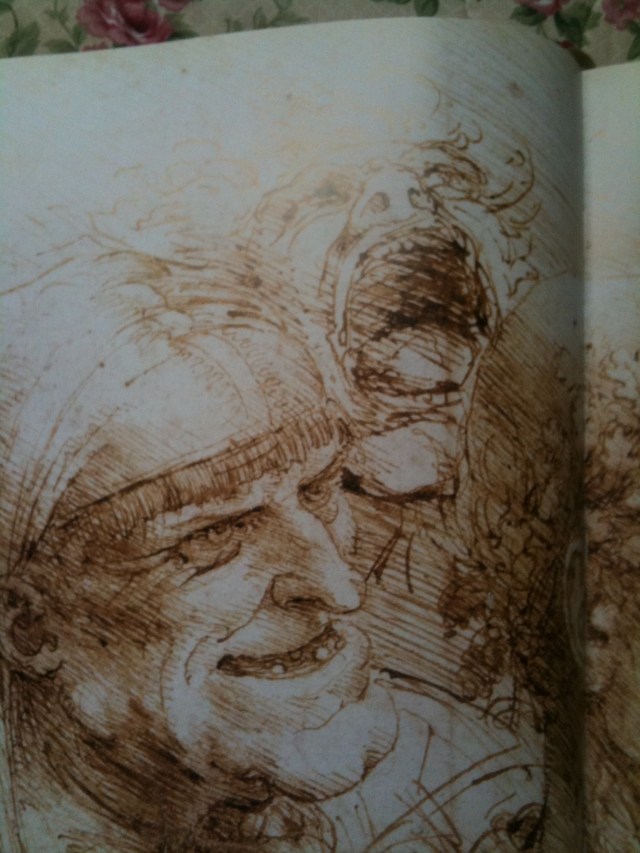
Faces. Leonardo.
[Dear Mother,]
There’s a certain amount of internecine feuding going on at my work, nothing directly involving me. Our two computer salespeople, man and woman, do not get along. Her name is D** and he is C**. D** is something of a feminist, originally from upper New York state, married to a Vistron engineer and with no children. She’s in her mid-thirties. C** is a good ole East Texas boy, very gregarious and personable, a hard worker and effective salesman. Came to us from E** Oil Tools, where he had a distinguished record. Even though I call him a good old boy, C** dresses every bit the IBM style, has silver-gray hair, always looks distinguished. I guess C**’s attitude toward professional women is one shared unconsciously by many Texans in mid-forties: respectful, but a little patronizing. For example, I’ve urged him not to call women colleagues “honey,” “sugar,” “dumpling,” etc., to their faces. D** has been in the computer business for several years, whereas C** came into it new less than a year ago. She’s much more reserved than C**, and derides him as just a “talker,” implying that she has the expertise that he doesn’t. On the other hand, he sold more in the half of 1986 that he was active than she sold in all of 1986. So this has brought tension into the workplace, and has caused D**, in my view, to do some maneuvering designed to thwart C**. She has also managed to irritate N**. P**, our owner, has not responded to the complaints of C** and N** energetically enough to satisfy them. At any rate the level of dissension is so much lower in this company than where I’ve worked previously [U of State-Somewhere] that I’m philosophical about it most of the time. I manage to personally get along most of the time with most of the people, and try not to adopt other peoples’ antagonisms as my own.
[Correspondence, Copyright (c) 2018 James Mansfield Nichols. All rights reserved.]

Jill Lepore, the author of “These Truths: A History of the United States,” outside the Widener Library at Harvard, where she is a professor.Credit Kayana Szymczak for The New York Times.
[Jill Lepore, Harvard professor, has just published “These Truths,” a new history of the United States.]
If “These Truths” ends on a note of “Gibbonesque foreboding,” as she put it, she hopes it will take us out of the frenzy of the present and provide perspective, if not necessarily comfort.
“Yes, the internet is disruptive of democracy, but this has happened before,” she said. “You shouldn’t stop worrying. But here’s a way to be a more informed worrier.”
(Jennifer Schuessler, “Jill Lepore on Writing the Story of America (In 1,000 Pages or Less)” NYTimes, 9-17-18)
[Copyright (c) 2018 James Mansfield Nichols. All rights reserved.)

Mark Twain. HJN, drawing.
[Dear Mother,]
I’ve read about a third or so of Hamlin Hill’s “Mark Twain: God’s Fool.” It’s about the last ten years of his life, based on materials that were not available or publishable when family members were still living. It paints a mixed picture of the man, a number of things not particularly inspiring, as is the case with most mortals, even famous writers. He was a compulsive speculator and was involved in get-rich schemes all his life. He lost a lot of money, but seemed to live well most of his life. The book blurb says Hamlin Hill is a professor of English who has taught at various universities and was educated at the Universities of Houston, Texas, and Chicago. I had not heard of him. To me one of the more dismal features of Twain’s life is the tortured, Victorian family relationship. He had several daughters; one died, and the anniversary of her death was forever after observed; both the wife and the other daughters were “ill” much of the time with what Hill says was the Victorian equivalent of “nerves,” depression, hysteria, hypochondria, etc. Apparently, much of the women’s problem was Twain himself.
Here’s a happier subject: Andrew. I’ve been singing “Baa Baa, Blacksheep” to him for a couple of weeks, and the other evening he sang it back. From the start he listened, and was obviously interested. Then he started saying (or singing) “baa baa sheep.” But the other night I was on the floor with him in the living room; he was playing with something, and almost as an afterthought, he got through it something like this: “baa baa sheep, have you wool, yessir, yessir, thee baa fool.” I just had to hug him to death. He’s been feeling very good and doesn’t seem to be affected by the little allergic conditions that bring him down now and then.
[Correspondence, Copyright (c) 2018 James Mansfield Nichols. All rights reserved.]
![“We_re going to rock rock rock till the broad daylight.” [Photo by Michael Peto from The Guardian]](https://ethicaldative.com/wp-content/uploads/2018/09/e2809cwe_re-going-to-rock-rock-rock-till-the-broad-daylight-e2809d-photo-by-michael-peto-from-the-guardian.jpg?w=640)
“We’re going to rock rock rock till the broad daylight.” [Photo by Michael Peto from The Guardian]
Photographer Michael Peto and writer Anthony Samson visited the cinemas of south London to see what the Rock ‘n’ Roll fuss was all about…
…To the South London teenagers Rock ‘n’ Roll is something quite mysterious, and different from the old jazz. But to the jazz experts its pedigree is dull and not very respectable. Rock ‘n’ Roll, it seems, is a rough mongrel of blues and hill-billy, with some hot-gospelling thrown in. It’s novelty isn’t so much in its beat or tunes, as in the raucous, jungly accompaniment of a honking saxophone and crude guitar-strumming, and a very powerful beat. The result is a naked, aggressive kind of jazz which most jazz pundits despise…
…But in the long, bleak streets of South London, Rock ‘n’ Roll seems suddenly to have touched off frustration and boredom. London is still two cities; and South of the River it seems inconceivable that anyone should not know who Bill Haley is, and what is a “square.”
***A “square” in jazz language is an outsider who doesn’t understand. A “hep-cat” is a jazz fiend. “Dig” means understand; “gone” and “in the groove” mean lost in jazz ecstasy. The words of Rock Around the Clock are reproduced by permission of Edward Kassner Music Co.
Dig That Crazy Jive, Man! by Anthony Sampson was published in the Observer on 16 September 1956.
(Greg Whitmore, “Observer archive – Rock Around the Clock, 16 September 1956,” The Guardian, 9-15-18)
[Copyright (c) 2018 James Mansfield Nichols. All rights reserved.]
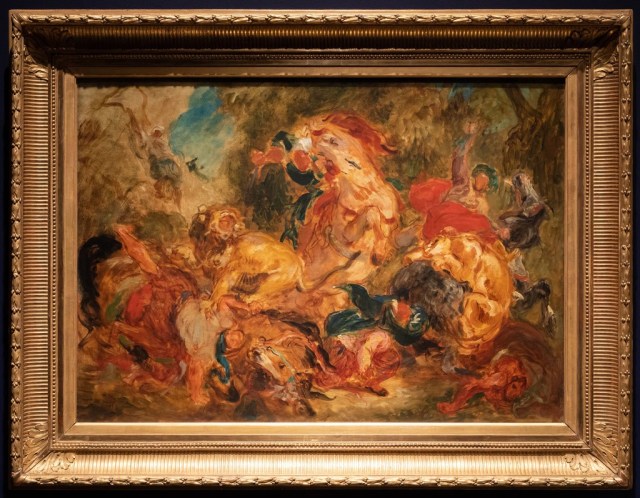
Delacroix’s “Lion Hunt, sketch,” oil on canvas, shows the improvisatory confidence of a de Kooning. Credit Agaton Strom for The New York Times.
“That bastard. He’s really good.” (Picasso to Françoise Gilot, about Delacroix)
“The first merit of painting is to be a feast for the eye.” (Delacroix’s last journal entry, June 1863)
(Quotes from Roberta Smith, “At the Met Museum, the Grand Enigmas of Delacroix,” NYTimes, 9-15-18)

Main image Rei Kawakubo, founder of Comme des Garçons and Dover Street Market. Photograph Paolo Roversi.
[Adrian Joffe, Kawakubo’s husband, acts as interpreter during The Guardian interview, conversing with her in Japanese and relaying her answers to the English journalist. She seems to understand English.]
“She said I should explain to you the amount of work she has to do, the shops she has to design as well as the collections. It never stops,” Joffe says. What elements of the job do you enjoy? She shakes her head on translation. “There is no pleasure in the work,” Joffe tells me. (She always calls it “the work”.) “She says people who say they enjoy the work, she thinks they don’t take it seriously. The only way to hope to make something new is not to be satisfied.” Does she, famously unenthralled by fashion history, ever think about what her legacy will be? They chat for several minutes, then Joffe turns to me and says, “She’s never thought about it. She doesn’t care about or believe in posterity.” She says something in Japanese – the tone is dismissive – and he turns to her and says, in English, “Everybody else thinks about it! You are the only one who doesn’t think about it. That’s why designers make foundations, because they care about history, about what will be their legacy. You are the only one who thinks like this.” She says something else, quieter this time. “She says when she’s not here any more, she doesn’t care if nothing is here any more,” Joffe says with the hint of a sigh. “She is highly unusual.” She looks at me, and smiles.
(Jess Carter-Morley, “A rare interview with Comme Des Garçons designer Rei Kawakubo,” The Guardian, 9-15-18)
[Copyright (c) 2018 James Mansfield Nichols. All rights reserved.]

Adverbs Ahead
The House of Law is built on the sands of Adverbia.
On Friday, Mr. [***] broke in a big way — agreeing to cooperate “fully, truthfully, completely, and forthrightly” regarding “any and all matters” the special counsel, [***], wants him to. (Emphasis added.)
(NYTimes, 9-15 -18)
[Copyright (c) 2018 James Mansfield Nichols. All rights reserved.]
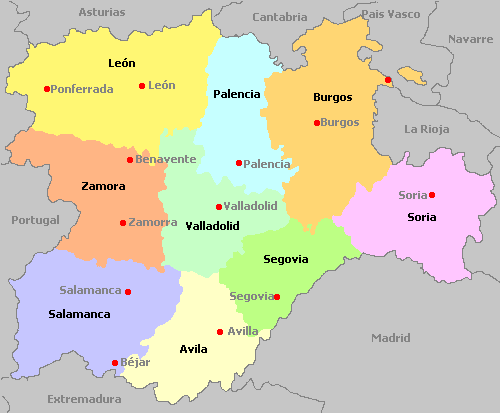
Map of Castile and Leon. wineandvinesearch.com.
“Soria” by Antonio Machado, Spanish Poet, 1875-1939
From “Campos de Castilla,” Antonio Machado, Biblioteca Anaya, 1964. (English translations by James Mansfield Nichols)
Translating into meter is a lost cause, but adding a rhyme scheme escalates it to a punishing lost cause. You’re faced forcefully with using more words in order to say what Machado says, but also with not saying more than he says in the process — not padding with cheesy, “poetic” diction or lexical barnacles — but you gotta fill up that mold you’ve foolishly committed to. You feel like you’re taking greater and greater distance from the original poem, turning a masterful concoction into something puny, a shadow of itself. It’s a diabolical but noble challenge, like the Golden Rule. It drives home how spare and ingenious Machado’s verses are, the amazing music he makes with such simplicity and restraint, the drama in quietness and stillness he lays bare, how it’s all woven together seamlessly with the naturalness of his rhyme and count.
The futility of translating poems is more extreme than even the futility of writing them (“poetry makes nothing happen”). It won’t help ameliorate climate change or keep infrastructure from crumbling — but by Thor’s hammer it ameliorates my distress, and that ain’t nothin’!
By way of preemptive excuse, I say I ought to know more about the intricacies and protocols of scansion in both languages. It would behoove me to read myself into a greater state of informedness on the topic, but I’m too busy blogging to do that.
Spanish Original
[Eight-syllable lines rhyming A-A-B-B-C-C / D-D-E-F-E-F-G-H-G-H / I-J-I-J. Line 13, “que pululan,” with only four syllables is “quebrado” or broken, I think — there is a term of art in Spanish prosody called “pie quebrado” (broken foot) which I’ll have to refresh myself on. It’s undoubtedly intentional on Machado’s part, but it’s a mystery to me what purpose it might serve. It deserves mention that in Spanish the name “Soria” is pronounced with two syllables, the ‘-ia’ being a diphthong. A diphthong is “broken” into two syllables with a written accent mark, as in “fría.”]
¡Soria fría, Soria pura,
cabeza de Extremadura,
con su castillo guerrero
arruinado, sobre el Duero;
con sus murallas roídas
y sus casas denegridas!
¡Muerta ciudad de señores,
soldados o cazadores;
de portales con escudos
de cien linajes hidalgos,
de galgos flacos y agudos,
y de famélicos galgos,
que pululan
por las sórdidas callejas,
y a la medianoche ululan,
cuando graznan las cornejas!
¡Soria fría! La campana
de la Audiencia da la una.
Soria, ciudad castellana
¡tan bella! bajo la luna.
******
“Soria” by Antonio Machado
English Version 1 by JMN
[The literal meaning as best I can interpret it, with no attempt to impose any metric pattern on the translation. English seems to prefer the Portuguese “Douro” for the river. To me “Duero” is more familiar, but whatever. I’m not crazy about “warlike” for “guerrero.” The latter can be “warrior,” too. For a time I wanted to just say “fierce.” The poem paints a decrepit structure made for defense. For me the trickiest area involved the “gentry” (not a word I particularly like here) and the “landed lineages” with their “shields” (or “escutcheons” — I like that word, but it’s too exotic here) etched or chiseled or engraved over their doorways (“portals” is cognate in English but freighted with too much IT baggage). “Señores” could be lords or nobles, but that’s too lofty a rank for this poem. These “señores” were “hidalgos” or “hijos de algo,” sons of something, meaning inherited property owners, petty nobility. In England they were the “landed gentry,” the barons. I took liberty in splitting that term in two to create a “gentry” with “landed lineages.” I haven’t thought of a better way for now. As for the “greyhounds,” a Wiki-dip establishes that the “galgo” is the Spanish greyhound, an ancient breed, related to the English greyhound but different. I didn’t know that. I would prefer just “hound,” which is less evocative of languid, anglophone aristocracy, but for some reason I stuck with “greyhound.”
Soria cold, Soria pure,
head of Extremadura,
with its warlike castle
in ruins, upon the Douro;
with its walls gnawed away [“roer” to gnaw]
and its blackened houses!
Dead city of gentry,
soldiers or hunters;
of doorways with the shields
of a hundred landed lineages,
of greyhounds lean and sharp,
and of famished greyhounds,
that swarm
through the squalid side streets,
and at midnight howl,
when the crows caw!
Cold Soria! The bell
of the Courthouse strikes one.
Soria, Castilian city,
so lovely under the moon!
******
“Soria” by Antonio Machado
English Version 2 by JMN
[An attempt to put the translation into an English meter, iambic pentameter, and to honor the rhyme scheme of the Spanish original. “Aquí fue Troya,” as the Spanish say: “Here was Troy,” evoking the scene of a great defeat much like Napoleon’s at Waterloo. First of all, forgive “Extremadure.” There was no other way. And “Soria” is intended to be spoken with three syllables: SO-ree-ah. The other compromises advertise themselves.]
Soria the cold, Soria the pure,
the noble head of old Extremadure,
whose warrior castle lies now in repose,
a ruin next to where the Douro flows;
whose walls meander gnawed away by time
and whose houses sit blackened by old grime!
Dead city where petty barons held sway,
soldiers in war, and hunters in their day;
and of emblazoned shields that doorways flaunt
for many an illustrious family,
and greyhounds with sharp profiles, bodies gaunt,
yes, packs of greyhounds ranging hungrily,
that swarm in throngs
along the squalid, narrow streets and lanes,
and at the stroke of midnight howl their songs,
when cawing crows also voice their refrains!
Cold Soria! The somber courthouse bell
sounds with a single toll the hour of one.
This Soria, old city of Castile,
so lovely underneath the shining moon!
[Copyright (c) 2018 James Mansfield Nichols. All rights reserved.]
 EthicalDative
What to Do With Your 2-Week Vacation!
French fries. It’s quarter-inch cut all the way. Credit Gentl and Hyers for The New York Times. Food stylist Maggie Ruggiero. Prop stylist Rebecca Bartoshesky.
Make french fries!
Below is a quick summary of the process. For details, go to the article: Gabrielle Hamilton, “Spoil Them a Little With Homemade French Fries,” NYTimes, 9-12-18)
01. Peel-cut 5-6 russet potatoes into .25-x-.25-inch fries.
02. Refrigerate overnight in cold, clean water.
03. Working quickly, remove fries from water, drain off as much water as you can without breaking the fries.
04. Discard the water, place fries in a large, wide, heavy-bottomed pot.
05. Cover with 2.5 quarts clean, cold water.
06. Add two tablespoons plus one teaspoon distilled white vinegar.
07. Bring to low boil for six minutes.
08. The fries should be cooked through but not falling apart.
09. Remove fries with slotted spoon or spider onto baking sheet fitted with paper-towel-lined rack.
10. Cool and dry the potatoes on the rack.
11. Heat 3 quarts canola oil in large Dutch oven with candy thermometer attached to side until gauge reads 395.
12. Working in 3 batches, cook fries for 1.5 minutes.
13. With slotted spoon or spider, remove fries and place on another baking sheet fitted with paper-towel-lined rack.
14. Cool the fries on the rack for one hour.
15. Gently place fries in large, plastic food-storage container, being careful not to break them.
16. Cover and freeze the fries overnight.
17. Cool, strain and reserve the canola oil.
18. The following day, reheat the reserved canola oil in the Dutch oven, candy thermometer attached to read 395 again.
19. Working in 3 batches, fry for about 4 minutes, agitating with slotted spoon or spider to ensure even cooking. In the process, adjust your fryer as needed to maintain 375 temperature, or a little lower, but not higher.
20. Remove fries into metal bowl lined with paper towels.
21. Season all over with kosher salt.
22. Serve at once.
[Copyright (c) 2018 James Mansfield Nichols. All rights reserved.]