I knew an English professor who remarked during the season of final exams that it was time, once again, to see how badly he had failed his students. I loved that an academic identified, at least rhetorically, as the tested one and not the master. I suspected he was a good teacher for it. I myself failed at teaching on various counts, the fundamental one being, in my own estimation, that I couldn’t make students love what I loved.
Today, November 5, 2024, we’re poised to find out how badly we’ve failed our country. Yesterday I savored two eloquent blog posts (here and here). They acknowledge the election, but urge redirection of focus to the higher plane of spirituality without expressing favor for a particular candidate. Sincere piety is ever to be respected. How readily does a pretend Caesar of today distinguish between what’s his and what isn’t? Render to Caesar… exactly what? That seems a practical problem posed by this election.
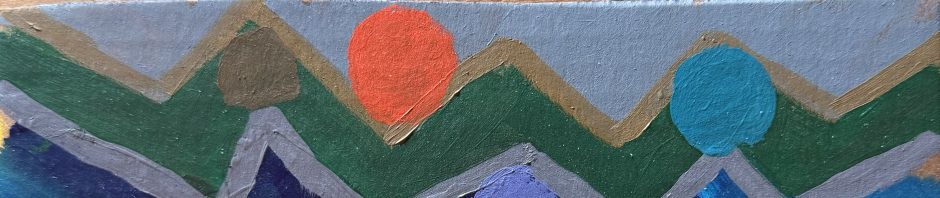
Edge of the paper.
Whatever the outcome, much is lost. Decent civility has taken a grievous hit. We’ll be united in that loss; riled, roiled and riven, we lose together. It won’t be a blessed feeling for many. If we can negotiate a domestic ceasefire on the rhetoric front, at least, our prospects may improve.
I’m working my way through the archive of the BBC4 In Our Times religion podcast as a means of taking distance from the moment. As it happens, history crowds the moment. An episode from 2018 recounts that 3 weeks before he committed suicide Hitler ordered the execution of theologian Dietrich Bonhoeffer. The name of Bonhoefer brought back earnest, searching seminars conducted by my undergrad religion professor during the death-of-God heyday.
Bonhoeffer is reported on the podcast to have been hanged from a meat hook with piano wire. Two hours elapsed before the Nazi doctor pronounced him dead and his corpse was taken to the crematorium; he didn’t die quickly — an egregiously cruel death (like crucifixion) inflicted on a good man by an egregiously bad man.
Avoid martyr stories. Considering how brutally the human species deals with its own kind, it’s not hard to embrace a notion of “original sin,” if it means the congenital taint of a species prone to wreaking atrocity upon its own kind. Is it impossible to imagine a world with less deity and more amity? One in which unicorns can fly?
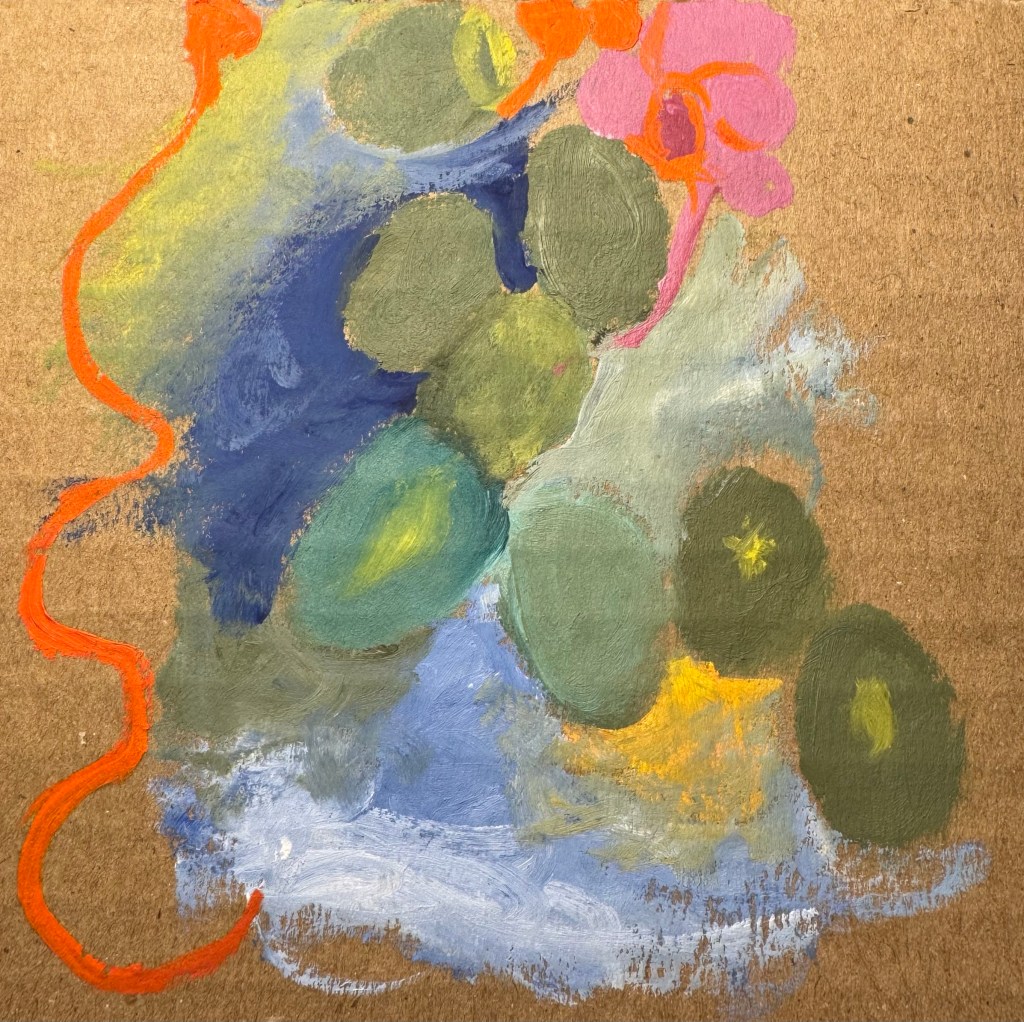
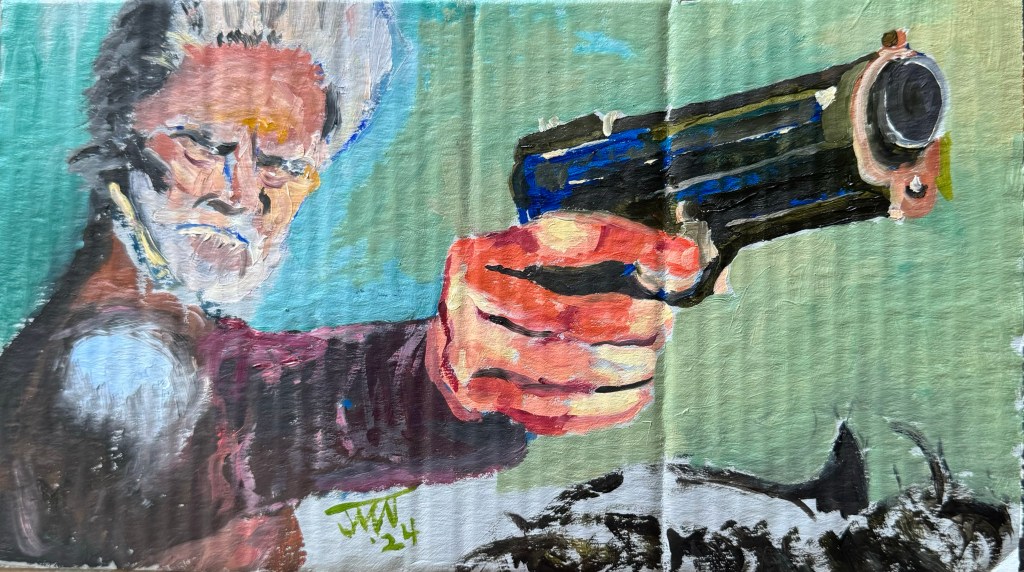
“Daub Wreck,” oil on cardboard, a few inches wide and tall (JMN 2024). Sometimes you have stranded paint and a dirty brush. What’s to do but run riot?
… The gravity of curiosity. Our lives should be lived in interrogatives rather than imperatives. It’s more magnanimous to move through the world with wonder than with unearned certainty… [Poems] encourage us to ask the complicated questions, both of ourselves and those around us. They expect us to embrace all of our foolish wisdoms.
(Adrian Matejka, from Editor’s Note, Poetry, November 2024)
Matejka’s remarks reminded me of a comment I’ve heard attributed to Wittgenstein, which is that in order to create we must follow our nonsense. To “follow nonsense” has an oxymoronic feel almost as explicit as that of the phrase “foolish wisdom.” An important qualifier, I think, is the restriction to following our nonsense and not someone else’s. These phrases have an appeal that makes me giddy. I read in them an exhortation to locate my inner holy fool and bare that fool. Easier said than just do it. I should follow up with Matejka’s starting words in his Note, which speak of the upfront investment:
Poetry is mostly like other arts: work and more work, curiosity and contemplation, studying and more studying.
“Head of a Skeleton With a Burning Cigarette” (1886), by Vincent van Gogh. Credit… Juho Kuva for The New York Times. [New York Times caption and illustration (enlarged)]
Whether it’s taken as a grin or a snarl, all skulls bare their teeth; it goes with being a skull. But sometimes an art historian is in pursuit of a story to tell — it goes with being an art historian. Anna-Maria von Bonnsdorf, director of the Ateneum Art Museum, part of the Finnish National Gallery, says Vincent was “tuned into a late 19th-century trend that revived religious symbolism from the Middle Ages”:
Van Gogh gave the [Dance of Death] allegory an update, von Bonsdorff said. “Because it has a cigarette, and it’s grinning, it has this very modern attitude,” she said. “It’s death in a modern setting, death as the dandy.”
Art historian Juliet Simpson characterizes the alarming state of affairs at turn of century, when the first of two world wars was looming:
“The world is speeding up and rushing to a state of potential collapse or meltdown,” Simpson explained. “It shifts into a question: What is the meaning of all this, and what can artists do about that?”
The contrasting demonstratives stand out; “this” could be the speeding up, and “that” could be the meltdown. A matter of greater concern is that Nina Siegal’s second sentence in the following passage is missing a preposition and a predicate:
But for Northern Europe and the Nordic artists, from around 1870 until 1920, there was an alternative center of artistic influence in Berlin, Von Bonsdorff said. Artists inspired by the culture of the German capital who were interested a darker, more spiritual interpretation of life, and looked to the Middle Ages to express fin de siècle discontent and a search for deeper meaning.[My bolding.]
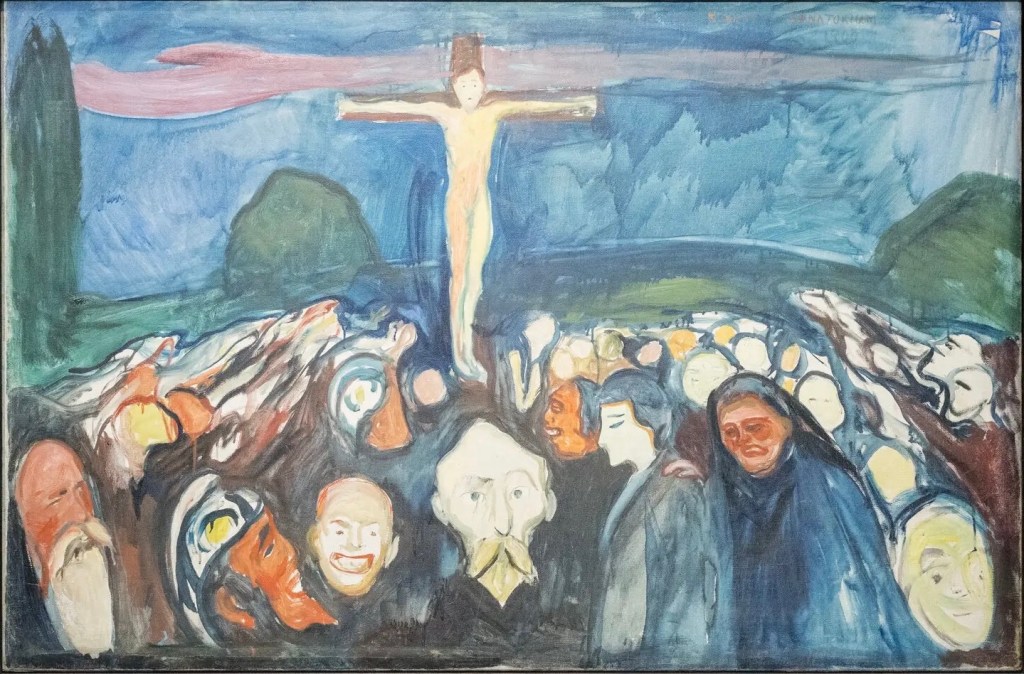
But I didn’t mean to dwell on style. I enjoy seeing the luscious modeling in shades of ivory of Vincent’s skeleton, which the article says he painted during his art student days. A second painting is also interesting — the Munch crucifixion. According to a curator of the National Museum of Norway in Oslo, it’s the artist himself who is depicted on the cross, “sacrificing himself for his art.”
“Golgotha” (1900), by Edvard Munch. Credit… Juho Kuva for The New York Times. [New York Times caption and illustration (enlarged)]
(Nina Siegal, “Did van Gogh Have a Goth Phase?” New York Times, 10-26-24)
Between “passionate” and “dispassionate,” why not the latter? Having a “passion” for something threatens to be trite. “Passion” emits heat, and there’s enough heat circulating already. How about “devotion” instead? I’m devoted to the art of mimickry. A bent for imitation, along with a musical ear, is useful for learning aother language. Adopting a foreign language can feel like stepping into a different skin.
Times movie critic Alissa Wilkinson writes a sprightly, sensitive essay about the art of doing impressions on “Saturday Night Live” and in movies. She cites this comment of Jacob Rubin’s:
Writing in Slate in 2015 about Carvey’s Bush take, Jacob Rubin observed that a great impression “helps us imagine the perspective of the imitated rather than calcify him in ways already seen.” It’s as if we’re seeing his point of view. [My bolding.]
But my favorite reference in the article is to Simone Weil:
THIS IS WHERE a great impression or dramatic performance begins. The actor engages in mind-meld, a sense of deep connection that can only come from careful and deeply interested attention to the subject. I can’t help but think, though it might be a little perverse here, of the philosopher Simone Weil’s observation that “attention is the rarest and purest form of generosity.” [My bolding.]
Weil’s remark crystallizes my philosophy of blogging.
(Alissa Wilkinson, “In a Season of Political Impressions, Why Does Dana Carvey’s Biden Stand Out?” (New York Times, 10-23-24)
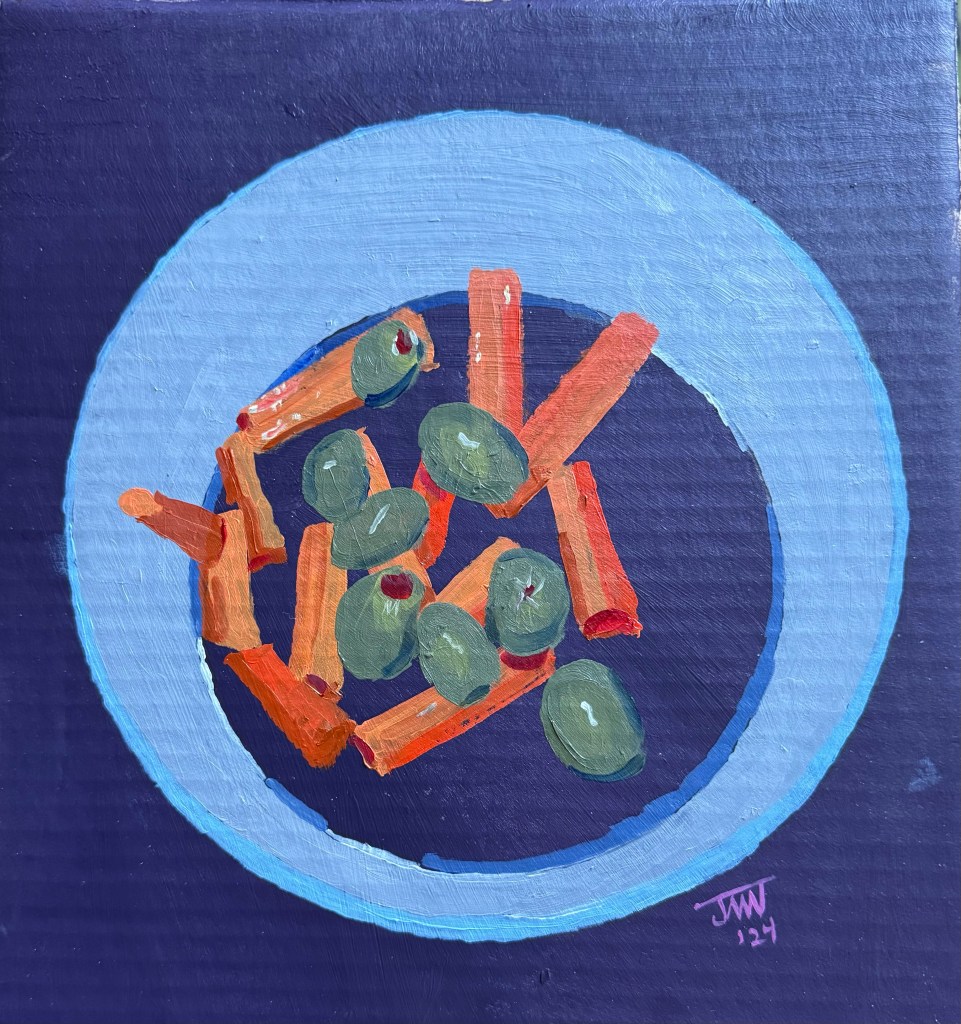
“Aerial View of Crudités Wreckage,” oil on cardboard, 10 x 11 in. (JMN 2024).
The cross-referencing contained in scripture reminds me of the infinite scrolling feature that afflicts social media. In the scriptures it doesn’t have pernicious intent, but can lead, nevertheless, to addictive chasing after the satisfaction of curiosity if one isn’t careful. It’s harder to go in a straight line with a train of thought that you’re trying to put into words. Rabbit holes beckon!
In my Arabic reading practice I’ve reached Quran 4:156, which says this:
My English for the verse is this: “And with (or ‘for’) their unbelief and their saying about Mary a great slander”
The Spanish translation of the Quran I keep at hand is the edition of my teacher Julio Cortés (Editora Nacional, Madrid, 1979). He translates the verse thus (the ellipsis is his): … por su incredulidad, por haber proferido contra María una enorme calumnia*,
Cortés notes:
María fue acusada de fornicación. Según una leyenda judía, Jesús habría nacido de la unión extraconyugal con un soldado romano llamado Pandera. Quizá Jn8:41 aluda a esa leyenda — entendiendo el pronombre ‘nosotros’ enfáticamente y la frase como una ironía —, si es que se refiere a una prostitución física y no moral (Os1:2). En el Talmud y en la literatura talmúdica se le llama a Jesús ‘hijo de Pandera’. V. ActPil2.3 y Orígenes Contra Celsum 1.28. C 19.27. El islam, en el pasado, ha visto en el Corán un reconocimiento del nacimiento virginal de Jesús. Algunos modernistas niegan que el Corán lo reconozca. (“Mary was accused of fornication. According to the Jewish legend, Jesus would have been born of the extramarital union with a Roman soldier named Pandera. Perhaps John 8:41 alludes to that legend — understanding the pronoun ‘we’ to be emphatic and the sentence as irony—, if what’s referred to is a physical prostitution and not a moral one (Hosea 1:2). In the Talmud and in talmudic literature Jesus is called ‘son of Pandera.’ See The Acts of Pilate [Gospel of Nicodemus] 2.3 and Origen Contra Celsum [Against Celsus] 1.28. [Also] Quran 19.27. Islam, in the past, has seen in the Quran a recognition of the virgin birth of Jesus. Some modernists deny that the Quran recognizes it.”)
In my translation of the note, I’ve bolded the cross-references to emphasize that there are five (!) of them. I’ll expand only the first two here.
The note’s first reference, John 8:41, says this (the bolded words are attributed to Jesus): Ye do the deeds of your father. Then they said to him, We be not born of fornication; we have one Father, even God. (In the margin is a pointer to Isaiah 63:16.) This, of course, is the possible allusion to Mary’s alleged affair with the Roman soldier, condemned as calumny in the Quran.
The note’s second reference, Hosea 1:2, says this: The beginning of the word of the Lord by Ho-se’a. And the Lord said to Ho-se’a, Go, take unto thee a wife of whoredoms and children of whoredoms: for the land hath committed great whoredom, departing from the Lord. (In the margin are pointers to Deuteronomy 31:16, Jeremiah 2:13 and Hosea 3:1.) This verse illustrates the possibility of the people’s breaking of their covenant with the Lord being symbolized as a “moral prostitution” — a consorting with false gods.
Traditions treating certain speech as divine illustrate how consequential it is to understand and clarify grammatical structures. A useful online resource for Quranic text analysis was developed by the late Dr. Kais Dukes at the University of Leeds, England. A 2010 interview with Dr. Dukes is here.
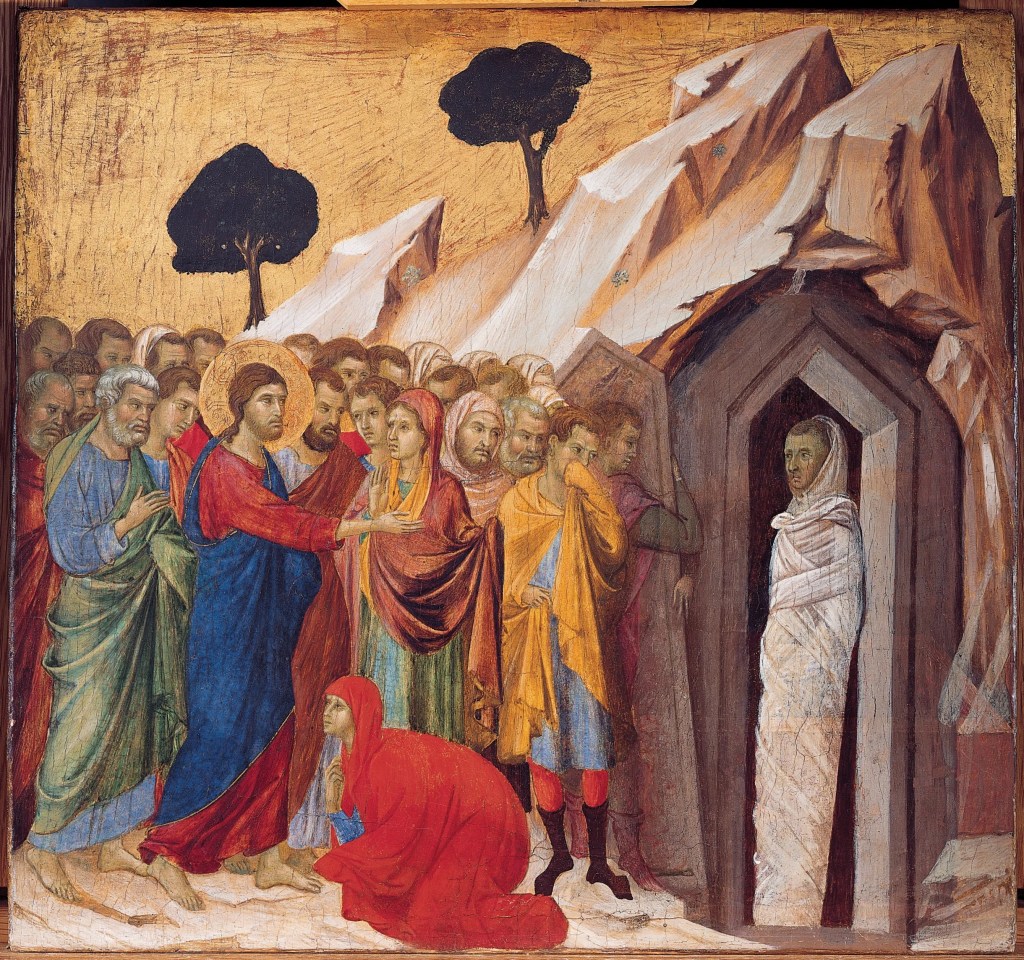
“The Raising of Lazarus” (1310-11), by Duccio di Buoninsegna. Art work by Duccio di Buoninsegna / Courtesy Kimbell Art Museum. [New Yorker caption and illustration]
The Met’s new show… makes clear how astonishing it is that paint, of all things, became the center of Western art… There may never be another big American exhibition about this freakish little era, when artists figured out how to make colorful ooze do their bidding… Nobody ever looked at an egg yolk, the signature ingredient in tempera, and thought “sublime,” let alone “enduring,” but here we are, seven centuries later.
The first part of Jackson Arn’s piece about the “rise of painting” in 14th-century Siena is interesting for its detail about materials and technique.
Chop down a poplar tree. Other kinds of wood could work, too, but poplar is an especially soft one, and your task is to trim it into thin planes. These you’ll need to coat in a barrier of plaster and animal glue—naked wood is highly absorbent, and you can’t have it drinking down everything you put on it. Wait until the barrier has dried. Sand. Repeat until you have a perfectly smooth surface. Sketch your preferred silhouettes with a stick of charcoal, slather the negative space in a gluey reddish mixture, cover that in translucent gold leaf (glueless, the metal has a queasy green tinge), and burnish that with a wolf’s tooth. Now, and only now, you may pick up your brush.
(I haven’t found what a “wolf’s tooth” is. Presumably a tool.)
At an earlier phase of life I couldn’t see through the treacly piety of early painting to the art beneath. Now I can look at the paintings per se, setting aside the religion. In “The Raising of Lazarus” (above), the ashen, revivified corpse peers wanly from its intensely rendered, rifled coffin, eclipsed by the gorgeous attire of Jesus and the crowd. The chromatic splendor of opulently studied garb captivates, along with the faces striving to enact emotions.
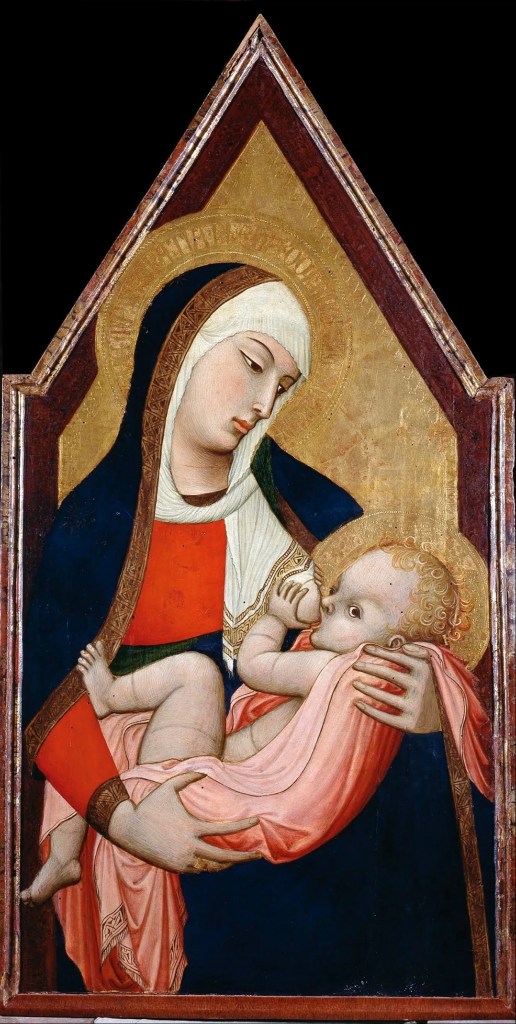
“Madonna del Latte” (ca. 1325), by Ambrogio Lorenzetti. Art work by Ambrogio Lorenzetti / Picture Art Collection / Alamy. [New Yorker caption and illustration]
We can’t feel the full trecento shock of axial perspective anymore, but even the most familiar parts of these images still land with a slap.
I’m prepared to be shocked, if not slapped, as soon as I can understand and visualize what axial perspective is.
(Jackson Arn, “City of God, The Met’s Revelatory Show on Siena,” The New Yorker, 10-16-24)
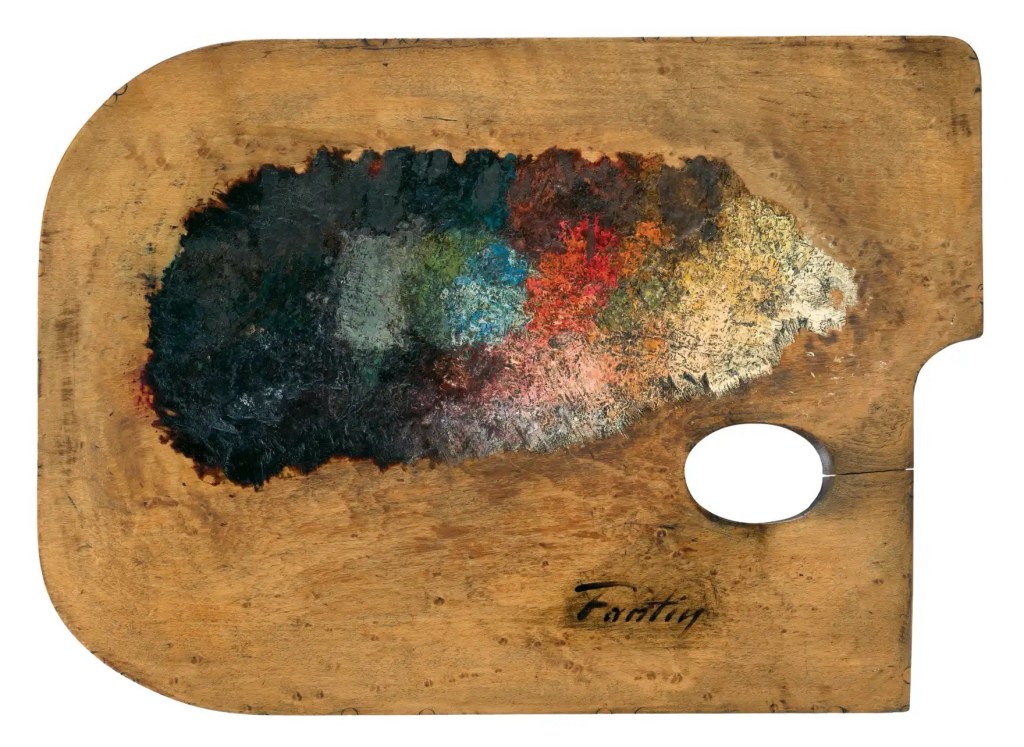
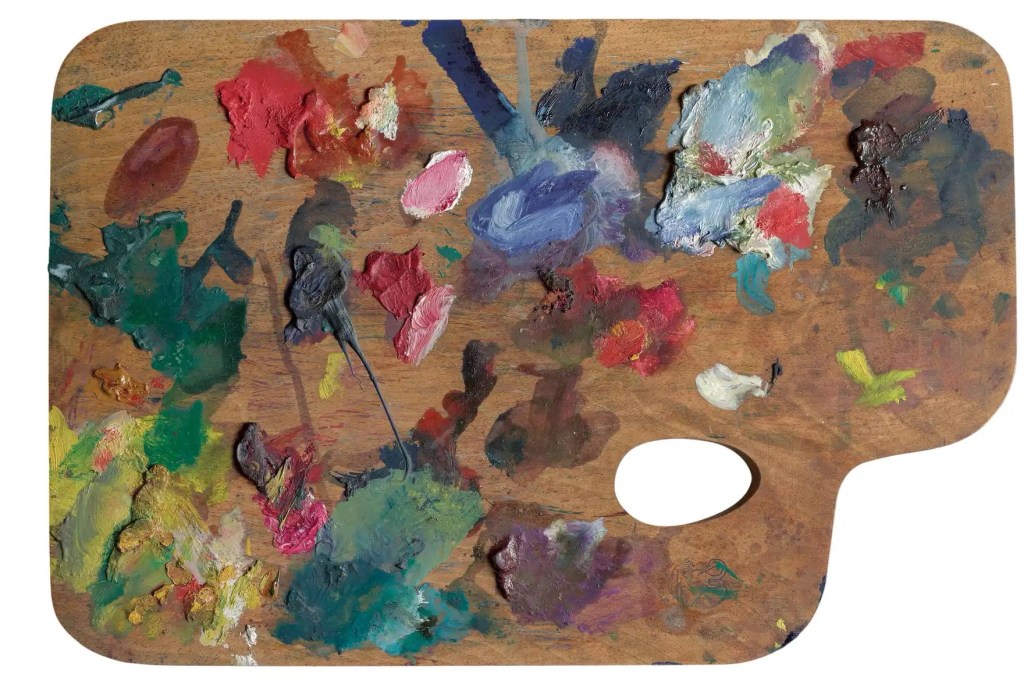
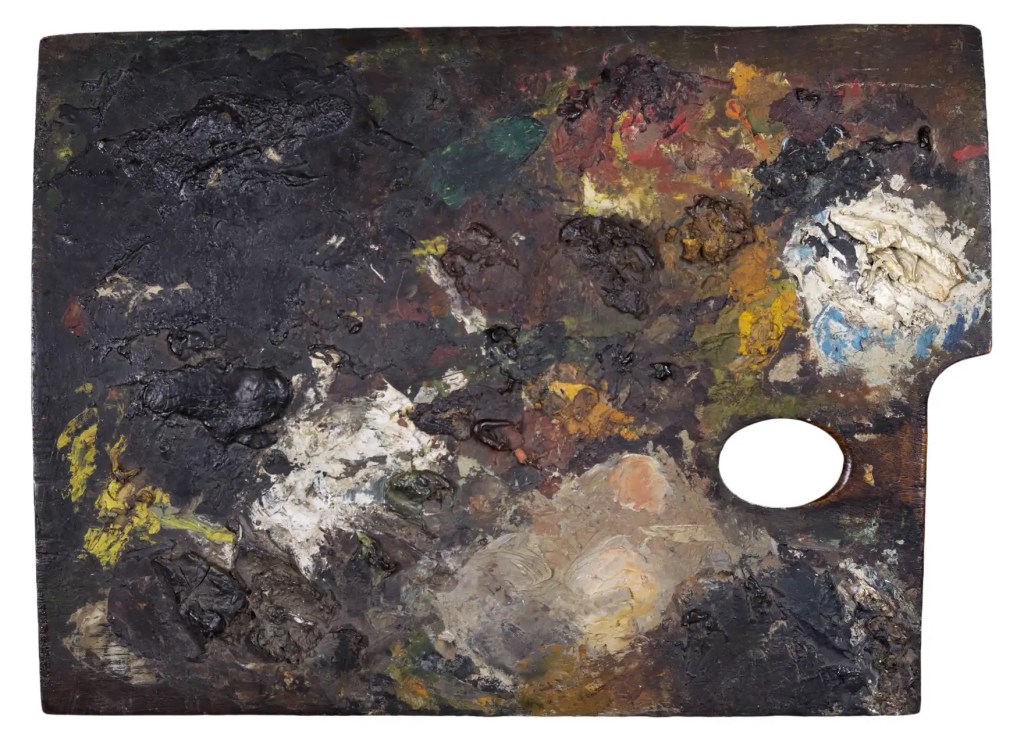
The phrase “smeared with [a] personalised spectrum of paint” snagged me. The palettes are interesting in relation to who used them and/or for what they suggest about the painter’s “attack,” for lack of a better word.
Fifty of these small artworks, smeared with their owners’ personalised spectrum of paint, have now been collected in a new book, many of them for the first time. “A palette is both a timeless blank canvas and the ultimate abstract work of art,” says the book’s author, Alexandra Loske, curator of the Royal Pavilion in Brighton. “It is the most intimate and personal of tools, and perhaps the closest we will ever come to connecting with a long-dead artist.”
Eleven palettes are shown in the article; I’ve chosen six of them to share here.
Henri Fantin-Latour, 1887. Photograph: Baltimore Museum of Art. [Guardian caption and illustration] Edvard Munch, undated. Photograph: Munch Museum, Oslo. [Guardian caption and illustration] Egon Schiele, 1918. Photograph: Courtesy of Ressler Kunst Auktionen, Vienna. [Guardian caption and illustration] Edward Hopper, undated. Photograph: Edward Hopper House Museum & Study Center, Nyack. The Sanborn-Hopper Family Archive. [Guardian caption and illustration] Gustave Courbet, undated. Photograph: Musée départemental Gustave Courbet, Ornans. [Guardian caption and illustration] James Abbott McNeill Whistler, 19th century. Photograph: Colby College Museum of Art, the Lunder Collection, Waterville, Maine. [Guardian caption and illustration]
(Kit Buchan, “Board masters: artists’ palettes as works of art — in pictures,” The Guardian, 9-28-24).
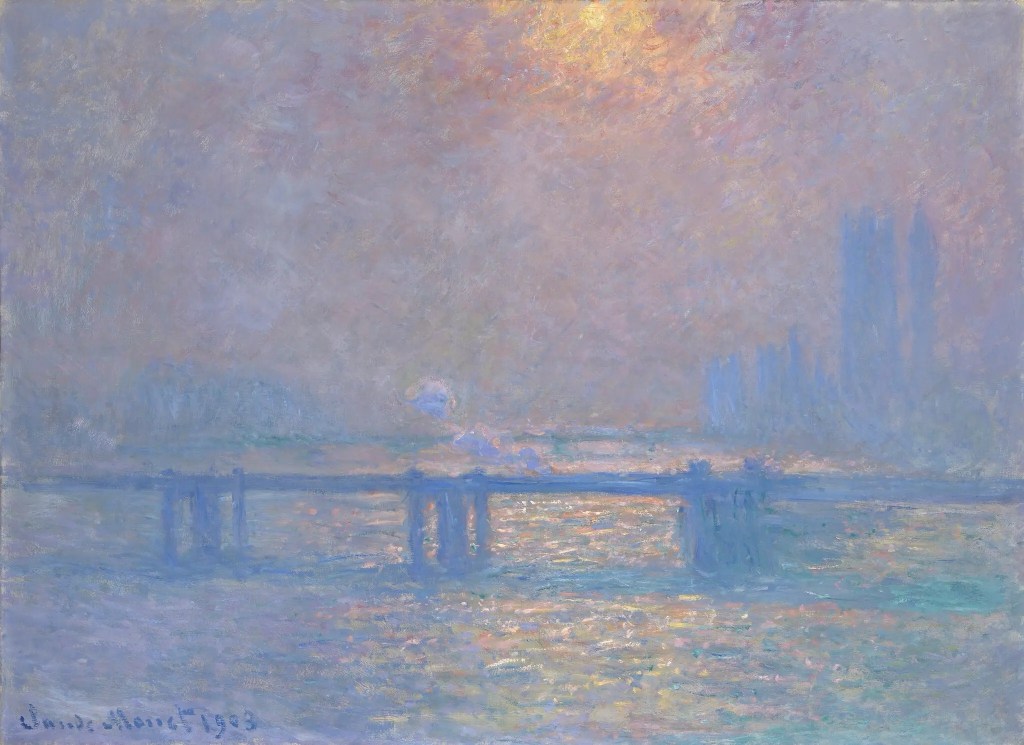
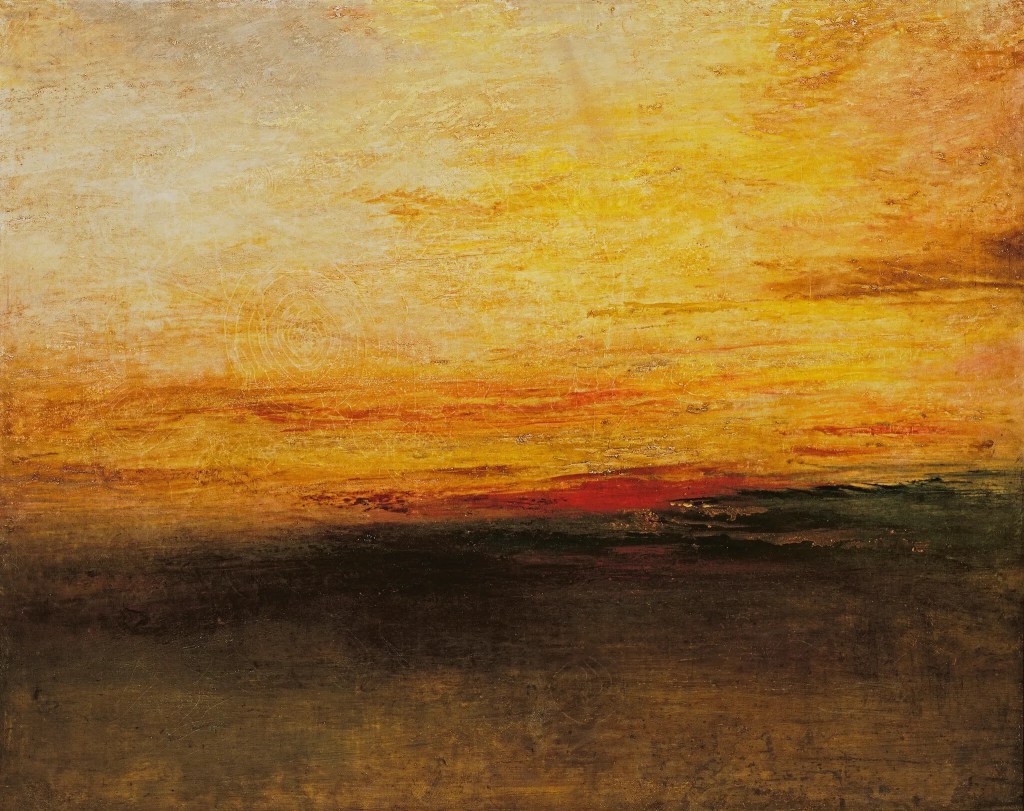
Volcanic ash from Mount Tambora’s eruption, as well as coal pollution, gave Turner glowing atmospheres to paint in his day. So did the toxic air enveloping the city of London which Monet responded to in some of his paintings a century later. A recent article by Emily LaBarge in The Times treats of the two artists.
Here’s one of several Monets reproduced in the article:
Monet’s “Charing Cross Bridge, The Thames” (1903). Credit… Alain Basset/Lyon Mba. [New York Times caption and illustration]
It’s interesting that Monet started his canvases en plein air in London, but finished them at his studio in Giverny, France where, as the article says, “they took on new life. As much as they are representations of a city and its unearthly fog, they also show how art best captures nature when it transforms it.” The part of that statement I’ve bolded provokes thought. “Transformation” is a large word. I wonder what relevance it may have to the workaday strivings of the painter back in his studio? I hear you say, But Oscar-Claude Monet wasn’t the average painter! Granted. But did he know that then?
Here’s the sole Turner reproduced in the article:
“Sunset” (1830-35), by J.M.W. Turner, is on display at Turner’s House in London as part of the exhibition “A World of Care: Turner and the Environment.” Credit… Tate. [New York Times caption and illustration]
The Turner painting has a starkness and severity — a primeval glow depicting almost nothing. It steers clear of prettiness, feels more modern than Monet’s.
Here’s how I would apostrophize Monsieur Monet: Kind sir, beautiful man, brush genius, color maestro, your oeuvre is deathless, but I’ve seen an awful lot of it in many unlikely places (dorm room posters, sides of buses, etc.).
In a second article, stunning and lavishly illustrated, Jason Farago usefully emphasizes how, familiar as they are now, the painters whom we know as “impressionists” (originally a term of derision) were innovators going rogue and poking a finger in the eye of an Olympically hidebound and snooty French art establishment. He writes this:
And if you find Monet, Renoir, Degas too pretty and popular — if you think Impressionism is the artistic equivalent of a pumpkin spice latte — I want you to taste the espresso beneath the foam.
I’m particularly fond of a painting by Berthe Morisot and what Farago says about it.
[No caption. Referenced in the article as “… Picture No. 107 in the exhibition of 1874: another of Morisot’s lugubrious bourgeois bachelorettes.”]
But her dress is an open tangle of white, as opaque as the brushy harbor, and between her black hat and violet choker is a face dissolving into vapor. No gatekeepers remain to decree how to picture her. Art, from 1874 onward, means freedom: so sad, so beautiful.
[No caption. Detail, “… Picture No. 107.”]
(Emily LaBarge, “When Artists Found Beauty in London’s Toxic Fog,” New York Times, 10-7-24; Jason Farago, “How the Impressionists Became the World’s Favorite Painters, and the Most Misunderstood,” New York Times, 9-10-24).








 EthicalDative
Pour Me a Draft of Heartsick with a Shot of Hope
I knew an English professor who remarked during the season of final exams that it was time, once again, to see how badly he had failed his students. I loved that an academic identified, at least rhetorically, as the tested one and not the master. I suspected he was a good teacher for it. I myself failed at teaching on various counts, the fundamental one being, in my own estimation, that I couldn’t make students love what I loved.
Today, November 5, 2024, we’re poised to find out how badly we’ve failed our country. Yesterday I savored two eloquent blog posts (here and here). They acknowledge the election, but urge redirection of focus to the higher plane of spirituality without expressing favor for a particular candidate. Sincere piety is ever to be respected. How readily does a pretend Caesar of today distinguish between what’s his and what isn’t? Render to Caesar… exactly what? That seems a practical problem posed by this election.
Whatever the outcome, much is lost. Decent civility has taken a grievous hit. We’ll be united in that loss; riled, roiled and riven, we lose together. It won’t be a blessed feeling for many. If we can negotiate a domestic ceasefire on the rhetoric front, at least, our prospects may improve.
(c) 2024 JMN — EthicalDative. All rights reserved