Onward and Upward with the Language

Francisco Gómez de Quevedo y Santibáñez Villegas, Juan van der Hamen, 17th century (Instituto Valencia de Don Juan)

Francisco Gómez de Quevedo y Santibáñez Villegas, by Juan van der Hamen, 17th century (Instituto Valencia de Don Juan)

I learned a new word today: “derp,” meaning “foolishness or stupidity.” Here’s the context:

So that’s why I’m a crypto skeptic. Could I be wrong? Of course. But if you want to argue that I’m wrong, please answer the question, what problem does cryptocurrency solve? Don’t just try to shout down the skeptics with a mixture of technobabble and libertarian derp.
[Paul Krugman, “Transaction Costs and Tethers: Why I’m a Crypto Skeptic,” NYTimes]

Irrelevant Postscript: I wanted to confirm my instinct not to capitalize “with” in my title. (I recalled learning not to capitalize prepositions.) I consulted the World Wide Wind. It passed the following:

“Short” words, those with less than five letters, are lowercase in titles, unless they are the first or last words.

And there we are. I’m taking language advice from a site that says “less than five letters” instead of “fewer than five letters.”

Copyright (c) 2018 James Mansfield Nichols. All rights reserved.

Posted in Commentary, Quotations | Tagged | 2 Comments

Sir Alistair Has Much in Common

Tagg's Island, Sir Alfred Munnings, 1919. Philip Wilson Publishers, 1978.

Tagg’s Island, Sir Alfred Munnings, 1919. Philip Wilson Publishers, 1978.

Sir Alistair Chichester is just like you in so many ways: He can quaff a pint with the next man at the Thane of Thoth; he enjoys his Marmite soldiers with an egg, his faggots with mushy peas, his bangers and mash, syllabub on weekdays, Eton mess on Sundays. Moreover, when Wadsworth dresses him Sir Alistair puts first one leg, then the other, into his trousers, just like you. Well, perhaps you don’t have a butler, but the point is made. It only so happens that Sir Alistair is a hereditary wealthy nobleman and you are common.

It likewise so happens that Sir Alistair owns the Tottenham Hotspurs, a professional football team. Though it be infra dig for the august man to rub elbows with the hobbledyhoys who throng Wadham-Threadneedle Stadium, he joins them in roaring approval for sundry maneuvers on the pitch from the luxury of his private box. “Well done, you!” Who would deny a man saddled with preferment the fugitive spasm of ebullience?

As it happens, a berobed potentate from sands of the desert has tendered to Sir Alistair an offer to purchase the Hotspurs at a price little short of breathtaking. The exact amount is irrelevant for lesser mortals — suffice it for your paltriness to say that Sir Alistair would realize a gain of some seventeen percent over his original investment.

Here the plot thickens. Whilst Sir Alistair mulls the sheikh’s gesture, the Council of Worthies has found an anonymous potential buyer who would give Sir Alistair only a thirteen-percent current profit; with, however, a promise to press the Exchequer for abatement in perpetuity from certain taxation inflicted upon rents and interest income of the struggling well-to-do. The deferred profit to Sir Alistair over 2.4 years would surpass his immediate take from the potentate.

Your assignment is as follows: Pretend you are Sir Alistair’s advisor. (Implore assistance from a social superior to lend verisimilitude to your impersonation.) It’s clear Sir Alistair profits serenely from either offer — pecuniary advantage is not at issue here. But which currency more complements the Chichester line’s preeminence: petrodollars or pounds? Also, Panama or the Caymans? Speculate as to which haven for proceeds of the transaction Sir Alistair’s accountants will prefer.

(Social Math — UK, Copyright (c) 2018 James Mansfield Nichols. All rights reserved.)

Posted in Anthology | Tagged | Leave a comment

Making Bold

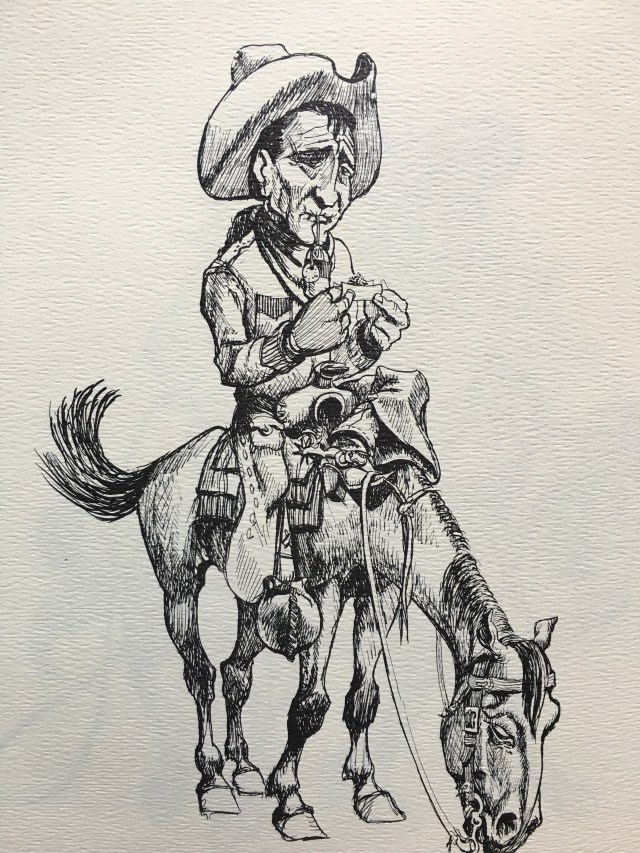
Tom Jones drawing, bronc-riding cowboy

Tom Jones drawing, bronc-riding cowboy

They say seek forgiveness, not permission, if you’re bold. I make bold here to respond publicly to a fellow blogger with whom I am enjoying a rewarding exchange of views — one of several bloggers who kindly respond to me with discriminating and sensitive comments, and I thank you all. He’s an artist and writer, and here I talk to him pell-mell (I hope to cite his blog soon, but I’m uncertain of the protocols for that at present, and would like to consult him first):

I’ve read all your latest comments and they’re echoing for me as I write this. Your remarks just keep on ringing bells. It’s so stimulating to talk about art with you. When I say something like “don’t-give-a-shit” painting, after feeling clever for a moment I regress to “uh-oh, that sounds cocky and glib.” I’ve said before that I’m a passive-aggressive expressionist. I’m torn between bold sallies and remorseful retrenchings — whatever that means. In fencing you thrust and you parry. And I think you “lunge.” What’s it called when you back up like hell? “Retreat” sounds a little wussy! Yes I’m a wuss.

I admire painting that’s… daring. Your work is daring. It springs from elsewhere, the haunted imagination lassoed with fiery technique. I’ve always wanted to live “elsewhere.” One of the many Waterloos in my life is that I will die in Texas, whence I came. I “fondly” call it a buttcrack state, along with its southern sisters whose glutes sandwich the Mississippi. I would like to have expired at a remote time in the future near Colby College, for example. Or Bard. Or Salamanca or Soria in Castilla la Vieja. As it stands, I’ll just tell my son to scatter my ashes somewhere in the yard where they don’t blow back into the house.

Your remark on “trained” eye is insightful. “Seasoned” eye would have been good. I’ve internalized the shibboleth that says true artists earn the right to paint unconventionally (daringly) by having traversed the rungs of rigorous academic training first. Like all received wisdom I’m sure it’s rife with exceptions (is Basquiat one?), but you show the marks of having mastered much craft. As you say, you’ve gained your eye with much looking. And your ear for music with much listening! — another thing I admire.

I spent most of a summer in Paris once and hung out at the Louvre. One day I was staring at a painting — I wish I could remember the picture precisely. Its title was something like “Tâche violet” (or “violette”? — I’m not sure of the gender). A lady came up beside me, looked for a moment, then turned and said in French, “What is it?” I answered, “Madame, it’s a ‘Purple Splotch,’ ” simply quoting the label. I thought I was so smart and hip. “What you see is what you see.” (I know “violet” is a closer match, but I like “purple” for the story!)

To give you an example, I have a book of Milton Avery’s work, and I like his work. It has something of the feel I noticed in Henry Taylor, sort of a willed coarseness (?) — a terrible word, I’m really going out on a limb which will probably break off as soon as you blow on it, but it feels good to ramble. In much of my writing I edit my stuff until it’s terse and clenched to a fault. But do you recall the literally *white* face on the horseback guy in Taylor’s painting? It’s stark and startling. Some of his portraits look like he has literally shit pigment on the canvas. The eyes have no nuance whatsoever. Yet those paintings grab me. I didn’t post a couple of his pictures that are truly wrenching. I’m loath to court controversy on my shingle, and we’re all full up with arguments anyway.

Painting like Taylor’s and Avery’s gives me a feeling not so much of “I could have done that” but rather “I should have done that.” How dare they thwart my expectations so seductively! As a hobbyist I labor to model plausible representations in the oils my dad left behind. I’m OK with that, I didn’t make the sacrifices necessary to be an artist, but as a viewer I’ve been a fan of painters like Kandinsky and Mondrian. Degas was my early idol. I have half-sleeping in my brain a moonscape by Albert Ryder. Was it “Albert”? I haven’t thought of him in years. I liked the so-called Ashcan painters. The gritty urban scene was exotic to a country boy longing for escape. Eliot wrote of the poet’s duty to find beauty in the not-beautiful — I paraphrase him drastically and from memory. It reminds me of a phrase by a friend who is a “Texas poet.” He speaks of the “bluebonnet plague” that swamps our Sunday landscape painters. Ouch, I think I’m one of the pack, though my landscapes usually try to be faces. And I paint during the week. At least not sunsets though. Yet! (But they *are* so pretty.)

Copyright (c) 2018 James Mansfield Nichols. All rights reserved.

Posted in Commentary | Tagged | 4 Comments

Waking the Dogs

13 Cookie napping

Bess fills the paw prints left by Cookie, shown napping here.

It’s been a red-letter several days in my quiet life, and I’m afraid it has me sounding off more than I should here on topics that normally I would let lie with sleeping dogs. I have a fear of goading beyond their endurance persons who generously visit my blog.

Two days ago I received a letter from my former wife with news of our only child, a daughter, who has grown up and thrived in another country. Three children of her own, a good marriage, a prosperous career — all fantastic. It was a bolt from the blue which literally brought tears of gratitude. We’ve had no contact all this time. I’ve mailed  letters to both of them, and hope mightily to continue the conversation.

A dear friend and neighbor with whom I’ve shared the details said today, “I know you don’t believe in God, but I think your ex-wife’s reaching out to you is a blessing from God. He is responsible.” And here is where the dogs stir.

I wouldn’t have this dialog with my neighbor because I renounce any effort to argue with another person’s piety. For me “freedom of religion” implies freedom *from* religion as well, but also respect for others’ beliefs provided they don’t cause harm.

But here I say with trepidation that I don’t actually *disbelieve* in God either, it’s more like I don’t have an opinion on the matter. Can I choose not to believe anything for now except that the universe makes more sense if we respect all life? I like the “don’t kill” commandment. Is it number six? I don’t want to live in a world that doesn’t have lizards and tarantulas.

Atheism isn’t an option for me because it is itself a systematized form of thinking about being without God, of disbelieving in “him.” It’s as much an article of faith that “He” isn’t as that “He” is. Neither leap is congenial to me personally. I simply choose not to take a stance. “I would prefer not to,” like Bartleby the Scrivener.

A canny philosopher or theologian might say that my being on the fence is not a tenable position, or not an honest one, that I must poop or get off the pot. (That metaphor wears out quickly.) It may be true. I try with all my heart to keep an open mind about most things. I may yet be “surprised by joy” like C.S. Lewis in the matter of religion.

Meanwhile, my question is: Why the rush to attribute a good happening to God? Is it possible my ex-wife, bless her soul, acted on a generous impulse of her own accord with no divine intervention? Should God be credited also with bad happenings? The burning deaths of folks in Greece and California due to wildfires? The drowning of children in the duck boat? I don’t want to be the one telling relatives and parents it was God’s will. I know the debate over “why bad things happen to good people” is as old as the rocks in my driveway, but I haven’t followed it closely.

My aunt, member of a mainstream Protestant sect, told me once she believed with all her heart that on the Day of Judgment every person who ever lived would be resurrected in the flesh. We were driving home from having held hands and wept as we watched my uncle, her brother, draw his last breath. All I said was, “Ina Bess, I love you.” I believed that she believed her belief. That was enough. Love fills in the blanks. I implore forgiveness if any of this comment smacks of squib. It’s far from my intention to be sarcastic or ironic about matters of faith.

Copyright (c) 2018 James Mansfield Nichols. All rights reserved.

Posted in Commentary | Tagged | 4 Comments

Enough About Me

JMN2016, Puckering, oil on canvas, 16 x 20 in. (c) 2018 James Mansfield Nichols. All rights reserved.

JMN2016, Puckering, oil on canvas, 16 x 20 in. (c) 2018 James Mansfield Nichols. All rights reserved.

The Supreme Court in its five-four wiseness has ruled that money is speech and therefore protected under the “free” clause. I rule that image is language and therefore commentable under the “thoughts on art and language” clause. And thus I find that no matter how Zuckerberg cloaks his t-shirt with coat-and-tie he still looks and feels and parses like an underage Ken Doll minted in Silicon Valley, callow, shallow, deer-caught-in-the-lights-eyed, unwrinkled, banged, you know the look, it’s all over Kardashistan, and I respect him all the less for not having achieved a diploma from Harvard, so he’s rich, yes I’m envious, and yes I continue to shun F’book like bad breath, like the only-slightly-less-evil twin of Twitter, and a pox-de-deux on both their goonytunes, not on Z’berg personally, I don’t even know him, but yes, hard feelings.

Copyright (c) 2018 James Mansfield Nichols. All rights reserved.

Posted in Commentary | Tagged | 1 Comment

An Inconvenient Perception

Isabella Rossellini

Isabella Rossellini and Friends

I read once somewhere that much of the violence inflicted upon the world is at the hands of young men who have never held a job or a girl’s hand.

For some reason the comment comes back to me with a sad ring of truth. Perhaps it’s triggered by the fact that today my son, a highly trained Navy nurse, is being deployed to a war zone.

Too many young men throughout the world are trapped in circumstances which, at a pivotal time in their development — adolescence and early adulthood — give them little or no outlet for the restless energies and ambitions that come awake in those years. Their cultures stifle them with lack of education, lack of careers, and with social and institutional mores that do not facilitate, perhaps even actively discourage, constructive interaction with females.

One-Woman Riot

One-Woman Riot

Such men, in their young prime, stew with impotence, boredom and frustration; they become marks for exploitation by older men of a different sort — ideologues, fanatics, criminals, tyrants, myrmidons. And of course a percentage of the exploited young men turn into the next generation of thugs who exploit… young men.

Woman Conversing With Riot Police

Woman Conversing With Riot Police

It’s hard to see a way out of the global syndrome of undeclared wars, endemic conflict, and fleeing masses of people unless and until the reactionary, repressive, defensive measures widely resorted to by governing entities give way to attempts, however tentative, to remedy the underlying causes of dysfunction and turmoil at their source. Those causes are tiresomely familiar in the recitations of fools like me: poverty, ignorance, injustice, gender discrimination, greed…. The litany begins to sound almost biblical.

Close Encounter

Close Encounter.

I resist most impulses to use my little blog for venting about inconvenient perceptions that don’t obviously correlate to art or language. I lost this particular skirmish with myself, but I’ll carry on the fight to say mostly nice things here and save despair for my pillow.

Copyright (c) 2018 James Mansfield Nichols. All rights reserved.

Posted in Commentary | Tagged | 3 Comments

On Mistranslation

Linda Huang. NYTimes.

Linda Huang. NYTimes.

When Jerome, the patron saint of translators, rendered the Bible into Latin, he introduced a pun that created one of the most potent symbols of Christian iconography, turning the Tree of the Knowledge of Good and Evil (“malus”) into the tree of apples (“malum”). It’s true that “malum,” in Jerome’s day, could mean any number of fruits: the serpentine creature on Michelangelo’s Sistine ceiling, for instance, is coiled around a fig tree. But in the 16th century, both Albrecht Dürer and Lucas Cranach the Elder, following Jerome’s lead, famously depicted Adam and Eve beside unambiguous apples. And when, the following century, John Milton wrote of Eve’s “sharp desire … / Of tasting those fair Apples,” he helped concretize the image of the bright rubine Malus pumila that we know today.
[Mark Polizzotti, “Why Mistranslation Matters,” NYTimes]

Copyright (c) 2018 James Mansfield Nichols. All rights reserved.

Posted in Commentary, Quotations | Tagged | 3 Comments

“Tibi Dabo”

“… et ait ei tibi dabo potestatem hanc universam et gloriam illorum quia mihi tradita sunt et cui volo do illa.” Copyright (c) 2018 James Mansfield Nichols. All rights reserved.

More Galleries | Tagged | Leave a comment

Thank you, and “I Could Eat Your Words”

Check out this video on YouTube:

Thank you to my precious, patient readers who spend a moment of their invaluable time to look my way here on EthidalDative. I can only strive to repay the compliment.

And although I try not to encumber you with irreflexive boosterism, I can’t stifle an endorsement of Patricia Barber’s singing and musicianship. I listen to music for much of my day — I don’t always *hear* it as I’m doing other things, but it it strikes the right note I do. Barber has a dusky, lower-pitched voice, like Diana Krall, and her renditions are unfailingly, often startingly, arresting, lyrical, head-turning. I never tire of hearing her, and I tire easily of certain music. I cite her lyrics to the song “I Could Eat Your Words” below. It’s from her album entitled “Verse.” The song presses all kinds of buttons on a linguist.

“I Could Eat Your Words” (lyric by Patricia Barber)

philosophy engenders a Rational man

Descartes would be the first to agree

syllogistically speaking if ‘A’ is you

and ‘B’ is me

logical proposition will lead us to’C’

Aristotle conditioned the Greeks to indulge

the brain and the body agree

psychologically speaking if the student can teach,

the teacher can learn,

lets leave the thinking to me

simplicity can charm the intellectual beast

a three-word phrase will suffice

hedonistically speaking if ‘food is for thought’

then ‘thought is or food,’ and

teacher, “I want you” tonight

i could eat your words

suck the salt from your ‘erudition’

light a fire under ‘inhibition’

season ‘reason’ with a transitive verb

i could eat your mind

sweeten ‘no’ with ‘equivocation’

blend your phrases with ‘provocation’

sip the spit from your bittersweet rhyme

poets need a holiday

professors need adulation

you can talk and talk

the right away

and make no case for ‘moderation’

i’ll drink ‘remorse’ like a cabernet

champagne with ‘indecision’

‘guilt’ like garlic

needs to sauté with cream, butter

and wine

I could eat your words

melt ‘objection’ with ‘stimulation’

simmer ‘truth’ with ‘prevarication’

taste your ‘virtue’ and ‘honor’ and ‘time’

baby teach me tonight

Copyright (c) 2018 James Mansfield Nichols. All rights reserved.

Posted in Commentary | Tagged | 3 Comments

LinkedIn Just Gave You a New Reason to Make Fun of LinkedIn

LinkedIn, a social network for people who enjoy soul-crushing banality, knows you get more than a few emails from randos wanting to add you to their “professional network.” Sick of reading messages from these random acquaintances looking to discuss synergy-based solutions and B2B services? Well, now you can listen to them instead, thanks to voice messaging, the newest feature being added to LinkedIn’s iOS and Android app.

— Read on gizmodo.com/linkedin-just-gave-you-a-new-reason-to-make-fun-of-link-1827935162

Posted in Commentary | Tagged | 2 Comments