“Soria” by Antonio Machado, Spanish poet, 1875-1939
From “Campos de Castilla,” Antonio Machado, Biblioteca Anaya, Edición de José Luis Cano, 1964.
(English translation by James Mansfield Nichols)
The shield of Soria has the following heraldic description: [3]
In a field of gules (red), a castle, of argent, crenellated with three battlements, lined up and marbled with sabre, rinsed with azure (blue) and a king’s bust crowned with gold and with its attributes coming out of his homage, in its colour; silver embroidery loaded with the following legend: “Soria Pura Cabeza de Estremadura”, written in saber letters. (Wikipedia)
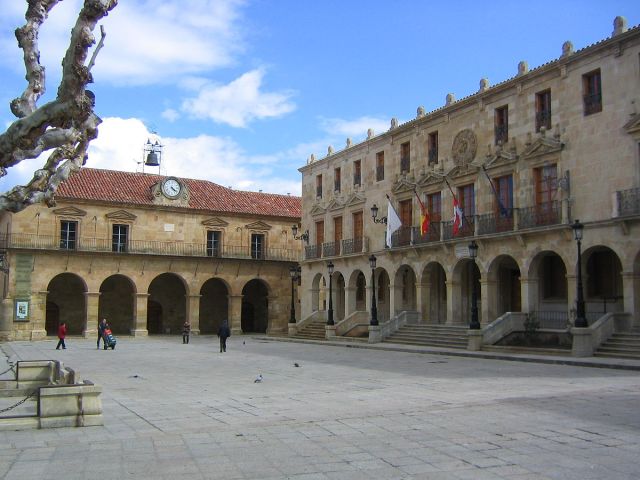
The poem “Soria” is a sequence of exclamations. (I reproduce the punctuation of my printed text.) The speaker evokes the somber beauty on a cold, moonlit night of an ancient provincial city fallen from its former glory. The details he describes aren’t beautiful in themselves — indeed, they depict decrepitude, decay and impoverished neglect of which the marauding, starving Spanish greyhounds (galgos) are an emblem. However, embellished by moonlight and the late hour, the scene adds up to loveliness for the
speaker, as he asserts in the ending twist: ¡Tan bella bajo la luna!
Note: Soria today is at a considerable remove from Extremadura. A footnote in my Spanish edition says (I translate): Here “Extremadura” is used in a broad sense referring to ancient Extremadura.
Draft literal translation:
¡Soria fría, Soria pura,
Soria cold, Soria pure,
cabeza de Extremadura,
head of Extremadura,
con su castillo guerrero
with its warlike castle
arruinado, sobre el Duero;
in ruins, upon the Douro;
con sus murallas roídas
with its walls eaten away
y sus casas denegridas!
and its blackened houses!
¡Muerta ciudad de señores,
Dead city of gentry,
soldados o cazadores;
soldiers or hunters;
de portales con escudos
of doorways with the shields
de cien linajes hidalgos,
of a hundred landed lineages,
de galgos flacos y agudos,
of sharp and skinny greyhounds,
y de famélicos galgos,
and of famished greyhounds,
que pululan
that swarm
por las sórdidas callejas,
through the squalid byways,
y a la medianoche ululan,
and at midnight howl,
cuando graznan las cornejas!
when the crows caw!
¡Soria fría! La campana
Cold Soria! The bell
de la Audiencia da la una.
of the Courthouse strikes one.
Soria, ciudad castellana
Soria, Castilian city
¡tan bella! bajo la luna.
so lovely! under the moon.
[Copyright (c) 2018 James Mansfield Nichols. All rights reserved.]






The Blanco River, by Molly O’Halloran
Photograph: Molly O’Halloran. “This was created using pen, ink and watercolor. The map’s primary focus, inked and washed in blue, is the 84-mile twisting length of the Texas’s Blanco river, including all its tributaries.”
This picture captured me. The act of hand-drawing and painting a map must tap into deep reserves of disciplined obsession. I live toward the bottom of the Guadalupe-Blanco Watershed. When it rains heavily up country it’s possible the mighty Wadi-Loopy may come a-calling on my front lawn. Hasn’t happened since October ’98, but we live in loopy times!
[Copyright (c) 2018 James Mansfield Nichols. All rights reserved.]