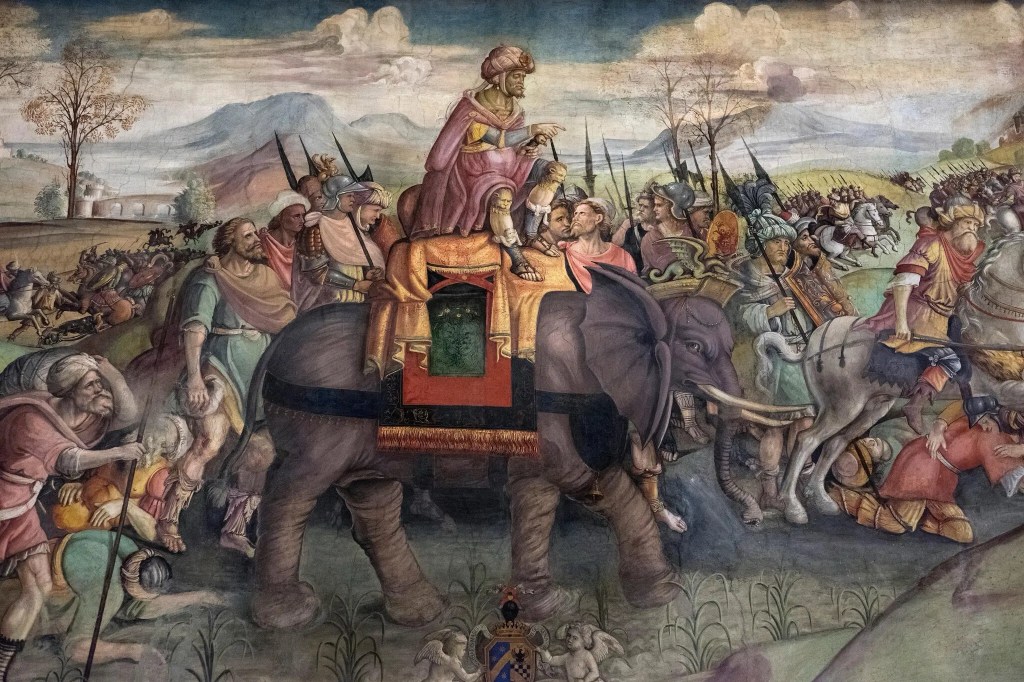
A Renaissance-era fresco attributed to Jacopo Ripanda depicting Hannibal on the back of an elephant during the Second Punic War, in the third century B.C. Credit… Adam Eastland/Alamy. [New York Times caption and illustration]
ELEPHANTS ARE EMINENTLY SENTIENT
Of course they are, you ninny. So is an Amoeba in its way. But these big beasts In magnitude are titans of sweetness; Matriarchal, family prone, pacific, Communicative browsing herbivores.
Pressed upon a time into the misery Of cock-besotted, bipedal mammalians, Elephants were frogmarched to a bitch Of a wreck by a puny Punic horde, Martyred on the cross of a mountain.
Well rest you, tusk-shorn Surus, last to fall! Where justice reigned, God were a Pachyderm Enthroned up yonder, trumpeting on high, Mounted on a hellion known as Hannibal, Riding eternally the bastard in the sky.
DAPA and something about gender orientation and ethnicity are common data points in Poetry’s thumbnail profiles of contributors to the magazine. They’re like snapshots of bodybuilders flexed for pose-off. Musculature duly noted, but here’s what’s truly interesting:
How do you get around? Car? Bus? On foot? Content of your fridge and spice rack at this moment? Where do you write? If by a window, what’s the view? Favored travel destination? How do you decide verses need to go public?
Do you say “glow worm” or “lightning bug”? “Seesaw” or “teeter totter”? Does “route” rhyme with “rout,” “root” or neither? What about “hoof” and “hooves”? Pray for “peace” or for “victory”?
Distilling such info into an essence is challenging, but that’s the point. You’re a poet! Say something revelatory and evocative about yourself in two or three sentences.
This is me:
I avoid shelf-stable soy milk in favor of the “fresh” stuff. I’d choose “peace.” My recipe for a getaway is a bicycle equipped with pannier and the Upper Peninsula in the Fall. Lightening bug, seesaw, rout.
If I named God, I would name him more like a boat than a dog, but more like a dog than a dead relative. (Leslie Sainz, from “When I imitate myself, I am a number of certain people,” Poetry, January-February 2026)
The God I grew up with promises the wicked they’ll experience undying agony after they die. There’s a better post-death outlook for the non-wicked. By rights the godfearing fear God.
Is it possible to shop Gods? There’s a jealous God and an indulgent God. One personal and familiar, One high-and-mighty, stern but loving, vice versa. An almighty more-than-One, with many shapes or None, an ever-All-ness and back-of-Beyond-ness. There’s faith in a Her, in a Them, in the “primitive” God of the “savage,” and in ritual devoid of the divine altogether.
Capitalize what you will, it’s able to be rendered cult. Religion walks on water and rules the sky.
What about richness of possibility, plausibility, ineffability, of god -head and -hood and -lessness that’s conceivable or inconceivable, actual and latent, plural or unitary, unbelievable and doxological, above all supremely stateless? Does worship need sharp elbows?
No sé. I don’t know. They’re important words in any language. I know that I feel, if not what I feel, when a poem goads me into articulating what skirts the edges of speech. That sentence cloaks confusion in some kind of dress. It may be to say that I don’t know what the poem says other than it speaks to me — and this is irony — wordlessly. What’s conveyed floats over, under, around and through the friction it generates on the page. Azurea’s Spanish has a pellucid, propulsive quality that crests like a swell summoning me to body-surf it in English. That’s the unruliest simile I can fabricate for the sweet consternation induced by intruding upon someone else’s fugitive lyric.
OCTOBER WITH WINGS by Azurea20 translated from Spanish by JMN
Before her the greatest certitude lacks importance
and the voice which names her ceases to be mine.
How to abandon the me. How to abandon the me, to create from nothing. To be a god, or goddess. To dig down deep where pronouns don’t exist, digging to where the verb is, where the act is conjugated, where the tatters of life are mute, at rest, ceasing to air their rifts.
What’s conjured steers between a school of synchronized fish, a forest of silent beeches, an unfathomed ocean, a mountain sheltering misfortune. I don’t know.
Maybe the embrace of river with sea… and Certitude. Certitude, I say.
Frente a ella, la mayor certeza carece de importancia
y la voz que la nombra deja de ser mía.
Cómo abandonar el yo. Cómo abandonar el yo, crear de la nada. Ser un dios, una diosa. Cavar hondo donde no existen los pronombres; cavar donde existe el verbo, donde el acto se conjuga, donde los harapos de la vida enmudezcan, reposen, dejen de airear sus desgarros.
Camina el conjuro entre un bancal de peces sincronizados, un bosque de hayas silenciosas, un océano incomprendido, un monte que acoja la desdicha. No sé.
Tal vez el abrazo del río con el mar… y la Certeza. Digo: la Certeza.
The gentleman from Kentucky rises to… say something.
Some burger joint names are hard to pin down. The following excerpt is from MySA (“My San Antonio”).
Whataburger rival ramps up expansion with new $1M Texas outpost. This is the third Shack Shack coming to the Austin area in 2026. By Cristela Jones, Austin Trending Reporter Jan 9, 2026
Last spring, Shake Shake filed a TDLR for its first $980,000 location in Georgetown, a suburb about 34 miles north of Austin. Now, the chain will be moving into another Williamson County city down the road.
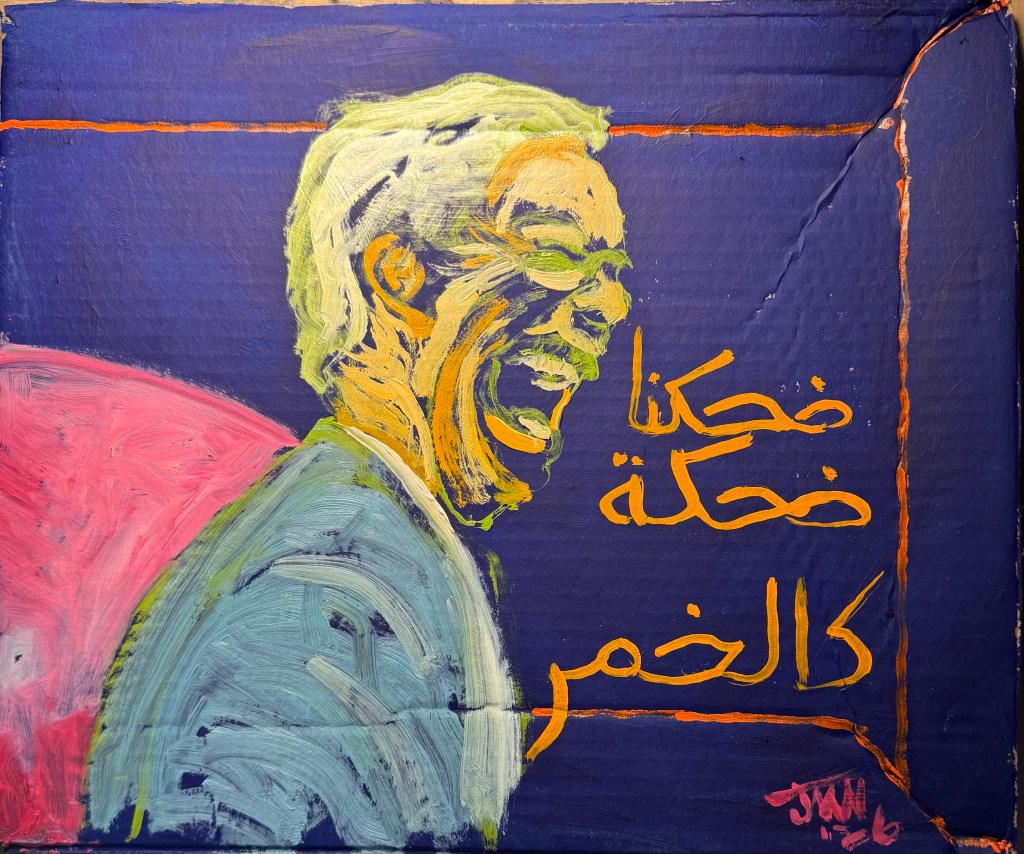
ḍaḥik-nā ḍiḥkaẗ(an) ka-l-ẖamr(i) “We laughed a laughter like the wine.” The phrase is from a poem by Haidar Al Abdullah titled Tarajjal yā ḥiṣān. I like to translate the title as “Make Like a Man, O Horse,” and the phrase more freely as “We spilt laughter like wine.” Their respective published translations by Yaseen Noorani are Go Dismounted Like a Man, Horse and We let out a vinous peal of laughter. (From Tracing the Ether: Contemporary Poetry from Saudi Arabia, ed. Moneera Al-Ghadeer, Syracuse University Press, 2026.)
RULE OF GOLD Treat others like you want to be treated.
RULE OF IRON Believe in Me or else.
RULE OF THUMB Steer into the skid.
TOLERANCES “Every trade works to different tolerances. Steel workers aim to be accurate within half an inch; carpenters a quarter of an inch; sheetrockers an eighth of an inch; and stone workers a sixteenth.” (Burkhard Bilger, “The Art of Building the Impossible,” The New Yorker.)
The Greek derivatives in English spurt from a font of abstruse vocables that gives us, say, “dithyramb” — “a passionate or inflated speech, poem or other writing.” It’s a short hop to coinage such as “pithyramb” — “a passionate or inflated instance of pith” — proffered by… wait for it… a “pithyrambo.”
Take Hemingway, whom many of us cite unread. One of his characters says something like “bankruptcy comes on gradually, then all of a sudden.” A certain Ms. Clausing quoted in The Times pithyrambed it shamelessly:
… Ms. Clausing, the U.C.L.A. economist, warned against assuming that just because Mr. Trump’s policies haven’t harmed the economy yet, they never will. “The long run takes a long time to arrive, and when it comes it comes with astonishing swiftness,” she said.
As we await the long run’s arrival let’s kill some time tinkering with Woody’s ditty:
THIS LAND IS OUR LAND (Call and Response)
This land is our land (That land is our land) From th’ shores of Green Land (To th’ Cuban Eye Land)
From fair New Found Land (Where’er we lay hand) To th’ Hemisphere’s End (Or where our troops land)
Your land is our land (There is our Home Land) (ICE Land is MY Land) (Mar-a-La-GO-Land)
All real estate grand (A place to grandstand) Snooty Switzer-land (Little Saint James Land)
All mine to COM-mand (Kiss thy behind land) The former Rhine Land (All thine to DE-mand)
How do we rue you, cunning tongue? Grant us, sir, spit out a lung. Perdition’s grease fire. Odium’s pimp. Perversity’s pal. Plague’s piece of tail. Malice engorged. Enormity in a suit. Torrent of keening. Badmouth bard. Punch down, PUNCH HARD!
Swervy weaver. Voyeur warrior. Randy prancer. Double downer. Pope of payback. FULMINATOR! Pulling woolster. Sharp practitioner. Dirty trickster. Spurning truther. Crimson wattle. Rights reneger. Dodge disaster. CASTIGATOR!
Hustle’s apostle. Carnage’s barker. Deferment’s dandy. Decency’s bruise. Putter’s potentate. Pageant’s peepster. Casino’s crap shot. Crypto’s mule. Columbia’s thorn. Liberty’s blindfold. Spurred heel. Sultan of feel. Man of steal. HELL OF A DEAL!
Remarks by podcaster Jason Staples have led me to ponder the notion of “original” language relative to scriptures widely known via translation. My attention was drawn to Staples’s comment that the Book of Revelations “has mixed metaphors all over the place.”
… The Greek of Revelations comes off as very clumsy, reads like someone who is not exactly a native Greek speaker, or… well trained… Greek writer. This is someone who probably is multilingual and probably a Semitic speaker of some sort who is writing in this way.
Where Staples gooses the matter to the throaty pitch of a hermeneutical Harley is in asserting that “the messiness of it is also part of the design.”
And I think there are certain places where the grammar and so on is clumsy in ways that force you to kind of have to grapple with that aspect of it. I think the messiness of it is also part of the design, even, that forced you to deal with those mixed metaphors…
The rhetoricians will have a Greek term filtered through Latin for argument premised on convictedness drawing foreordained conclusion qualified by contingent disclaiming. Still, I’m attracted to the venture of tilting with refractory text through a grammatical lens as a discipline that courts illumination.
There’s that moment where the thunder — he hears “the thunders” — and he’s told, “Don’t write that down! Seal that up!” And that in some ways is I think the book communicating that, like, look, there’s a lot about this stuff that you’re just not going to be able to get, and that’s okay. There is a mystery that from the earthly perspective, from this side of heaven, you’re just, you’re not going to really fully understand, you have to get the angle from, you know, from heaven down, you have to get the God’s eye view to understand, to hear what’s going on, and you don’t have that luxury, but don’t worry, it’s under control.
This sort of language stymies communicative logic, but poetically and confessionally it has a grappling aspect not easily discounted.
 EthicalDative
Degrees, Accolades, Publications, Affiliations (DAPA)
DAPA and something about gender orientation and ethnicity are common data points in Poetry’s thumbnail profiles of contributors to the magazine. They’re like snapshots of bodybuilders flexed for pose-off. Musculature duly noted, but here’s what’s truly interesting:
How do you get around? Car? Bus? On foot?
Content of your fridge and spice rack at this moment?
Where do you write? If by a window, what’s the view?
Favored travel destination?
How do you decide verses need to go public?
Do you say “glow worm” or “lightning bug”? “Seesaw” or “teeter totter”? Does “route” rhyme with “rout,” “root” or neither? What about “hoof” and “hooves”? Pray for “peace” or for “victory”?
Distilling such info into an essence is challenging, but that’s the point. You’re a poet! Say something revelatory and evocative about yourself in two or three sentences.
This is me:
I avoid shelf-stable soy milk in favor of the “fresh” stuff. I’d choose “peace.” My recipe for a getaway is a bicycle equipped with pannier and the Upper Peninsula in the Fall. Lightening bug, seesaw, rout.
(c) 2025 JMN — EthicalDative. All rights reserved