The family must have had a matriarchal streak, for I was grandly mothered.
Grandmother had a choir-dominating soprano voice in the native stone church. She knew her way around the hymnal. Could coax some harmony from the ivories of an upright piano. Reveled in a good singin’ in the living room: Rock of Ages, The Old Rugged Cross, Bringing in the Sheaves.
When Elvis reached the West Texas scene, she sniffed that she couldn’t fathom how anyone could find his music pretty. In its way her assessment was accurate. It wasn’t.
Oh, she could curse, and kept a shotgun in her kitchen in the day — it was a wild, lonely place and lean times. But her nature was sweet. She was a placid, benevolent, stalwart, indulgent, inquisitive, supportive, gregarious, voluble presence. A loyal correspondent in a strong cursive hand.
I never knew her as “granny” or “nana” or the like. She was Grandmother.
Only once before have I presumed to “write a song.” I use scare quotes because I’ve really no idea how it’s done. This latest go-round involves new lyrics for an existing tune. I posted the first version here, and have since added a coda. The last line of the posted version is changed to:
Old roan horse, she’ll lead me to you. (versus Old roan horse, she’ll know what to do.)
I had rejected the “lead me” line earlier, feeling it was implausible on top of sentimental, too close to Disney. Horses return to where they’re fed, and they don’t play Lassie. But here’s the thing: Whereas sentimentality pollutes poetry, it sits pretty in songs. Songs are not poems, nor poems songs (in my view).
The coda is a fourth stanza with a diverging rhyme scheme (AABB) sung with melodic variation. Reprising certain imagery, then invoking redundantly the bondedness of the humans to each other and to the beast, makes the story arc feel more complete:
We’ll tarry a spell where the shadows grow long, Lay us down softly in mourning dove song, Then the old roan horse will carry us two, The two of us home on her back, me and you.
An interesting trait of songs is their affinity with nonstandard grammar. She don’t, he don’t or it don’t often fits a country-western song’s rhythm and spirit better than “doesn’t.” The same is true with “ain’t” versus “isn’t” or “aren’t.” Songs are amenable to nonstandard or antiquated usage. I was aware of using beat-driven idiom in previous stanzas of the “Roan” lyrics:
A sip of sweet water is nought but her due … The ranchwoman gazes where last she did see Her good man a-mounted set out for Old Blue
We embrace old-timey, emotive, even mawdlin language in minstrelsy and balladry which we would find distracting in other contexts.
So in my lyrics, the cattleman’s horse has wandered home riderless. The ranchwoman mounts it and rides to where her husband lies in some disabled state. Maybe she splints his injured ankle and the two return home double mounted. Maybe she finds him dead from a rattler’s bite, and returns with his body draped across the saddle. Perhaps, in grieving over his corpse in cottonwood umbrage at creekside, enveloped in the lonesome plaint of mourning doves, she herself expires, plumb heartbroke, and the two of them go dearly departed, spirit-wise, into the cosmic by-and-by, transported on the back of an astral roan. It could happen — it’s a song!
My car radio is newly parked on my local country-western music station. It’s giving me the opportunity to hear music tangled in my ranch roots. The music partakes of both the familiar and the strange. In certain respects I’ve changed and it hasn’t. Or maybe I thought I had, and it has — knowing what’s true is all but impossible these days.
The vocals seem weighted male, and have a strong-arming thrust to them. I suppress a reflex to run from these guys. Yet they’re telling me something I need to stand and hear, which is the voice of an America that elected MAGA.
Johnny-Cash-like baritones are rare in current country-western. In its classic conformation, the genre is the domain of the nasal tenor with a drawl. The celebration of women is jauntily sexual alternating with ostentatiously reverential. There’s many a gusty apology to a long-suffering woman for having strayed while liquored up. I’m changin’, honey!
The songs occupy a tightly defined range of key and chord sequence. The lyrics are comfortable with unabashed schmaltz. The fellas sing about their feelin’s with loquacious earnestness and stick-to-your-ribs wit. It has taken me aback how verbal the songs are. Almost every ballad leaves me doing an eye roll, yet singing its hook at the next stoplight. This is music running strong in deep fissures.
Vibes gleaned from the radio coalesce around a resounding affirmation of contentment with a personal and cultural status quo. The troubadour is profoundly proud of who he is, what and where he comes from, resolved to be none other. There’s an exaltation of, and exulting in, rural landscape, the old ways, talking damn straight, standing tall for the Protestant red-white-and-blue.
The paeans to we’uns (apologies — the pun is decadent) go with slaphappy scorn for the mincing modalities of the nabobs of knowledge, the prissy castrati, the preening city dwellers who haven’t a clue as to what it’s all about.
I relish the tension that exists between certain verb pairs often used as roughly synonymous. This isn’t scientific, but here’s how I think of a couple of common verbs: “Look” describes the action of directing the eye to a focal point. “See” connotes cognitive reception of what the eye has detected. “Listen” describes the action of focusing the aural faculty on sound. “Hear” connotes cognitive extraction of definition from the noise.
Consider this exchange:
— Did you see the tiger? — No, I thought it was a shadow.
Or this exchange:
— Did you hear the explosion? — No, I thought it was thunder.
Of course in each case the second speaker could have prefaced his answer with “yes,” followed by the same wording. It’s still a statement that something was picked up by the sensing faculty, but was not made sense of by the cognitive faculty. It was “translated” erroneously.
I want to compel the meditation to encompass “read” versus “understand,” with specific application to poetry. At one time I thought that rhythm and rhyme, metaphor and simile, were meant to give more immediate effect to poetic discourse, to make it easier to remember by being memorable. “Wine-dark sea” registers and lodges.
But it’s more realistic, I think, to posit that the poet, often as not, injects friction into the reading experience, such that the payload carried by the text may not be readily apparent. My use of the term “payload” betrays a bias that the sense-making reflex of the human is indomitable. We look for meaning, within, beyond, beneath the wording, wherever we can extrapolate, imagine, concoct it. The doing so goes with language, which is what poetry is built from, on, with and around.
I scrounge for analogies with which to evoke how verses can feel:
X-ray language: A configuration of bone. Animal or human? A wrist? A wing?
Scaffolding language: Erected around an indistinct edifice. Bell tower? Skyscraper? Rocket?
Disarticulated language: A stream of lexemes with sparse intercalation of relators, no capitals, no punctuation, ragged lineation. What is its “story” when the dust has settled?
There’s a rhetorical much-making around “stories” in Poetry, March 2025.
stories span through time alongside life, stories extend with prayers, stories extend with songs, stories extend the stories are still moving (Manny Loley, from “From the Mesa: A Reflection on Language, Poetics and Personhood”)
Go on, soi-disant poet, spin me a story. Make it short, tart, square, level and true.
English isn’t made for rhyming compared to Spanish, French or Arabic. Alliteration was its strong suit of old. My title flaunts it with a homophone. It also goes to town on sibilants, which is icing on the cake. That’s a metaphor.
My fellow Americans, a veritable warlock’s brew of billingsgate and contumely is fermenting in our musky juices. I’m sure I didn’t dream it — surely? — but read somewhere that the land’s unelected executive co-pilot tooted on his social medium that persons opposing some view of his should go “fuck their faces.” How do you even?
From my favorite tech podcast helmed by The New York Times’s Kevin Roose and Platformer’s Casey Newton, I learned that Butthole Coin is a real memecoin, marketed on pump.fund as “The Foundation of Flatulent Finance.” Its market cap at the time of Kevin and Casey’s broadcast was $40 million. Pump-and-dump schemes are thriving, and nowhere more than in the precincts of the poobahs.
On my country-western radio station a song’s hook was “Don’t drive your truck when you’re all tanked up!” I’ve got to track down the female artist, because I love her saucy ditty. While a train kept me stalled at the railroad crossing, a snatch from another song said something like, “I want to wake up with you in the back of my truck and start all over again.” A man’s pickup truck is the vehicle of romance in this part of the country. The “bed” of a truck is a metaphor in its own right. It’s where an F-150 mates with its load.
An ad on Hardfork spoke of Source Code, the title of Bill Gates’s new book about his “origin story.” “It’s not about Microsoft, the Gates Foundation or Technology,” says the ad. That’s a daring publishing move: Title a book with a term of art from the domain which made its subject famous, in order to have to assert that the book is not about that! Here’s the title I would give to a memoir by the graying eminence of Redmond: My Voice Never Changed.
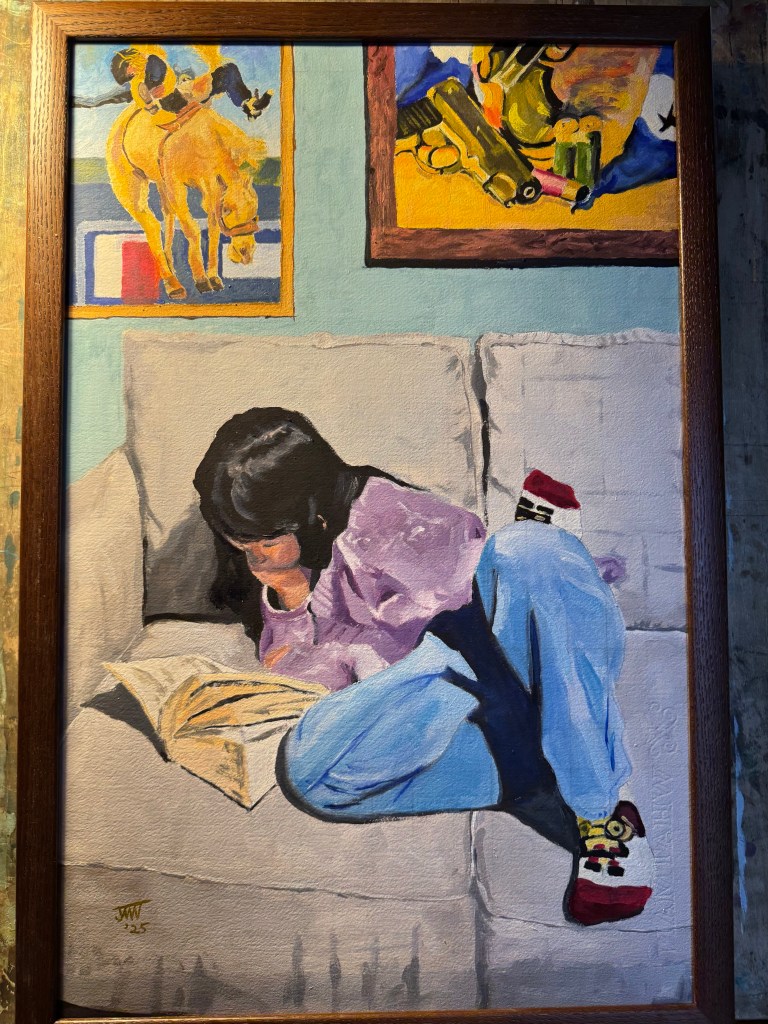
“Figure Reading a Book,” oil on paper, 16 x 25 in. (JMN 2025).
My title is the ending tag line of “JOHANNE SACREBLU[E] ‘el musical’ un homenaje a EMILIA PEREZ.” Adapted to the English formula, it means “Thanks to each and every one of you.” Camila D. Aurora is the artist behind the no-budget parody “filmed on the streets of Mexico City with Mexican performers.” The article linking me to the video is here. It has useful background for what triggered the spoof. (Hint: The film “Emilia Pérez,” helmed by French director Jacques Audiard, “tells a story set in Mexico but was mostly shot in Paris with a mostly non-Mexican cast.”)
“Johanne Sacreblue” is tagged “Una Película Muy Francesa” (A Very French Film), and its dialog is a gloriously garbled mix of ruptured French spitroasted at uproarious demotic velocity with wicked-wondrous Mexican Spanish punishing the uvular ‘r’ and the mixed vowels mercilessly.
Disclosure: I’ve studied Spanish and French since childhood, and I understood perhaps half the dialog in my (so far) single viewing. It doesn’t matter, that’s partly the point, and the visuals tell themselves, a saucy comedic cross between mime and mummery. The “plot” enacts over-the-top musical melodrama around a faceoff between the baguette and the croissant, with yeasty, below-the-belt symbolism attached to each Gallic icon for the staff of life.
If you have 28 minutes to invest wisely, watch this video. It trumps whatever else you had planned for those minutes. If it turns you off, tant pis. (Translation with soupçon of irony: “I’m devasted with sympathetic regret.” Pas tellement.)
“She went to girls’ schools and was taught French, and history, and geography, and music, and painting, the usual things that a… middle class? You might say middle class. She was really more of the sort of upper yeoman peasant class. Her father was, at any rate.”
The quotation refers to Mary Anne Evans (1819-80), aka George Eliot, and is from the BBC4 podcast titled “Middlemarch” of April 19, 2018. The comment is by Rosemary Ashton, Emeritus Quain Professor of English Language and Literature at University College, London. (Should that be “Emerita Quain Profesoress”?)
I assume “Scarborough Fair” is an old melody, though it’s sometimes hard to distinguish what’s echt and what’s ersatz in the matter of “traditional” airs. Simon and Garfunkle did a defining version of the song for my generation. I like to hum the melody and chord it on guitar, but I’ve contrived words to it that are closer to my own experience.
They evoke my grandmother’s tales of the rigors and sweetness of ranch life. She was a tough, sentimental woman with a knack for storytelling. Ranching between the Wars in Chihuahuan Desert country of a county bigger than Connecticut was no picnic. A thousand-and-one mishaps could befall a lone rancher riding fence (looking for breaches), checking watering holes, locating strays, etc.
Grandmother had responded to a number of crises in her day. Her dread of a horse returning riderless to the house impressed me. Mounted or not, a seasoned work horse would make its way back to the barn from even the furthest pasture, which was by way of being a distress call of its own devising, triggering an anxious search for the rider. Old Blue was the tallest peak on the family ranch in the Glass Mountains.
***
Are You Riding the Strawberry Roan? (To the tune of “Scarborough Fair”)
Are you riding the strawberry roan? Grass is green at the foot of Old Blue. If you are tired, dear, give her some rein, Old roan horse, she’ll know what to do.
Fence mending’s done and the shadows are long, Creek’s running fresh at the foot of Old Blue. Tarry a spell there in mourning dove song, A sip of sweet water is nought but her due.
(Instrumental bridge — where I pick-and-canoodle something resembling an instrumental solo)
The ranchwoman gazes where last she did see Her husband amounted set out for Old Blue: Dear, if you’re not able to come home to me, The old roan horse, she’ll know what to do.
My granddad put reverse English on his curses with statements such as: The blessèd cinch strap on this saddle is busted! And my uncle by marriage had the same name as a legendary western outlaw, but shared no other trait with that scoundrel. “Scoundrel,” in fact, was his strongest insult, except when compounded in a rare extremity of exasperation into “confounded scoundrel” with stress on the CON-.
The family trivia has little relevance except to point out that if Mr. Trump swore like a West Texas rancher, his repertory could include invective such as:
That blessèd Gavin Newsom, the confounded scoundrel who governs California!



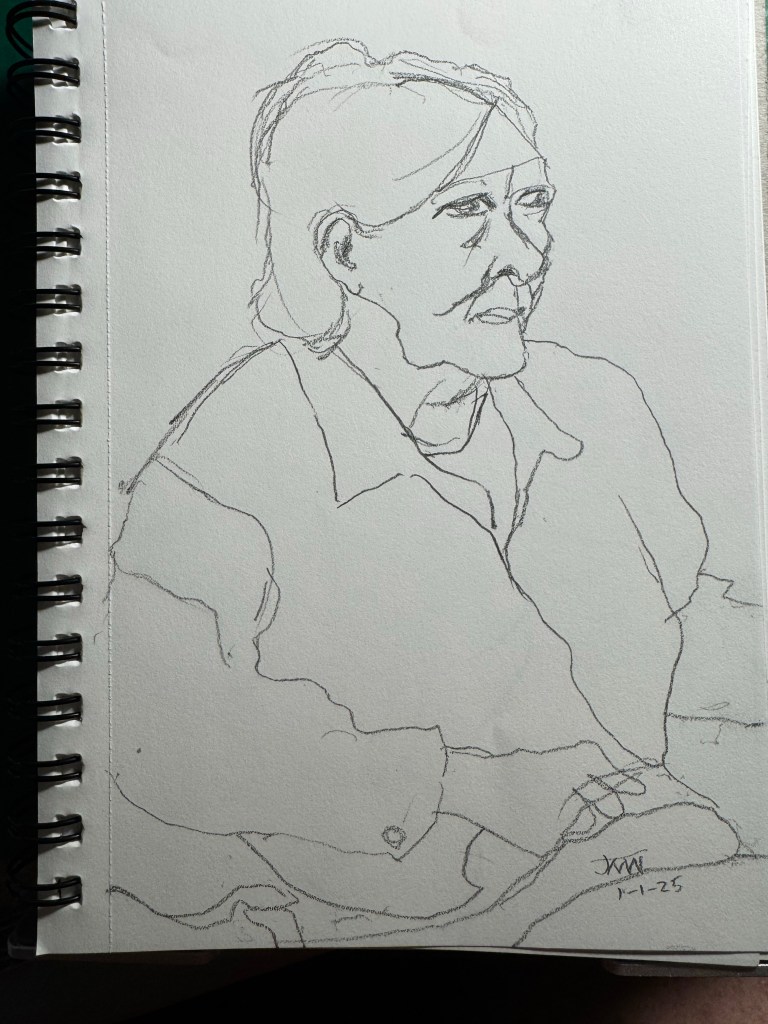

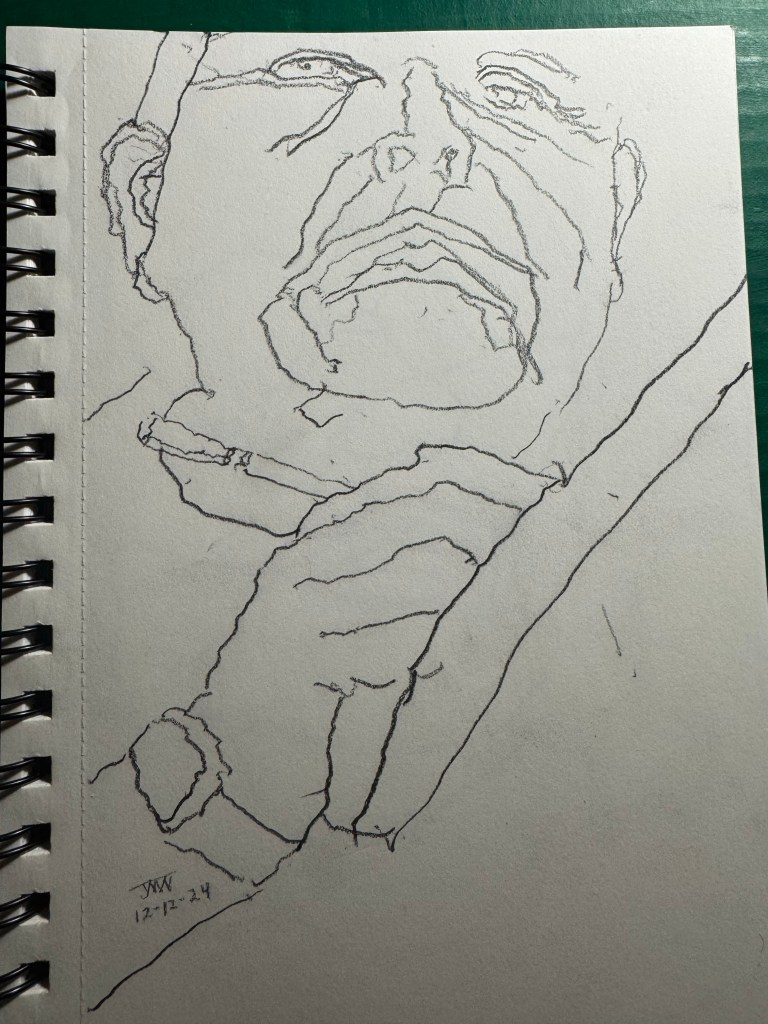


When You’re Gagging on Humbug, Remember Someone Fondly
The family must have had a matriarchal streak, for I was grandly mothered.
Grandmother had a choir-dominating soprano voice in the native stone church. She knew her way around the hymnal. Could coax some harmony from the ivories of an upright piano. Reveled in a good singin’ in the living room: Rock of Ages, The Old Rugged Cross, Bringing in the Sheaves.
When Elvis reached the West Texas scene, she sniffed that she couldn’t fathom how anyone could find his music pretty. In its way her assessment was accurate. It wasn’t.
Oh, she could curse, and kept a shotgun in her kitchen in the day — it was a wild, lonely place and lean times. But her nature was sweet. She was a placid, benevolent, stalwart, indulgent, inquisitive, supportive, gregarious, voluble presence. A loyal correspondent in a strong cursive hand.
I never knew her as “granny” or “nana” or the like. She was Grandmother.
(c) 2025 JMN — EthicalDative. All rights reserved