
‘Romer’s Gap’ by Tian-Ai is published in Poetry, January/February 2024.
Romer’s gap, supratidal, intertidal, subtidal, fly agaric, snailfish, and aphotic are terms I boned up on in scaling the text.
Italic print sets off three sections, headed by the tidal terms, and one quotation. There are no capital letters. The text is comprised of commands (draw back —) and noun phrases (fear of grief).
draw back —
fear of grief.
disdain toward
desired thing.
The speaker speaks to the speaker’s self in shorthand, as if jotting things in a Field Notes 48-Page Memo Book that fits in a shirt pocket or lab coat: perceptions, associations, phraseology registered on the fly.
— tsunami:
fly agaric.
herbalist porn fantasy.
vivisection.
simultaneous orgasm atop lab table.
Coherence emerges on the wings of inference when one notices punctuation. Periods are pivotal, helping to extrapolate statements from cryptic enunciations. Em-dashes and colons connote connective pauses. Of commas there are two; they’re helpful. Stanzas organize the flow; they capture discrete psychic events: lab experiences, biomarine observations, internet forays, carnal rumblings, note taking, perhaps staring out a window and letting a reflective mind roam (through window, cormorants / arrow into the sea.)
google medieval torture boxes.
google eradication of female
genitalia without mutilation.
carve orifice out of fruit.
toy with idea of sharing.
in sunlight, anemones
ball their fists.
write text.
delete text.
note several ways to hide.
That rare declarative sentence couching an arresting description — in sunlight, anemones ball their fists — is notable also for its violent enjambment spanning a stanza break.
Intrigue centers around certain of the speaker’s self-directed exhortations. They seem to reflect a grappling with the world and with feelings it lights up. Here are key imperatives sliced alive (vivisected!) from the poem:
draw back — […]
suppress memory.
unsuppress memory.
withdraw permission. […]
The poem turns a corner unearthing a childhood list of desired objects:
nautilus
cidada husk
tender zing of
freshly toothless hole —
permission granted:
The mementos are admitted to the mind’s workings. Perhaps they bridge the gap in the speaker’s own fossil record. The permission — to be impinged upon? bestow access? — withdrawn earlier is granted now, culminating in an achieved resistance, or perhaps a fortified self-containment:
emerge immune
to rapture.
Immune, not prey, to rapture. Thank goodness for facile conclusions forgone; the well-trod path would have led to rapture realized — a being sucked up rather than a taking hold.
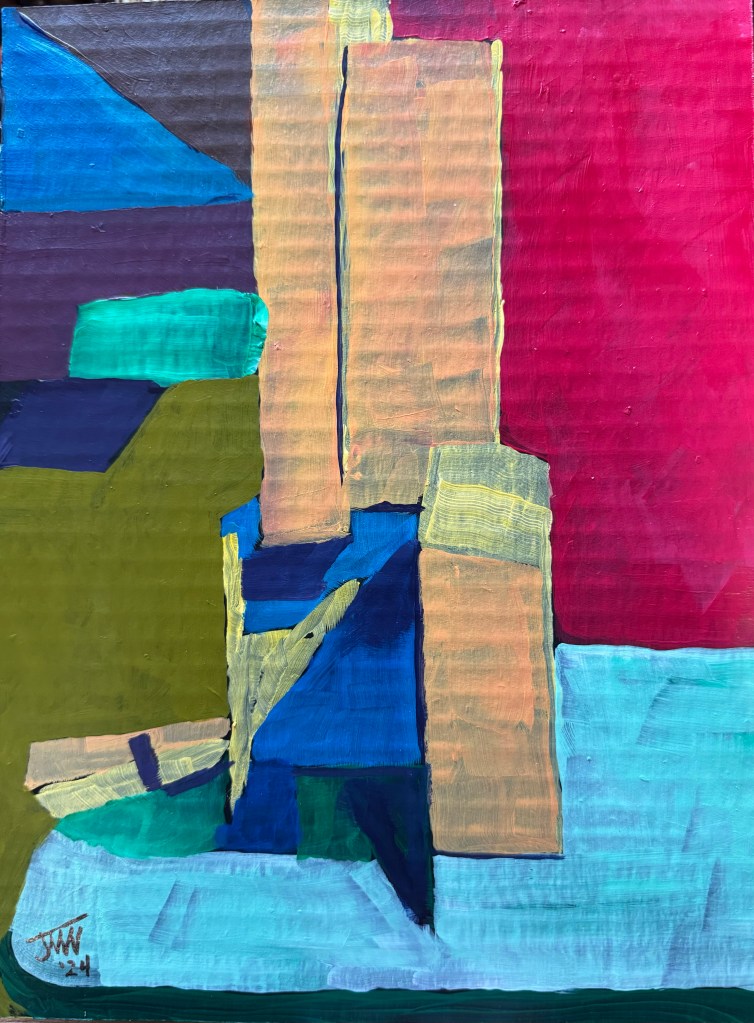
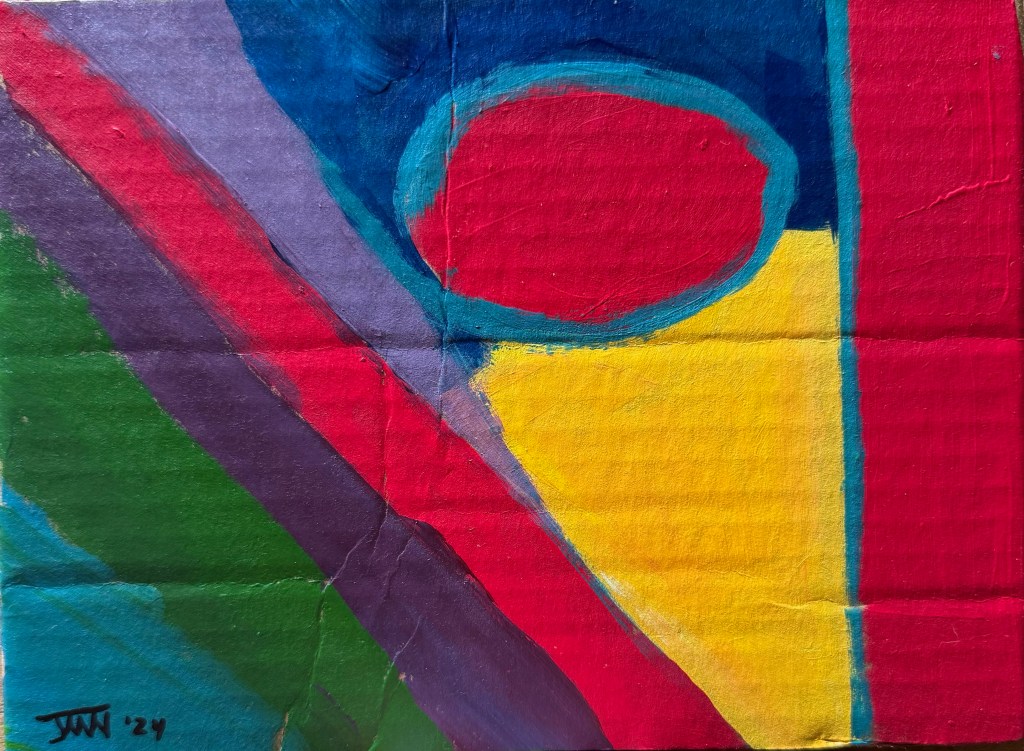
The poem leaves me keepsakes. I make out a spicy exhortation which I can take on board, especially in my painting (sometimes in life):
for once,
careen.
I also borrow a clue on how to navigate poetry’s dark reaches:
in the aphotic zone, creatures must conjure
their own light.
Carve orifice out of fruit. Yes! I’ve no idea whether I’ve intersected with the several ways to hide which the poem reifies, but my privilege, indeed function, as reader is to own what the text makes me, not its author, see.
(c) 2024 JMN — EthicalDative. All rights reserved









 EthicalDative

What’s in a Name?
Ask César Cuauhtémoc García Hernández, holder of the Gregory Williams Chair in Civil Rights and Civil Liberties at Ohio State University. Ask Atahualpa Yupanqui (1908-1992), born Héctor Roberto Chavero Aramburu, holder of a guitar in Argentina.
Ask Helen-Marie Lyon-Dalberg-Acton, wife of David Runciman, 4th Viscount of Doxford. Ask Sixtus Dominic Boniface Christopher Rees-Mogg, 6th son of Sir Jacob William Rees-Mogg (elder sibling of Annunziata Mary Rees-Mogg) and wife Helena Anne Beatrix Wentworth Fitzwilliam de Chair. (These are living people as we speak on 16 Mar 2024.)
Do not ask J.R.R. Tolkien, J.K. Rowling, C.S. Lewis, E.M. Forster, G.K. Chesterton, D.H. Lawrence, P.G. Wodehouse, P.D. James, J.B.S. Haldane, H.L.A. Hart or A.S.D. Smith.
As a child I would say, “Mother, I’m a lone, lorn crittur and everything goes contrary with me.” She would raise her eyebrows approvingly and murmur, “Now, now, old mawther.” (Or was it “There, there”?) Mrs. Gummidge’s lament was our bond. Mr. Micawber inhabited our deep lore.
(César Cuauhtémoc García Hernández, “This Immigration Bill Was Never Going to Fix the Border,” New York Times, 2-7-24)
César Cuauhtémoc García Hernández is the author of “Welcome the Wretched: In Defense of the ‘Criminal Alien’” and holds the Gregory Williams Chair in Civil Rights and Civil Liberties at Ohio State University. [New York Times biotag]
(c) 2024 JMN — EthicalDative. All rights reserved