Hospital staff members, children and patients during a day trip near the Saint-Alban Psychiatric Hospital, circa 1950. Credit… Baldran Collection, Saint-Alban-sur-Limagnole. [New York Times caption and illustration]
“Gathering, touching, connecting — these are Tosquelles’s methods.”
This article highlights an exhibition at the American Folk Art Museum in Manhattan that will end on August 18, 2024:
The Catalan doctor Francesc Tosquelles was “a psychiatrist who spent decades dismantling the hard bars between illness and health, pathology and normalcy, artists and everyone else. He drew on Freud and Marx, and also on his experience as a refugee, in exile from Franco’s fascist Spain.”
Auguste Forestier’s sculpture “Untitled (Boat),” 1935-1949, opens the exhibition at the American Folk Art Museum. Credit… CNAC/MNAM, via RMN-Grand Palais/Art Resource, NY. [New York Times caption and illustration]
Against the historical trauma of fascism, war and displacement, Tosquelles built radical psychiatric practices around non-hierarchical relations between patients, doctors and their neighbors… He also encouraged his patients’ creativity, which put him at the confluence of Modernist avant-gardes and Art Brut. All these ideas converged at a psychiatric hospital in Saint-Alban, a small village in southern France, where Tosquelles worked from 1940 to 1962.
Marguerite Sirvins, “Landscape With Boats, Hunters, and Animals,” circa 1944-1955, rayon thread embroidered on fabric. Credit… Musée LaM. [New York Times caption and illustration]
Tosquelles also instructed his colleagues in psychoanalytic concepts and trained local people in basic psychiatry. With fascists on the march and decades of unthinkably brutal war, it seemed clear to Tosquelles that just about everyone needed therapy. If the affliction is social, he reasoned, the treatment must be too.[My emphasis — JMN]
”Untitled (Known as ‘Myrllen’s Coat’),” circa 1948-1955, a cloak covered in pale blue curls, heart-shaped groups of figures and illegible letters, made by a woman named Myrllen. Credit… Tennessee State Museum, Nashville. [New York Times caption and illustration]
The story behind “Myrllen’s Coat” is poignant:
Its maker, a woman named Myrllen, reportedly experienced symptoms of schizophrenia, and was one of the first Americans prescribed Thorazine. Her harrowing hallucinations subsided, but so did her desire to sew.
(Travis Diehl, “The Avant-Garde Psychiatrist Who Built an Artistic Refuge,” New York Times, 7-22-24)
The IOTD (illustration of the day) is by Ben Wiseman of the New York Times.
She had the effrontery to burden the critics with her good looks. I speak of Yvonne Furneaux.
In a review of a 1955 production of Jean Giraudoux’s “Ondine,” the august British theater critic Kenneth Tynan wrote Ms. Furneaux off as a “buxom temptress” who was “more impressive in silhouette than in action.”
The Daily News of New York described her in a 1958 headline as an “English peach.”
The Australian writer and film critic John Baxter noted her “considerable ability to cringe, flinch and moan.”
Furneaux found at length two Italian “lions of cinema,” Fellini and Antonioni, who allowed her acting prowess to blow past the testicular japes triggered by her allure. She’d taken an Oxford degree in modern languages, and spoke five of them. Studied acting at the Royal Academy. Earned roles in Italian, French, West German and Spanish films. Was married to cinematographer Jacques Natteau for 45 years until his death in 2007. Is survived by a son, Nicholas.
Is living well and long the best revenge? Yvonne Elizabeth Scatcherd was born into privilege saddled with looks and talent. But the blessings of beauty and longevity aren’t necessarily without cost. She seems to have shouldered her condition gracefully: Asked later in life which country had the biggest impact on her, Ms. Furneaux responded: “Italy. Because England taught me everything, but Italy gave me everything.”
(Alex Williams, “Yvonne Furneaux, Cosmopolitan Actress in ‘La Dolce Vita,’ Dies at 98,” 8-2-24)
“Last year the [U.S.] Transportation Security Administration intercepted a record number [of firearms] at airport security checkpoints: 6,737. More than 90 percent of them were loaded when they were discovered.”
(Andrew Keh, “An Olympian’s Awkward Packing List: Toothbrush? Check. Rifle? Check.” New York Times, 7-23-24)
In “Marcos and His Cronies,” 1985–95, Pacita Abad depicts the former Philippine president and dictator Ferdinand Marcos and his cabinet members as fearsome, fanged demon masks. Credit… Kris Graves/MoMA PS1. [New York Times caption and illustration, from Andrew Russeth, “Stitch by Stitch, Pacita Abad Crossed Continents and Cultures,” New York Times, 8-1-24]
Various scriptural matter I read has the theme of the “test” through adversity. Failing the test consigns a person to The Fire — agony until the end of time. Flood, drought, pestilence, persecution, war, Vance, all manner of affliction are to be met with fierce resignation, fierce resolve, fierce piety.
The theme cuts across too many competing revelations for it to be shrugged off as scaremongering. Where there’s smoke there’s Vance. It goes with the requirement that certain beliefs be believed, contingent on knowing certain knowledge conveyed in certain writings via certain spokespersons deputized by an omniscient.
The thesis that belief comes through right knowledge is potent, but what about wrong knowledge? It, too, can foster belief. Is there “true” versus “false” belief? Which is which, and says who? One man’s heresy is another man’s gospel. What, truly, is “ignorance” anyway? Absence of truth? Presence of Vance?
There’s usually an evil angel known as Whore of Babylon on hand, but don’t listen to him (remember The Fire). Whore’s job is to sow seed of Vance in the vineyard, and he’s damned good at it. I dunno. Maybe Louisiana’s law to display the Ten Commandments in public schools can keep that Whore at bay.
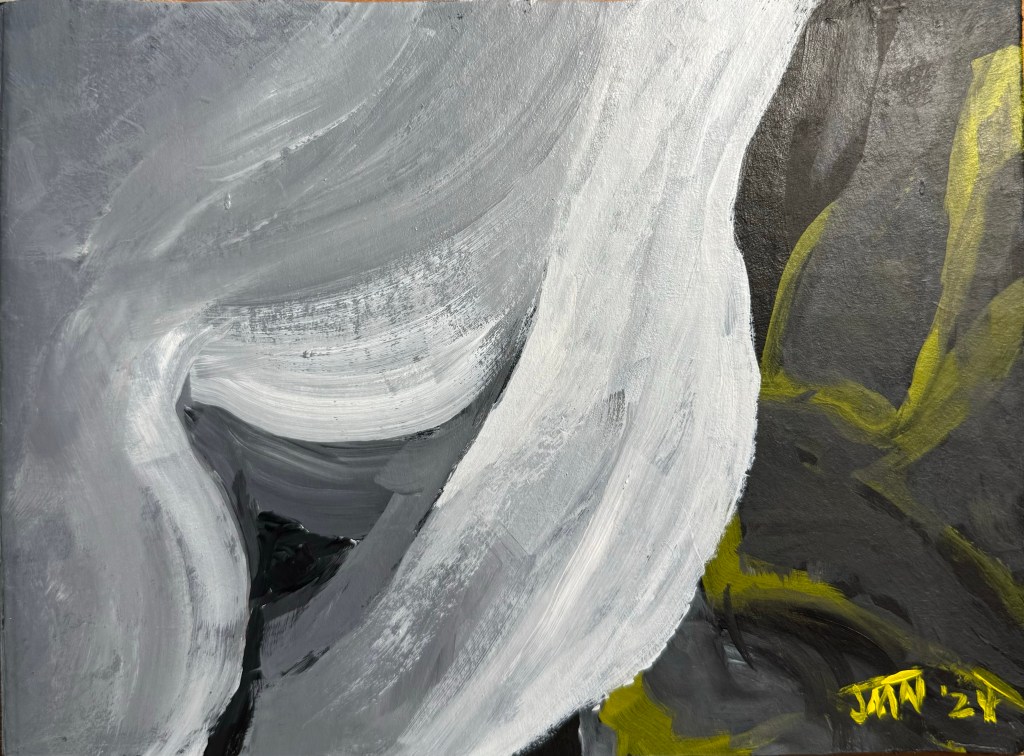
“Forms Arranged Against a Wall,” oil on watercolor paper, 21 x 27 in. (JMN 2024).
The elbow room in ivied halls of bard rapture Has the vastness of atomic space. Let ring lute! — Recorder, mandolin and dulcimer. Let move your lips with mine while reading silently. Let BE our noise! Be louder than it sounds!
A sub-segment of an elite reads literature; a subset of the sub-segment reads poetry. It’s a fit state of affairs for proud stragglers, fringe element, crowd-shy obsessives — the ones who weather linear monsoons, whom verse can bother.
Darling’s “March of the Valedictorians,” on display in the Arsenale during the 2019 Venice Bienale. Credit… Laura Chiesa/Pacific Press, via Alamy. [New York Times caption and illustration]
Verse can have visual ramifications as well as verbal ones. Text commandeers white space on the page in one-off patterns reflecting a close collaboration between author and typographer. The ensemble is larger than the words which are its literal medium. The reader-viewer is granted leeway to court speculation and draw bespoke conclusions as to what they mean.
I’m emboldened to invert the analogy and call Jesse Darling’s lofty chairs a visual poem. I get a kick out of the Turner Prize laureate’s “March of the Valedictorians,” not least for its title, but also for its send-up of the hard-charging achiever class by a salutatorian wit.
[Darling] learned how to weld and began creating his found-object installations, guided by associations he made between the materials and their historical and economic contexts… “Plastic is this zombie medium,” he said, because it does not decompose and is made from fossil fuels derived of dead organic matter. “Steel is a technology of empire that enabled guns, the colonial project.”
(Thomas Rogers, “He Won the Turner Prize. But Does He Still Want to Be an Artist?” New York Times, 6-6-24)
A table with tubes of paint and more collage materials. Credit… Chase Middleton. [New York Times Caption and Illustration]
Artist Sarah Sze was interviewed in the New York Times’s feature titled “Artist’s Questionnaire.” This was my favorite question and answer.
Which work of your own do you regret or would [you] do differently now?
I guess I would say that I don’t think of work that way. Work doesn’t always get better — we know that. When you make something that you feel is very strong, there’s a sense of dread because it’s like, What can you make next?
Torn images that may be integrated into a future painting. Credit… Chase Middleton. [New York Times caption and illustration]
And sometimes the thing that’s next is struggle. Creative resilience is really important; you have to work through bad work to get to good work. The work that doesn’t work makes the next work that does.
(Marisa Mazria-Katz, “An Artist Who’s Been Making Work About Life and Death Since Chldhood,” New York Times, 7-2-24)
“Ojo de Cabra,” oil on cardboard, 6 x 9 in. (JMN 2024).
Ask yourself how often you’ve found yourself in this familiar pickle: It’s late Saturday night and you’ve run out of ammunition. The stores are closed until Monday. It’s beg, borrow or steal some rounds, or else fiddle away the rest of your weekend with empty clips.
Relief is at hand, pardner. A company based in Richardson, Texas, a suburb of Dallas, is taking steps to make being out of ammo a thing of the past.
The company, American Rounds, is rolling out its first ammunition vending machine in Canyon Lake. Individuals who provide ID and a facial recognition scan will be able to purchase rifle and pistol bullets from the machine. Like fallin’ off a log!
And rest easy, friend, it’s legitimate and aboveboard. As long as you’re not convicted of a felony or domestic violence you don’t have to put up with a background check in order to buy ammunition. The CEO of American Rounds says the company’s “protocols” are “within industry standards and state law.”
(Source: Allyson Waller, “The Brief,” The Texas Tribune, 7-16-24).
… I want to say / this is how it started: / there was a mystery / it begged / to be stroked (Alexis De Veaux, “For my love at the time of our ceremony,” Poetry, July-August 2024)
“YxzY” by Ronaldo V. Wilson (Poetry, July-August 2024) is shaped text. It enacts a bulge on the page by means of 30 lines padded with the letter ‘x.’ If you read no further, know that my essential takeaway from the poem — the line I cherish — is this:
[…] to be tested in the wrack wrack of the parlance.
“Test” and “wrack” and “parlance” are germane to the notion of trial by vernacular, ordeal by word. “Wrack wrack of the parlance” crystallizes the attentive deference which a text such as this commands (yes, it says “dwade to the river” and not “wade to the river”).
From the beginning, here are its words:
Is the way xxxxxxxxxxx B when the meetingxxxxxxx went down in the square bizxxx dig my Dream slayin’ imposterxxx transcripts whip Y flag masterslavex dialects Drip drip: in a time like the sex were made fo tastahs choice. xxxxxxxxx
The mention of “dialects” merits attention. Vernacular is evident. The parsing element of my brain wants to make out utterances that may align thus:
Is the way Be [?] when the meeting went down in the square biz [a question?]. Dig [“Observe”?] my Dream-slayin’ imposter transcripts whip Yo [?] flag, masterslave [a command?]. Dialects Drip drip: in a time like the sex were made fo tastahs choice [a statement?].
Interfering with a text in this way is something an author surely hates. It insults scriptural integrity and pokes poetry in the eye, but it’s how the reader with a translator’s vocation rolls. The seeker of an entryway to a walled garden looks for clues: Why is the ‘D’ of “Dream” and the first “Drip” capitalized? Colon after second “drip” noted. (Punctuation is usually helpful.) Look how the line ending in “sex” doesn’t require extra padding. There’s an allusion to Taster’s Choice, a brand of instant coffee. Period after “choice” noted. Allusion to consensual kinky sex posited. Is any of this signally dispositive? Undetermined.
Here’s the rest:
Squid, big up to my ligers in LION-Oxxxxx YELL-O-FAGE is here, a dewey decimalxx System, to flow broke, go back to snap chatxx Attica. A Spun top, up rock — heal the chi’renxx of my guise man pussy dream chair face squat,xx & how many Kisses to the center of m Y creamxxx die dere NordicTrack cuz ain’ much of a wayxxxxx to be tested in the wrack wrack of the parlance,xx go parlor game, into your own way into it yo,xxxx gogoogleogogo parkour weekend in the spy eye,x go to The Guiding Light — ya need a belt,xxxxxx and glasses, and tu, you stink, fat, but orange,x t-sprock. Too much is too much, like gather,xx the pimpgame. Go dwade to the river of thexx extant plant the rim shot in the transgibxx gib dis my language of gong gonxxxxxx $6.45 for my SBucket no freezexxxx dried brown worker in a poloxx Blot twist is the shapexxx and the formxxxxxx Is in whitexxxx My ownxx ICUxx X x x x x x x x
The last word, “ICU,” conjures “intensive care unit.” The manner in which the poem tails off in a sequence of ‘x’s is reminiscent of many a movie scene in which the monitoring device clocking the patient’s vitals fades to a high-pitched drone at the moment of death.
It’s hard to tell whether ‘YxzY’ is spangly or hirsute. Two things: I challenge you to say its title spontaneously without stumbling. The reflex to maintain the letters in ‘XYZ’ order asserts itself. And it occurred to me belatedly that the title may have a chromosomal vibe to it, with ‘z’ as the nonconforming element. Never mind that now; it recedes in hindsight. To forge a connection with the text I had to start writing about it from the outset. I’ve tossed out almost everything I tried to say, having remembered that reading is mostly listening.









‘Just About Everyone Needed Therapy’
Hospital staff members, children and patients during a day trip near the Saint-Alban Psychiatric Hospital, circa 1950. Credit… Baldran Collection, Saint-Alban-sur-Limagnole. [New York Times caption and illustration]
This article highlights an exhibition at the American Folk Art Museum in Manhattan that will end on August 18, 2024:
Francesc Tosquelles: Avant-Garde Psychiatry and the Birth of Art Brut.
The Catalan doctor Francesc Tosquelles was “a psychiatrist who spent decades dismantling the hard bars between illness and health, pathology and normalcy, artists and everyone else. He drew on Freud and Marx, and also on his experience as a refugee, in exile from Franco’s fascist Spain.”
Auguste Forestier’s sculpture “Untitled (Boat),” 1935-1949, opens the exhibition at the American Folk Art Museum. Credit… CNAC/MNAM, via RMN-Grand Palais/Art Resource, NY. [New York Times caption and illustration]
Against the historical trauma of fascism, war and displacement, Tosquelles built radical psychiatric practices around non-hierarchical relations between patients, doctors and their neighbors… He also encouraged his patients’ creativity, which put him at the confluence of Modernist avant-gardes and Art Brut. All these ideas converged at a psychiatric hospital in Saint-Alban, a small village in southern France, where Tosquelles worked from 1940 to 1962.
Marguerite Sirvins, “Landscape With Boats, Hunters, and Animals,” circa 1944-1955, rayon thread embroidered on fabric. Credit… Musée LaM. [New York Times caption and illustration]
Tosquelles also instructed his colleagues in psychoanalytic concepts and trained local people in basic psychiatry. With fascists on the march and decades of unthinkably brutal war, it seemed clear to Tosquelles that just about everyone needed therapy. If the affliction is social, he reasoned, the treatment must be too. [My emphasis — JMN]
”Untitled (Known as ‘Myrllen’s Coat’),” circa 1948-1955, a cloak covered in pale blue curls, heart-shaped groups of figures and illegible letters, made by a woman named Myrllen. Credit… Tennessee State Museum, Nashville. [New York Times caption and illustration]
The story behind “Myrllen’s Coat” is poignant:
Its maker, a woman named Myrllen, reportedly experienced symptoms of schizophrenia, and was one of the first Americans prescribed Thorazine. Her harrowing hallucinations subsided, but so did her desire to sew.
(Travis Diehl, “The Avant-Garde Psychiatrist Who Built an Artistic Refuge,” New York Times, 7-22-24)
(c) 2024 JMN — EthicalDative. All rights reserved