Old Plantocracy and Retrofuturism

In this telling, art is a global and porous affair. And far-flung provinces serve as entrepôts to and from the vanguard — not just detours to be “represented” like Nashville hot chicken in the flavor portfolio of Pringles.

(Walker Mimms)

I clipped this article on November 30, 2023, and only now have absorbed it thoroughly. It’s more engrossing even than I had anticipated, which has me echoing its illustrations with greater abandon than usual. The article is by Walker Mimms, ‘Southern/Modern’: Rediscovering the Radical Art Below the Mason-Dixon Line,” New York Times, 11-30-23. Here are the particulars about the exhibition it references:

Southern/Modern
Through Dec. 10 [2023], Georgia Museum of Art, 90 Carlton Street, Athens, Ga., (706) 542-4662; georgiamuseum.org. The show will travel to the Frist Art Museum (Jan. 26, 2024, through April 28), 919 Broadway, Nashville, Tenn., (615) 244-3340; fristartmuseum.org.

***

On John Kelly Fitzpatrick’s “Negro Baptising”:

The lobes of cyan and mud-green… jelly into a sunny riverbend. Two parishioners are about to be dunked […] A tall bridge traces the inner margins of the canvas […] It’s a framing device George Bellows and other urbans employed to remind us where we, the viewers, stand — that is, outside the action.

[…] John Kelly Fitzpatrick’s “Negro Baptising,” 1930 […] Credit… Montgomery Museum of Fine Arts. [New York Times caption and illustration]

On Hale Woodruff’s “Southland”:

[…] Woodruff renders the actual painted earth in tones of salmon and sherbet — singing, iridescent hues that negate all the death. It’s a Rorschach test: do you see a wasteland, or a vibrant painterly possibility?

Hale Woodruff, “Southland,” 1936 […] Credit.. Estate of Hale Woodruff/Licensed by VAGA at Artists Rights Society (ARS), NY; via Amistad Research Center, New Orleans, LA. [New York Times caption and illustration]

On the “watercolor satire” of Homer Ellertson:

In his suavely executed [painting] a Goodyear service station has set up shop in the front yard of a plantation home. The sepia tone of this work feels retrofuturist, as if we’re glimpsing some coming destiny from an even later date.

Homer Ellertson’s watercolor satire, “The Dean House, Spartanburg, S.C.,” circa 1932 […] Credit… The Johnson Collection, Spartanburg, S.C. [New York Times caption and illustration]

On James A. Porter’s “When the Klan Passes By”:

[Porter] uses dark but thin brushloads to convey, through the averted eyes of the Black family in the foreground, the private consequences of race terrorism.
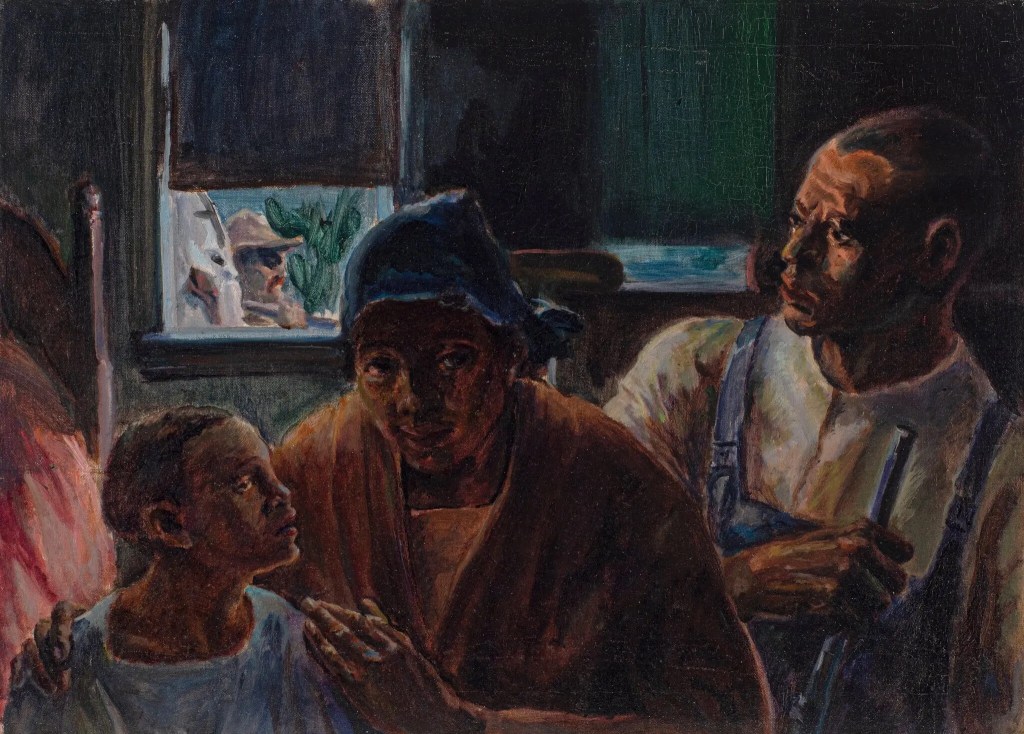
James A. Porter, “When the Klan Passes By,” circa 1939. From Southern/Modern […] Credit… via Michael Rosenfeld Gallery, New York. [New York Times caption and illustration]

On Elaine de Kooning’s “Black Mountain #6”:

To the Big Apple, graduates of Black Mountain College, in North Carolina, returned like winged pollinators to a hive. (Representing the Black Mountain contingent here is an early jigsaw-paned composition by one graduate, Elaine de Kooning. […])
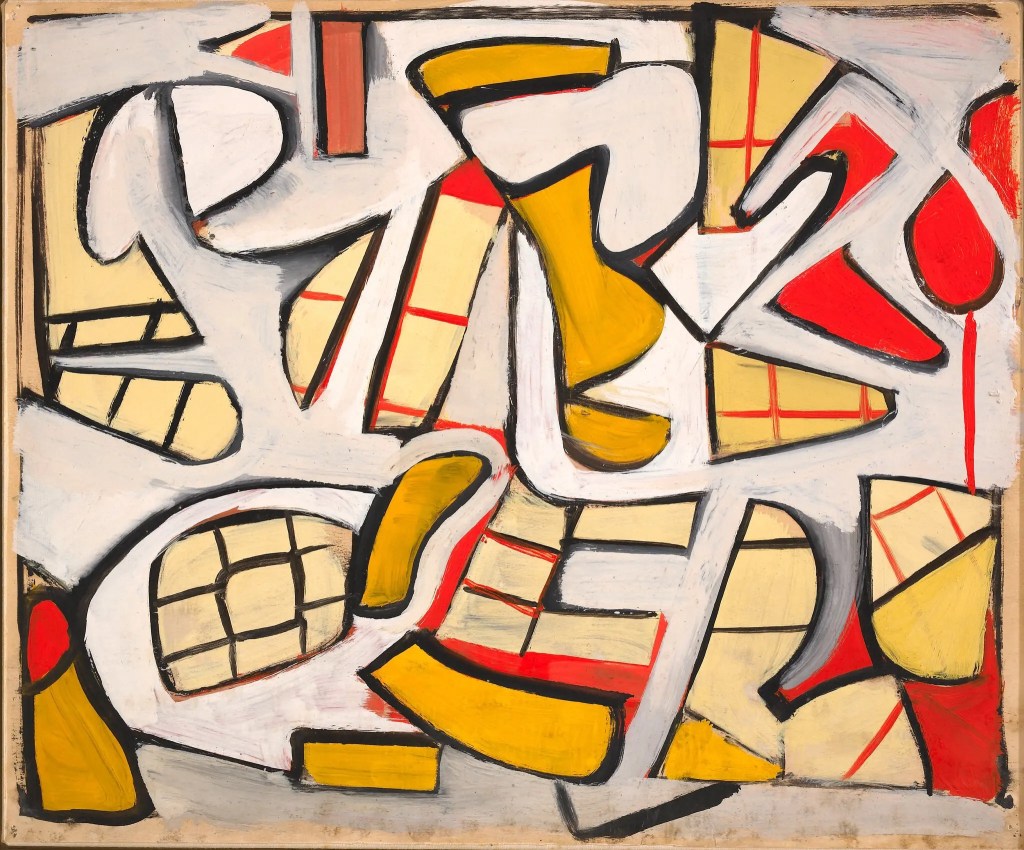
Elaine de Kooning, “Black Mountain #6,” 1948, enamel on paper […] Credit… The Heckscher Museum of Art, Huntington, N.Y. [New York Times caption and illustration]

Here’s Mimms’s memorable summation:

More than Agrarian conservatism, […] the painters in this show echo what the historian C. Vann Woodward later called the “irony of Southern history”: the fact that, as America dominated the global stage from the Monroe Doctrine [1823] to World War II, the southeastern quadrant of the country persisted in a long line of self-destructive, embarrassing regressions, from a feudal regime to a secession attempt to an apartheid state.

(c) 2024 JMN — EthicalDative. All rights reserved

Posted in Quotations | Tagged , , | 4 Comments

‘Blaise Cendrars (1887-1961): Poetry Is Everything’

A section of “The Prose of the Trans-Siberian,” which Cendrars and Delaunay called “the first simultaneous book.” Credit… Blaise Cendrars/Succession Cendrars/Pracusa 20230412; via The Morgan Library & Museum. [New York Times caption]

This piece clipped back in August 2023 reminded me of my youthful infatuation with the School of Paris, which included the Delaunays, Sonia and Robert, as well as Fernand Léger. The article’s appeal lies as well in the matchup of poetry and painting that it treats of. My title is the title of the show held at the Morgan Library & Museum. Jason Farago describes it as “a concentrated pop of free-spirited trans-Atlantic modernity, alive with rich color and typographical pyrotechnics.”

A spread from Blaise Cendrars’s 1918 book, “J’ai tué” (“I Have Killed”), with illustrations by Fernand Léger. Credit… Blaise Cendrars/Succession Cendrars/Artists Rights Society (ARS), New York/ADAGP, Paris; via The Morgan Library & Museum. [New York Times caption]

I did not know that Blaise Cendrars was Swiss, not French, nor that he was born Frédéric-Louis Sauser. He lost his right arm in the Second Battle of Champagne in 1915. Convalescing, he taught himself to write with his left hand and proceeded to engage in other landmark collaborations with 20th-century artists. It hits home when Farago says Cendrars was a writer “who saw his time disrupted and disrupted his style in turn, and who models today how to live up to upheaval [my bolding].”

(Jason Farago, “Blaise Cendrars at the Morgan: A Modern Match of Poetry and Painting,” New York Times, 8-3-23)

(c) 2024 JMN — EthicalDative. All rights reserved

Posted in Commentary | Tagged , | 4 Comments

Just Say Right, It’s Only Weather

As long as the nation’s fleet of private jets can take to the skies there’s no call to whine about so-called climate (the Dems’ name for weather). There’s a right way to think about it, just do a thought experiment. Imagine the Rio Grande frozen by some flukish Arctic blip. Poison blood can just walk across the ice straight into Texas — steal your Evinrude, peep at your wife, whatever. Crazy, right?

First of all, flukes happen. Welcome to life as we know it. Old Mother Nature can be uppity — she’s a woman! But there’s a come-to-daddy moment when the chips are down, and that’s when the private jets go airborne, from Boca Chica to Belarus, from Dallas to Davos. They carry the right fellas doing the right thing in the right places for the right people to make the weather great again.

As long as gushers outnumber dusters, wealth is protected, the lobby’s good-’n-greased, the dark money flows, and there’s a firm hand on the till, the world can count on right guidance in all weathers. You can take that to wherever you hide your stash, pardner.

(c) 2024 JMN — EthicalDative. All rights reserved
Posted in Anthology, Commentary | Tagged | 1 Comment

Epistemic Hubris: Unwarranted Certainty (About Complex Issues)

Holly Warburton [New York Times illustration and credit for Maggie Jackson’s article “How to Thrive in an Uncertain World, 1-13-24].

Greek words are a nerd’s downfall. I’m a nerd, therefore felled by epistemic hubris. Whenever I encounter “epistemic,” as in Maggie Jackson’s essay, I have to mentally re-solder its connection to epistemology, which I barely retain has to do with what we can know.

Jackson’s paraphrase for epistemic hubris is “unwarranted certainty about complex policy issues.” She cites gun control as one such issue. That issue is common as dirt, which triggers three questions:

(1) Doesn’t every issue involve “policy” of some kind, private or public? (A policy of mine is to stifle a belch after sipping a fizzy beverage.)
(2) What’s an even thornier complex issue than gun control?
(3) What’s one non-complex issue about which certainty is warranted?

As I drove her home to Pecos from Odessa in the late ‘90s, my elderly aunt said to me, “I believe with all my heart that when the end times come every person who ever lived will be resurrected to judgment.” She was devout Church of Christ. I’m lapsed Disciple of Christ. Christ figured divergently in our lives, hers and mine.

Earlier that day my aunt and I had stood holding hands and weeping while her brother, my uncle, breathed his last in the hospital. Her affirmation came from out of the blue as the sere West Texas plains slipped past our silent selves on the empty highway. I nodded with a dutiful nephew’s noncommittal respectfulness.

The answers are: (1) Yes. (2) Life after death. (3) There is none.

(c) 2024 JMN — EthicalDative. All rights reserved
Posted in Anthology, Commentary | Tagged , , | 8 Comments

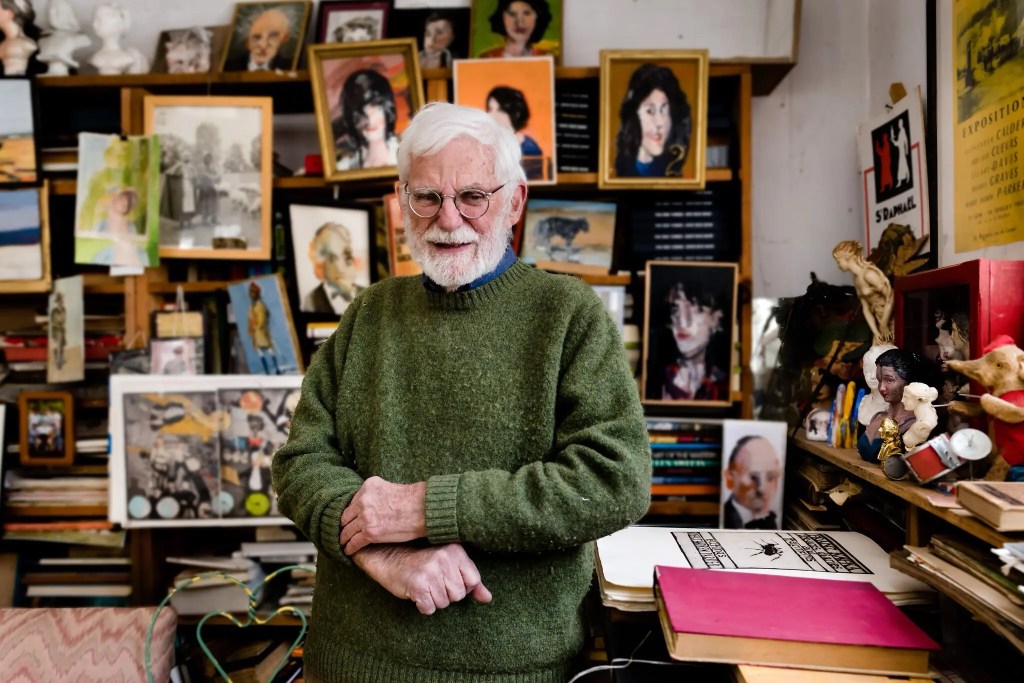
Robert Andrew Parker (1927-2023): ‘Susceptibility to Happiness’

The artist and illustrator Robert Andrew Parker in 2017. He worked into his 90s even though his vision was diminished by macular degeneration. Credit… Leo Sorel. [New York Times caption]

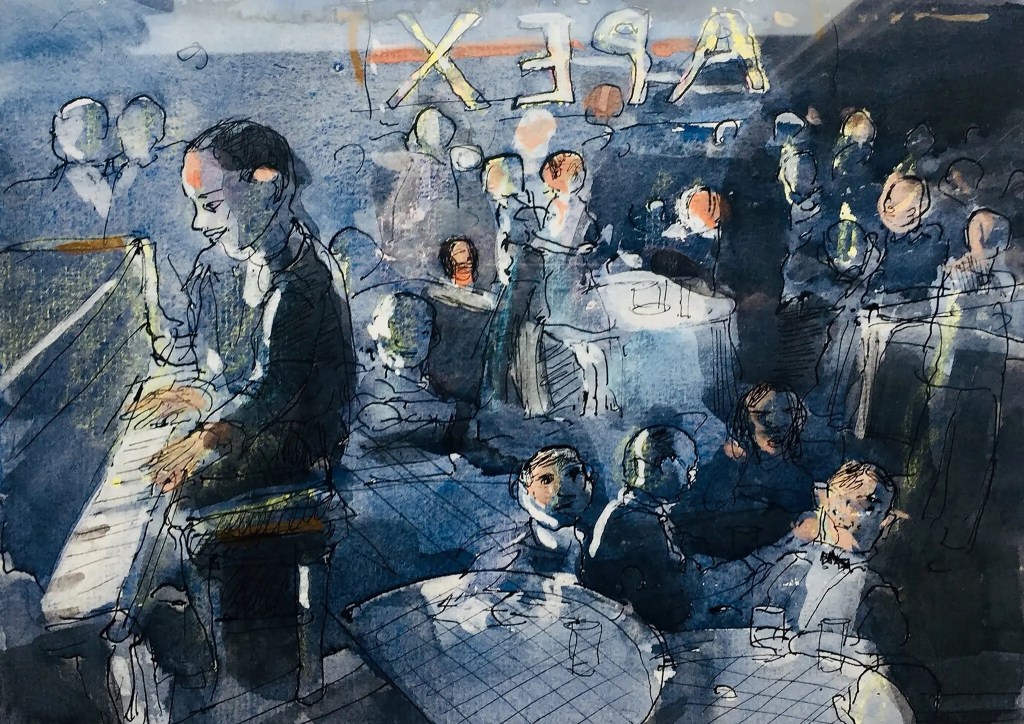
What’s not to like about an artist-illustrator who partnered with poets and loved jazz? Parker played drums in a band called Jive by Five and is survived by five sons, all of whom play drums professionally. (One is an artist.)

“Robert Parker is one of the most accurate and at the same time most unliteral of painters,” [Marianne Moore] wrote in Arts magazine [1958]. “He combines the mystical and the actual, working both in an abstract and realistic way.” In praising a Parker watercolor of a dog, she added, “A cursive ease in the lines suggests a Rembrandt-like relish for the implement in hand; better yet, there is a look of emotion synonymous with susceptibility to happiness.”

Mr. Parker wrote and illustrated the 2008 children’s book “Piano Starts Here: The Young Art Tatum.” Credit… via Rachel Walls Fine Art. [New York Times caption]

(Richard Sandomir, “Robert Andrew Parker, 96, Dies; Prolific Magazine and Book Illustrator,” New York Times, 1-12-24)

(c) 2023 JMN — EthicalDative. All rights reserved

Posted in Commentary, Quotations | Tagged , , , | 3 Comments

‘Bare’ with Me: I’m of Two Minds

Untitled, oil on watercolor paper, 16 x 20 in. (JMN 2023).

Writer Charles Behlen told me that reading a poem could be like stepping off a plane into Madagascar when you thought your destination was Lubbock, Texas. Things would look different, he said. I took it as his way of chiding me for a cheeky chirp about his phraseology in a poem.

How did Behlen’s airy simile make me feel? Treated as if a clueless upstart. Infantilized. Mad as hell. When I mentioned I’d been reading Louise Glück’s collected work, Behlen returned the following (we were corresponding) about her effect on him: “I need more dirt on my potato.”

Notwithstanding the thin skin I bare above, I’ve kept Behlen’s remonstrance, along with his dirty potato, in my pipe for smoking along the way as I stutter-step my way through current verse. The quest is to do something directly with it — what verb do I want: Experience? Confront? Process? Interpret?

Oh God! Is this a kind of readerly populism that implies I’ve had enough of experts? That I want to meet the product head-on without the mediation of a poetry clergy? That I want to wallow in being a truculent (protestant?) outsider bent on getting to grips with “difficult” texts, going mano a mano with the word of dodgy deities?

Could be.

The most a haiku has fulfilled me is this one ending Ocean Vuong’s “Immigrant Haibun”:

Summer in the mind.
God opens his other eye:
two moons in the lake.

(from Night Sky with Exit Wounds, Copper Canyon Press, 2016)

Why? I feel bare and clueless in saying it, but: it’s because eyes are orbs, like the moon; two moons reflected in the lake seem fluky but possible in the physical world, and it seems more accomplished to make poetry from the plausible than from the fantastical. Also, who has two eyes? We do! I like the conceit of an ocular God with double peepers; support is lent to the intuition that man created God in man’s image, but also, since other creatures have two eyes as well, to the conclusion that God might just as soon look like a possum or a woman.

(c) 2024 JMN — EthicalDative. All rights reserved

Posted in Anthology | Tagged , | 5 Comments

‘God, in the Form of Lightning’

Untitled, oil on watercolor paper, 16 x 20 in. (JMN 2023).

“Calling myself religious while living a life unbeholden to Scripture doesn’t make sense, of course.”

(Temim Fruchter)

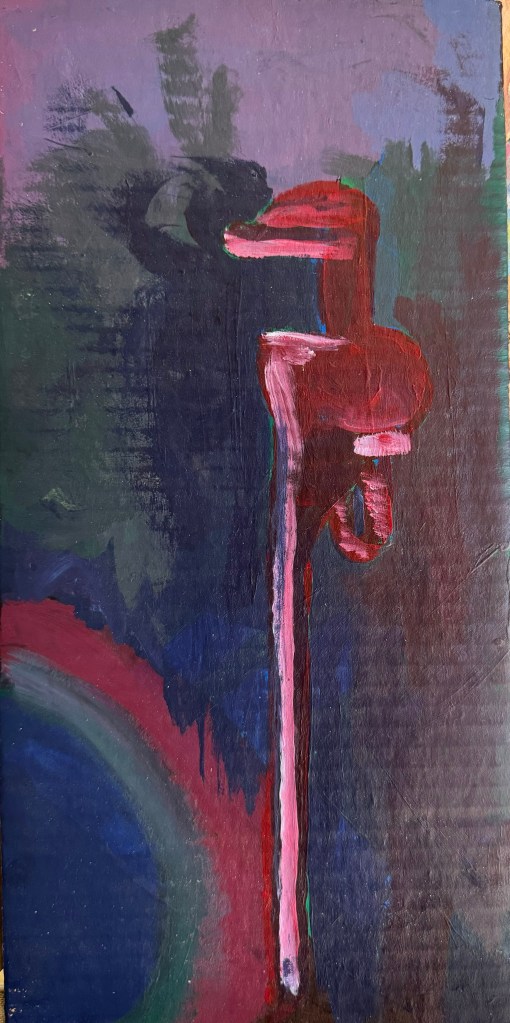
Temim Fruchter’s essay about her spiritual evolution struck me, another scriptural expat, as full of poetry. I was moved to lift statements from the essay verbatim, in their order of occurrence, and put them down versiform. I hope her essay doesn’t feel unduly interfered with. Mine is only the interference.

GOD, IN THE FORM OF LIGHTNING
We wonder whether God, in the form of lightning, will strike.
Is there space for a whole past, or several, to coexist with so divergent a present?
I, for one, am crowded. Parts of me jostle noisily around.
I resent my practice. I defend it. I love it. I am a part of it, this half-practice, and it is a part of me.
And belief in God has made me, too. God, a relationship I can’t language.
God, the extra inches a room grows when we sing together.
All of the parts that created me are still here,
Jostling around, trying to make a cacophonous kind of sense.
And on the rare occasion when all the parts of me really sing?
Without fail, the room around me grows ever so slightly bigger.

(Temim Fruchter, “I Left My Faith. God Didn’t Flinch,” New York Times, 1-3-24)

The Times carries this biographical note: Temim Fruchter is the author of the forthcoming novel “City of Laughter.”

(c) 2024 JMN — EthicalDative. All rights reserved
Posted in Quotations | Tagged | 1 Comment

We’ve Dealt With Earth. Let’s Go Fix Mars

(c) 2023 JMN — EthicalDative. All rights reserved

Posted in Commentary | Tagged | 3 Comments

Choices the Chosen Cherish

I’m proud of the choice I made
to be squeezed from momma’s vagina
in the Hamptons and not old Carolina.

I’m proud that the daddy I chose
was several cuts above the rest,
fetching me the fortune sans the quest.

Proud I am of the me I’ve arrived at,
my private jet, my vessel’s girth;
but sternly must I not lose sight of that
acumen with which I planned my birth.

(c) 2023 JMN — EthicalDative. All rights reserved

Posted in Anthology | Tagged | 10 Comments

Message in a Bubble

Hola, H.

He aquí todo un poema de un tal Ben Okri que sale en la revista Poetry de diciembre 2023.

SEGOVIA
I walked your acueducts at dawn.
With giant legs they bestrode the landscape
Of the Moors. Stick insects. Like Romans
On stilts. Bearing water across the sky.

Ésta es mi traducción hecha para ti.

SEGOVIA
Yo pisaba tus acueductos al amanecer.
Con piernas de gigante montaban a horcajadas el paisaje
de los Moros. Bichos de palo. Como romanos
sobre zancos. Cargando agua através del cielo.

Éste es un diseño que hice. Monigote con gafas. Me gusta como logotipo de la empresa de fingirme <<pintor-poeta>>. ¡Jajaja! ¿Qué te parece?

¿Vas bien? ¡Un abrazo de avi!

(c) 2023 JMN — EthicalDative. All rights reserved

Posted in Anthology | Tagged , , , , | 1 Comment