[Oh what a tangled web we weave when first we practice ironic bloviation. The message buried in a made-up rant full of ludicrous rhetoric (posted previously) is that the assertion “It never happened,” or that an encounter was “consensual,” implies that women lie about being violated. That assumption is patently outrageous is my point.]
“Somnambula,” 12 x 14 in. oil on canvas (JMN 2020)
Swaggart. Trump. Weinstein. Epstein. Windsor. Brand. Rose… the list goes on. When will such men be spared the allegations of conniving women? It’s the one time the word “liaress,” feminine of “liar,” would be a useful addition to the language.
Everyone knows women are liaresses; it’s inherent in their DNA, a viral, vapors-prone disposition passed readily from one vixen to the next. How the contagion travels is a mystery. Where there may be, initially, one or two attention-seeking hellcats hollering rape, soon there are six, then a dozen, then twenty or more — it becomes a frenzy of follow-the-lying-liaress, a game of make-up-a-crazy-story about being violated by a powerful, charismatic man. The mendacious flibbertigibbets morph into prevaricating gerbils diving off the cliffside in their suggestible droves, infected by the vicious and delusional inventions of the original liaress. He raped me! they gibber and jabber during their richly deserved plummet to oblivion, to be dashed upon the rocks far below, where the waves consign their lying carcasses to Davy Jones’s locker.
What’s an upstanding celebrity with imperious urges to do when exposed to ripe wenches? Society can’t simply salt away its womb-stock in a secure purgatory, canopied in weeds, in order to make itself safe from female mischief. For now, the sole recourse of the harried victim is to gas off to his fanbase, lawyer up, and ride hell-bent for leather on a hobbyhorse named Consensual.
(Michelle Goldberg, “Why on Earth Are Jewish Leaders Praising Elon Musk?” New York Times, 11-20-23)
UNSTABLE GENIUSES, THEY GO AND COME The dude bogarts a joint and jinxes X, hocks the truth with loogies of spit juice. There’s not a problem Elon can’t unfix. Boca Chica Tex is on the loose!
It’s a rhetoric thing. My doggerel fustigates the fouling of standalone nouns (truth, fact, gift, love) with dishonest adjectives (“actual,” “alternative,” “free, “true”). Essential words watered by a pissed well wither. C’mon, everybody, this tongue is your tongue. Keep it sharp.
“Dirt Candy,” oil on paper, 18 x 22 in. (JMN 2023).
The Spanish text I translate to English here is from Las palabras de Javier (November 16, 2023).
In reading poetry of the day I brace for being left in the lurch, for being denied more than a cerebral engagement, at best, with what the verses purport to voice, the correlative they model or invoke. Now and then, however, a text helps me feel a feeling, as these lines by Javier Sánchez do. The internal accusative pounces unstalked. It’s a hurt that punctures numbness, not unsweet, but eye-watering, too, like a stitch in the side or twitch of a dormant muscle. How and why a given text springs an art attack is anybody’s guess. Javier writes Spanish that is taut, tuneful and pointed, the essence of poetic. My English can only shadow it.
WHEN I GO AWAY by Javier Sánchez
When I go away, I’ll leave you the exact letters for you to create a pretty poem.
When I go away, I’ll leave my memories in back of the painting in the house’s dining room.
When I go away, I’ll depart with fear for what I leave behind, and for whom, but not with fear of where I’m going. I know already where I’m going.
And we will see each other again.
From the verb conocer — to know someone.
But don’t be in a rush, life of mine, do not hurry. You’ll see that one summer day I’ll be out there, sitting at the door of the painter’s house on Angel Street, where you used to play when little.
You’ll see me, and without hesitation you’ll read me the poem you’ve written with the letters I gave you before my departure. That towheaded little boy will read with you, line by line, the pretty poem.
That will be when we smile, the two of us, again.
***
Postscript: In reading “When I Go Away” I felt distant vibes from a poem in an old anthology read me by my mother when I was a cotton-top brat myself. It was “Little Boy Blue” by Eugene Field.
André Derain, “Environs of Collioure” (“Environs de Collioure”), 1905… Credit… Artists Rights Society (ARS), New York/ADAGP, Paris; via Galerie Philippe David, Zurich. [New York Times illustration]
“Fauve painting is not everything,… but it is the foundation of everything.”
(Matisse)
I have an affinity for the stripe of painting perpetrated by the Fauves.
André Derain’s “Fishing Boats, Collioure” (“Bateaux, Pêcheurs, Collioure),” 1905. Credit… Artists Rights Society (ARS), New York/ADAGP, Paris; via The Museum of Modern Art. [New York Times illustration]
Their manic attack with brush and pigment gestures offhandedly toward trees, water and sky.
Henri Matisse, “Study for ‘The Joy of Life’” (“Etude Pour ‘Le Bonheur de Vivre’”), 1905. Credit… Succession H. Matisse/Artists Rights Society (ARS), New York; via Forma, Paris. [New York Times illustration]
The performative nonchalance makes pure abstraction look cautious.
Henri Matisse, “View of Collioure,” 1907. Credit… Succession H. Matisse/Artists Rights Society (ARS), New York; via The Metropolitan Museum of Art. [New York Times illustration]
When Matisse and Derain cut loose it was like nobody’s business for the blink of an eye (1904-08). Over a century later their effusions still are fresh, outrageous, and goading.
(Roberta Smith, “Matisse and Derain: The Audacious ‘Wild Beasts’ of Fauvism in a Radiant Show,” New York Times, 11-9-23)
… A consummation devoutly to be wished.” (Shakespeare)
Evangelical euphemisms like “Grab ‘em by the prissy” and “Kiss my aft” have hopped from bully rally to pulpit rave in American discourse thanks to the God lobby. But, Britannia, oh dear! “Fuckpigs,” “morons” and “cunts” have recently been heard on the airwaves of the Sceptered Isle straight from the recorded lips of a political ruffian at 10 Downing Street. The unchurched epithets he sticks to Whitehall functionaries knock America’s sanctimonious cockuppery into a cocked hat.
See here, sir hooligan, to wit, Mr. Cummings:
In His Majesty’s Government, 778 members sit currently in the unelected House of Lords. It’s the superior chamber comprised of the better sort from the preferred schools and the loftier lineages. This pantheon of life peers will emit the mother of all harrumphs, followed by a scorching remonstrance with thunder of tut-tutting in deprecation of scurrilous utterance at Number Ten. I wager a guinea on it and shall be astonished if not. The Palace is briefed, mind you, and will keep vigil.
Italian prime minister Georgia Meloni is in the news for rinsing her hands of longtime, live-in boyfriend Andrea Giambruno, caught prospecting for group sex. Reportage has reached again for bunga bunga, which keeps this reliable trope of male-hormonal culture merrily cohabiting with family values.
That old Boccaccian satyr Berlusconi (RIP) was patron saint of bonking and baloney (QED).
(JMN)
Mattia Ferraresi comments on the nepo-incestual tenor of power in Italy, “where politics, media and business interests are toxically entwined”:
More than half a century ago, an aphorism commonly attributed to the journalist Leo Longanesi captured the problem: “The revolution will never take place in Italy, because we all know each other.” The same is seemingly true for functional government.
(Mattia Ferraresi, “Italy’s Prime Minister Broke Up With Her Boyfriend. It’s Actually Quite a Big Deal,” New York Times, 11-1-23)
“The whole secret of politics is knowing who hates who.”
(Kevin Phillips)
“MY pronoun,” said Cruz, “is ‘kiss my ass.’” On Ted’s form of address I’ll take a pass. A smooch bestowed on the croup of this solon is honor paid to the poop of his colon.
The scatology of my lampoon is icky even to me, but language follows play-the-leader. Ted Cruz nominally represents Texas in the world’s — wait for it — “greatest deliberative body,” aka the U.S. Senate.
Kevin Phillips published The Emerging Republican Majority in 1969. The influential book presciently theorized that Republicans could build an enduring majority by attracting conservatives from the South and West who were troubled by “the Negro problem.” The “Sun Belt” (he coined the name) is now a GOP bastion.
(Jamelle Bouie, “This Is How the Republican Party Got Southernized,” New York Times, 10-13-23)
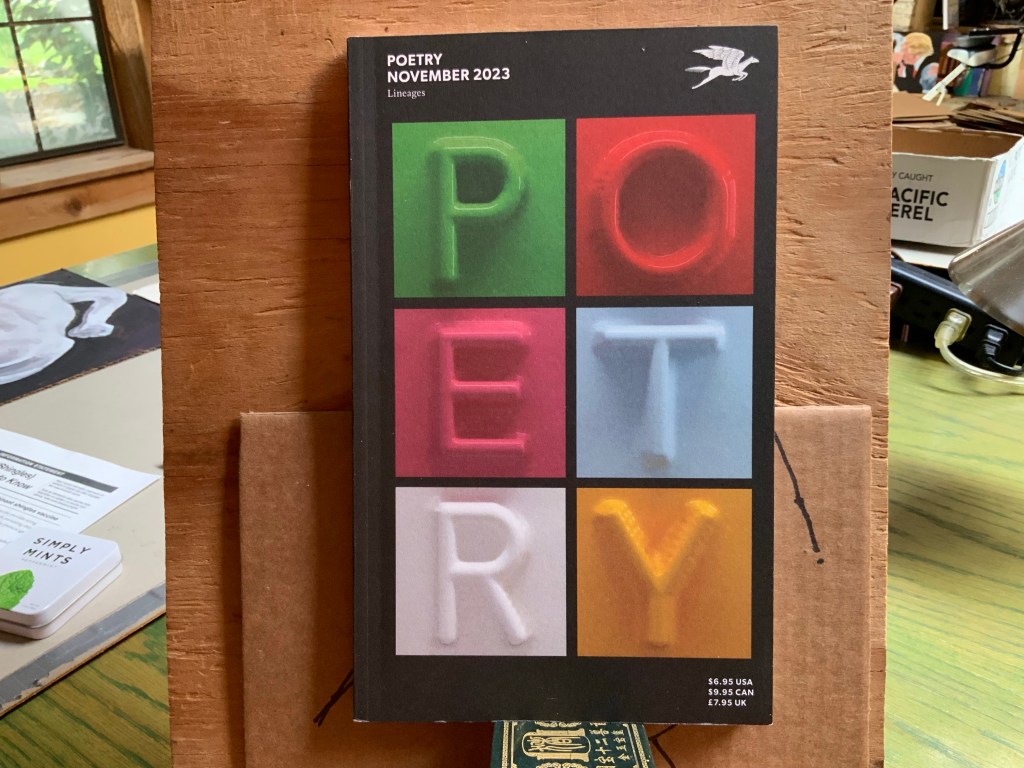
Carlo Cadenas is the cover artist for Poetry, November 2023, whose tagline is “Lineages.”
“We love the balance and control of rhyme even if it unbalances us, but, after the music, we want meaning.”
(Adam Gopnik)
When Adam Gopnik writes, “No prosody can immunize poetry against the test of experience… What’s always at stake with literature and lyrics is their relation to the world,” I take his point to be that one can’t read poems without concerning oneself one way or another with what they “mean,” with how they map to something outside both the text and the poet’s head, and which is perceivable by the reader. Gopnik puts signification up front by quoting the Duchess in Alice’s Adventures in Wonderland: “Take care of the sense, and the sounds will take care of themselves.” I hazard a suspicion that some versifiers invert these terms.
Gopnik makes his observations in an essay about rhyme (“The Rules of Rhyme,” The New Yorker, 5-23-22). The fact is, rhyme has retreated from much lyric. I like to think of simile and metaphor as part of the “sound” that verse tries to make now. The other part comes from fractured syntax and irregular typography. These devices comprise the wave that carries signal, or meaning.
Gopnik’s position might be thought hidebound by some, but has validity if the notion of meaning is given room to rattle around in. A job of writers striving to be poets is to prosecute effrontery unforgettably. They’re not in the business of making things easy for the complacent reader. When, however, the carrier wave fumbles its cargo and signal is ungraspable, the reader perceives noise.
“Noisy” is an unforgiving descriptor to confer upon a text. I wonder if cases arise in which the burden sought to be lyricized remains stuck in the writer’s mind, snagged in jagged rhetoric, and wants only more cunning application of art in order to mount the wave? To course from the writer’s “soul” or “spirit” into the reader’s apprehending faculty?
Here’s a metaphor plucked from the November 2023 issue of Poetry:
… My willingness to sit still — to bear the hornet’s nest of everyday life turning in my throat like a giant, wet eye…





 EthicalDative
There’s So Much to Be Said for Saying Less
Afterword
I’m copious and so are you.
(From Cowpunk by Diane Seuss in Poetry, December 2023)
(c) 2023 JMN — EthicalDative. All rights reserved