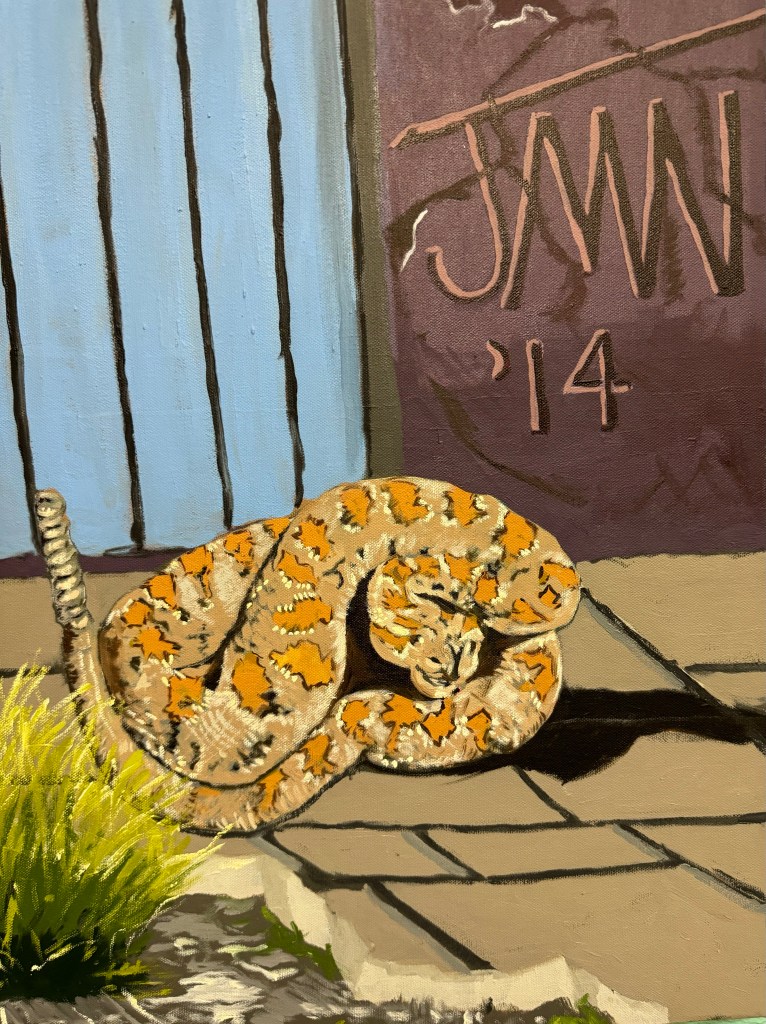
I harbor the goofy notion that we’re infused with a sap common to all that’s animate. You and I have a greater dollop of it than a snake, or a bee (apparently). It remains the case, notwithstanding, that in their skins, but for the do-si-do of starry dust, go we.
I’ve no idea how or why I got more sap than the snake, but the crux is that what makes him and me tick came from the same place. We’re sap-sisters, if you will.
In practical terms, the hokum makes me try not to step on anything that looks alive.
(I’m not a religious person, and if I were alleged to have said any of this I would tempestuously disavow it.)
From Tallahassee to the sea the state of Florida shall be lab-grown meat and climate free.
Sources Dionne Searcey, “‘We Will Save Our Beef’: Florida Bans Lab-Grown Meat,” New York Times, 5-3-24. Coral Davenport, “DeSantis Signs Law Deleting Climate Change From Florida Policy,” New York Times, 5-15-24.
The artist Jonathan Yeo and King Charles III at the unveiling of Mr. Yeo’s [2024] portrait of the king at Buckingham Palace in London on Tuesday. Credit… Pool photo by Aaron Chown. [New York Times caption and illustration]
I warm to Jonathan Yeo’s smoldering rendition of Charles the Third for the fastuous havoc it wreaks on canvas, not to mention expenditure of fiery pigment. It will inflame disdain in all the right quarters, though reportedly not in his highness’s breast.
For dead-eye daring of treatment there’s the barechested blueblood with the princely schnoz and bluebottle on his shoulder. Asked if he thought the painting resembled him, Philip said, “I bloody well hope not.” I like to imagine his comment was proffered through a grin. It could have happened!
Stuart Pearson Wright’s [2003] portrait of Prince Philip. Credit… Kimberly White/Reuters. [New York Times caption and illustration]
Mining magnate Gina Rinehart reached watercolorist Vincent Namatjira’s eyes in guise displeasing to the billionairess. Australia’s richest woman has demanded that her portrait be removed from the National Gallery of Australia. (It reaches my eyes as an avatar of Rosie O’Donnell.)
Gina Rinehart (right) and a portrait of her by Archibald prize-winning artist Vincent Namatjira. Composite: AAP/Getty Images. [Guardian caption and illustration]
Portraiture of the grand which doesn’t court obloquy is a missed occasion. Namatjira’s paintings are said to be “about changing people’s perspectives by using satirical humour as a commentary on power.” When will the wealthy and entitled catch a decent break!
Sources Emma Bubola, “Too Red, Too Vampiric, Too Sexy: A Brief History of Polarizing Royal Portraits,” New York Times, 4-15-24. Australian Associated Press, “Gina Rinehart Demands National Gallery of Australia Remove Her Portrait,” theguardian.com, 5-15-24.
“Six Persimmons” (detail), a still life of an autumn fruit likely by the monk Muqi and one of Japan’s most revered works of art […] Credit… Okada Ai/Kyoto National Museum. [New York Times caption and illustration]
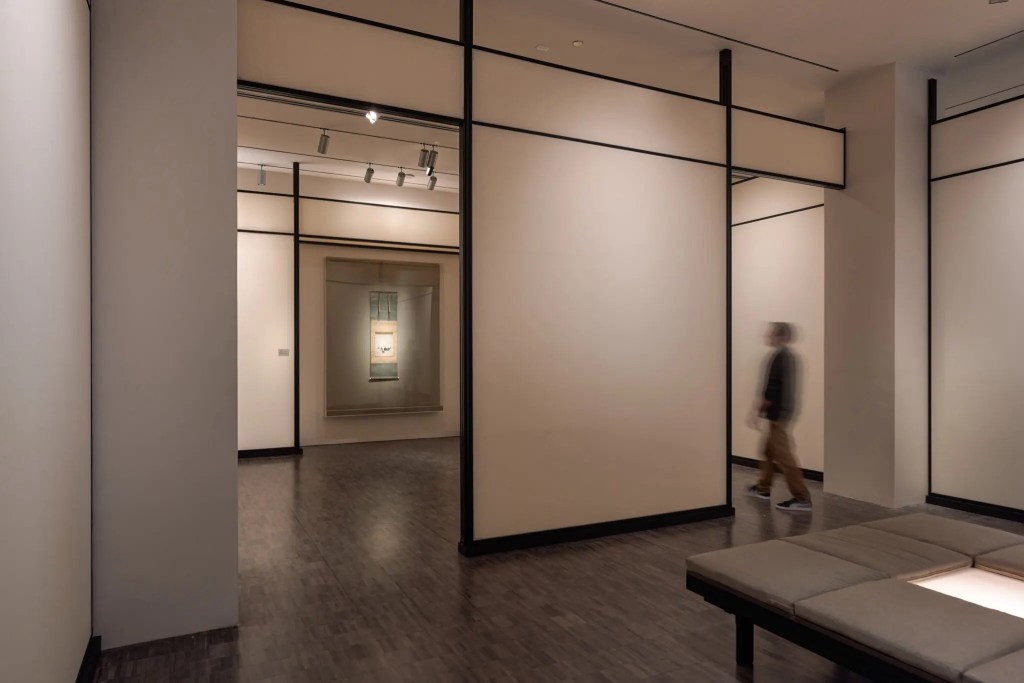
In a show called The Heart of Zen, “Six Persimmons” was displayed for three short weeks in late 2023 at the Asian Art Museum in San Francisco. It was “painted with ink on paper in the 13th century, probably by a Chinese monk named Muqi, as part of a handscroll that also included ‘Chestnuts’…”
In China, where ink paintings were valued for their order and precision, Muqi and his lumpy fruit went quickly out of style. But in Japan, with its taste for asymmetry and ambiguity, his work sparked a whole school of followers.
… The persimmons’ stems, six crisp, T-shaped handles into the here and now that remind us that the really Zen way to look at a painting is simply to look at it.
At the Asian Art Museum, “Six Persimmons” is displayed by itself in a gently lit gallery with off-white walls reminiscent of a Japanese temple. Credit… Asian Art Museum. [New York Times caption and illustration]
… The flesh of the persimmons looks to be made from spontaneous puddles of watery ink, rough-edged puddles that capture with precision the very imprecision of human sight. It’s an approach to painting that Europeans reached only 600 years later, if then.
Will Heinrich concludes that “the point of all the simplicity, or minimalism, associated with Zen isn’t really to make anything simple. It’s to…,” but never mind. Isn’t Zen about not looking for a point?
(Will Heinrich, “A Rare Appearance for ‘Six Persimmons,’ a 13th-Century Masterpiece,” New York Times, 11-24-23)
Thoughts and prayers from the legislatures. Thoughts and prayers from the donors. Thoughts and prayers from the councils. Thoughts and prayers from the courts. Thoughts and prayers from the boards. Thoughts and prayers from the embassies. Thoughts and prayers from the churches. Thoughts and prayers from the armories. Thoughts and prayers from artificial intelligence. Thoughts and prayers from air, land and sea. Thoughts and prayers from you and me.
If you say all the words out loud, it works.
This is neither the time nor the place to record that I’m loath to divulge where, but have just encountered Aldous Huxley’s phrase “batrachian grappling.” It will haunt my day.
Untitled, oil on watercolor paper, 14 x 22-1/2 in. (JMN 2024).
Frank Stella has died. He’s the one who said, “What you see is what you see,” with reference to painting (his painting, at least), a slogan someone described as “pithy and enduring.” I liked it so much I had it printed on a tee-shirt several years ago. Then wore that shirt.
I’ve adapted Stella’s slogan, with added emphasis, to reading poetry, because I have a bias, which is this: Publishing has consequences. I should have a say commensurate with the writer’s as to what a poem “means.” It falls to me, a humble (?) reader, to sense its burden and weigh its import. My job is to summon attentiveness, the poem’s to deserve it. What I make of the poem needn’t be, nor even can be, what Helen Vendler or Yvor Winters made, or would make, of it.
This cocky stance gravitates against a nagging unease that a poem will hover beyond my grasp, that I will fail to apprehend the message or signal encoded in it. Here’s a thought: The poem’s words and their layout on the page are its signal. The poem’s message becomes what I take from it and keep for a length of time. If it leaves no mark, verse stayed on the page, poetry didn’t happen.
My attitude makes nothing happen critically, but it keeps me chugging through shed-loads of verse with a mulish resolve verging on enjoyment.
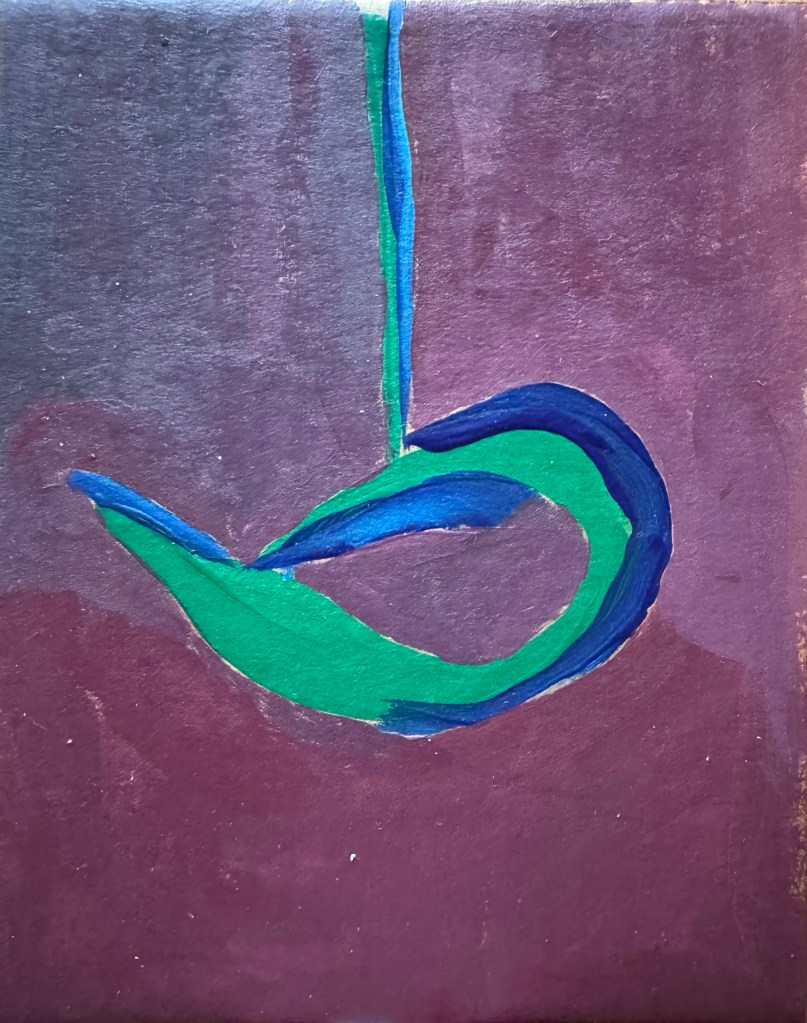
“Love With Nowhere to Go,” oil on watercolor paper, 14 x 30 in. (JMN 2024).
The most terrifying exercise I know is to calculate how many seconds I can expect to live. I refuse. Never send to know for whom the clock ticks. It ticks for thee (not me). I heard my dad in his sixties tell a buddy, “I don’t plan to die.” He was sipping and smoking and enjoying himself. He had another couple of decades left in him at the time. It was a good plan.
Time, time, time… You can’t live with it and can’t live without it. Can’t pump more of it or drill for new reserves. Just runs out when it’s good and ready, and you’re done. Let it count down on its own clock, not on mine.
Blame these straggly thoughts on Trey Moody. In “Against Distance” (Poetry, May 2024) he writes a single sentence that goes for fourteen lines of a seventeen-line poem. The sentence starts here…
I don’t know who needs to hear this other than me, but the moon will never leave you,…
and ends here:
… so when you try counting your remaining moments with the moon, the moon that will never, ever leave you, give up.
It’s a transparent, readable sentence, too, not Proustian or Jamesian — you know what I mean. Then Moody does a deft turn in the last three lines: Writes three sentences in quick succession, and one of them is a zinger. By that I mean it has the aphoristic sheen of a nugget so quotable it cries out for citation even out of context. I don’t take the bait. Here in toto are the last three lines of the poem with the embedded zinger:
Even the moon inches a little more distant every year. I’ve heard grief is only love with nowhere to go. But then you look up.
It may not be the “best” poem of the lot — who am I to distinguish good from bad? — but the moment of my reading it, usually morningtide, and the fact of it saying a particular something in a given way conspire not to “trigger” in me — that word is grubby now — but to wring from me a flicker of joy. You take it where you find it.
Commentary blogs, or clogs, are thriving. There’s also a raft of ‘fluencer blogs, or flogs, out there. The difference between clogging and flogging can be subtle. In general the flogger is covertly, if not overtly, selling something; the clogger is engaged in expressing impressions more or less for their own sake. Cloggers like to be liked — the more of it, the more we clog; floggers want to be paid, sooner rather than later, if possible.
‘Fluencers, by the way, have led a wave of migration to platforms such as YouFlog, where eyeball-centric flogging, termed egging by its enthusiasts, is trending. You name it and it’s egged on YouFlog: recipes, cancer cures, diets, gun kits, escorts, alternative facts, amazing tools, this incredible glue….
Some of us cloggers are crafting ways to slow-walk, if not stymie, the takeover by generative AI next month. We are the sloggers. There are only so many opinions in God’s language model, and we intend to hold as many as possible before the algorithm comes for us. Obiter dictum, Altman!
Call it the agony of the long-distance reader. There’s a lot of verse out there. It’s hard to give any one text a non-cursory read. On occasion there’s a specimen I’d like to flounder around in, nudge and knock about, importune, reconnoitre. Something lands; or tickles; or excites; or provokes; or befuddles. But wait… what’s this? More verse coming down the pike! Must… keep… reading. <Gasp>
An upside hides in what I’ve depicted as the downside of a landslide. I know that I will know when I’ve bumped into greatness. It will be when a text has shattering immediacy. It will poke through the scree, knock me sideways, shock me to a standstill. A writer will have been astonishing and I’ll have met the poem. I’ve gotta be ready, loins girded for the long haul.
Idra Novey’s “That’s How Far I’d Drive for It” (Poetry, November 2023) tickled. A cross between wry poetry and delicious standup (think Tig Notaro), it limns a beautiful, trippy, preposterous expedition to transplant a venerable rhubarb plant. Here’s how it takes off:
I’m in the car with Helen, supreme guide to proceeding otherwise.
My relatives refused to travel hours for a rhubarb, but Helen said, why get out of bed, if not for a private quest of minor significance to anyone else?
It’s a question of libido, she said, sometimes you wake up craving sex.
Other days a hunger comes for shoveling, to dig up whatever your relatives deem worthless.
As the poem arcs and flies it mentions this:
Meaning is a hunger. Some of us need to eat and eat it.
“Frank Marshall Davis: Writer” (Poetry, December 2023) sprang a sticky line on me: “I was black and black I always was.” (Davis lived from 1905 to 1987.) Among other things the poem says this:
I was a weaver of jagged words, A warbler of garbled tunes A singer of savage songs I was bitter Yes Bitter and sorely sad For when I wrote I dipped my pen In the crazy heart Of mad America
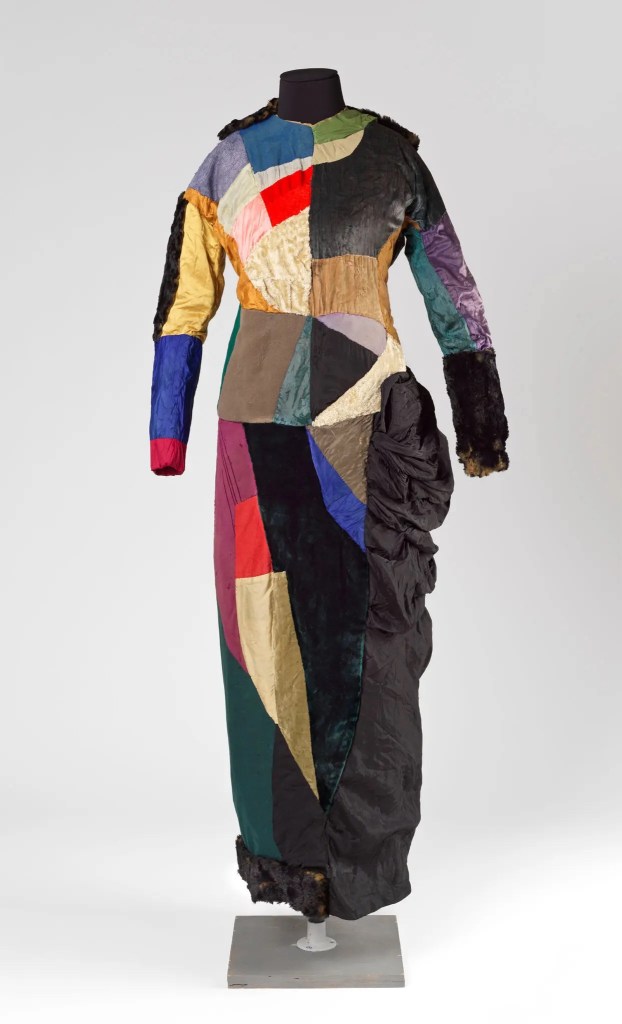
Sonia Delaunay’s “Robe Simultanée” (1913), a grand patchwork dress evokes the movements of her lively paintings and is a highlight of the Bard Graduate Center’s show “Sonia Delaunay: Living Art.” Credit… Bruce White, via Pracusa. [New York Times caption and illustration]
Inspired by the theorist Michel Eugène Chevreul — whose 1839 treatise on color harmony is on display in this show — Sonia [Delaunay] and her fellow pioneers in abstraction had to train the individual elements of color, such as contrast and inversion and value, to speak for themselves as never before.
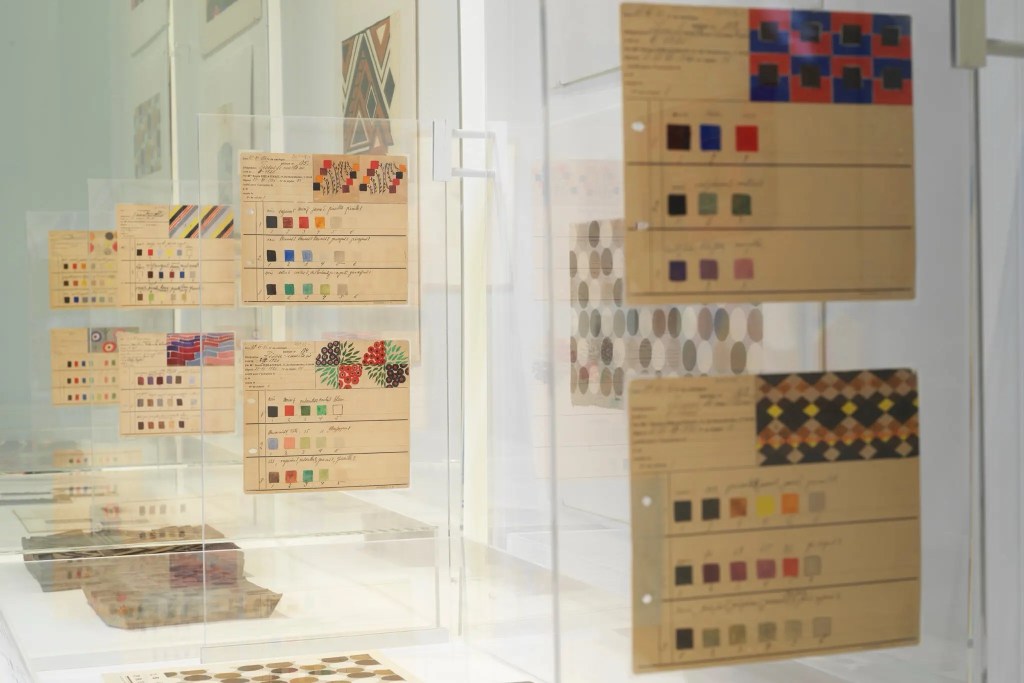
I’m familiar with the phrase “color scheme,” but I’ve got this far without having encountered its synonym “colorway”:
Floated in glass dividers between the swatches are Sonia’s instructional “color cards” to the fabric manufacturer. Exacting and propulsive, these colorways show that she understood the kinships and rivalries of hue with a shrewdly marketable instinct.
The color cards Sonia Delaunay dispatched in the 1920s to her Dutch manufacturer, explaining which patterns and colorways she wanted printed on crepe silk. Credit… Bruce White, via Bard Graduate Center. [New York Times caption and illustration]
… Only in Bard’s dense wardrobe of a show do the sources of Sonia’s painterly voice become obvious: the bunchable, joinable, repeatable textures of cloth.
In her late painting “Rhythm-Color” (1970), Sonia Delaunay returned to the same contrasts of texture and color she had used in her early patchwork dresses and vests of the 1910s, breakout garments that put her on the map of early abstraction. Credit… Richard Nixon Presidential Library and Museum. [New York Times caption and illustration]
It’s fun to see a handsome black-and-white illustration in an article celebrating color (as well as geometry):
While sheltering in Portugal during World War I, Delaunay painted vases, jugs, books and tablecloths with vibrant zig-zags, pie pieces and bull’s-eyes. “I have lived my art,” she once said. Credit… Bibliothèque nationale de France. [New York Times caption and illustration]
Also stimulating to note the connection between Sonia’s handiwork and her husband’s still life:
Robert Delaunay’s “Portuguese Still Life” (1916) expands upon the abstract geometries his wife, Sonia, had emblazoned on their housewares. The husband’s inclusion in the show, while designed to illuminate his wife’s work, “affirms the old ‘power couple’ reputation of these two artists,” our critic says. Credit… Norton Museum of Art, West Palm Beach, Fla. [New York Times caption and illustration]
(Walker Mimms, “One for the Ages: Sonia Delaunay’s Wearable Abstractions,” New York Times, 4-27-24)








Red Alert: Portrait Riot!
I warm to Jonathan Yeo’s smoldering rendition of Charles the Third for the fastuous havoc it wreaks on canvas, not to mention expenditure of fiery pigment. It will inflame disdain in all the right quarters, though reportedly not in his highness’s breast.
For dead-eye daring of treatment there’s the barechested blueblood with the princely schnoz and bluebottle on his shoulder. Asked if he thought the painting resembled him, Philip said, “I bloody well hope not.” I like to imagine his comment was proffered through a grin. It could have happened!
Mining magnate Gina Rinehart reached watercolorist Vincent Namatjira’s eyes in guise displeasing to the billionairess. Australia’s richest woman has demanded that her portrait be removed from the National Gallery of Australia. (It reaches my eyes as an avatar of Rosie O’Donnell.)
Portraiture of the grand which doesn’t court obloquy is a missed occasion. Namatjira’s paintings are said to be “about changing people’s perspectives by using satirical humour as a commentary on power.” When will the wealthy and entitled catch a decent break!
Sources
Emma Bubola, “Too Red, Too Vampiric, Too Sexy: A Brief History of Polarizing Royal Portraits,” New York Times, 4-15-24.
Australian Associated Press, “Gina Rinehart Demands National Gallery of Australia Remove Her Portrait,” theguardian.com, 5-15-24.
(c) 2024 JMN — EthicalDative. All rights reserved