My title sounds like a hoary aphorism distilling virtuous wisdom passed down through the ages in simple, God-fearing households. But I just made it up.
The “aphorism” models usage gone all but missing from English. An encounter with it in current writing, especially journalism, is bracing, and feels like hearing English spoken by a harpsichord.
Here’s the specimen encountered in the New York Times (my bolding):
But the way we typically test advances in medicine — a rigorously designed randomized clinical trial that takes years — won’t work here. After all, by the time the trial were complete, the technology would have changed. Besides, the reality is that these technologies are going to find their way into our daily practice whether they are tested or not.
Most speakers would write “by the time the trial was complete.” “Was” is the way English works now. Correctness isn’t at issue, only modern versus classical style.
What the doctor who writes the article expresses is a condition contrary to fact followed by its future, theoretical outcome. It calls for a verbal mode that English has (mostly) discarded. That mode, the subjunctive, is alive and well morphologically in other languages. In Spanish, for example, the sentence might look like this:
Después de todo, cuando se hubiera completado la prueba, la tecnología habría cambiado.
It’s a conditional sentence that’s also predictive. The pluperfect subjunctive “hubiera completado” marks the protasis, the conditional perfect “habría cambiado” the apodosis. The construction can show a shift from indication or confident expectation to conjecture, doubt, fear, joy and other speaker states of mind concerning the message.
A reader may have noticed that my aphorism doesn’t quite align with the topic. It should read:
When the work were done, then rest would come.
Or better yet:
When the work had been done, then rest would have come.
(Daniela J. Lamas, “There’s One Hard Question My Fellow Doctors and I Will Have to Answer Soon,” New York Times, 7-6-23)
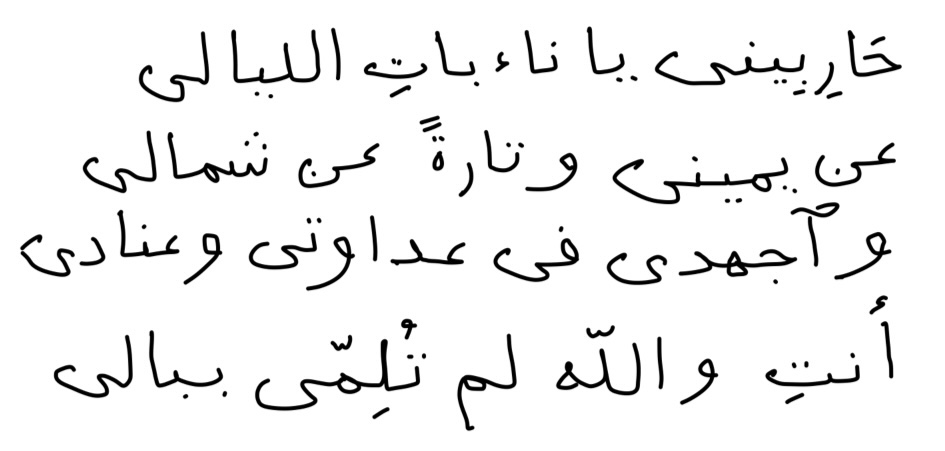
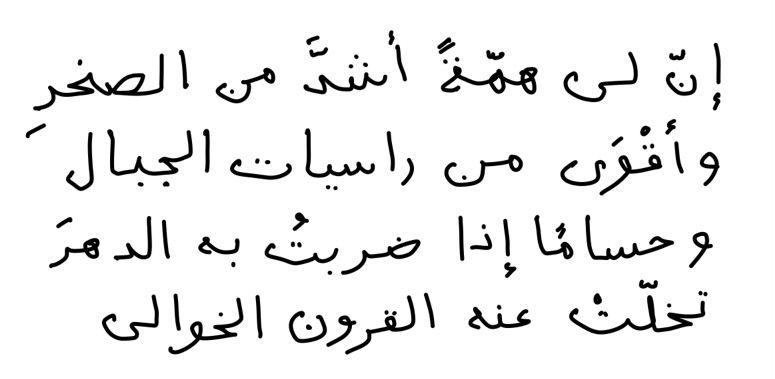
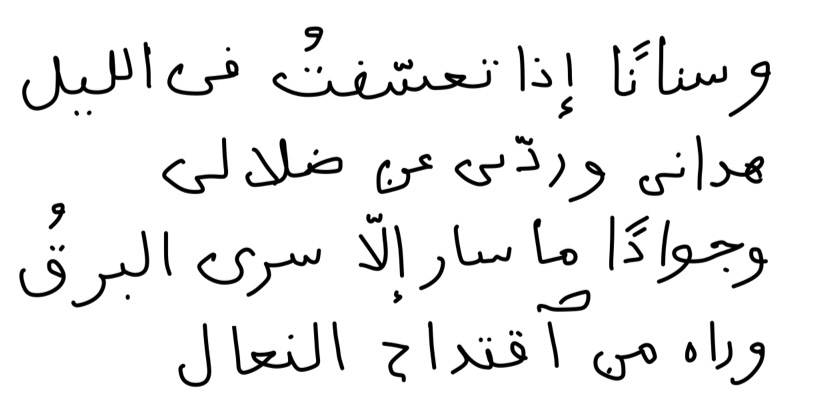
The text I use is from A.J. Arberry, Arabic Poetry: A Primer for Students (Cambridge University Press, 1965). Arberry says the poem is likely not by ^Antara, but is in the spirit of “one of the greatest hero-poets of the sixth century” who “became in medieval Islam the central figure of an extensive popular romance.”
The speaker glorifies his prowess in battle, the gleam of whetted weapons, and the fiery spirit of his war horse. Two different words are used for “spear-head”: one is qarn ( pl. qurūn), which is “horn”. Early spear-heads were made of horns, according to Lane*. The other word used is sinān, from the root for “tooth.” The whiteness of the teeth is an analog for the gleam of polished metal, bright enough to guide the warrior as he moves in the night. At the end the speaker invites predators to nourish their offspring on the brains of “the people,” i.e., corpses strewn on the battlefield. There are 14 verses.
1 Wage war on me, nighttime travails, from my right side now, again from my left. 2 Do your utmost to be hostile and resist me: by God, you haven’t camped inside my head.
3 Mine is a determination harder than rock, stronger than towering mountains; 4 I have a sword with which I deal blows such as keen spear-heads fall away from;
5 And mine is a spear-head that guides me at night and keeps me from straying; 6 Mine a charger that has only to move to trail lightening from its spark-making shoes;
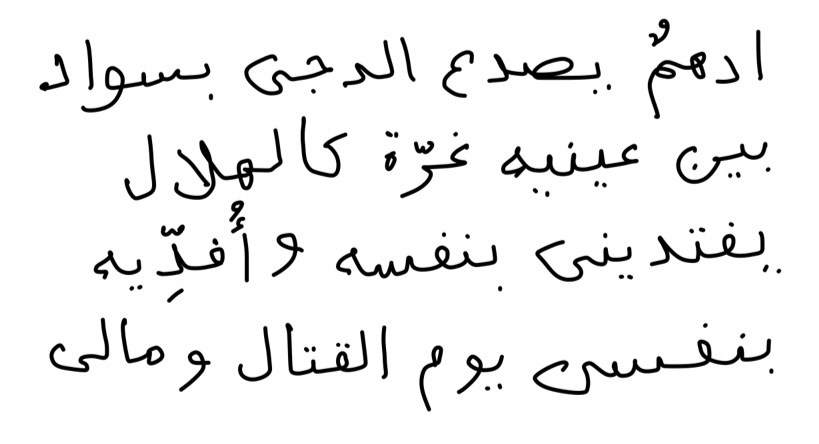
7 ‘adham(un) yaṣda^u-d-dujā bi-sawād(in) | baina ^ain-ai-hi ḡurraẗ(un) ka-l-hilāl(i) 8 yaftadī-nī bi-nafs(i)-hi wa-‘ufaddī- | hi bi-nafs(ī) yaum(a)-l-qitāl(i) wa-māl(ī)
7 Dark in hue it cleaves the gloom with blackness, a crescent-moon blaze between its eyes; 8 It ransoms me with its life, I it with mine and with my treasure on the day of battle.
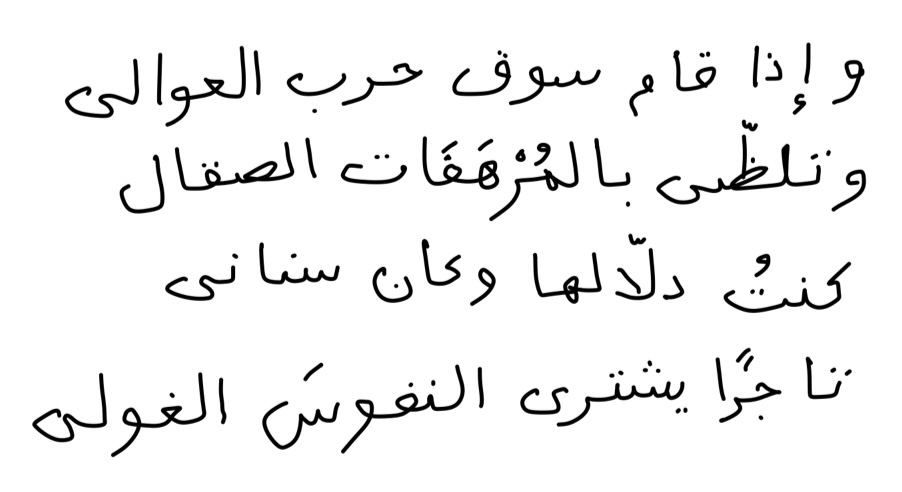
9 And when the market of war of the tall is afoot, ablaze with the sharpened and polished, 10 I am its broker and my spear-point a merchant purchasing valuable souls.
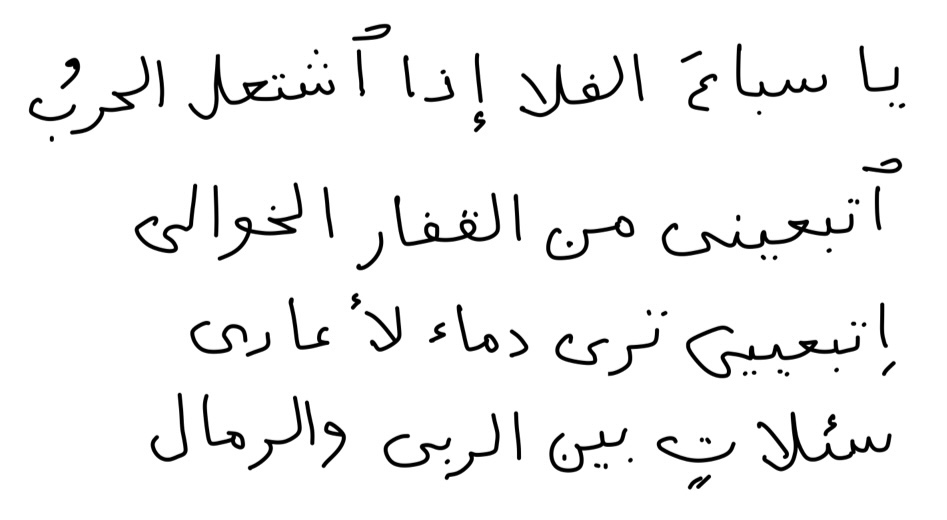
11 Predators of the desert, when war burns bright, follow me from the empty wastelands. 12 Follow me and see the blood of enemies flowing between the hills and the sands.
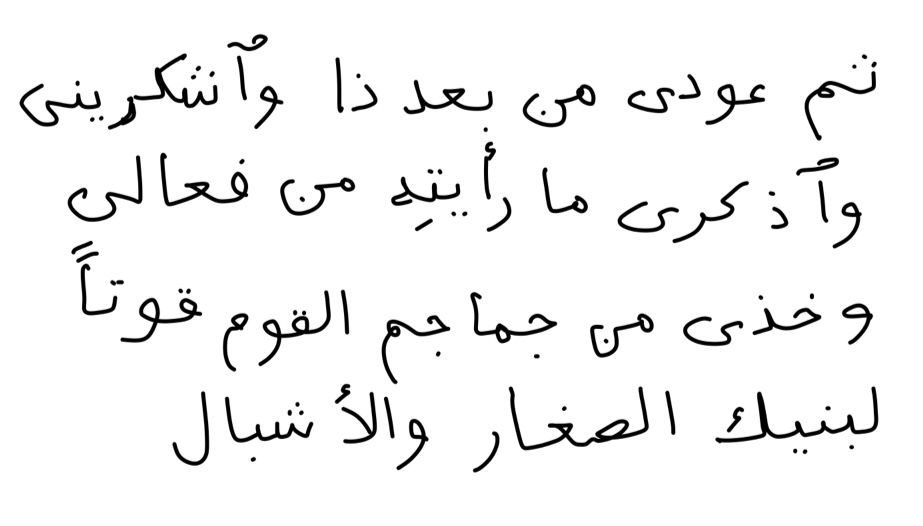
13 ṯumma ^ūdī min ba^d(i) ḏā wa-škurī-nī | wa-ḏkurī mā ra’ai-ti-hi min fi^āl-ī 14 wa-ẖuḏī min jamājim(i)-l-qaum(i) qūt(an) | li-bunayy(i)-ka-ṣ-ṣiḡār(i) wa-l-‘ašbāl(i)
13 Then return and thank me, remembering what you’ve seen of my exploits, 14 And take food from the skulls of the people for your little ones and your cubs.
Notes *Edward William Lane, Arabic English Lexicon, 1863 — reprint by Suhail Academy, Lahore, Pakistan, 2003) 9 I’ve kept the Arabic’s metonymy on the shaky premise that the resulting obscurity conveys a “modern” tone! “The tall” may be tall lances, “the sharpened and polished” swords and spear-heads.
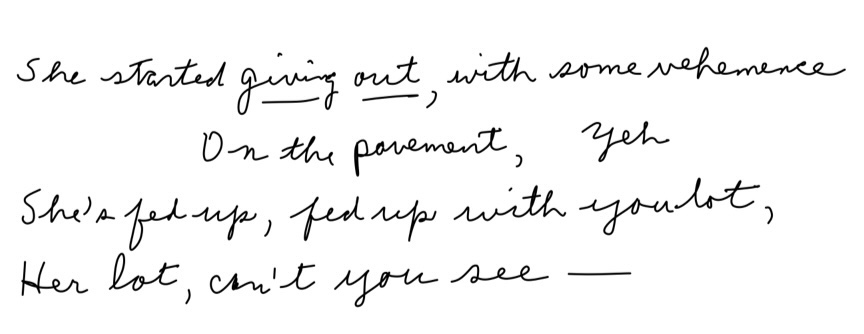
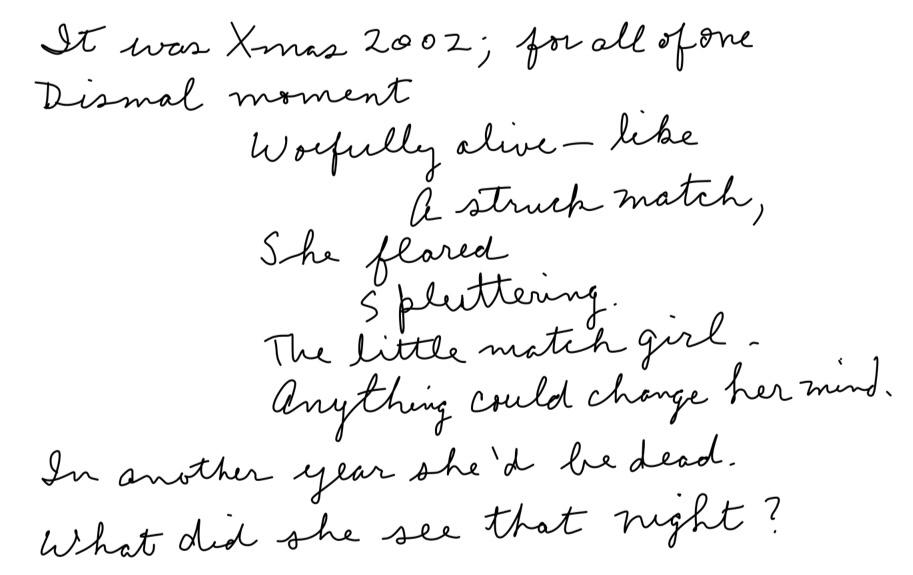
Midway through Wong May’s poem titled “The Last Film,” the speaker’s mother-in-law melts down briefly after a movie (“8 Women” by François Ozon) and a restaurant dinner (fried courgette flowers, salade Niçoise) with the family.
In my Texas dialect “give out” means to break down from exhaustion: The old boy plumb gave out. Wong May’s usage feels different, more akin to “letting out” emotion. She does so “with some vehemence.” I like the phrase “you lot” a lot. It’s often proffered sneeringly, and I associate it with British English: You lot are spewing an inverted pyramid of piffle.
The mother-in-law quickly recovers her composure; the outburst is absorbed into embarrassed silence by her offspring, never to be spoken of. The poem ruminates on the circumstances surrounding a lifespan haloed with winter misting, ending with a question.
The lady who glitches outside the restaurant is 83 years old. Time’s wingèd chariot tailgates her. The flare and sputter of the match is a glowing emblem for the outburst pondered in the poem: an access of rage at decline, possibly of ambivalence and exasperation over the impudent vitality of progeny. The phrase woefully alive stamps her dismal moment.
British radio presenters report someone’s death by inserting a formulaic “sadly”: So-and-so sadly died. It’s a bargain basement bauble of bogus sympathy, threadbare and fatuous like America’s “thoughts and prayers.” Death, be not proud — nor slobbered by pious rhetoric, please. Those who are woefully alive may well go happy into that good night, glad to be quit of their lot.
The issue’s appealing yellow-jacket cover is credited to Tré Seals.
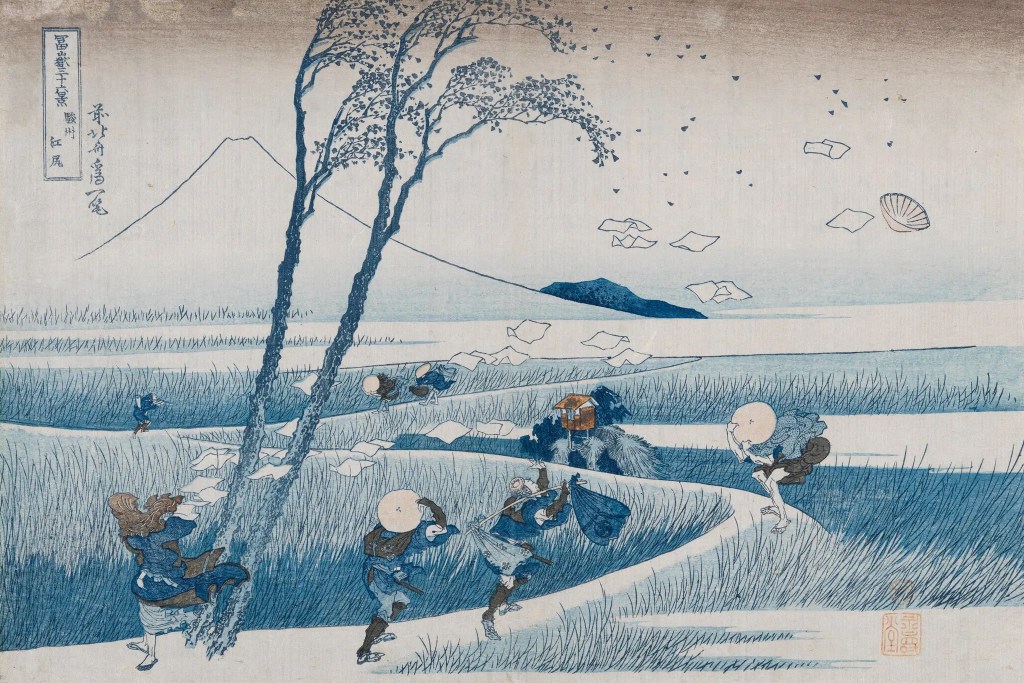
“Ejiri in Suruga Province” from the series “Thirty-six Views of Mount Fuji “ by Hokusai, about 1830-31. Woodblock print depicting travelers blown off a twisting road by a sudden gust of wind. Credit… William Sturgis Bigelow Collection; via Museum of Fine Arts, Boston. [New York Times captioned illustration.]
As for Fuji… it’s nothing but three quick strokes: a swoop to the top, a bobble for the summit, a long glide back to the ground.
[…] What Hokusai and his successors affirm over and over is that there’s no such thing as a pure “culture” divisible from others — not even the culture of a shogunate whose subjects couldn’t leave on pain of death. Culture is always an ebb and flow of fragmentations and recombinations, of encounters both violent and peaceful. You cannot stay separate; everything floats […].
(Jason Farago, “How Hokusai’s Art Crashed Over the Modern World,” New York Times, 6-22-23)
I’m passionate about is trotted out like a mirror, I adjust the last of my hair, my dubious neck folded
into my collar: a dirty wad of dollars. (Randall Mann, from “The Ritz,” Poetry, May 2023)
Many are “passionate” about this, that, or the other. It makes them shouty. They could cool their jets with some good poetry. We’d be none the worse for it.
“Is it ever easier?” a young writer asked me recently. “Do you ever grow a thicker skin?” She was suffering because an essay she’d written about the death of her mother had been rejected by every outlet that conceivably might publish it. I had no answer, so I told her a story. Just before the outbreak of Covid, the novelist and short story writer Nathan Englander had moved into my neighborhood in Toronto, and we would sometimes sit around my backyard firepit, drinking and complaining. “Is it ever easier?” I asked him one night. “Do you ever grow a thicker skin?” Englander had no answer, so he told me a story. He had once been at dinner with Philip Roth. “Is it ever easier?” he asked Roth. “My skin will get thicker with each book, right?”
(Stephen Marche, “A Writer’s Lament: The Better You Write, the More You Will Fail,” New York Times, 2-11-23)
Emilie Moorhouse’s translations of the verse of Joyce Mansour (1928-1986) in Poetry, June 2023, give full-throated voice to the satisfactions of the originals.
Take the line from “Fever your sex is a crab” that serves as my title: Lack of good judgment would make me argue for “The avidity of your man-eating membranes” over “The eagerness of your cannibalistic tissues,” which is Moorhouse’s civilized rendering.
“Muqueueses” is a hairy caterpillar of a word, a phonological jamboree oozing with vowels, glorious as French can be. I love saying “muqueuses cannibales,”talking about saying it, imagining being heard doing so.
Mansour’s language seems notably “musical” to my ear, not tinkly but savage. A pleasurable aspect of reading the poems alongside their translations is savoring their acoustic power while leaning confidently on Moorhouse for help with unfamiliar words. The bolded terms in the extract below were new to me:
Rhabdomancie … Puis affalée dans l’armoire près du lit Projetez votre oméga plus une poignée de salamandres Dans le miroir ou l’ombre se dandine … Taquinez ses penchants avec un blaireau de soie Saupoudrez son phalène de sang et de suie … Malgré moi ma charogne fanatise avec ton vieux sexe débusqué Qui dort.
Dowsing … Then sprawled in the armoire next to the bed Project your final word along with a handful of salamanders In the mirror where the shadow sways … Tease his kinks with a silk brush Sprinkle his moth with blood and soot … In spite of myself my carrion fanaticizes over your ousted old cock That sleeps
This writing seems very current though its author died over 3 decades ago. It conjures words going for a walk as Klee took line for a walk. The sensuous fact of themselves is that to which they lead, and what they share with dream is the quality of slipping capture.
What does “surreal” mean, anyway, to a lay reader of today? It’s easy to call much contemporary verse surreal insofar as it doesn’t “make sense” in the ordinary way, doesn’t correlate to realities that are objective, if that means perceptible or conceivable in an awake, reasoning state of mind. I thought perhaps that’s what Eliot meant by “objective correlative,” but a quick Wiki-dip reminded me that what he meant was too abstruse to be memorable.
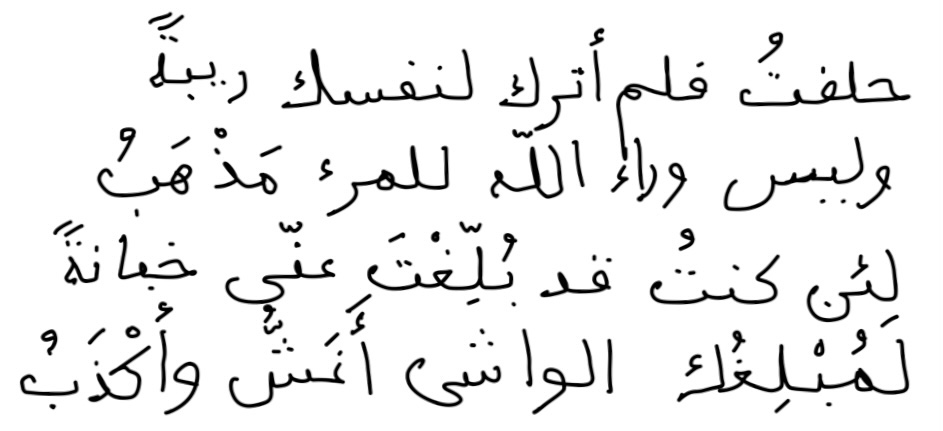
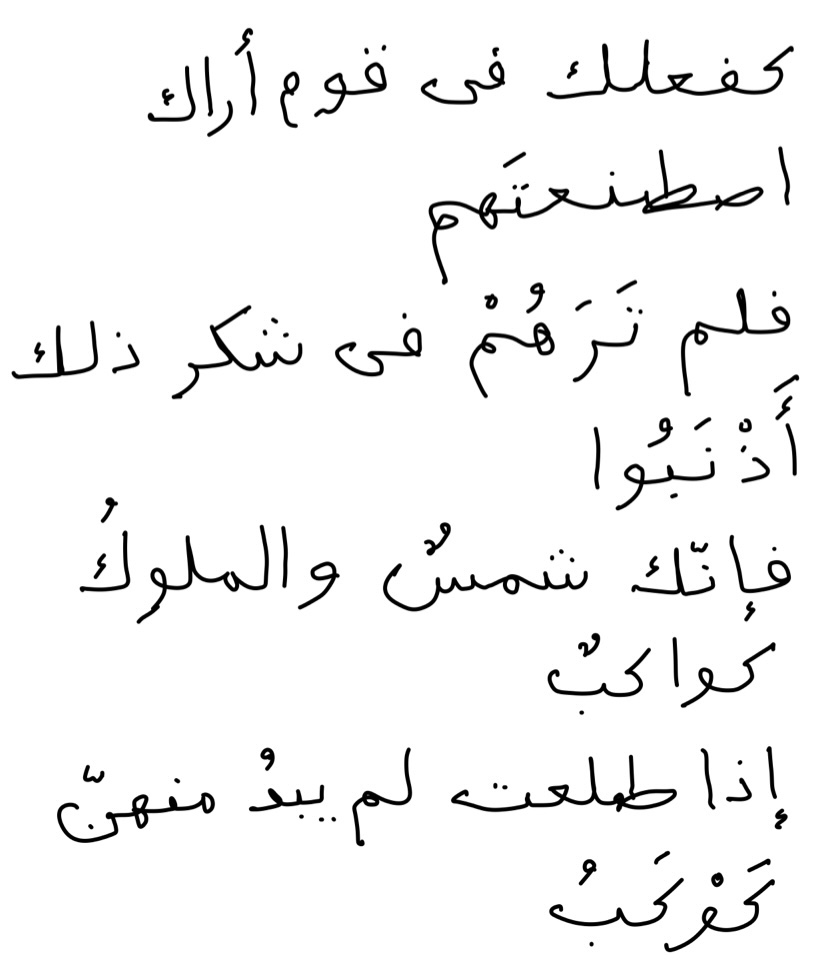
In this complicated, ancient poem* I glimpse the life of squalid intrigue and dependency that was ever the courtier’s lot. At the mercy of the tyrant’s whim and the plots of competitors, his is a routine of flattery, complaint and cunning self-promotion. Skill with panegyric is a tool for survival.
A brute comparison of the Arabic text’s word count to that of my paraphrase highlights Arabic’s extraordinary facility for compression.
As a matter of style, consider verse 6. The English speaker yearns for active voice, yet the Arabic verbs are passive, as if to underscore the speaker’s lack of agency in the matter of his own welfare.
At the end, verses 11 and 12 twist fulsome praise of the patron, self-abasement and special pleading into a tight weave of indirection.
1 Word reached me — may you shun cursed behavior! — that you blamed me and things over which I am vexed and exhausted. 2 So I spent the night nagged by thoughts that seemed to spread a spiny bush for me, by which my bed was tossed and poisoned.
3 I swore, leaving no doubt in your mind — and beyond God there is no escape for a person. 4 If you’ve been whispered to about treachery on my part, your slandering informant is a conniving liar,
5 Whereas I am a man with a tract of land on which to wander and find retreat. 6 With kings and brothers, when I’ve come to them, I’ve been made responsible for their possessions and treated as an intimate,
7 Just as you’ve done with persons I’ve seen you favor, and yet not consider to have sinned from lack of gratitude. 8 For you are a sun, and other kings are stars; when (your sun) rises, not one of those stars appears.
9 Don’t leave me with the threat as though I were, to the people, smeared with tar, covered in scabs. 10 Don’t you see how God has given you power, and how every monarch quakes before it?
11 You are not one to spare a brother whom you have not straightened out. What man is the refined one? 12 If I am wronged, I’m a slave you have treated badly; and if you are disposed to restore me to your good graces, a man like you grants favor.
Notes *The text I use is A.J. Arberry’s Arabic Poetry, A Primer for Students, Cambridge University Press, 1965. 1 may you shun cursed behavior: Lane: (A greeting addressed to kings): “Mayest thou refuse… to do a thing that would occasion thy being cursed…” 2 tossed: the Arabic says “lifted” or “raised.” 3 I swore: Presumably an oath of innocence invoking God’s name. 4 slandering: the Arabic says “embroidering” or “embellishing.” 5 I am a man: I.e., man of substance. 11 Which man…etc. I.e. “Which man can claim to be truly refined?” 12 Key words are verb yu^tibu and its derivative ^utbā. Of the latter, Lane says: “Its primary signification is the returning of one whose good will, or favour, has been solicited, or desired, to the love of his companion.” As an example of the former, Lane translates ‘a^taba-hu as: “He granted him his good will, or favour; regarded him with good will, or favour; became well pleased, content, or satisfied, with him.”
In reading “The ‘Change’ in Climate Change” by Jacob Shores-Argüello (Poetry, June 2023), I stiffened attentively at the following:
… Because a year before, a hurricane reaved its way across this country for the first time in recorded history…
The country is Costa Rica. “Reaved” looked vaguely familiar; I thought of Faulkner’s The Rievers, a book I know of but haven’t read. I wasn’t sure if it was the same word, nor what it means in either case.
“To reave” is to carry out forays in order to plunder, rob, despoil or purloin. My research revealed that the Faulkner title is spelt The Reivers, and that “to reive” means the same as “to reave.”
Here’s the rest of “The ‘Change” in Climate Change”:
…Tornado or torbellino or something else, I ask her about the valley’s strange wind. And she laughs, says
that she was calling to ask me the same thing. I don’t know why I keep forgetting the change in climate change. My grandmother
sighs as the sky darkens to the color of rum. Why I still think that we’ll have names for all the things that will come.
This straight-talking text pulls what I took at first to be a kind of turn in its final sentence — the reader of Poetry braces for bumps in the road. After I had drafted a catchy paragraph of deconstruction, the climax of which was, “I’m left in a sweet agony of dangling,” my various re-readings caused the penny to drop. My agony was no longer sweet. I had simply read wrong.
The key to grasping the writer’s conclusion is this: The independent clause which is antecedent to the final dependent clause — Why I still think…, etc. — is in the penultimate stanza: I don’t know why…. The last sentence fleshed out is, then, (I don’t know) why I still think / that we’ll have names for all the things that will come.
Once I had snapped to the discontinuity, it was as obvious as the nose on my face. Such are my misadventures with lined speech, given a weakness for skies darkening to the color of rum, forgetting that lucid exposition isn’t coin of the realm in the genre.
No sé por qué aun creo que sabremos darle nombre a todo lo que ha de venir. Je ne sais pas pourquoi je crois toujours que nous aurons des nombres pour tout-ce qui viendra.
I’ve saved this passage by Kafka translator Ross Benjamin in my notes since early February. In re-reading it I realize anew how cogently it expresses my own experience of reading poetry, never mind translating it. It ends with a compelling recommendation to let certain writing speak for itself — “as far as possible”!
***
My translation [of “The Diaries of Franz Kafka”], which I delivered to my publisher shortly after turning 40, Kafka’s age when he died, was the result of eight years spent groping and straining to make sense of Kafka’s groping and straining to make sense. Not only could I not always — or even often — be certain that I knew what Kafka meant, but I also didn’t know whether at any given moment he himself knew what he meant. Like many diarists, he didn’t always achieve a clear-cut articulation of his inchoate consciousness, to say nothing of his unconscious, but often relied on a kind of mental shorthand or associative logic hinted at only barely in the words and syntax.
I typically translate by circling back to unresolved quandaries as many times as it takes for me to feel convinced of my choices. But chasing Kafka’s almost physically elusive sense, I found myself in the same predicament that afflicts many of his characters: the more tenaciously certainty is sought, the more insistently doubt and frustration are sown. It’s a self-perpetuating, potentially interminable cycle. I came to realize that only by putting aside my demands for clarity and coherence could I do justice to what was strange, disconcerting, and even baffling in Kafka’s writing, to what unsettled any narrow interpretation or reductive theory we might otherwise be tempted to impose on it. Kafka’s irresistible appeal is preserved— indeed, in my view, it’s only enhanced — by, as far as possible, letting his writing speak for itself.
(Ross Benjamin, “A Century On, the Search for the Real Franz Kafka Continues,” New York Times, 2-2-23)








 EthicalDative