… A consummation devoutly to be wished.” (Shakespeare)
Evangelical euphemisms like “Grab ‘em by the prissy” and “Kiss my aft” have hopped from bully rally to pulpit rave in American discourse thanks to the God lobby. But, Britannia, oh dear! “Fuckpigs,” “morons” and “cunts” have recently been heard on the airwaves of the Sceptered Isle straight from the recorded lips of a political ruffian at 10 Downing Street. The unchurched epithets he sticks to Whitehall functionaries knock America’s sanctimonious cockuppery into a cocked hat.
See here, sir hooligan, to wit, Mr. Cummings:
In His Majesty’s Government, 778 members sit currently in the unelected House of Lords. It’s the superior chamber comprised of the better sort from the preferred schools and the loftier lineages. This pantheon of life peers will emit the mother of all harrumphs, followed by a scorching remonstrance with thunder of tut-tutting in deprecation of scurrilous utterance at Number Ten. I wager a guinea on it and shall be astonished if not. The Palace is briefed, mind you, and will keep vigil.
Italian prime minister Georgia Meloni is in the news for rinsing her hands of longtime, live-in boyfriend Andrea Giambruno, caught prospecting for group sex. Reportage has reached again for bunga bunga, which keeps this reliable trope of male-hormonal culture merrily cohabiting with family values.
That old Boccaccian satyr Berlusconi (RIP) was patron saint of bonking and baloney (QED).
(JMN)
Mattia Ferraresi comments on the nepo-incestual tenor of power in Italy, “where politics, media and business interests are toxically entwined”:
More than half a century ago, an aphorism commonly attributed to the journalist Leo Longanesi captured the problem: “The revolution will never take place in Italy, because we all know each other.” The same is seemingly true for functional government.
(Mattia Ferraresi, “Italy’s Prime Minister Broke Up With Her Boyfriend. It’s Actually Quite a Big Deal,” New York Times, 11-1-23)
“The whole secret of politics is knowing who hates who.”
(Kevin Phillips)
“MY pronoun,” said Cruz, “is ‘kiss my ass.’” On Ted’s form of address I’ll take a pass. A smooch bestowed on the croup of this solon is honor paid to the poop of his colon.
The scatology of my lampoon is icky even to me, but language follows play-the-leader. Ted Cruz nominally represents Texas in the world’s — wait for it — “greatest deliberative body,” aka the U.S. Senate.
Kevin Phillips published The Emerging Republican Majority in 1969. The influential book presciently theorized that Republicans could build an enduring majority by attracting conservatives from the South and West who were troubled by “the Negro problem.” The “Sun Belt” (he coined the name) is now a GOP bastion.
(Jamelle Bouie, “This Is How the Republican Party Got Southernized,” New York Times, 10-13-23)
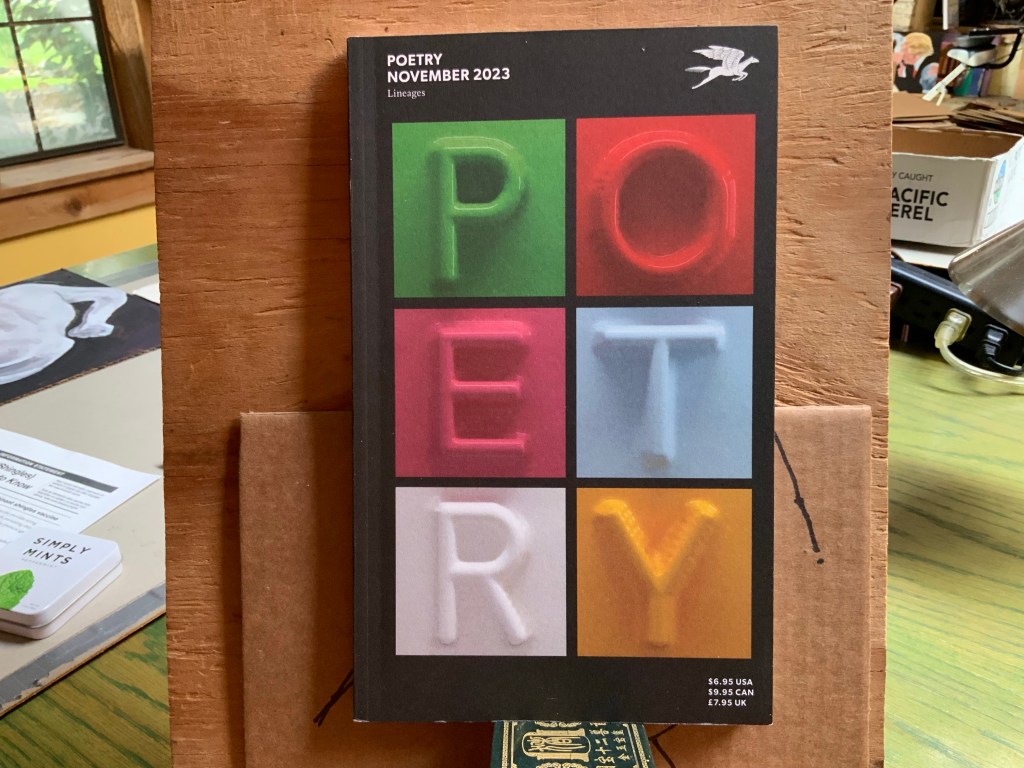
Carlo Cadenas is the cover artist for Poetry, November 2023, whose tagline is “Lineages.”
“We love the balance and control of rhyme even if it unbalances us, but, after the music, we want meaning.”
(Adam Gopnik)
When Adam Gopnik writes, “No prosody can immunize poetry against the test of experience… What’s always at stake with literature and lyrics is their relation to the world,” I take his point to be that one can’t read poems without concerning oneself one way or another with what they “mean,” with how they map to something outside both the text and the poet’s head, and which is perceivable by the reader. Gopnik puts signification up front by quoting the Duchess in Alice’s Adventures in Wonderland: “Take care of the sense, and the sounds will take care of themselves.” I hazard a suspicion that some versifiers invert these terms.
Gopnik makes his observations in an essay about rhyme (“The Rules of Rhyme,” The New Yorker, 5-23-22). The fact is, rhyme has retreated from much lyric. I like to think of simile and metaphor as part of the “sound” that verse tries to make now. The other part comes from fractured syntax and irregular typography. These devices comprise the wave that carries signal, or meaning.
Gopnik’s position might be thought hidebound by some, but has validity if the notion of meaning is given room to rattle around in. A job of writers striving to be poets is to prosecute effrontery unforgettably. They’re not in the business of making things easy for the complacent reader. When, however, the carrier wave fumbles its cargo and signal is ungraspable, the reader perceives noise.
“Noisy” is an unforgiving descriptor to confer upon a text. I wonder if cases arise in which the burden sought to be lyricized remains stuck in the writer’s mind, snagged in jagged rhetoric, and wants only more cunning application of art in order to mount the wave? To course from the writer’s “soul” or “spirit” into the reader’s apprehending faculty?
Here’s a metaphor plucked from the November 2023 issue of Poetry:
… My willingness to sit still — to bear the hornet’s nest of everyday life turning in my throat like a giant, wet eye…
Been to the broke-heart mountain. Been to the Jesus well. Thoughts and prayers for the Shepherd’s cause, the Founders’ flaws, the House of Laws, from We the People’s hell.
“Untitled: Red and Blue,” 1961, on display at the Nagoya City Art Museum in Japan. It has been called his signature work. Credit… Collection of the Nagoya City Art Museum. [New York Times illustration]
I’ve pondered how much to grudgingly admire the towering raspberry Tadaaki Kuwayama gave rhetorically to the practice of art. His expressed approach oozes iconoclastic gore in the spirit of outré versecraft from the pages of Poetry.
… He wanted to “create works with no trace of touch that can be made by anybody and replicated endlessly.”
“I didn’t want to create any distinction between ‘good’ or ‘bad’ colors. I wanted to treat them as equivalent to each other. So I used some horrible colors — all on purpose.
“I’ve never felt the need to sign or date my works… I can remake [earlier paintings]. If anything, it’s more interesting to remake them now. The only thing that changes is the material.”
“Construction/Materials,” 2019, at the David Richard Gallery in New York. Credit… Yao Zu Lu/Tadaaki Kuwayama Estate, via David Richard Gallery, New York. [New York Times illustration]
[The Art Students League] “wasn’t a very interesting place to be… It was where amateurs and bourgeois wives went, and the teachers were all conservative. So I hardly went to school at all. I would just sign in and go home.”
“When I started my practice… I felt the age of painting was over, and I wanted to make things that had no trace of painterliness in them, things that existed in a different dimension. I wanted to create things that people who believed in painting wouldn’t understand. And I still do.”
Never mind whether I can understand or look much at what he did. Mr. Kuwayama, a “celebrated painter,” made his own weather. Kind regards, by the way, to amateurs and bourgeois wives everywhere!
(Will Heinrich, “Tadaaki Kuwayama, 91, Dies; Painter Who Carved His Own Spare Path,” New York Times, 9-15-23)
The person who commits lèse majesté on the pugnacious lord of Magalago incurs a stiff barrage of coo-coo ack-ack from keyboard hoplites flogging his farrago.
My favorite Spanish word is sigiloso. It comes to me unbidden of a sudden from that place frondoso in my noggin, the quarter that is menos lugareño, con tan poco apego to the local that I can be exotically vocal.
Resulta que me_evoca English “sigil,” a seal que no_es lo mismo que foca; of logic en mi_idioma hay muy poca. It leads me to your sister’s chest-of-drawers: No_es lo mismo “la cómoda de tu hermana” que “acomódame a tu hermana” — ¡Dios, qué_escándalo! The play on words es un retruécano.
Arturo Rodríguez told me this tale: A man’s car failed him in a lonely dale. Nearby pastured a horse, and distant lay a farmer’s house where urchins were at play (Arturo’s word for “urchins” was escuincles). “Es el carburador,” murmured a voice. As to who had spoken there was no choice. The man hightailed it to the house in panic. “YOUR HORSE JUST TALKED!” he stammered halfway manic. “It said my problem is the carburetor!” “Not possible,” the farmer said. “That horse no sabe nada de mecánica.”
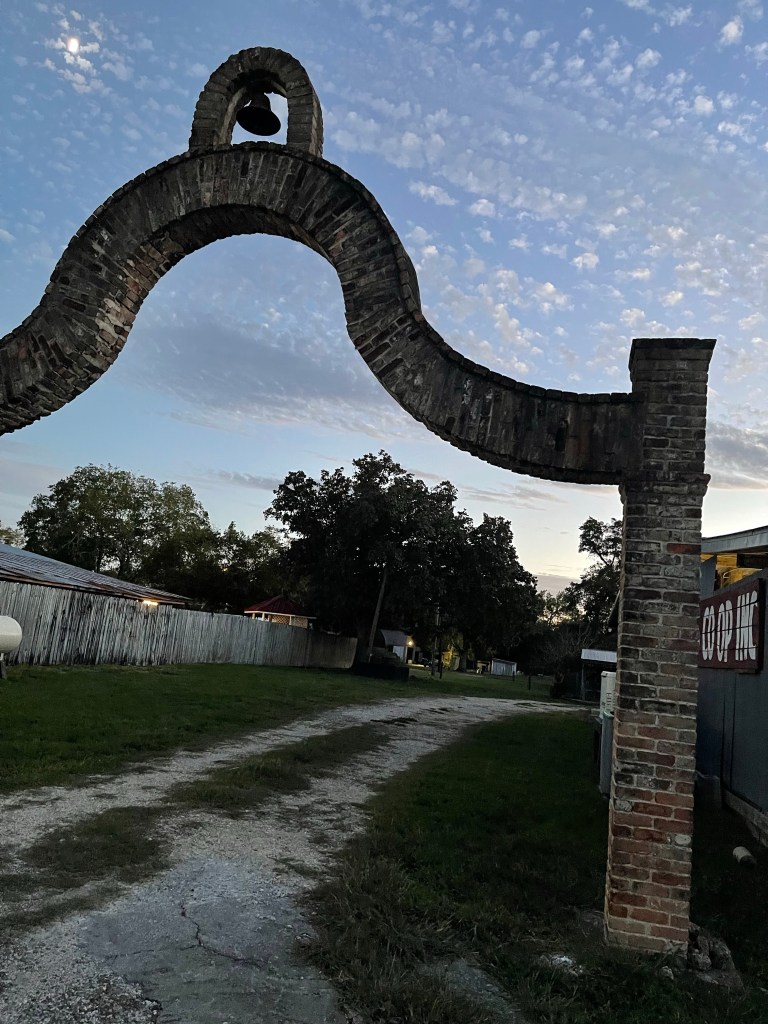
Artesano del arco, ¡te saludo! Arturo, amigo de grato recuerdo, viviste_antaño en mi cobertizo. En paz descanses, maestro de canto, y obra de ladrillo y cemento.
Never a bird had fairer scientific name than Upupa epops, the jaunty hoopoe, for which the Arabic is hudhud. “Heron” is balaSHUN.
I experience this delicate lyric written in Arabic as all signal with no noise. If it alludes to other than what it says, I’m clueless. The poem exalts confusion, and being humbly confused is divine in my book. Wallowing in certainty is where mischief lies. Only today I read this: … Stay with the questions and entertain doubt as the unlikely bedrock of understanding.
The translation to English and transliteration of the Arabic text are mine.
2013-8-16 I sing of you, O bird, migrating heron. I sing of your whiteness, and your unhurried gait in fallow land. I sing of you also, O hoopoe, who are resident. I sing of your little crown as you gather seeds in the plowed field. I am like this, my song is confused; it puts one foot in the fallow land and another in the plowed land. One time I say the prayer of the resident, another the prayer of the traveler. (Zakaria Mohammed, Poetry, September 2023)






Please, Your Majesty. Say, ‘We Are Not Amused’
… A consummation devoutly to be wished.”
(Shakespeare)
Evangelical euphemisms like “Grab ‘em by the prissy” and “Kiss my aft” have hopped from bully rally to pulpit rave in American discourse thanks to the God lobby. But, Britannia, oh dear! “Fuckpigs,” “morons” and “cunts” have recently been heard on the airwaves of the Sceptered Isle straight from the recorded lips of a political ruffian at 10 Downing Street. The unchurched epithets he sticks to Whitehall functionaries knock America’s sanctimonious cockuppery into a cocked hat.
See here, sir hooligan, to wit, Mr. Cummings:
In His Majesty’s Government, 778 members sit currently in the unelected House of Lords. It’s the superior chamber comprised of the better sort from the preferred schools and the loftier lineages. This pantheon of life peers will emit the mother of all harrumphs, followed by a scorching remonstrance with thunder of tut-tutting in deprecation of scurrilous utterance at Number Ten. I wager a guinea on it and shall be astonished if not. The Palace is briefed, mind you, and will keep vigil.
(c) 2023 JMN — EthicalDative. All rights reserved