I Have a Bone to Pick with the Food Chain

In a neighboring town I glimpsed a lone cow in a chute back of a meat processing plant. She was staring fixedly at something unidentified off to my right, heedless of my passing. Only one outcome was left for her. 

A “meat processing plant” is a slaughter house. She was in her last hours. Was she afraid? Did she have any inkling of what came next? What was it that had captured her attention? She was so still, staring. What kind of conscience lights the bovine brain? Can anyone know? When had she last been given any food or water? It didn’t matter, did it. She was worth no further investment by anyone. She was meat now, just not dead yet.

In this nation under God, condemned humans can choose whether to be shot, poisoned or electrocuted. How do we kill what we butcher?

There’s been very little beef in my present. There’s none in my future. Adios, Whataburger. I can’t get her out of my head. This jolly season bearing down on us like a toy train driven by Goofy: I”m thinking of celebrating it with some fasting and meditation. Bean soup. Piece of fruit.

(c) 2025 JMN — EthicalDative. All rights reserved

Posted in Commentary | Tagged , | 4 Comments

The Parable of Angus Burdoo

“Interdependence is no longer our choice… It is our condition. We will either build healthy interdependencies and rise together or suffer through unhealthy interdependencies and fall together.”


(Dov Seidman, quoted here)

Picture a man who engenders a lovely daughter. In the fullness of time he is party to the bestowing of this daughter upon a deserving partner with her full consent.

The rhetoric of the ceremony lets the daughter’s partner think she is subservient. When he’s cold he nestles against her. When he’s horny he copulates with her. When he’s hungry he demands meals from her. When not mothering children she dances for his entertainment.

The father sees his daughter reduced to a shadow of herself. He confronts the partner to whom he entrusted her and says:

You didn’t read the covenant carefully. Heed this wisdom: A good man returns the tool sharper than when he borrowed it. You received into your care this being unique in the entire universe so far as you know. Your welfare was contingent upon your putting yourself in her service, exalting and nurturing her in exchange for her support. Instead you’ve wasted and abused her. I’m afraid you’ve made your Hell. Now lie in it, fool.

THE BALLAD OF ANGUS BURDOO
Gather round me, children, let me tattle you a tale
‘Bout the grandest gob of guff you’ll ever see.
Buy twenty of the suckers, get the second one for free,
And we’ll gambol ’til we’re silly in the dale.

Listen up, my brothers, let me say it loud and clear:
Rosin up the bow and lick a toad.
There’s stories I could tell you as would make your ears explode,
And we’ll perish all together, never fear.

(c) 2025 JMN — EthicalDative. All rights reserved

Posted in Anthology | Tagged , , | 2 Comments

Never Too Many Books


In the paneled sitting room of Peter-Ayers Tarantino’s Manhattan apartment, a circa 1780-1840 painting from Bolivia in the Cuzco School style has been placed among the apartment’s many bookshelves, which house a library of over 4,500 volumes. Beneath the painting is a banquette with ikat pillows from the Turkish company MD Home. Credit… Annie Schlechter. [New York Times caption and illustration]

… Peter-Ayers Tarantino[’s aesthetic] recalls that of maximalist bibliophiles of centuries past, including Marcel Proust and Johann Wolfgang von Goethe, was formed during a life on the road.


The bed is decorated with ikat pillows and a silk ikat spread from Material Culture in Philadelphia. Behind it are Tarantino’s desk, bookshelves and 19th-century brass alms dishes. Credit… Annie Schlechter. [New York Times caption and illustration]

In the Abstract Expressionism section, Tarantino extracts, almost without looking, a thick book on Sonia Delaunay. “She did one of my favorite paintings, ‘Yellow Balloons,’” he says, pointing to a framed lithograph of the work on the wall. 


Another view of the bedroom, with a collection of Peruvian ceramic bowls by the Shipibo-Conibo tribe. Above them is a framed illustration of turtles from Albertus Seba’s 18th-century publication “Cabinet of Natural Curiosities.” Credit… Annie Schlechter. [New York Times caption and illustration]

His closet contains more than 40 Hermès ties in the iconic feather pattern, and more than 50 twill Burberry plaid button-downs in assorted pastel shades.


The suite of antique furniture in the sitting room has been upholstered in a white cotton ribbed fabric from Brunschwig & Fils. A 1920s Navajo rug sits beneath a glass coffee table by Ludwig Mies van der Rohe. Credit… Annie Schlechter.  [New York Times caption and illustration]

But arguably his most striking collection can be found in the small kitchen[:]…  his 62 cream-colored ceramic English pudding molds from the 19th and 20th centuries. It took him 30 years to amass them…

On the primary bedroom’s mantel, ceramic vases and urns from Guatemala hold tulips. Behind them, a mirror is layered with a framed image of Albrecht Dürer’s 1502 “Young Hare” watercolor. On either side are head pots that Tarantino bought in Sicily. Credit… Annie Schlechter. [New York Times caption and illustration]

(Alexa Brazilian, “A Home That Proves That You Can Never Have Too Many Books,” New York Times, 11-8-25)

(c) 2025 JMN — EthicalDative. All rights reserved

Posted in Quotations | Tagged , , | 2 Comments

And One More Thing…

I adore compression and spareness, and Infinite Jest, finished at 7:29PM on 11-16-25, is bloated and prolix. It tells you something that it’s a novel with footnotes. Hundreds of them. During the periods when I ground my teeth, it tracked as a firehose of garrulity, by turns prissy, numbing, assaultive, revolting. Other times darkly and truly funny. (Humor cures lots of ills.) The novel can touch, amuse and grip when it chooses. 

David Foster Wallace had (the past tense saddens me) the phrase-making inventiveness and fecundity of a god. His lexicon is cavernous, his wit, um, infinite. A perennially intoxicated woman is termed a “sexual papoose.” A minor character looks “as if his hair had grown his head.”

There are jaunty, jocose, sardonic, devilishly dark set pieces around chemical dependency — demonically detailed deep dives into the arcana and experiential murk of the thing, soaked in clinical savvy and street jargon, conveyed in the voicings of characters that are drawn and overdrawn with cellular exactitude, machined to screamingly minute, reiterative, recursive tolerances.

Approaching the end, after days of intermittent listening, sometimes distractedly, I had a sense that a general modifier applicable to the novel could be the term “joyless.” For all the brilliance and vivacity and brute spunk and hip ennui that it flaunts and flashes, I detected little if any joie de vivre. Which is a stupid thing to say, because who contends that novels are meant to be bowls of cherries? What do I even mean?

Maybe Jest is a gargantuan poem, showing rather than telling. What’s it about? comes easily to poetry.

I’m just a reader, but Dwight Garner is a critic. I stumbled last night upon his review of David Szalay’s novel Flesh, the new Booker winner. His conclusion about Flesh captures a large part of how I feel about Infinite Jest:

I admired this book from front to back without ever quite liking it, without ever quite giving in to it. Sometimes those are the ones you itch to read again. Sometimes once is more than enough.

***

Postscript: On the open road I received a speeding ticket while listening to Jest on my noise-canceling headphones. The officer clocked me at 90, speed limit 70. I didn’t pull over toot sweet, to his chagrin. He had run his siren and I didn’t hear it, he said. “You were distracted, sir,” he said.

(c) 2025 JMN — EthicalDative. All rights reserved

Posted in Anthology | Tagged , , , , | 6 Comments

‘I’m Too Old to Paint Such Beautiful Things’


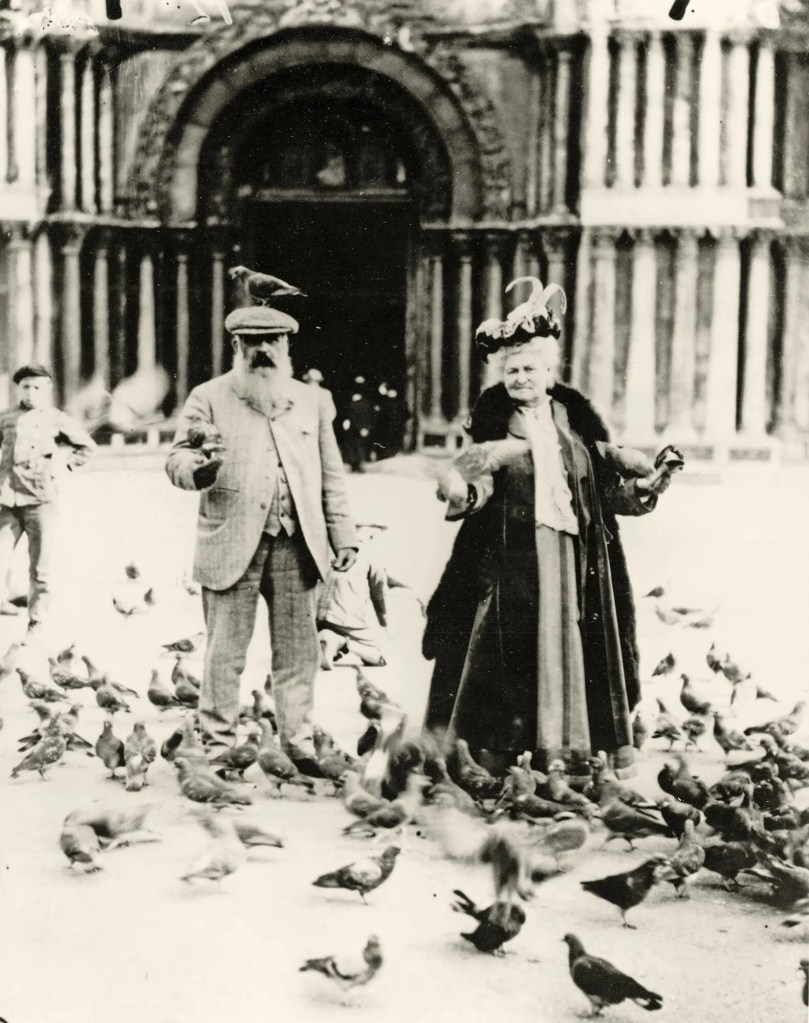
Monet and his wife, Alice Hoschedé, in the Piazza San Marco in 1908. Credit… via Brooklyn Museum and Bridgeman Images. [New York Times caption and illustration]

Monet made the comment about being too old before starting to paint the town feverishly. I’ve seen enough of his paintings for now. They’re on pillowcases and doilies. They’re everywhere! 

What I relish is seeing the man himself feeding the birds at Saint Mark’s Basilica with wife Alice. He sports an impromptu pigeon on his cap, and Madame a fetching hat. Walker Mimms submits a snappy account of the Brooklyn Museum exhibition “Monet and Venice,” which he describes as “lush and greedy.”

[About the Doge’s Palace]… Its alternating pink and white stonework, like a bar of lathered soap standing on tippy toes… Even through his fluffy brushwork and his off-kilter distances, the rectangle is pocked with seven perky Gothic windows…

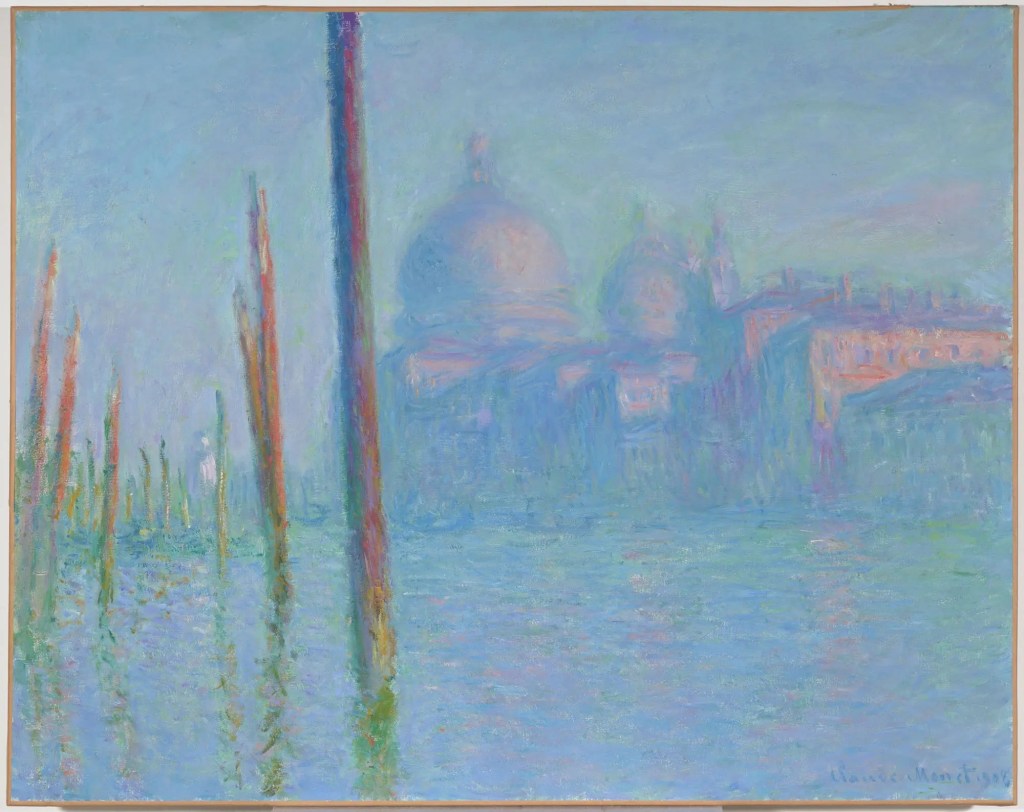
When painting something famous, Monet might zoom in or swaddle it in the woozy atmospheric effect he called the “enveloppe,” to draw our attention to the act of seeing through space.

In Venice, Monet seems more cowed into representation. In the five views of San Giorgio Maggiore… he broadcasts specific pediments and column bays through his soups of periwinkle, emerald, buttercream and rose.

“It’s frightening the number of painters here, in this small square on San Giorgio,” Alice wrote to her daughter.

Plein-air realists… tended to segregate ground from water with their different kinds of brushstrokes. They seem to be intuiting what scientists have only recently found: that we perceive solids and liquids in different parts of the brain. But Monet saw things differently. He wanted to capture perception before the brain has time to digest different kinds of matter.

When the paintings went up at Bernheim-Jeune in 1912, to critical praise, he confided to his longtime dealer Paul Durand-Ruel, “They are bad and I’m certain of it.”


Claude Monet. “The Grand Canal, Venice,” 1908, oil on canvas. When Monet and his wife arrived in Venice, they hired gondolas down the Grand Canal. “I’m too old to paint such beautiful things,” he told her. Credit… via Brooklyn Museum. [New York Times caption and illustration]

(c) 2025 JMN — EthicalDative. All rights reserved

Posted in Quotations | Tagged , | 2 Comments

Middlesex Praise God, Texas View

Imagine Middlesex — it must exist — a town, maybe a “village,” not a city. It’s in The Shires — wherever that is — an English village situated on a stream whose name is sufficiently spelt with three letters. The Cob? Middlesex-on-Cob! A traditional place which knows its mind, Praise God. 

The Middlesexuals are staunch Monarchists, Church of Englanders. That will tell you about their principles. Middlesex knows where it stands. Political blood runs blue (equals conservative) thereabouts. Bending to Reform of late. Mr. Farage knows whereof, settled in his views, speaks from the heart, one thinks. The village is rightly exercised over the immigrant problem, though there’s little of it locally, praise God. 

The owner of The Currant and Cornflower is thought to be Eastern European but has managed not to stick out. It was his great grandfather turned up from nowhere after The War — not that one, the first one — and founded the shop the family lives from. A swarthy lot they are, mind you, but with clear eyes. And marry their own, praise God.

(c) 2025 JMN — EthicalDative. All rights reserved

Posted in Anthology | Tagged , | 4 Comments

Time’s Wingèd Hotrod Tailgates Our Patoots*

 “It’s easier to turn an aquarium into fish soup than to turn fish soup into an aquarium.”


(Russian saying)

Time’s wingèd hotrod tailgates our patoots.
The piper that denies it is pie-eyed.
Rosin up the bow and lick a toad!
Time’s wingèd hotrod tailgates our patoots.
The Jackass and the Knave are in cahoots.
Fancy your cojones** boiled or fried?
Time’s wingèd hotrod tailgates our patoots.
The piper that denies it is pie-eyed.

*Texan for the nether cheeks
**Spanish for the testicles

“The decisive test of our age… is whether we will recognize this in time.”


(Eric Beinhocker)

(c) 2025 JMN — EthicalDative. All rights reserved

Posted in Anthology | Tagged , , | Leave a comment

Review of ‘Infinite Jest’ (Don’t Worry, I’m Jesting!)

I haven’t finished listening to the novel on my new Audible subscription, but I see no reason not to review it.

It’s twenty-seven Titanics of insanity steaming with breakneck slowness over an eternity of pages towards a who-knows-what species of icebergian reckoning beyond all feasible capacity of expectation.

It’s the ideal volume to be stranded on a desert island with, expiating one by one, word by word, every sin committed from cradle to grave (yes, in the metaphor you die on the island), keeping count by dropping grains of sand into a teacup salvaged from the shipwreck of life that brought you to this pass.

I don’t entirely dislike “Infinite Jest.” Read that as a positive statement in spite of its syntax. My son is a medical professional involved in mental health. I strive to recommend it to him. It has narratives he could profit from hearing. I can’t bring myself to do it. He has a life to lead, a profession to practice, and his time, unlike mine, is valuable. Saddling him with “Infinite Jest” would be like yoking him to a plough to turn 65 acres of sod for some intriguing weed-life to peek through. 

I try to know as little as possible about writers’ lives. The knowledge distracts from their poems and doesn’t “explain” them any more than an alcoholic’s life “explains” his disease. The poem (or novel), and the disease, have their own voice. I know only that David Foster Wallace liked tennis and killed himself in his forties. 

“Infinite Jest,” of its own accord, seems to me written by a brilliant, disturbed tennis nut possessed of suicidal ideation and an exquisitely attuned eye, ear and tongue for every species of human fallibility, deviancy, eccentricity and putridness under the sun. But and so (as he would write), not without glints of illumination, I affirm cautiously, suspiciously and hesitantly. 

Will I have begrudged the time spent in hearing “Infinite Jest” read when it’s done? Nope. You can’t know the view from a jagged peak until you’ve climbed it. I anticipate the view from “Infinite Jest,” when reached, will be close to indescribable. 

Here’s my anticipatory conclusion which I’ll reach when I get there: What I think of “Infinite Jest,” besides admiring its title, is neither here nor there. This novel will find those it needs to find, if and when they damn well want it and have the time. It found me, and vice versa. No complaints.

(c) 2025 JMN — EthicalDative. All rights reserved
Posted in Anthology, Commentary | Tagged , | 3 Comments

Enshittified* Cadence of the Unitaries

“When she says, ‘We have failed you,’ she means ‘We, the Democrats,’ okay?”
— Speaker Mike Johnson
(Say What? Archive)

We.
Other. Smother. Blight. Slight. Smite.
Are.
Invert. Divert. Revert. Subvert. Pervert.
Not.
Condemn. Conflate. Confuse. Concoct. Conspire.
Them.
Suck. Wreck. Mock. Block. Duck.
They.
Judge. Fudge. Dredge. Dodge. Purge.
Are.
Garble. Wrangle. Tangle. Fiddle. Muddle.
Not.
Inveigh. Deny. Belie. Besmirch. Belittle.
Us.
Accuse. Refuse. Abuse. Misuse. Bemuse.
You.
Disserve. Disrupt. Disdain. Disgorge. Dispute.
Are.
Pander. Slander. Hinder. Maunder. Dither.
Not.
Feint. Taint. Shunt. Taunt. Vaunt.
You.
Revile. Defile. Despoil. Derail. Curtail.

*Pace Cory Doctorow who coined “enshittification.”

(c) 2025 JMN — EthicalDative. All rights reserved
Posted in Anthology | Tagged , , | 2 Comments

Oh Besity! (Anthem)

Oh Besity! With tenderness
Our country stands for thee,
Staunch rampart against slenderness
From sea to shining sea.

Oh Besity! Forsake us not,
No di-et shrink our girth.
Caloric excess be our lot,
Our destiny from birth.

Ours the fat and ours the cream,
All exercise to shirk.
Oh Besity, thou art the dream,
Our Nation’s fairest work!

(c) 2025 JMN — EthicalDative. All rights reserved

Posted in Anthology | Tagged , , | 5 Comments