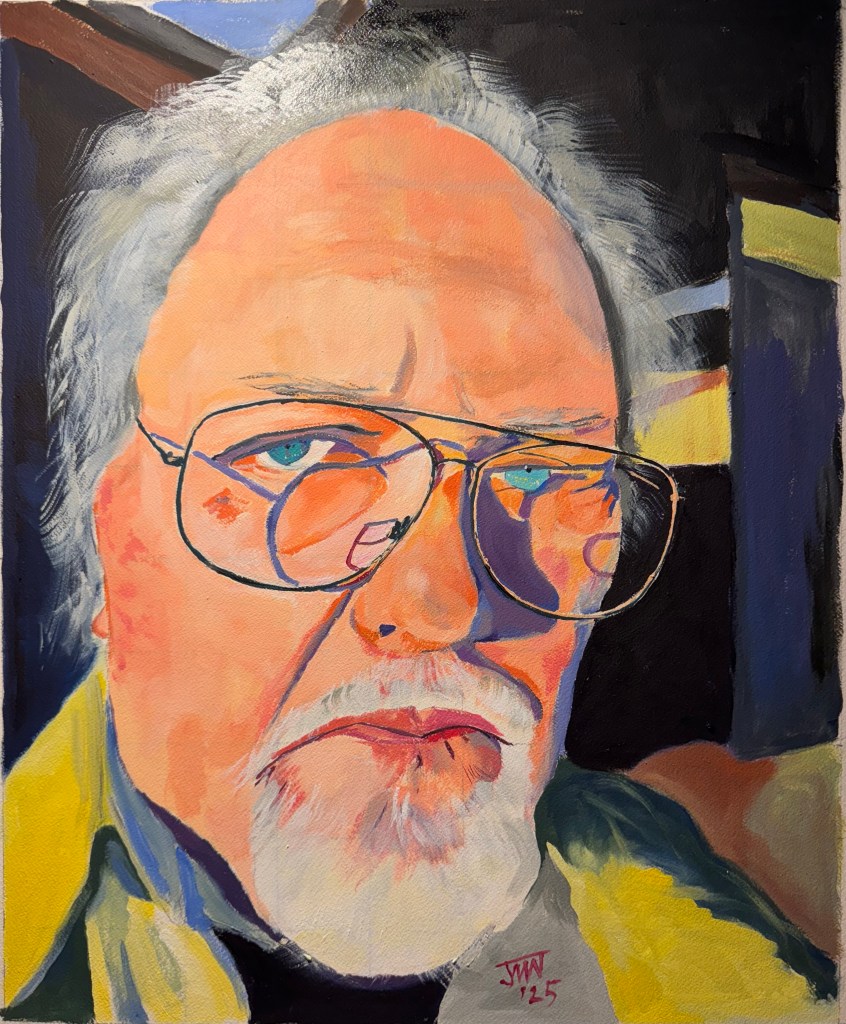
“Gray Isn’t a Black-and-White Proposition: Ivory Black Mixed With Phthalo Green Light (Vert Anglais Clair, Englisches Grün Hell, Verde Cromo Claro) Cut to Varying Values With Titanium White,” oil on watercolor paper, 24×30 in., (JMN 2025).
What the hell is going on in “The Gazing Ball”? I had to lock horns with Mitchell Glazier’s poem (Poetry, May 2025) and break it down robustly in order to reach a fragile accommodation. I’ve come to expect having to do this with much verse filtered through Poetry’s reading committee. My approach is to fall back on the godliness of syntax. If the writer respects language half as much as I do, chaos is dodged. If the writer doesn’t, we never met.
Fortunately, what scans as jabberwocky in “The Gazing Ball” does have structure once you look below the bizarro surfaces and cracked lines.
Consider the first 18 words of the poem:
Queenly swans nudge eternity figs
Yellow rose fire
Lit by a ghost breath
I’ve eaten you someplace before
[…]
Wrap your mind around the base assertion that “swans nudge figs.” An obvious-enough adjective describes the swans: “queenly.” A curious adjective describes the nudged figs: “eternity” A flagrant metaphor placed in apposition to those nudged figs further characterizes them: “yellow rose fire lit by a ghost breath.” (The reader must intuit a full stop here.) Figs whose hue is like the fire of a yellow rose — radiance blasted by a fastuous flower — is rather pretty. Go figure what kind of illumination “a ghost breath” casts upon that fire, but the expression’s metaphysicality gives it a certain staying power. In the next assertion, a speaker apostrophizes (talks to) the swan-nudged eternity figs: “I’ve eaten you someplace before.”
Let me go straight to paraphrase in order to save you and me time. Next, several unlikely subjects conjointly “nip” something and “curtsy” to something else. The subjects (actors, agents) are “venom,” “chops” (lamb? pork?), “novels” and “peacocks.” The venom is that of a “terrapin” (a freshwater turtle); the chops are “heart-shaped”; the novels are “beautiful [and] rare”; and the peacocks are “bedlam,” denoting uproar and confusion. The terrapin venom is making a mess on someone’s clothing, “sopping cream suits.” What these several creatures and objects functioning as subjects of the sentence engage in nipping are “limbs”; indeed, “nip limbs a-rosy” is what they do. Leaving them pink? The thing venom, chops, novels and peacocks curtsy to is “the apricot cross.”
Terrapin venom
Sopping cream suits
Heart-shaped chops
Beautiful, rare novels
Bedlam peacocks
Nip limbs a-rosy
Curtsy
The apricot cross
[…]
There’s more than half the poem yet to parse and construe. You take it from here (the link’s up top). Dozens of other new poems await my grappling and I’m out of time for this one. I’ll only remark that the “The Gazing Ball”’s last line is stated so baldly, in contradistinction to what precedes, that it fluoresces:
The poets who offed themselves
Have formed a small country
(c) 2025 JMN — EthicalDative. All rights reserved




 EthicalDative
Purloining With Pizzazz: Wayne Thiebaud
Wayne Thiebaud – A Sunday on La Grande Jatte (after Georges Seurat), 2000. Photograph: Wayne Thiebaud Foundation. [Guardian caption and illustration]
I blush to own it, but I was never keen on pointillism. For all that it purported to be scintillating, it has a diffuseness that feels static. It did show how not to use line to delineate boundaries, which was helpful, but then I liked Degas and Toulouse Lautrec, who outlined deliciously. Thiebaud’s Seurat thrills more than Seurat. Does that make me a frivolous person?
Supper at Emmaus, (after Rembrandt van Rijn), by Wayne Thiebaud. Photograph: Wayne Thiebaud Foundation. [Guardian caption and illustration]
The following quotation is about Thiebaud’s own paintings:
Speaking of light, there is so much glorious negative space in these paintings, largely taken up by whites as thick and delicious as a wedding cake, ranging across so many subtle differences in hue and texture as to be an exhibition within an exhibition. “It’s a symphony of whites,” Burgard enthused again and again as we walked the show’s galleries, pointing out the radiant greens, yellows, blues and reds that Thiebaud subtly layered into the ostensibly “empty” space in his paintings, making his trademark halo effect. “It’s every single white known to humankind is practically how it feels,” Burgard said. “It’s a sea of white that you could fall into…”
Wayne Thiebaud – Three Machines, 1963. Photograph: Wayne Thiebaud Foundation. [Guardian caption and illustration]
(Veronica Esposito, “‘A self-described art thief’: how Wayne Thiebaud channeled other artists,” The Guardian, 4-16-25)
(c) 2025 JMN — EthicalDative. All rights reserved