Separate and United

U.S. President Donald Trump shakes hands with British Foreign Secretary Boris Johnson as they take part in a session on reforming the United Nations at U.N. Headquarters in New York

The Atlantic, KEVIN LAMARQUE / REUTERS.

“England and America are two countries separated by the same language.” (George Bernard Shaw)

The two countries nowadays are united by a common divisiveness, an internecine feud over their respective futures. This excerpt from the NYTimes* is dated Nov. 18, 2019. Britain or America? The blanks are yours to fill.

A decade on from the crash, __________ is still mired in the longest period of wage stagnation since __________, while productivity growth slows. Unsecured household debt is at a record high, and more than __________ million people in working households live below the poverty line. Among the young especially, for whom unaffordable housing and job insecurity are the new normal, the aspirational story that gently moderated capitalism once told about itself has smashed against the rocks of reality.

Given that the next government must oversee some kind of resolution to the __________, and will have the job of repairing both a dysfunctional democratic infrastructure and a tattered social fabric, the choices it makes will be far more consequential than those usually faced by incoming governments. Throw in the fact that the next __________ will be in charge for [part] of the decade identified by the Intergovernmental Panel on Climate Change as the final one in which full-scale climate catastrophe could be averted, and it is no exaggeration to conclude that the victor [in the election] will set __________’s course for a generation and beyond.

*Jack Shenker, “Britain’s Election Is Not About Brexit.”

(c) 2019 JMN

Posted in Commentary | Tagged , | Leave a comment

E Pluribus Unum: Relief for a Pedant

uncle sam

… If applied to everyone, “they” would complete the leveling-up progress of equal dignity that “you” started centuries ago.

(Teresa M. Bejan, “What Quakers Can Teach Us About the Politics of Pronouns,” NYTimes, 11-16-19)

1. A person has to register early if he wants to vote.
2. A person has to register early if he or she wants to vote.
3. A person has to register early if they want to vote.

As a half-woke pedant I’ve stuck with version 2 until now, but version 3 is winning.

The history provided by Professor Bejan helps me. She notes that English nobles could call themselves “we.” (The Queen still does.) At that time “thou” was the proper singular, so commoners were required to address a noble as plural “you,” since he (or she) considered himself (or herself) to be more than one. (The Duke of York still does, though he “let the side down.”)

The Quakers leveled down by “thou-ing everyone, including blue-bloods, but English eventually went the other way and leveled up. I got to be you, and you got to be you, like our blood was blue, too.

The fact that plural “you” crossed over to singular furnishes a respectable precedent for the migration of “they” to neutered singularity. It relieves one of the cross of pedantry they have borne. They’re chiefest concern now — our chiefest concern, or mine if I’m humble — is to get comfortable with the contracting of future “they-all” into “th-all,” where it will team up with “y’all” as a disambiguator for them, whoever it is.

(c) 2019 JMN

Posted in Commentary | Tagged , , , | Leave a comment

Latin What?

question-mark

… Elizabeth Warren… began conducting her outreach to Hispanic voters using the term “Latinx.” (Though she did take a little flack, after the first Democratic debate, for pronouncing it “Latin-X.”)

(Ross Douthat, “Liberalism’s Latinx Problem,” NYTimes, 11-5-19)

Ross Douthat comments that “Latinx” is an ideological word aimed at “dismantling the default masculine” of romance languages, centering gender neutrality or nonbinariness in place of a cisgender heteronormativity.

Be that as it may, I’m still wondering how “Latinx” is to be said. I would capitalize “Romance” as a language family descriptor, on a par with Germanic, Slavic, Semitic, etc.

(c) 2019 JMN

Posted in Anthology, Commentary | Tagged , | Leave a comment

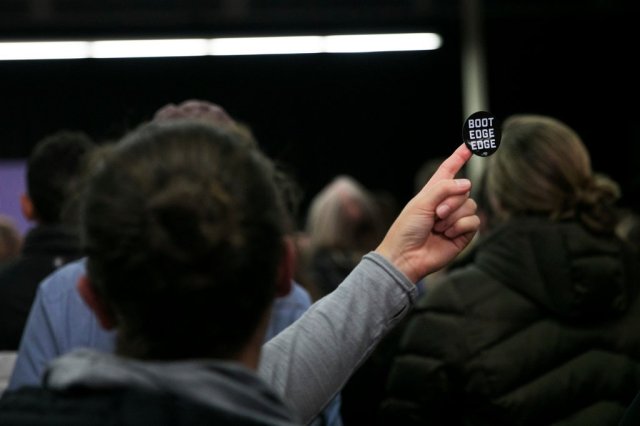
Boot Edge Edge

boot edge

Even if Mr. Buttigieg fails to capture the nomination, he’s already won himself a coveted place in the political universe. Credit…Maddie McGarvey for The New York Times.

… He acknowledged that his success may have irked those who have seen years of presidential campaign planning tossed aside by his rise.

“I’m not going to comment,” he said, “on the emotions of my competitors.”

(Reid J. Epstein and Lisa Lerer, “Why Pete Buttigieg Annoys His Democratic Rivals,” NYTimes, 11-9-19)

This is a good instance of how, sometimes, the most intelligent comments are the ones “not made.”

(c) 2019 JMN

Posted in Quotations | Tagged , , | Leave a comment

Sport Imitates It

sport

Cleveland’s Myles Garrett, right, pulled off the helmet of the Steelers’ Mason Rudolph and swung it at him. Credit…Jason Miller/Getty Images.

(c) 2019 JMN

Posted in Commentary | Tagged | Leave a comment

Art Hack

harrison1

Installation view of “Rachel Harrison Life Hack,” a mid-career survey of the artist’s work at the Whitney Museum of American Art. Credit…Charlie Rubin for The New York Times.

In her “Life Hack” exhibit at the Whitney Museum of American Art, Rachel Harrison corrals artifacts inside a circle of chairs facing away. Like eat my dust. Irony? Wit? Truculence? Genius? Contempt? Here’s how Holland Carter talks about it:

… I’ve learned that “life hack” is internetese for myriad improvised tricks or techniques devised to make the practical crises of daily existence — how to remove ketchup stains from a shirt, how to relax with strangers — more manageable. No doubt some of these interventions work better than others, but the fact that they’re a popular phenomenon, a thing, suggests that a lot of us are looking around and seeing chaos, and trying, with whatever panache we can muster, to make it productive. Ms. Harrison’s art is really good at that.

(Holland Carter, “Peas, Socks and Sidewalk-Trash Sculptures: Just Keep Looking,” NYTimes, 11-14-19)

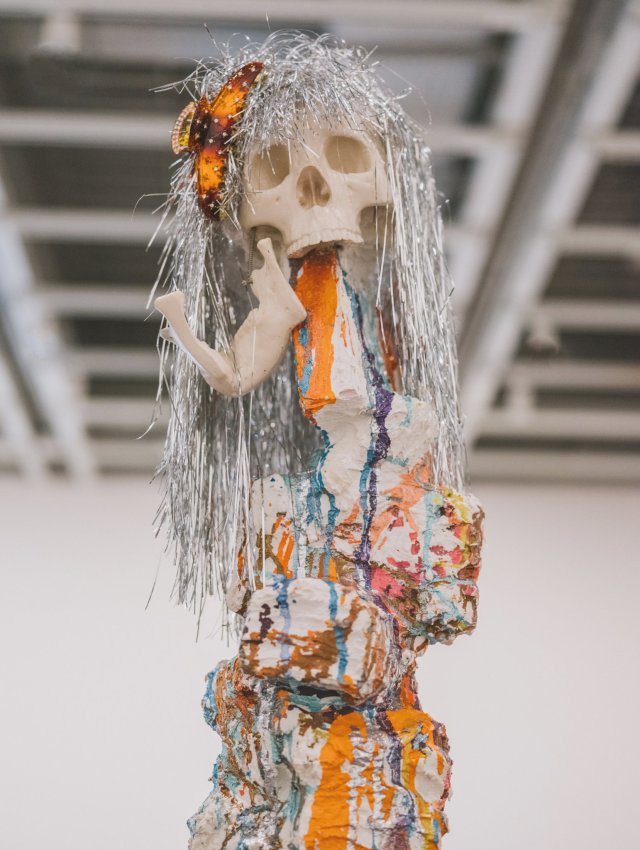
I’m drawn to Harrison’s “Brownie,” which scans as a queasy skeleton gagging itself.

harrison2

“Brownie,” from 2005, is a Giacomettian column embedded with life-size skulls. Credit…Charlie Rubin for The New York Times.

(c) 2019 JMN

Posted in Commentary | Tagged | Leave a comment

Thanksgiving Turkey

turkey3

en.wikipedia.org.

“You should revise your stance towards Turkey, which at the moment holds so many Isis members in prison and at the same time controls those in Syria,” Erdoğan told European countries in remarks to reporters in Ankara on Tuesday.

“These gates will open and these Isis members who have started to be sent to you will continue to be sent. Then you can take care of your own problem.”

(Bethan McKernan, “American Isis suspect stuck on border ‘not our problem’, says Erdoğan,” theguardian.com, 11-12-19)

(c) 2019 JMN

Posted in Quotations | Tagged , | Leave a comment

Precise, Forceful, Formal, Direct, Powerful

exclamation-mark

A letter to the NYTimes is signed by Roxana Robinson, former president of the Authors Guild, and 32 other writers. It exhorts The Times to “use precise and forceful language that reveals the struggle in which we now find ourselves.”

… Using [“quid pro quo”] — which means simply “this for that” — as synonymous with criminality is confusing to the public… Please use words that refer only to criminal behavior here. Use “bribery” or “extortion”… The more we hear words that carry moral imputations, the more we understand the criminal nature of the act.

Please also stop using the phrase “dig up dirt”… Use the more formal, direct and powerful phrase “create false evidence,” or “find incriminating evidence” or the simpler “tell lies about.”

“A Plea from 33 Writers: Words Matter. Stop Using Quid Pro Quo,” letter to the NYTimes, 11-8-19)

(c) 2019 JMN

Posted in Quotations | Tagged , , , , , , | Leave a comment

To Some Extent, Women

halpert

Edith Gregor Halpert, the pioneering art dealer, wearing a brooch and ring designed for her by Charles Sheeler, in a photograph for Life magazine in 1952. She is joined by artists she was promoting that year: Charles Oscar, Robert Knipschild, Jonah Kinigstein, Wallace Reiss, Carroll Cloar and Herbert Katzman. Credit…Estate of Louis Faurer; Time-Life Archive/Getty Images; via The Jewish Museum.

… Edith Gregor Halpert (1900-1970), was a formidable, feisty and sometimes manipulative self-starter with an ecumenical eye, a passion for art and an inborn instinct for sales and promotion. Halpert was central to establishing the market for between-the-wars American art and thought that everyone should own art. She liked to keep prices low, would sell on the installment plan and staged annual holiday sales. She also thought that anyone could make art, an idea that was crucial to the folk art revival of the 1930s. For her time, she was unusually open to artists of color and, to some extent, women.

(Roberta Smith, “A Forgotten Pioneer’s Art World Is Resurrected at the Jewish Museum,” NYTimes, 11-7-19)

Halpert’s low-balling of price, and her notion that “everyone should own art,” mark her as a visionary for her time and a relic for ours.

(c) 2029 JMN

Posted in Commentary | Tagged | Leave a comment

What Huge Imago

hands

Detail from Michelangelo’s Sistine Chapel painting.

On this Veterans’ Day I salute military persons past and present who have honored their country, including my son, a Navy man currently serving on a far shore.

I’ve undertaken my periodic re-memorization of W.H. Auden’s epoch-spanning poem “September 1, 1939.” In the diurnal crossing of the DMZ between sleep and reality, where horror and dread do their morning jog, it comforts me to meditate on images from the poem before I open my eyes.

… Accurate scholarship can
Unearth the whole offence

What huge imago
Made a psychopathic god:

In our debased twitterverse of facebookery and tomfoolery the appeal to scholarship of any stripe, accurate or not, rings sweet and quaint, like the mantra “Pray for peace” chanted in a bygone time during another of our lost wars.

However, it’s the “imago” that arrests attention. A wiki-dip of quasi-scholarship yields two meanings for the term:

(Entomology) The final and fully developed adult stage of an insect, typically winged.
(Psychoanalysis) An unconscious idealized mental image of someone, especially a parent, which influences a person’s behavior.

A full-blown insect doesn’t spawn something else. Auden guides us, of course, to sense 2 with his mention of a “psychopathic god.” It nudges us, in contemplation, to the driven psyche of a child-god’s pathological parent-worship, or something along those lines.

This single image goes a good way towards explaining the scriptural weight in 2019 of Auden’s 99 lines from 1940.

(c) 2019 JMN

Posted in Commentary | Tagged , , | Leave a comment