“I’m a Bit Worried”

bit worried

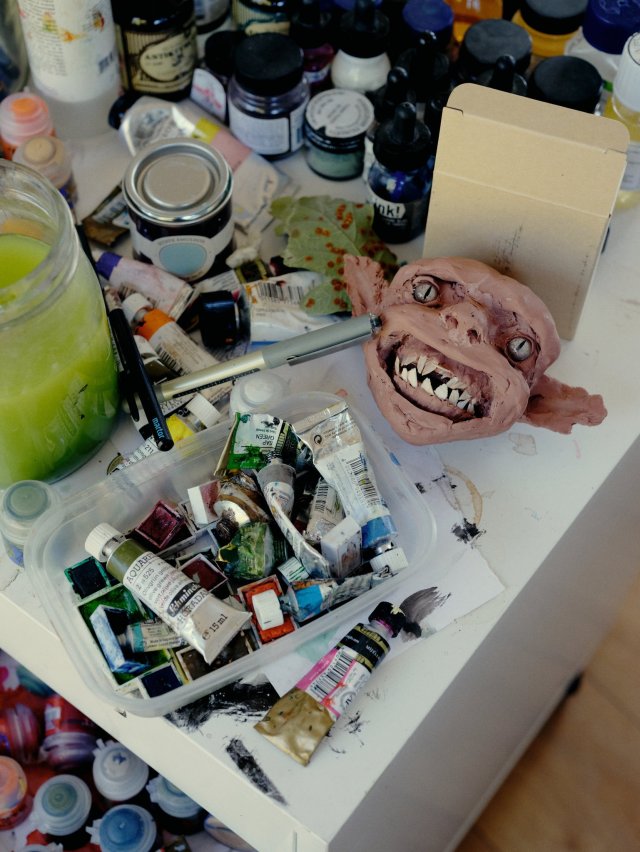
“You’re trying to get people to buy into an alternative world,” Jim Kay says. “The more you can seat it in apparent reality, the better it works. ”Credit…Charlotte Hadden for The New York Times.

Jim Kay, who lives in Sussex, England, talks about his work as an illustrator of Harry Potter novels.

How would you say your style has evolved over the years?
I haven’t found a style yet. I’m desperately trying to find a style. I’m a bit worried.

I think in black and white… so I surround myself with beautiful colors to make me push myself a bit harder. Otherwise everything I draw will look like a movie from the 1920s.

Sometimes if I’m working on a painting and there’s a piece of paper next to it that I use to clean my brushes on, I’ll often get rid of the painting but keep that piece of paper with the brush marks…

I really struggle with drawing, still, so it’s great to have something in front of you… The people who do the best drawings I think are sculptors… Henry Moore’s drawings… look solid, like they are occupying space…

Which character is the hardest for you to draw?
Harry by miles… Children are difficult anyway.. But Harry, also because he wears glasses and glasses are a nightmare to draw…

(Alexandra Alter, “How a Harry Potter Illustrator Brings the Magical to Life,” NYTimes, 11-6-19)

(c) 2019 JMN
Posted in Anthology, Quotations | Tagged , , , | 2 Comments

A Week of Orgisms

malevich

Kazimir Malevich self-portrait. BBC.com and Getty Images.

I’ve recently seen mention of cubism, orphism, synchromism, and now suprematism. This last is what Kazimir Malevich called his movement. Art history is a geyser of isms. This article illustrates the masterpiece-or-fake-ism that sprinkles journalism.

Internationally [Malevich] is probably most famous for Black Square – a work that epitomises his love of abstract forms, in a radical break from figurative art rooted in recognisable reality. Malevich finally created four versions of Black Square.

(Tatsiana Yanutsevich, “Kazimir Malevich: A mystery painting, either masterpiece or fake, puzzles experts,” BBC News, Belarus, 2 days ago [sic])

black square

“Black Square” by Malevich. BBC.com and Getty Images.

Yanutsevich informs us that “Malevich is one of the most popular modern artists internationally, his works are cherished by galleries and they fetch eye-watering sums at auctions.”

That Malevich created four versions of “Black Square” is itself eye-watering.

Here, eclipsed by viewers, is the mystery painting at the center of the “puzzle.”

man with shovel

BBC/TATSIANA YANUTSEVICH. Man with a Shovel went on show in a gallery in the Belarus capital Minsk in June.

Why is the unsigned painting attributed to Malevich? And why should it be presumed to be a “fake” trying to pass as a Malevich if it were determined not to be his? These are the true mysteries.

(c) 2019 JMN

Posted in Commentary | Tagged , , , , | Leave a comment

Humbug Goes Virile

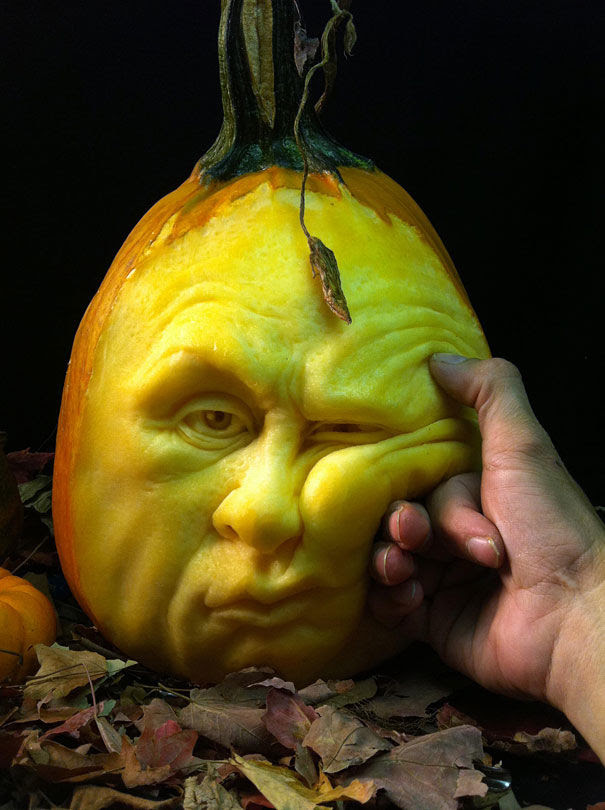
pumpkin 2

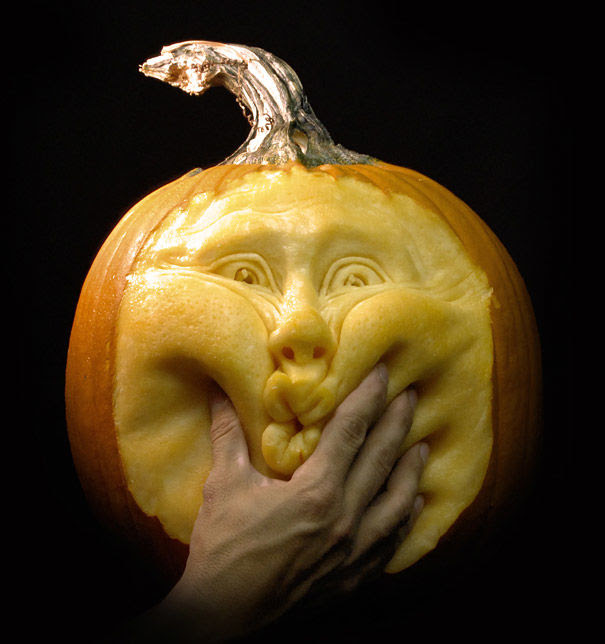
Rights groups also say that an increasingly bitter political climate surrounding Brexit has fueled the flames — as did recent remarks by Prime Minister Boris Johnson on the treatment of female lawmakers… In a parliamentary debate in September, Mr. Johnson dismissed such threats as “humbug” and said that lawmakers had only themselves to blame for the hostile political climate.

(Megan Specia, “Threats and Abuse Prompt Female Lawmakers To Leave U.K. Parliament,” NYTimes, 11-1-19)

Two cocks hatched in the Big Apple humbug the hens. Perhaps the hens will return the compliment.

pumpkin 1

Both images: Credit pumpkin artist Ray Villafane of Queens, New York.

(c) 2019 JMN

Posted in Commentary | Tagged | Leave a comment

Shades of Black

blackness

Stories in today’s press foster a rumination about “misconduct.”

The monarch of Thailand banished two courtiers from his entourage for “extremely evil misconduct.”

Unpacking the phrase’s implications suggests there may be three shades of misconduct:

Misconduct (White)
Evil misconduct (Grey)
Extremely evil misconduct (Black)

The stabbing death of a Maryland man in an argument over a Popeye’s chicken sandwich is white misconduct. Brutish and violent, but too stupid to be evil.

The man who attacked a Syrian immigrant for speaking Arabic on a San Diego trolley committed grey misconduct. Brutish, violent, and stupid, yes — but also poisonous.

The Thai story doesn’t specify the sin. Being a monarchy, it was probably either sexual or financial — more white than black except to kings.

Here’s where it gets grim.

A country teetering on failed narco-state status has seen the ambush and slaughter of three women and six children. The failing state borders the world’s largest market for psycho-active intoxicants. No authority in that market stems demand. No authority in the failing state stems supply.

If this post were really about grammar I would ask: What is a color of “misconduct” blacker than black? One that matches a massacre where toddlers burn to death strapped in car seats with mother shot dead point-blank in the chest?

(c) 2019 JMN

Posted in Commentary | Tagged | Leave a comment

Get the ‘Lead’ Out

Adverbs Ahead

Grammar Ahead

She has lead the way, but all the candidates need to come clean about their health care proposals.

(Elisabeth Rosenthal, “Elizabeth Warren Throws Down the Gauntlet,” NYTimes, 11-4-19)

The error in the NYTimes subheading is more exciting than usual. It allows me to theorize that the dastardly “read,” with its homographic past participle, has betrayed by analogy Ms. Rosenthal and her editor. I do not celebrate or mock in the least what I know to be an inadvertent solecism in a publication that adheres to high standards.

Has English shied away from “read-red-red” in parallel with “lead-led-led” because of overlap with the color? It seems a poor excuse for the tradeoff in potential ambiguity.

“I read every day.”

Absent context, who knows how that sentence should be read or said?

(c) 2019 JMN

Posted in Anthology, Commentary | Tagged | Leave a comment

A Descendant of Ralph the Wrecker

boris

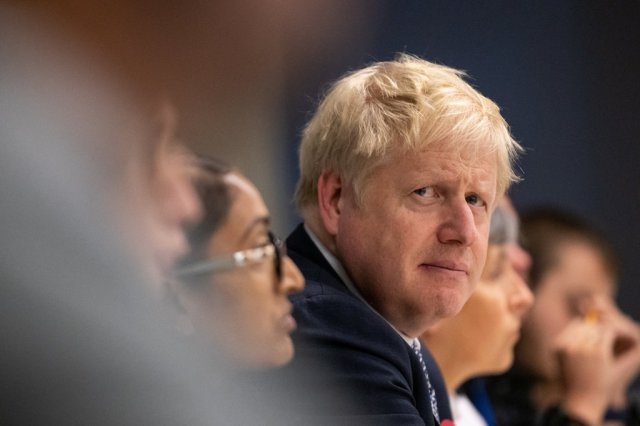
Prime Minister Boris Johnson may be the death of the United Kingdom. Credit Pool photo by Aaron Chown.

A mighty union that had lasted hundreds of years, running from the Orkneys to Cornwall, from Belfast to Llanfair Pwllgwyngyll, would have been torn asunder….

(Nicholas Kristof, “Will Great Britain Become Little England?” NYTimes, 11-2-19)

I would like to visit that last place in particular, to hear how it’s said. Columnist Kristof is the “descendant” of the title.

One of my British ancestors was Ralph the Wrecker, a pirate from Hunmanby in Yorkshire who set lights on the coast to fool ships so that they would crash on the rocks. He was finally arrested and sentenced to hang. As he stood on the gallows, the noose ready, a messenger galloped up with a pardon. Otherwise I might not be here.

(c) 2019 JMN

Posted in Commentary | Tagged , | Leave a comment

George Condo

condo

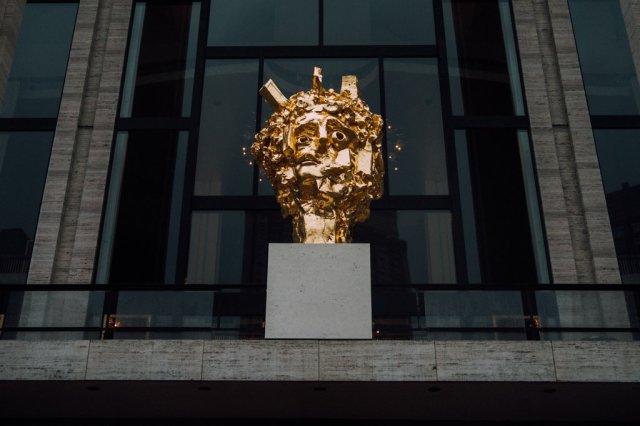
George Condo’s new sculpture, “Constellation of Voices,” on the terrace of the Metropolitan Opera’s facade. Credit George Condo/Artists Rights Society (ARS), New York; Antonio Santos for The New York Times.

Mr. Condo, 61, is best known for his bold figurative paintings that blend old master techniques and cartoonish characters, capturing a range of emotions from many perspectives in a method he calls “psychological Cubism.” “In the early days of Cubism, you would see a violin from four different angles simultaneously,” he said. “I like to create a chaotic imbalance that then needs to be reassembled back into something aesthetically pleasing.” At the Met, he has translated his manic approach massively into three dimensions, creating a head at once classical, futuristic and abstract.

(Hilarie M. Sheets, “A Sun God? A Cyborg? No, It’s a George Condo Creation,” NYTimes, 10-29-19)

I was introduced to George Condo’s painting several years ago by a profile of him in the New Yorker. The article described in some detail his palette and his technique. It was extremely helpful to a novice painter.

(c) 2019 JMN

Posted in Commentary | Tagged , , | Leave a comment

Meaning vs. Making

reagan

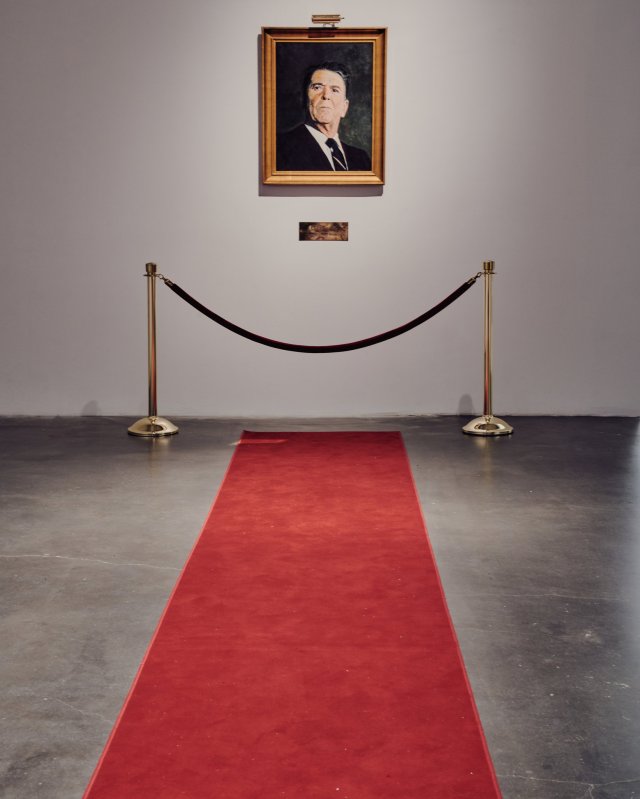
The “All Connected” show features Hans Haacke’s “Oil Painting: Homage to Marcel Broodthaers,” 1982, with a portrait of Ronald Reagan. Credit Hans Haacke/Artists Rights Society (ARS), New York; Vincent Tullo for The New York Times.

I do wish [the show’s curators] had enforced a bit more critical distance. Mr. Haacke, as each gallery proudly proclaims, has written every single wall label himself — which offers helpful context, but turns the show into an uncomfortable act of self-justification. The words put too much emphasis on what Mr. Haacke meant, and not what he actually made.

(Jason Farago, “Hans Haacke, at the New Museum, Takes No Prisoners “ NYTimes, 10-31-19)

Farago’s comment supports a bias of mine that an artist’s work may breathe more the less he verbalizes about it.

On a language note, this article acquaints me with the word “exudation,” a derivative from “exude,” meaning to ooze, as from a pore or wound.

… A giant flat-screen television displays the president’s most recent Twitter exudations….

(c) 2019 JMN

Posted in Commentary | Tagged , | 3 Comments

The History of Art, Minus Art

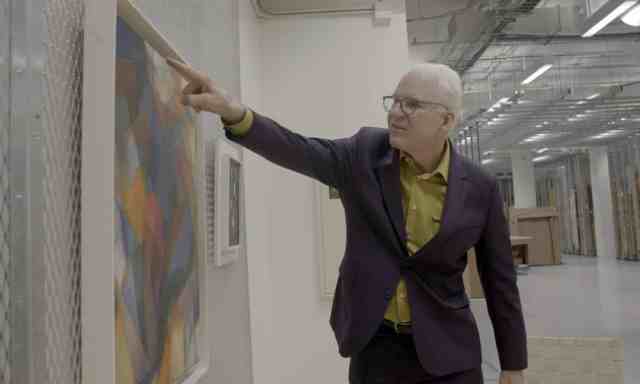
steve martin pointing

Steve Martin with Synchromy by Stanton MacDonald-Wright, painted in 1917 and now held at MoMA. Photograph: BBC.

I want to find this slightly bizarre article interesting, but I’m distracted by astonishment that it does not show a single illustration of the work of the artists it discusses: Stanton MacDonald-Wright and Morgan Russell. Well, unless you count the headline photograph of Steve Martin pointing to an indistinct painting. Absent anything else to look at, make of the following what you will:

They soon began to believe that colour was just as important as music to people, and that a painting should simply celebrate this, without straining to represent real life… “In Paris they started working in this completely abstract way of painting,” Martin said. “They called it synchromism, which means ‘with colour’… Yet the pair’s claim to have invented their own school of painting was challenged later by other well-known European abstract artists, such as Robert and Sonia Delaunay, who argued that the Americans had copied their own ideas about the use of colour and shape, referred to as orphism… For Martin, though, the work of the synchromists has been undervalued as a result and it is time for a reappraisal… It is not necessary to understand the technical principles of synchromism, he argues, because the works still communicate… “I don’t generally care about theories. The result of working from a theory could be fantastic, but you don’t really need to know the theory to look at it.”

(Vanessa Thorpe, “The history of art… according to Steve Martin,” theguardian.com, 9-21-19)

(c) 2019 JMN

Posted in Quotations | Tagged , | 3 Comments

“We live without a future”

woolf final

Virginia Woolf: detail from her final session with a professional photographer, Gisèle Freund Photo: Gisèle Freund/IMEC/Fonds MCC.

Virginia Woolf’s house was destroyed by bombings in the Second World War. One of the last entries in her journals before her suicide has imagery that lacerates. She sounds almost bemused by the despair she conveys, as if observing it at arm’s length from outside herself, ever the writer even in contemplation of vanishing. Her penultimate jotting limns awfulness with simple, slamming force — begging the question: Has the future returned?

“A kind of growl behind the cuckoos and t’other birds. A furnace behind the sky. It struck me that one curious feeling is, that the writing ‘I’ has vanished. No audience. No echo. . . . We live without a future. That’s what’s queer: with our noses pressed to a closed door.”

(Quoted by Erin Overbey, archive editor, The New Yorker, 10-30-19)

(c) 2019 JMN

Posted in Commentary | Tagged | Leave a comment