Hilarie M. Sheets writes an article about how people have coped with incarceration by drawing (“For the Incarcerated, Drawing Is a Lifeline,” NYTimes, 9-20-19).
What interests me on the margins of this interesting article is the innocent tell favoring depiction of comeliness that the writer discloses in singling out this drawing among the eight illustrated in the article as being “beautifully rendered.”
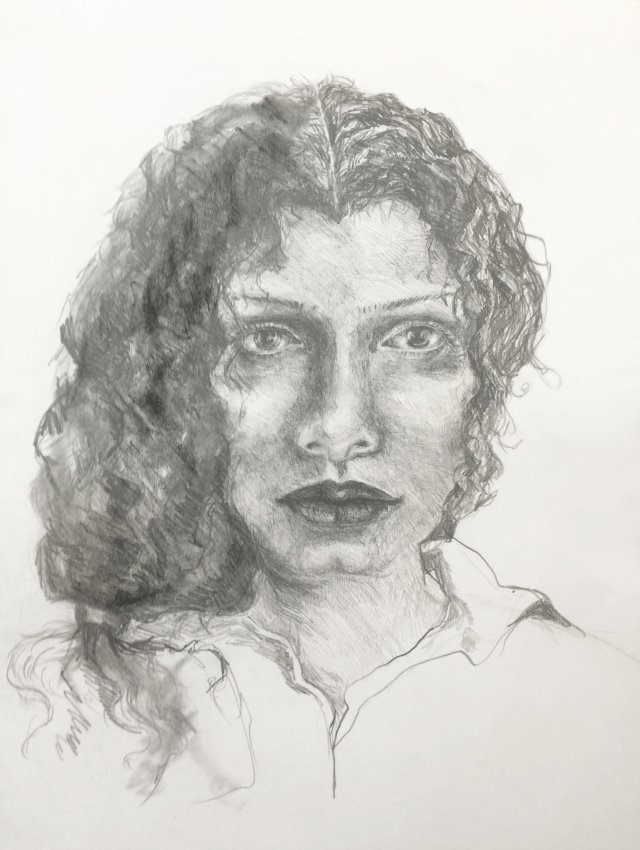
Azza Abo Rebieh’s “Nayfeh,” 2016, one of the portraits she did of fellow inmates while imprisoned in Syria. Credit Azza Abo Rebieh.
Here are four more of the drawings that illustrate Sheets’s article along with her descriptions of them.
Courbet’s chalk study is “delicate.”
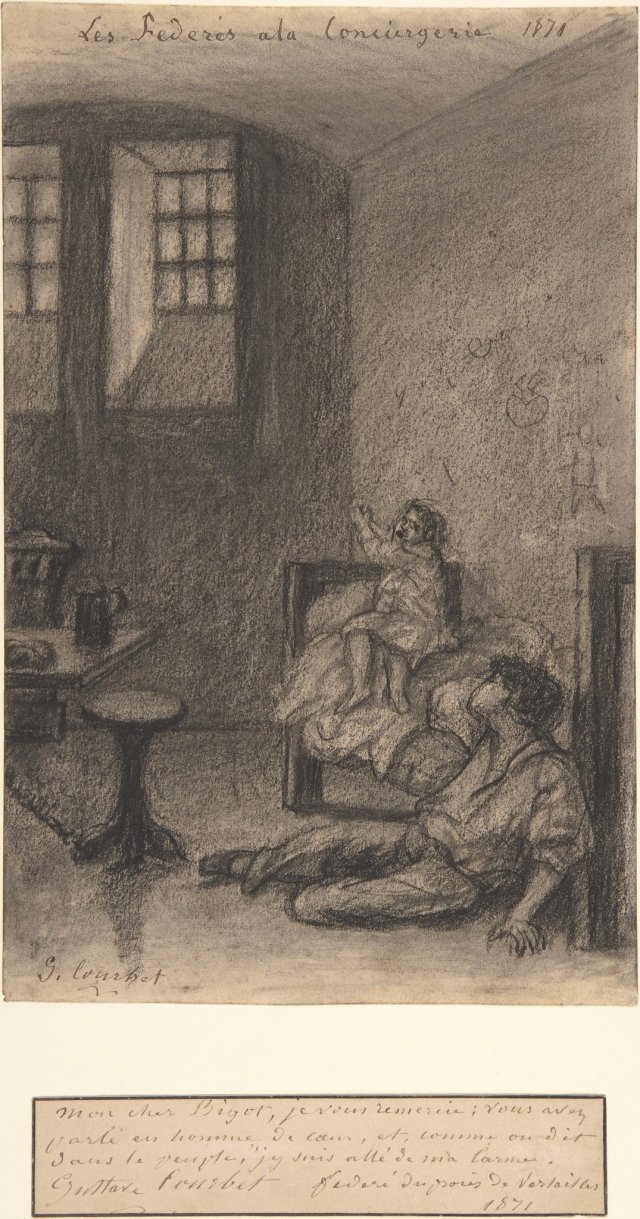
Gustave Courbet’s “Les Fédérés à la Conciergerie (Young Communards in Prison),” 1871. Courbet, who was jailed in 1871 after being accused of complicity in tearing down the Vendôme Column, captures a cell and cellmates in this chalk study. Credit The Metropolitan Museum of Art, via Art Resource, N.Y.
Ruth Asawa’s watercolor is “spirited.”
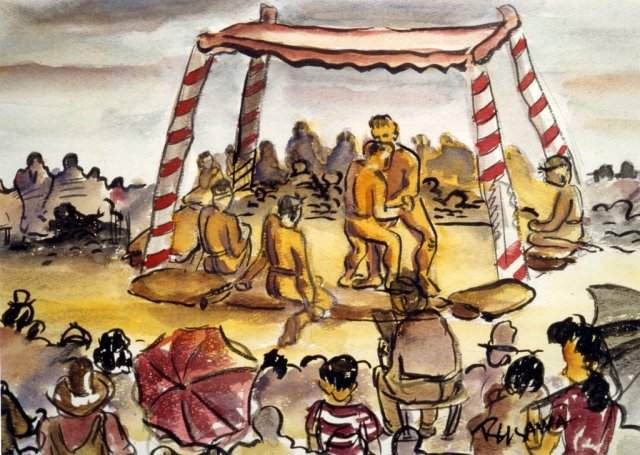
Ruth Asawa’s “Sumo Wrestlers,” 1943, a watercolor on paper she did while in an internment camp for Japanese-Americans. Credit Estate of Ruth Asawa, via David Zwirner.
Sheets does not characterize the portrait drawn by Jose Alvarez.

Mr. Alvarez’s “David H.,” 2012, a portrait he drew while detained for immigration violations. Credit Jose Alvarez and Gavlak Gallery.
Adolf Wölfli’s pencil rendering “maps the geography of his alternate imagined universe.”
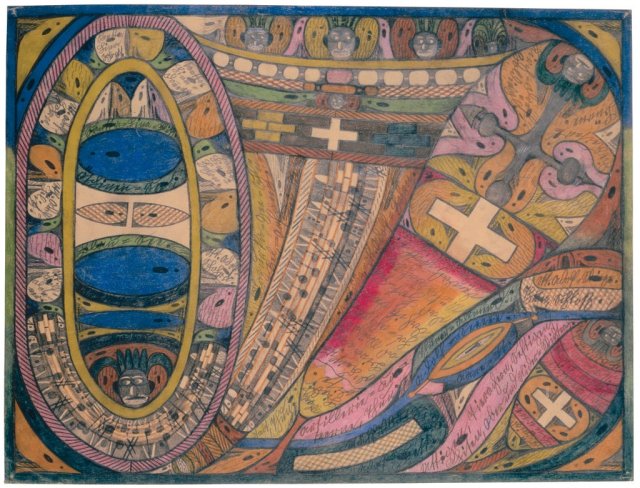
Adolf Wölfli’s “The Kander Valley in the Bernese Oberland,” 1926, pencil and colored pencil on paper. Credit American Folk Art Museum.
(c) 2019 JMN






 EthicalDative
Can a Lie Be “Unintentional”?
The Independent.
I propose as a reflection on semantics that a lie, strictly speaking, cannot be “unintentional.” A lie must know itself to be such in the mind of the liar. Consider the following quotation:
Mr. West’s unquestionably droll assertion is a proper lie because if he is sane he knows it not to be true. In a play for attention he is posing as tip of the turdberg of mendacity that floats worldwide. Otherwise, he would melt into a cast of rivals seeking slots in the Olympiad of hubris by lathering copious blush on their snouts. I credit him with being more artful than that.
Mr. Muilenburg testified before the House Committee on Transportation and Infrastructure. Credit Anna Moneymaker/The New York Times.
The case is different with Mark Forkner of Boeing.
By being under-informed about the “Maneuvering Characteristics Augmentation System” that augmented two 737 Max airliners out of the sky, Mr. Forkner apparently passed on bad information. He did not lie, however, because it was not his intention to do so (if he is to be believed). He misspoke out of ignorance. By analogy with the sliding scale of culpable killing applied by pettifoggers, it might be said that he contributed to manslaughter in the deaths of 346 people, but he did not negligently do so. The jury may still be out on his bosses.
(c) 2019 JMN