Elephant

elephant

A 1903 illustration shows President Theodore Roosevelt warning about protective tariffs going too far. Credit Photo12/UIG, via Getty Images.

I’m no connoisseur of illustration, but this one strikes me as having a distinctively painterly quality to it. It has introduced me to the work of J.S. Pughe (1870 – 1909), who is well documented in Wikipedia. The graphic appears in Margaret O’Mara, “Who Will Survive the Trade War?” NYTimes, 6-6-19.

(c) 2019 JMN

Posted in Commentary | Tagged , | Leave a comment

Vindication of Stuttering

darcey steinke

The author at home in Brooklyn. Credit Michael Kirby Smith for The New York Times.

The battle with speech impediment can equip persons like Darcey Steinke with fascinating insights into language.

It was around this time [in elementary school] that I started separating the alphabet into good letters, V as well as M, and bad letters, S, F and T, plus the terrible vowel sounds, open and mysterious and nearly impossible to wrangle. Each letter had a degree of difficulty that changed depending upon its position in the sentence.

Her article includes description of her experience recording the audio edition for her forthcoming book “Flash Count Diary: Menopause and the Vindication of Natural Life.”

As I started to read… I had no control over my vocal cords, adrift on waves of unpredictable sound… The young sound engineer was patient. His voice in my earphones was gentle and his expression open and empathetic… I explained that in the classroom as I teach and at my readings, my stutter brought intimacy to my listeners. He nodded. “They can hear your vulnerability…”

Steinke is the author of five novels and two memoirs.

The central irony of my life remains that my stutter, which at times caused so much suffering, is also responsible for my obsession with language. Without it I would not have been driven to write, to create rhythmic sentences easier to speak and to read…

(Darcey Steinke, “My Stutter Made Me a Better Writer,” NYTimes, 6-6-19)

(c) 2019 JMN

Posted in Quotations | Tagged , , | Leave a comment

Poet Brand

walt whitman apple sauce

A label for Poet Brand applesauce featuring Whitman’s image. It was sold in New Jersey starting in the 1930s. Credit via The Grolier Club. (From Jennifer Schuessler, “On Walt Whitman’s Big Birthday, 10 Glorious Relics,” NYTimes, 5-30-19).

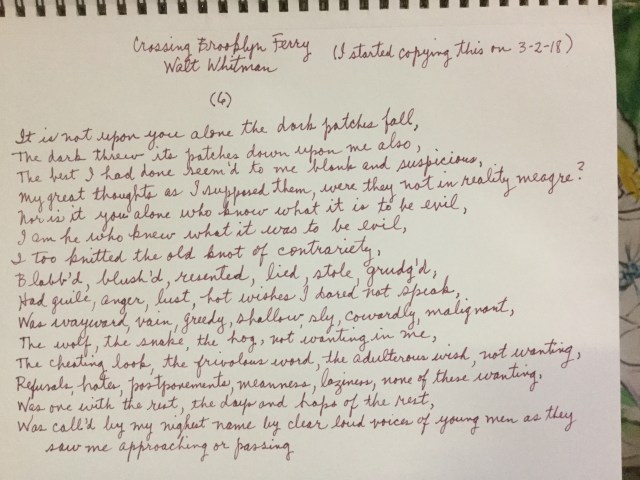
a whit crossing

JMN

(c) 2019 JMN

Posted in Commentary | Tagged , | Leave a comment

Didn’t Speak English

pope

Fox News.com

The Catholic leader changed the phrase “lead us not into temptation” to “do not let us fall into temptation”…

Francis explained… “It’s Satan who leads us into temptation, that’s his department.”

Fox News religion correspondent, Jonathan Morris, told Martha MacCallum on “The Story” that Jesus didn’t speak English so Church leaders are working on their best interpretation.

Francis also approved changes to The Gloria from “Peace on earth to people of good will” to “Peace on Earth to people beloved by God.”

(Caleb Parke, “Pope Francis made this big change to Lord’s Prayer,” Fox News)


(c) 2019 JMN

Posted in Anthology, Quotations | Tagged , , | Leave a comment

Parting Looks — HJN

Harold J. Nichols (1924 — 2013) (c) 2019 JMN

More Galleries | Tagged , , | Leave a comment

Guide by the Perplexed — More Inconvenience

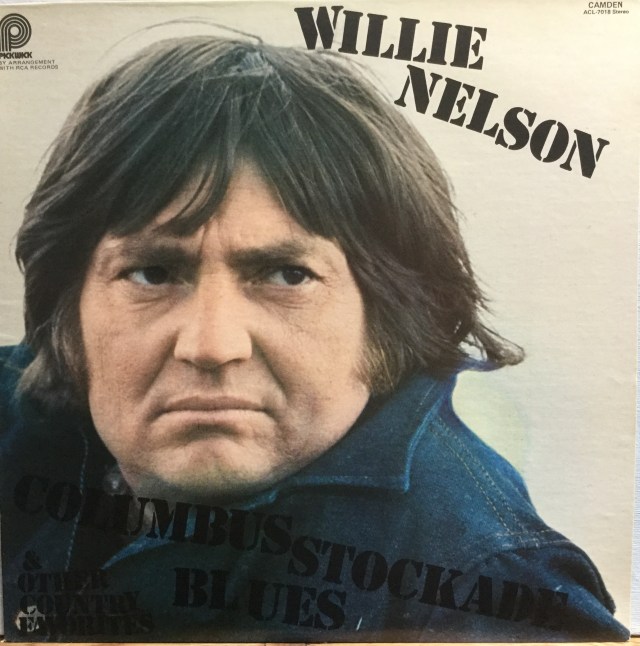
Willie

“It seems I am choosing words that will stand,
and you are in them,
but if I blunder, it doesn’t matter —
I must persist in my errors.

(Boris Pasternak, “For Anna Akmatova,” translated by Robert Lowell in “Imitations”)

The bond between finger and fret is of a piece with that between rubber and road; each is the juncture of a dawning — whether of music or locomotion.

A flaw in the premise that fretboard insight underpins superior guitarmanship raises its head: It’s the inconvenient comparison of guitar playing with race car driving. I invent this implausible analogy, before you do, in order to prick it.

Must I handle my guitar like Sharon Isbin for my rendition of “Bird on the Wire”? Or my car like Danica Patrick for my commute to Flatonia? The obvious answer is, No; mine is, It would be nice. Never let the obvious be enemy of the egregious.

So let’s proceed.

The flaw with Octave-of-Preceding (OOP) treated in previous chapters is that the adjacencies engender unisons, not octaves, as follows:

6-5A == 5-0A (6-0E —> 5-0A is a Perfect Fifth, or 7 semis)
5-5D == 4-0D (5-0A —> 4-0D ditto)
4-5G == 3-0G (4-0D —> 3-0G ditto)
3-4B == 2-0B (3-0G —> 2-0B is a Major Third, or 4 semis)
2-5E == 1-0E (2-0B —> 1-0E is a Perfect Fifth, or 7 semis — again)

That an earlier issue of the Guide misspoke itself vis-à-vis OOP is of little consequence. Renaming it to “Unison-of-Preceding” would make for not only a blurtive acronym but also unmusicological consistency. Try to find in the literature, for example, a retainable explication of the Major Third anomaly in guitar tuning.

There you have it. Time to take a modal dive — coming next.

(c) 2019 JMN

Posted in Anthology | Tagged , , , | Leave a comment

Parting Looks — Buck Schiwetz

Edward Muegge “Buck” Schiwetz (1898 — 1984) (c) 2019 JMN

More Galleries | Tagged , | 1 Comment

Parting Looks — Buck Schiwetz

Edward Muegge “Buck” Schiwetz (1898 — 1984) (c) 2019 JMN  

More Galleries | Tagged , | Leave a comment

Parting Looks — Tom Jones

James Thomas “Tom” Jones (1920 — 2000) (c) 2019 JMN

More Galleries | Tagged , | Leave a comment

Parting Looks — Tom Jones

James Thomas “Tom” Jones (1920 — 2000) (c) 2019 JMN

More Galleries | Tagged , | Leave a comment