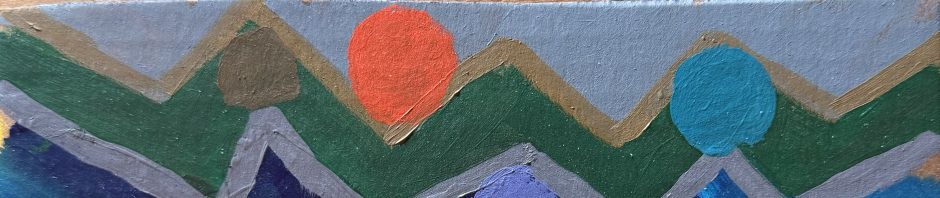

ABOVE: My first vocab list for Helena (age 10) made at her mother Eva’s request. I’m on pins and needles to show it. Each time I expose Helena to my fetish for coloring the enclosed spaces of letters, I detect a glimmer of interest — a practiced eye surveying a negligible specimen of decoration — followed by a look of scorn mixed with pity.
Food is much discussed in this household. Eva is a consummate cook and Eduard an exacting trencherman much attached to his culinary traditions. Their travels in Italy, Egypt, Turkey and Morocco have influenced the pantry. Terminology from a smorgasbord of languages arises over the dining table. The prevailing gist is: “What is this [foodstuff] in [language]?”
(c) 2018 JMN.

 .
.


 EthicalDative
The Dry Heaves
I picked up a colored marker, a sketchpad, and sat down. I looked around the room for a shape, a blade of light, a shadow, an assonance, a blur, something to trigger a spasm in my drawing hand and stain the pristine paper. Nothing. Forget the seen, I thought; let it come from the unseen. I summoned (conjured?) a mark of any kind — straight from the head — a squiggle, a spiral, a splotch, a graphical blarp, symbolic, idiotic, with no pretense to “be” something — whatever ensued. After all, what’s the downside of touching this paper with an inky point in this privacy, this solitude? The trash can is as close as a spittoon. Still nothing. Literal paralysis. Bemused, nonplussed, verging on despondent, I simply started writing words in loopy, longhand script. “Es lo que hay,” they say here. It’s what is.
I once watched a big, long-legged bird take to the air from a swamp. It flapped wing and paddled those ungainly legs in what looked like laugh-inducing desperation for what seemed like a coon’s age, until the ostensible jury-rigged excuse for a bird finally caught flight. And then it soared tear-jerkingly. You would have thought it was built to fly. Which of course it was.
(c) 2018 JMN.