
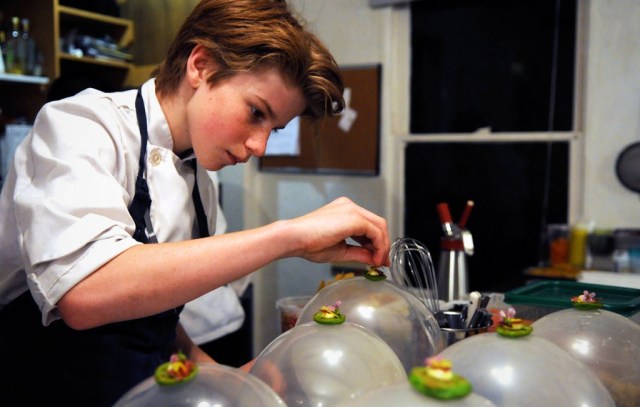
The young man [Flynn McGarry] seems a relatively gentle soul in a world still learning to be less needlessly rough.
(Glenn Kenny, “‘Chef Flynn’ Review: A Gastronomic Wonder from Boy to Man,” NYTimes, 11-9-18)
(c) 2018 JMN.
The young man [Flynn McGarry] seems a relatively gentle soul in a world still learning to be less needlessly rough.
(Glenn Kenny, “‘Chef Flynn’ Review: A Gastronomic Wonder from Boy to Man,” NYTimes, 11-9-18)
(c) 2018 JMN.
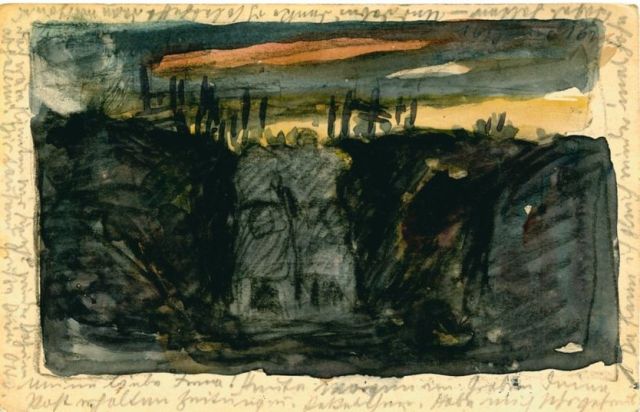
16 January 1916 My dear Irma! Received your mail in the trench this morning, newspaper and package. Made me very happy. Now I will eat ‘high on the hog’ [ich werde hohe Tafel halten] and, while doing so, I keep thinking how beautiful it would be if only we could do this at home. Thousand greetings to you. Your Otto
Art student Otto Schubert (1892-1970) was 22 years old when he was drafted into the war. As the conflict unfolded, he painted a series of postcards that he sent to his sweetheart, Irma.
…All pictures extracted from Postcards from the Trenches: A German Soldier’s Testimony of the Great War by Irene Guenther, published by Bloomsbury Visual Arts.
(“World War One: Painted postcards sent from the trenches,” https://www.bbc.com/news/in-pictures-46098878, 11-8-18)
(c) 2018 JMN.
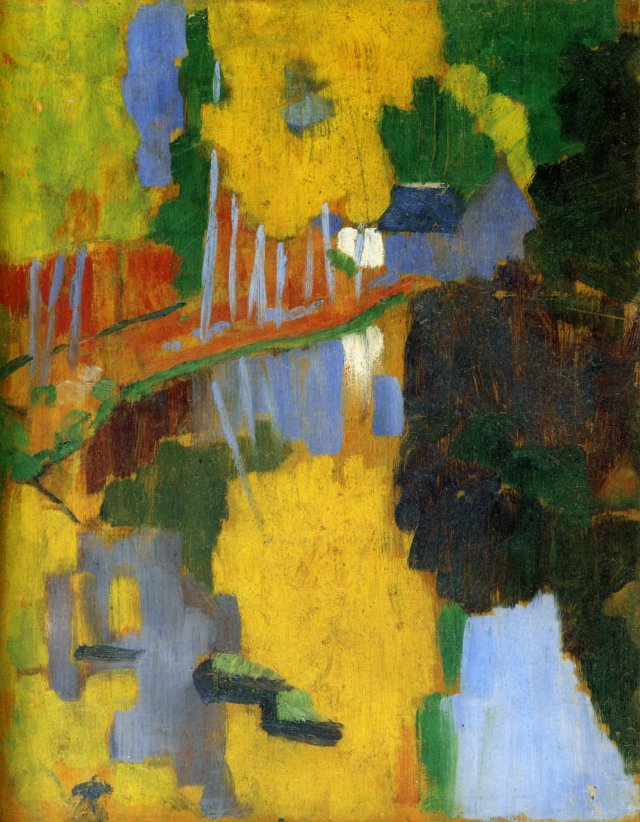
Paul Sérusier: The Bois d’Amour à Pont-Aven: The Talisman (Le Talisman), 1888, oil on wood…, Musée d’Orsay, Paris (By Paul Sérusier – Own work, Public Domain, https://commons.wikimedia.org/w/index.php?curid=121893.
“A picture, before being a war horse, a nude woman, or some anecdote, is essentially a flat surface covered by colours in a certain order.” (Maurice Denis)
(c) 2018 JMN.
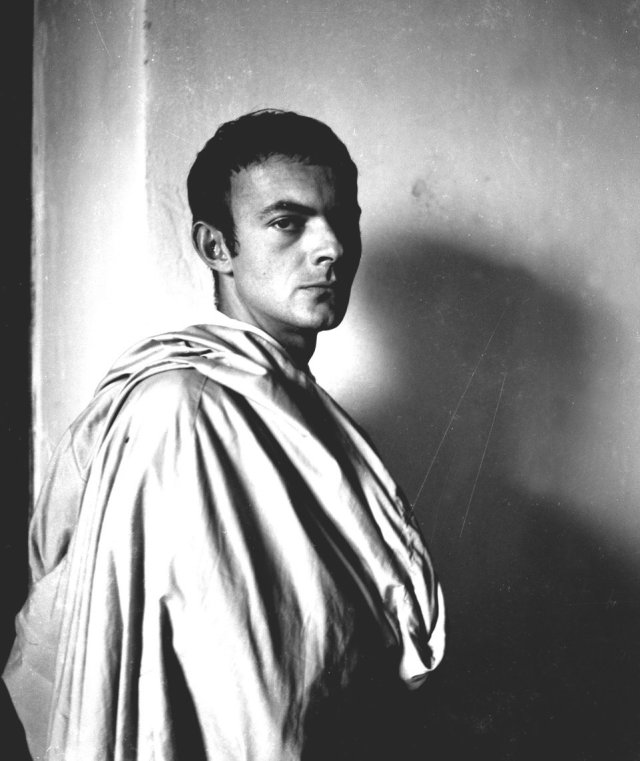
Cy Twombly in Italy, 1957. Credit Elizabeth Stokes.
“I swear if I had to do this over again, I would just do the paintings and never show them,” [Twombly] said in a 1994 profile in Vogue. “I was brought up to think you don’t talk about yourself. I hate all this. Why should I have to talk about the paintings. I do them, isn’t that enough?”…
“A bird seems to have passed through the impasto with cream-colored screams and bitter claw-marks,” is how the poet and critic Frank O’Hara described the early works. They invite not just admiration but ardor. A woman once took off her clothes and danced naked in front of them; another kissed an all-white panel, leaving a bright lipstick mark (“a rape,” the curator fumed).
(Parul Sehgal, “‘Chalk: The Art and Erasure of Cy Twombly’ Hunts for Big — and Elusive — Game,” NYTimes, 11-6-18)
(c) 2018 JMN.
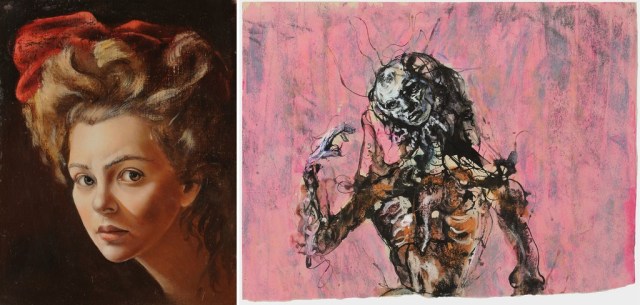
Leonor Fini’s “Self-Portrait with Red Turban” (1938), left, and the undated “Bust of a Woman.” Credit 2018 Artists Rights Society (ARS), New York/ADAGP, Paris; Weinstein Gallery, San Francisco.
“She always felt that identity was just a mask,” Ms. Rivera said. “So the masks that she chose to wear were more true than her biological face.”
(Daniel McDermon, “Sex, Surrealism and de Sade: The Forgotten Female Artist Lenor Fini,” NYTimes, 11-6-18)
(c) 2018 JMN.
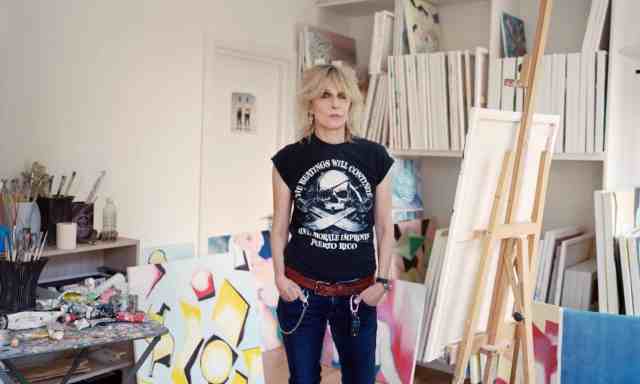
‘I just like drawing and making stuff’: Chrissie Hynde in her studio at her London flat. Photograph: Gabby Laurent.
Rock stars becoming painters remains one the most cliched career transitions in showbiz… Hynde has reservations about entering this gang. “I mean, who the fuck am I? There’s so many people who’ve been doing this all their lives and they can’t get a gallery… and then muggins walks in, dabbles for a couple of years and the next thing, here’s a big fuck-off box set of her paintings!” She laughs at herself, although she’s not a phoney, she says. “I’m really doing this shit. But yeah, I’m embarrassed by it. Of course I am!”
(Jude Rogers, “Chrissie Hynde: ‘It’s hard work being alone. Paintings are an outlet,'” The Guardian, 11-4-18)
(c) 2018 JMN.
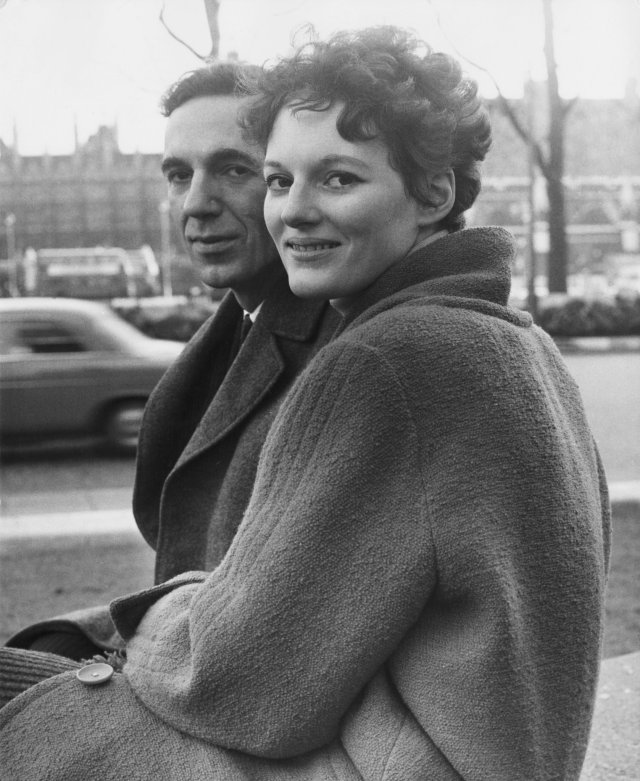
Judith Pakenham in 1962 in London with her then-fiancé Alexander Kazantzis. In a career that spanned nearly four decades, she published 12 collections of poetry, numerous essays and a novel. Credit Keystone/Hulton Archive, via Getty Images.
Ms. Kazantzis wrote in free verse, her language intelligent but not didactic, powerful but not polemic. It could be witty, with traces of sarcasm. She portrayed women as complex, to correct literature’s pigeonholing them in one-dimensional characterizations as goddess or villain.
(Iliana Magra, “Judith Kazantzis, British Feminist Poet and Activist, Dies at 78,” NYTimes, 11-4-18)
(c) 2018 JMN.
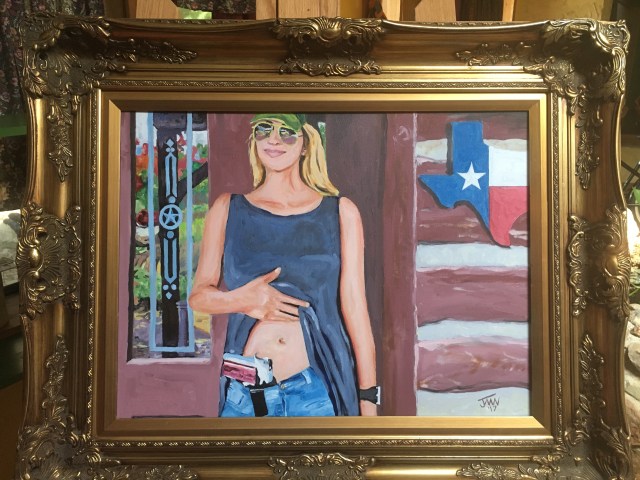
JMN2017 Woman With Automatic, oil on canvas, 18 x 24 in. (c) 2018 James Mansfield Nichols. All rights reserved.
(1)
My love goes deeper than a Ditch Witch pokes,
And higher than a cherry-picker soars.
But I done caught you, darlin’, way ‘cross town
Spendin’ my money in the Dollar Stores.
(2)
Baloney, rotgut wine, Chef Boyardee,
Bags of super-jumbo cotton puffs,
Oh Henrys, Mike-‘n-Ikes, and frozen pies —
Enough’s enough. Damn! lovin’ you is tough!
(Chorus)
Why oh why can’t you make do with me?
What’s in my pickup truck that you can’t find?
I’m right here for you, darlin’, Texas strong,
But hurtin’ bad now where the sun don’t shine!
(3)
Pigs feet, boiled goober peas, corn mush ‘n greens,
Ole Shep bayin’ at the moon, while me and you
Sop our plates plumb clean, then shuck our shorts,
Hear cricket song and do what lovers do.
(Reprise verse 1)
(Chorus)
(c) 2018 JMN.

Gould’s score for the ninth and 10th variations.Credit Bonhams.
Those scribbles? That’s Glenn Gould, scratching on his sheet music as he recorded Bach’s “Goldberg” Variations in 1981. We reported this week on the newly rediscovered score, which offers some insights — barely legible ones — into Gould’s process and will be put up for auction next month. (Estimate: $100,000 to $150,000.)
(Zachary Woolfe, “Glenn Gould’s Scribbles: The Week in Classical Music,” NYTimes, 11-2-18)
(c) 2018 JMN.
 EthicalDative
Lyrics Again
Selfie With Tea Kettle, JMN, photo. (c) 2018 James Mansfield Nichols. All rights reserved.
One of my playlists I call “aMix” is an eclectic selection of some 50 songs from various genres and periods. (There’s also a list called bMix.) This morning I heard Jacques Brel singing “Ne me quitte pas.” As the poignant song washed over me while I cooked, I became aware of the phrase “on a vu rejaillir le feu….” Also something along the lines of “il faut oublier les malentendus.” It occurred to me to revisit thoughts about song lyrics and what they’re for.
I’ve tried to get on board with the notion that there’s good modern music in which the words being sung aren’t recognizable, and that that’s okay. The content of the lyrics is dispensable without diminishing the song according to this line of reasoning. It is, after all, music, not poetry. A poem must be exceedingly well wrought and articulated linguistically to be successful; I see no room for compromise on that score. It would make no sense to mumble a poem to an audience, or to make it difficult to read by using a script font, for example, or poorly calculated line breaks. Song lyrics, on the other hand, take a back seat to melody, harmony and rhythm in much modern pop performance — even to dance, as Eric Wayne usefully points out.
Hearing the throat-constricting emotion conveyed in Brel’s “ne me quitte pas” (don’t leave me, don’t leave me), I gave in to a wave of sadness over a lifetime of betrayals and abandonments perpetrated by me — of relationships, children, goals and ideals — and of my dogs’ forsaking me in turn by dying. The song worked on me that way and I let it, grudgingly — what are a few more drops in the tear bucket.
Notwithstanding my desire to embrace innovation and eschew crusty conservatism, a still small voice keeps whispering to me that the most complete realization of a song happens when the lyrics — their content as well as their sonic properties — actually do support the music intelligibly and are supported by it, rather than engulfed in instrumentation and visual razzmatazz.
(Perhaps I’m too cerebral, or have tunnel vision, but I mistrust the concept of multimedia as much as that of multitasking. The latter is a mask for nimble serial monotasking, I surmise. And the notion that we can be shotgunned simultaneously by diverse sensory stimuli, as in music videos, and still process the experience optimally, is suspect, I hypothesize.)
Selfie with Guitar Music, JMN.
Back to lyrics. According to my still small voice, at the pinnacle of song the lyrics are integral to the music, like melody, and not separable from it or adjunctive or dismissable. That sort of melding doesn’t happen all the time, but neither do masterpieces in any art form. And, of course, I’m not sure what to do with rap, which has gone in the opposite direction, mostly words chanted in staccato torrents with percussive backing that’s minimally tuneful. Rap is of major importance in the music scene, but I’ve already said more than I know.
Oops, not quite. Out of curiosity, I recently researched whether or not “hip-hop” and “rap” are synonyms. A source served to me by Google clarified that, strictly speaking, rap is one of the three elements of hip-hop culture, the other two being break dancing and DJ’ing. The distinction may not be useful enough to survive. My impression is that it’s common to use the terms “hip-hop” and “rap” interchangeably in casual talk.
(c) 2018 JMN.