“Soria” Wrecked: Meter and Rhyme

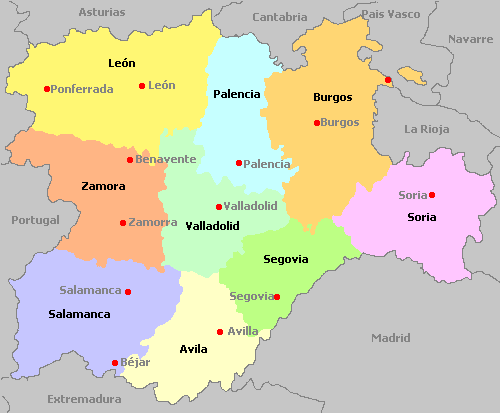
Map of Castile and Leon. wineandvinesearch.com.

Map of Castile and Leon. wineandvinesearch.com.

“Soria” by Antonio Machado, Spanish Poet, 1875-1939
From “Campos de Castilla,” Antonio Machado, Biblioteca Anaya, 1964. (English translations by James Mansfield Nichols)

Translating into meter is a lost cause, but adding a rhyme scheme escalates it to a punishing lost cause. You’re faced forcefully with using more words in order to say what Machado says, but also with not saying more than he says in the process — not padding with cheesy, “poetic” diction or lexical barnacles — but you gotta fill up that mold you’ve foolishly committed to. You feel like you’re taking greater and greater distance from the original poem, turning a masterful concoction into something puny, a shadow of itself. It’s a diabolical but noble challenge, like the Golden Rule. It drives home how spare and ingenious Machado’s verses are, the amazing music he makes with such simplicity and restraint, the drama in quietness and stillness he lays bare, how it’s all woven together seamlessly with the naturalness of his rhyme and count.

The futility of translating poems is more extreme than even the futility of writing them (“poetry makes nothing happen”). It won’t help ameliorate climate change or keep infrastructure from crumbling — but by Thor’s hammer it ameliorates my distress, and that ain’t nothin’!

By way of preemptive excuse, I say I ought to know more about the intricacies and protocols of scansion in both languages. It would behoove me to read myself into a greater state of informedness on the topic, but I’m too busy blogging to do that.

Spanish Original

[Eight-syllable lines rhyming A-A-B-B-C-C / D-D-E-F-E-F-G-H-G-H / I-J-I-J. Line 13, “que pululan,” with only four syllables is “quebrado” or broken, I think — there is a term of art in Spanish prosody called “pie quebrado” (broken foot) which I’ll have to refresh myself on. It’s undoubtedly intentional on Machado’s part, but it’s a mystery to me what purpose it might serve. It deserves mention that in Spanish the name “Soria” is pronounced with two syllables, the ‘-ia’ being a diphthong. A diphthong is “broken” into two syllables with a written accent mark, as in “fría.”]

¡Soria fría, Soria pura,
cabeza de Extremadura,
con su castillo guerrero
arruinado, sobre el Duero;
con sus murallas roídas
y sus casas denegridas!

¡Muerta ciudad de señores,
soldados o cazadores;
de portales con escudos
de cien linajes hidalgos,
de galgos flacos y agudos,
y de famélicos galgos,
que pululan
por las sórdidas callejas,
y a la medianoche ululan,
cuando graznan las cornejas!

¡Soria fría! La campana
de la Audiencia da la una.
Soria, ciudad castellana
¡tan bella! bajo la luna.

******
“Soria” by Antonio Machado

English Version 1 by JMN

[The literal meaning as best I can interpret it, with no attempt to impose any metric pattern on the translation. English seems to prefer the Portuguese “Douro” for the river. To me “Duero” is more familiar, but whatever. I’m not crazy about “warlike” for “guerrero.” The latter can be “warrior,” too. For a time I wanted to just say “fierce.” The poem paints a decrepit structure made for defense. For me the trickiest area involved the “gentry” (not a word I particularly like here) and the “landed lineages” with their “shields” (or “escutcheons” — I like that word, but it’s too exotic here) etched or chiseled or engraved over their doorways (“portals” is cognate in English but freighted with too much IT baggage). “Señores” could be lords or nobles, but that’s too lofty a rank for this poem. These “señores” were “hidalgos” or “hijos de algo,” sons of something, meaning inherited property owners, petty nobility. In England they were the “landed gentry,” the barons. I took liberty in splitting that term in two to create a “gentry” with “landed lineages.” I haven’t thought of a better way for now. As for the “greyhounds,” a Wiki-dip establishes that the “galgo” is the Spanish greyhound, an ancient breed, related to the English greyhound but different. I didn’t know that. I would prefer just “hound,” which is less evocative of languid, anglophone aristocracy, but for some reason I stuck with “greyhound.”

Soria cold, Soria pure,
head of Extremadura,
with its warlike castle
in ruins, upon the Douro;
with its walls gnawed away [“roer” to gnaw]
and its blackened houses!

Dead city of gentry,
soldiers or hunters;
of doorways with the shields
of a hundred landed lineages,
of greyhounds lean and sharp,
and of famished greyhounds,
that swarm
through the squalid side streets,
and at midnight howl,
when the crows caw!

Cold Soria! The bell
of the Courthouse strikes one.
Soria, Castilian city,
so lovely under the moon!

******
“Soria” by Antonio Machado

English Version 2 by JMN

[An attempt to put the translation into an English meter, iambic pentameter, and to honor the rhyme scheme of the Spanish original. “Aquí fue Troya,” as the Spanish say: “Here was Troy,” evoking the scene of a great defeat much like Napoleon’s at Waterloo. First of all, forgive “Extremadure.” There was no other way. And “Soria” is intended to be spoken with three syllables: SO-ree-ah. The other compromises advertise themselves.]

Soria the cold, Soria the pure,
the noble head of old Extremadure,
whose warrior castle lies now in repose,
a ruin next to where the Douro flows;
whose walls meander gnawed away by time
and whose houses sit blackened by old grime!

Dead city where petty barons held sway,
soldiers in war, and hunters in their day;
and of emblazoned shields that doorways flaunt
for many an illustrious family,
and greyhounds with sharp profiles, bodies gaunt,
yes, packs of greyhounds ranging hungrily,
that swarm in throngs
along the squalid, narrow streets and lanes,
and at the stroke of midnight howl their songs,
when cawing crows also voice their refrains!

Cold Soria! The somber courthouse bell
sounds with a single toll the hour of one.
This Soria, old city of Castile,
so lovely underneath the shining moon!

[Copyright (c) 2018 James Mansfield Nichols. All rights reserved.]

Posted in Anthology | Tagged , | Leave a comment

The Blanco River, by Molly O’Halloran

The Blanco River, by Molly O_Halloran

Photograph: Molly O’Halloran. “This was created using pen, ink and watercolor. The map’s primary focus, inked and washed in blue, is the 84-mile twisting length of the Texas’s Blanco river, including all its tributaries.”

This picture captured me. The act of hand-drawing and painting a map must tap into deep reserves of disciplined obsession. I live toward the bottom of the Guadalupe-Blanco Watershed. When it rains heavily up country it’s possible the mighty Wadi-Loopy may come a-calling on my front lawn. Hasn’t happened since October ’98, but we live in loopy times!

[Copyright (c) 2018 James Mansfield Nichols. All rights reserved.]

Posted in Commentary | Tagged , | Leave a comment

Category 4 Adverb Storm

Adverbs Ahead

Adverbs Ahead

This just in: Extreme preparedness for extreme wetness!

“Hurricane Florence / [***] says government is ‘absolutely, totally prepared’ for storm… [***] says storm will be ‘tremendously big and tremendously wet’….“
(The Guardian, 9-12-18)

[Copyright (c) 2018 James Mansfield Nichols. All rights reserved.]

Posted in Commentary | Tagged | Leave a comment

1987 By the way…

Old Calendar

Old Calendar.

[Dear Mother,]

By the way: I quoted a piece about biography in my last letter, to the effect that there is always an autobiography lurking. There is a figure that I almost think I’ve dreamed up, but that I know existed, and that I remember stumbling across in grad school days. I’ve thought for some time that I’d like to do a biography of this person because of what I remember him to have been and because I can’t imagine that anyone has done it before. The name itself seems fictitious: Marmaduke Pickthall. I’m not even sure that’s the exact spelling. But my recollection is the following: He was a nineteenth-century English orientalist; he converted to Islam and produced a translation of the Koran, as well as, supposedly, other writings on Middle Eastern topics. That’s it! I can’t summon any other information to mind. But doesn’t anyone with that name deserve a biography? If what I recall is true, it’s hard to believe that he led a boring or humdrum life. Although I’d like to do some snooping in an appropriate library (like UT-Austin), I’ve made no effort to do so thus far. If *your* snoopings turn up any evidence of this man, please let me know. Something else I *have* looked for on one occasion, at the Rice University Library, are the writings in French (or English, for that matter) of the Marquis de Sade. I defy you to find anything available. And yet, for years, I’ve come across remarks that he had a large effect on French literature and on literatures, such as ours, that have been influenced by the French.

[Correspondence, Copyright (c) 2018 James Mansfield Nichols. All rights reserved.]
Posted in Anthology | Tagged | Leave a comment

Darrien and Derrick Were Twins

Friday Night. Photo, JMN.

Friday Night. Photo, JMN.

Darrien and Derrick Wortham were twins. They looked as much alike as any two children could look. Played varsity ball together under Spunk McGruder. Spunk replaced Moon Wattles after Moon had that little problem in the locker room. Nice boys. Juneau thought she had a crush on Darrien, but it turned out to be Derrick.

Longhorn graduated before Spunk took over. His knee was just too messed up for him to play ball at Tarquin like he wanted to. He said, “Momma, what am I gonna do? All I’ve ever wanted to do is play sports.” I said, “Well then, honey, see if you can get a degree in education.” Sure enough, he switched his major from Agricultural Economics to Sports Psychology and Marketing. He’s applying for the assistant coach opening here at Stag High. He’ll have to teach Social Studies, too, but that shouldn’t be a problem. Heck, gimme the book and I could teach it.

Juneau has her heart set on rushing the Gamma Omicrons at Tarquin — that’s the cheerleading sorority. I said, “Sweetheart, Juneau darlin’, that’s just fine, but I’m gonna suggest you wait until your sophomore year to rush the Gamma Omicrons. Freshmen have a lot of adjustments to make. Plus — and I told her this point blank — you need to help raise this baby girl of yours. She’s just three months old now, but Bree Lynn needs her momma on weekends and holidays. I expect you to come home and help me out, especially until Derrick gets paroled. Hopefully he’ll lend a hand to raise the fruit of his loins. And it wouldn’t hurt if ya’ll got married while you’re at it!”

That’s what I told her. Juneau went off and sulked for awhile about it, but I think she’ll come around. There are too many mommas in this town who are raising their grandkids. I wish I’d put Juneau on the pill sooner, but that’s spilt milk. Thank goodness for modern medicine.

[Stag Country, Copyright (c) 2018 James Mansfield Nichols. All rights reserved.]

Posted in Anthology | Tagged | Leave a comment

This Is Akin to That: Scoping Language

Law West of the Pecos, Tom Jones drawing,

Law West of the Pecos, Tom Jones drawing.

“Gun rights groups have vowed to fight such moves [to limit the unfettered sale of bullets]: ‘Raising taxes on bullets to offset the cost of gun violence is akin to putting a levy on prescription drugs to pay for the price of heroin addiction,’ one critic said.”
(“Your Monday News Briefing…”, NYTimes, 9- 10-18)

Certain analogies, in my cautious opinion, can be disingenuous. They may possibly deploy a rhetorical sleight-of-hand that reminds me of a magician who dexterously draws the viewer’s eye away from where the trick is actually being pulled off.

The formula is akin to putting something made essentially for one purpose on an apparent equal footing with something else made essentially for a different purpose — guns with pencils, bullets with antibiotics, for example — then to proclaim (or imply) an ostensible absurdity deriving from similar treatment accorded the two things.

Here’s a rough paraphrase of two samples:

A. Disparate items joined in shotgun marriage: Guns [made to launch projectiles that make holes on impact] are like pencils [made for marking on various surfaces].
B. Ostensible absurdity: Saying guns kill people is like saying pencils make spelling errors.
C. Simplistic conclusion: It makes no more sense to impose controls on guns than to impose them on pencils! People are the problem!

A. Disparate items joined in shotgun marriage: Bullets [made to explode from a tube in order to deliver a hole-making payload] are like antibiotics [made to fight infection in people and animals].
B. Ostensible absurdity: Taxing bullets in order to offset the illicit harm they inflict is like taxing medicinal drugs in order to offset the harm inflicted by illicit drugs.
C. Simplistic conclusion: It makes no more sense to tax bullets than to tax penicillin! People are the problem!

Maybe it’s simply true after all that people are the problem behind all our problems. That, to almost quote Winston Churchill, is a proposition up with which I shall not fuck.

I’d like to try my own hand at the this-is-akin-to-that type of argument, though:

—> Proposition: Taxing sugar because it can contribute to diabetes is akin to taxing baby toys because they can get thrown out of the cradle.
—> Proposition: Imposing term limits on congressmen is akin to slapping governors on Ferrari engines.
—> Proposition: ‘i’ before ‘e’ except after ‘c.’

Aw hey, it’s all in good fun. This mouse doesn’t roar.

[Copyright (c) 2018 James Mansfield Nichols. All rights reserved.]
Posted in Anthology, Commentary | Tagged | Leave a comment

Gun Jumping

Ben Silbermann, the chief executive of Pinterest, “measures twice, cuts once,” said one early investor in the company.CreditCreditAnastasiia Sapon for The New York Times

Ben Silbermann, the chief executive of Pinterest, “measures twice, cuts once,” said one early investor in the company. Credit Anastasiia Sapon for The New York Times.

“In technology, people are very, very fast to declare something a winner or loser, like, ‘That’ll never work,’ or ‘That’ll take over the world.’ The truth is always somewhere in between.”
(Ben Silbermann, CEO of Pinterest, quoted by Erin Griffith, “Pinterest Is a Unicorn. It Just Doesn’t Act Like One,” NYTimes, 9-10-18)

[Copyright (c) 2018 James Mansfield Nichols. All rights reserved.]

Posted in Quotations | Tagged | Leave a comment

“Soria”

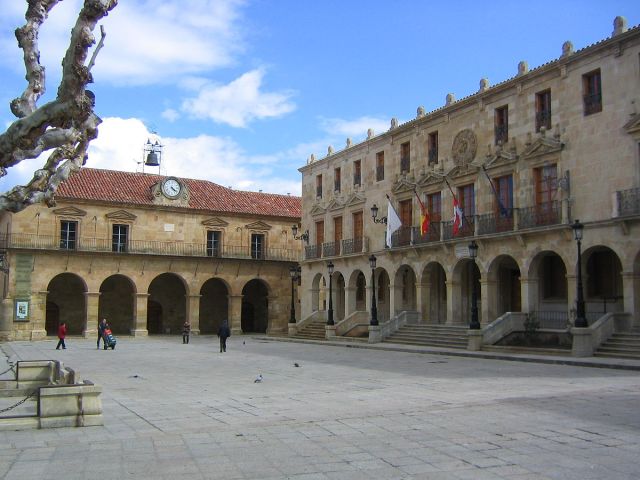
Plaza Mayor de Soria. Public Domain, httpscommons.wikimedia.orgwindex.phpcurid=1928281

Plaza Mayor de Soria. Public Domain, https://commons.wikimedia.org/w/index.php?curid=1928281.

“Soria” by Antonio Machado, Spanish poet, 1875-1939
From “Campos de Castilla,” Antonio Machado, Biblioteca Anaya, Edición de José Luis Cano, 1964.

(English translation by James Mansfield Nichols)

The shield of Soria has the following heraldic description: [3]
In a field of gules (red), a castle, of argent, crenellated with three battlements, lined up and marbled with sabre, rinsed with azure (blue) and a king’s bust crowned with gold and with its attributes coming out of his homage, in its colour; silver embroidery loaded with the following legend: “Soria Pura Cabeza de Estremadura”, written in saber letters. (Wikipedia)

The poem “Soria” is a sequence of exclamations. (I reproduce the punctuation of my printed text.) The speaker evokes the somber beauty on a cold, moonlit night of an ancient provincial city fallen from its former glory. The details he describes aren’t beautiful in themselves — indeed, they depict decrepitude, decay and impoverished neglect of which the marauding, starving Spanish greyhounds (galgos) are an emblem. However, embellished by moonlight and the late hour, the scene adds up to loveliness for the
speaker, as he asserts in the ending twist: ¡Tan bella bajo la luna!

Note: Soria today is at a considerable remove from Extremadura. A footnote in my Spanish edition says (I translate): Here “Extremadura” is used in a broad sense referring to ancient Extremadura.

Draft literal translation:

¡Soria fría, Soria pura,
Soria cold, Soria pure,

cabeza de Extremadura,
head of Extremadura,

con su castillo guerrero
with its warlike castle

arruinado, sobre el Duero;
in ruins, upon the Douro;

con sus murallas roídas
with its walls eaten away

y sus casas denegridas!
and its blackened houses!

¡Muerta ciudad de señores,
Dead city of gentry,

soldados o cazadores;
soldiers or hunters;

de portales con escudos
of doorways with the shields

de cien linajes hidalgos,
of a hundred landed lineages,

de galgos flacos y agudos,
of sharp and skinny greyhounds,

y de famélicos galgos,
and of famished greyhounds,

que pululan
that swarm

por las sórdidas callejas,
through the squalid byways,

y a la medianoche ululan,
and at midnight howl,

cuando graznan las cornejas!
when the crows caw!

¡Soria fría! La campana
Cold Soria! The bell

de la Audiencia da la una.
of the Courthouse strikes one.

Soria, ciudad castellana
Soria, Castilian city

¡tan bella! bajo la luna.
so lovely! under the moon.

[Copyright (c) 2018 James Mansfield Nichols. All rights reserved.]
 

Posted in Anthology | Tagged , | Leave a comment

Jacinda Ardern

Prime Minister of New Zealand Jacinda Ardern, at her home in Auckland. CreditMark Coote for The New York Times

Prime Minister of New Zealand Jacinda Ardern, at her home in Auckland. Credit Mark Coote for The New York Times.

She wants to show that women can lead with different styles, not cast themselves in the egotistical, brash mold of many male politicians. “One of the criticisms I’ve faced over the years is that I’m not aggressive enough or assertive enough or maybe somehow, because I’m empathetic, it means I’m weak,” she said. “I totally rebel against that. I refuse to believe that you cannot be both compassionate and strong.”

“I’ve been given so many [nicknames], it’d be quite hard to come up with a new one,” she said, laughing. “Back in the early days of my political career, I was called Socialist Cindy. I just hate the nickname Cindy.”
(Quoted by Maureen Dowd, “Lady of the Rings: Jacinda Rules,” NYTimes, 9-8-18)

[Copyright (c) 2018 James Mansfield Nichols. All rights reserved.]

Posted in Quotations | Tagged | Leave a comment

“A Prayer for My Daughter” (10 — final stanza)

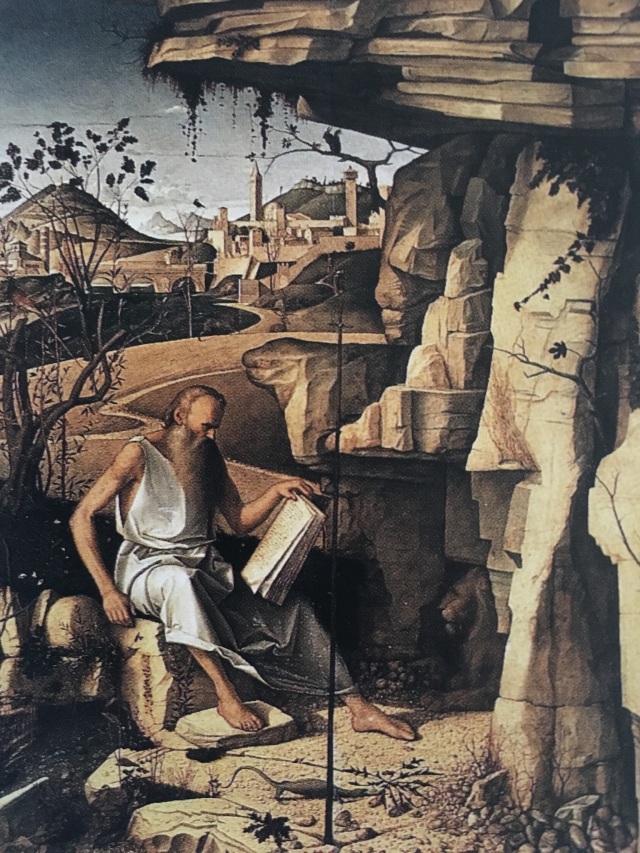
St Jerome, patron saint of translators, by Bellini

Saint Jerome, patron saint of translators, by Bellini

A Prayer for My Daughter by W.B. Yeats
(Spanish translation by James Mansfield Nichols)

https://www.poetryfoundation.org/poetrymagazine/poems/14635/a-prayer-for-my-daughter

A Prayer for My Daughter (10 — final stanza)

And may her bridegroom bring her to a house
Where all’s accustomed, ceremonious;
For arrogance and hatred are the wares
Peddled in the thoroughfares.
How but in custom and in ceremony
Are innocence and beauty born?
Ceremony’s a name for the rich horn,
And custom for the spreading laurel tree.

Una Oración para mi Hija (10 — estrofa final)

Y que su novio la traiga a una casa
Donde todo sea acostumbrado, ceremonioso;
Porque la arrogancia y el odio son las mercancías
Vendidas en las vías públicas.
¿Cómo si no es en la costumbre y ceremonia
Nacen la inocencia y la belleza?
Ceremonia es otro nombre para el cuerno rico,
Y costumbre para el amplio laurel.

[Copyright (c) 2018 James Mansfield Nichols. All rights reserved.)

Posted in Anthology | Tagged , | Leave a comment