
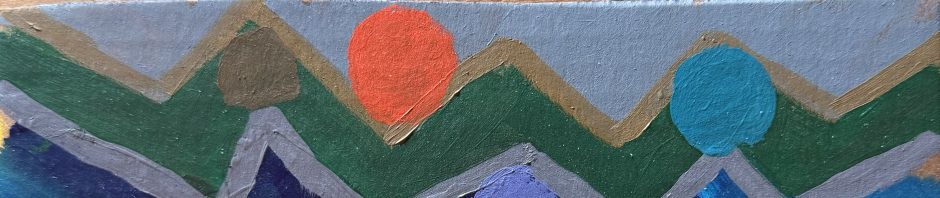
JMN2016, Puckering, oil on canvas, 16 x 20 in. (c) 2018 James Mansfield Nichols. All rights reserved.
The poetry editors of The Atlantic apologized recently for a poem they had accepted and printed. They say the poem “caused harm to members of several communities.” The author, a young white man named Anders Carlson-Wee, adopts the vernacular of a homeless black man in “How-To.” It drew outrage from readers who saw bad things at work in it. “Know your lane!” tweeted another poet. Carlson-Wee himself publicly apologized. I’ve read the poem.
It seems to me that a writer of fiction or poetry should be permitted to inhabit, to voice, and to body forth any persona that’s conceivable by human ingenuity. How much the effort succeeds or fails is another matter, but it’s an esthetic call, and one that may change for better or worse over time. There would be no guarantee against mockery or bad art, of course. Hatred and mediocrity are as endemic to the human condition as viruses are. Yes, Vachel Lindsay is much discredited. I’m not sure how John Berryman’s reputation is holding up. I was reading and admiring his “Dream Songs” when he jumped off the bridge. But it seems reductively censorious to condemn out of hand an artist’s good-faith effort to occupy an imaginative space in another dimension as an act of straying from his or her “lane.” Do such efforts in the best instances tread in the domain of empathy somehow? The heaven I’d like to live in is where invention runs free.
In the purgative, quandary-infested world I do live in, rabid debate and snarkery run free (amplified by prominent voices on Twitter and elsewhere) around issues of race and gender. If it’s verboten to do voices across ethnic lines in writing, is it also damnable on stage and screen? In stand-up? It seems to me there could be potential value lost in popular and high culture if the answer is yes.
And so…, having spilled sententious highmindedness here in defense of artistic license, I still feel conflicted about the legitimacy (or wisdom) of trying to talk in another person’s dialect. I indulged in a hip-hoppish-sounding, tongue-in-cheeky bit of tomfoolery several years ago that makes me wince now. Not to mock but to garner a chuckle. I’ve given much of my life to mastering other tongues, but I’ll never try again to ape another American dialect. There’s trouble enough speaking in one’s own voice. I have a playlist of hip-hop music I enjoy, but I’ll leave the lingo to the cognoscenti and their adepts.
(Reference: Grace Schulman, “The Nation Magazine Betrays a Poet — And Itself,” NYTimes, 8-6-18.)
[Copyright (c) 2018 James Mansfield Nichols. All rights reserved.]


 EthicalDative
Personal Goal
HJN, Hand. Fired clay with partial glaze.
When I was a student of literature I recall being influenced by a school of critical theory (Rene Wellek?) that said an author’s biography was irrelevant to a consideration of his or her text. Once it was loosed from the pen it had an existence of its own irrespective of the character and deeds of its author.
I think the predisposition acquired in those studies to seek a direct, unmediated confrontation with art has stayed with me as I ponder the current climate in which the work of certain artists in various media, both living and dead, is being reconsidered by some, shunned by some, in light of crimes or abuses known or alleged to have been committed by the artists. I can’t see how this serves art.
I hope that, in the realm of human conduct, decency will prevail and justice will be served where justice is due. My duty as citizen of a struggling democracy with flawed institutions is to exert myself however possible to support the good and resist the bad. Where art is concerned, my goal is to try to keep my eyes, ears and mind wide open to the art as art.
[Copyright (c) 2018 James Mansfield Nichols. All rights reserved.]