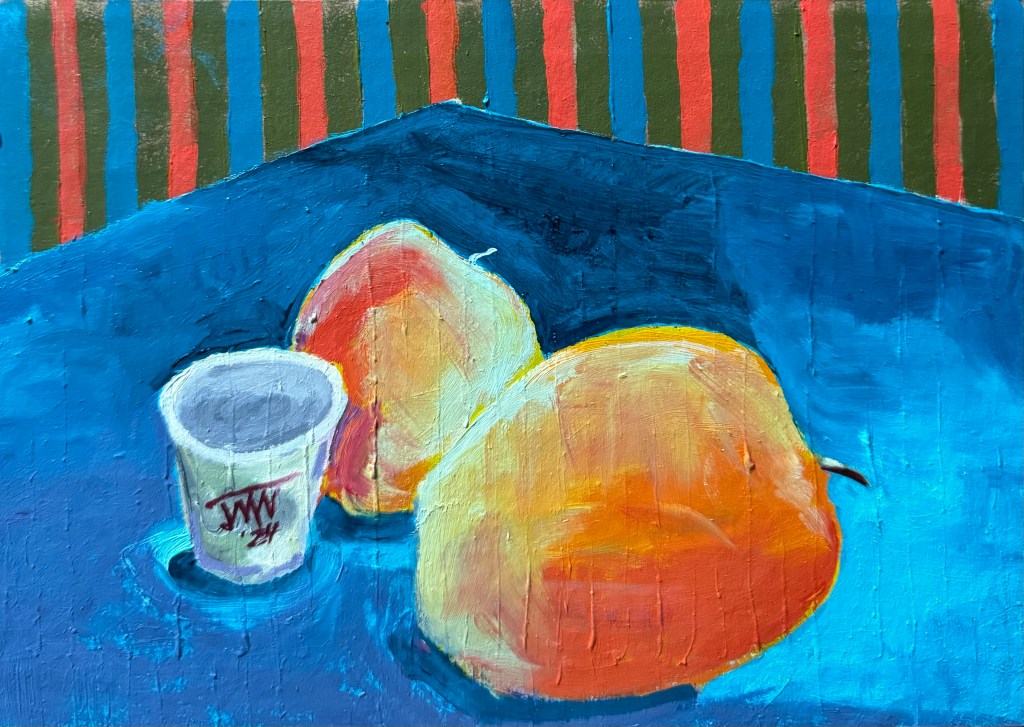
“Sapphire in a Ruby Setting,” Apple Pencil (JMN 2024).
DJ, my lord! The grail from which you sup runneth over, sir, with fulsomeness. By your leave I’ll tell it like it is: JD, as well, sips from a frothy cup.
DJ, JD, a mirror’s dream times two, chosen well you have, each one the other. Musk and myrrh anoint you, sir and sir — claw with which to rake, and tooth to chew!
In nineteen hundred forty-six, this land birthed a baby swathed in currency. That hero now courts Lady Liberty with touch from his exploratory hand.
Hell yes to thee, my Chief! Our Flag receive thy kiss, virgins reciprocate thy tongue! My MAGAnificent, be thee self-sung by NFT’s surpassing make-believe!
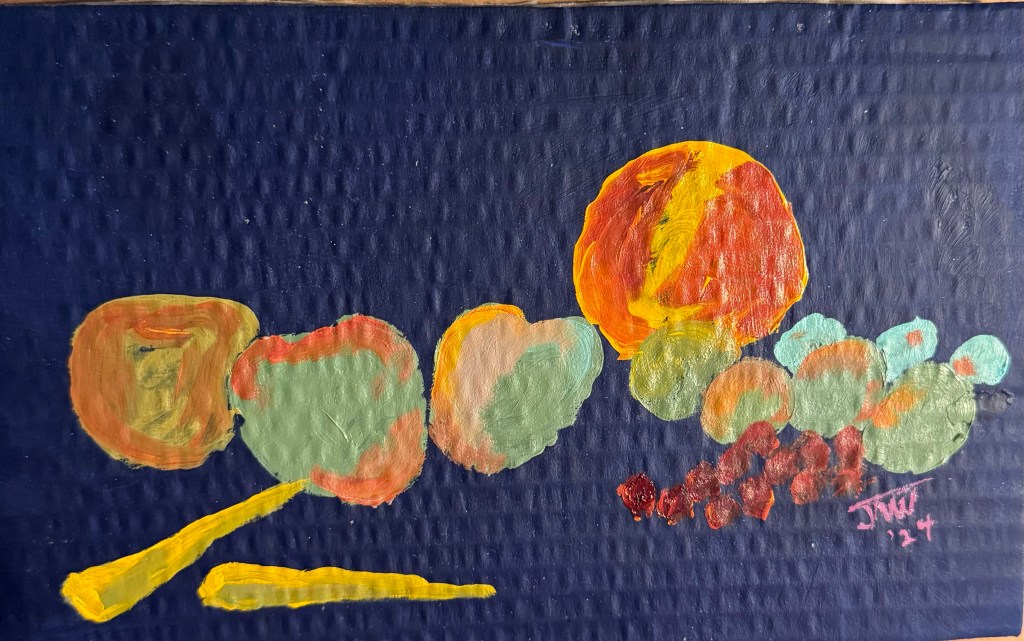
“Fruit,” oil on cardboard, 8-1/2 x 6 in. (JMN 2024).
Christian J. Collier publishes three poems in Poetry, September 2024: “God,” “Case Study” and “The Compline.” Spoken cleanly, rhythmically, hotly, they orbit around experience gleaned from the crucible of propagating life.
Formal religion can be heavy on bone and light on meat. Collier’s poems flesh out the argument with God that makes faith flicker for me as a kind of alive thing in others. The poems emit sparks of light from the human clash with a theology swaddled in hoary patristics, with the unendurable meant to be endured. Paradox’s alter ego is the Great Indefinite, the Hidden-yet-Revealed eidolon which demands abject submission on top of dogged adoration. It has to be unreal and otherworldly to cohere, if at all, in the human psyche.
I’ll write only of Collier’s “God.” It starts here:
I used to think there was only one of You before the miscarriage. Now I am not so sure. Maybe there are a number of Gods to wade through before falling at the feet of the last true one:
In an indented block, the poem cycles through a divine catwalk of temporizing avatars attached to primitivistic epithets and reductive seductions:
the jade God we pray to who does not come or answer & and the plum one who appears to offer salvation; the opal God who offers a limited extent of His kingdom and the olive one who only offers condolences; let us not forget the violet God that is bad with man because He is deeply holy.
The poem alights on the ostensibly desirable God: “We all seek the one of manna though, don’t we?” Three stanzas evoke with ambiguous edginess the God “holding all we hunger for / like butterscotch in His palms.” The speaker, traversing inky moments of mundane days and nights, dreams “with eyes open of goading Him into halting my child’s rest, / guiding his or her tiny light close to the brushfire / flickering in my breath.”
Goading Him! The verb is explosive. Indefinite binary “his or her”; light that’s “tiny”; anomalous “halting” of a child’s “rest”; these are stinging formulations. The rest in question is death. An unrealized life form is being sucked back into the impossibly capacious bosom whence it came, or whatever. Where are “mercy” and “justice” in this sorry transaction? The poem voices a despairing piety that seethes to rescue an imperiously snatched entity from “that God.” Here’s the ending:
That God? That great and swollen orange storm? That’s the God haunting me. The God who keeps His distance. The God whose star-draped hands I envy. They come at day’s end to tuck my baby, my ember, into its infinite, feathered bed.
“My ember” calls back piercingly to the “brushfire flickering in my breath.” I’m rarely reached as acutely as this by poetry in which faith and grief tangle with such expressive fury.
Martha Diamond’s “New York With Purple No. 3” (2000), oil on linen, at the David Kordansky Gallery in Los Angeles[…] Credit… Martha Diamond Trust, via David Kordansky Gallery. [New York Times caption and illustration]
She completed an oil painting in one sitting, often mixing colors on the surface of the canvas.
Martha Diamond’s approach to painting, and her execution, delight me. I dream of achieving something even approximating her studied generality in my own practice. Her subject matter was New York City architecture. I relish the critic’s observation that Diamond wasn’t concerned with “assiduous documentation of the built environment,” but rather with conveying how it felt to her.
Her small studies — preparatory exercises for the large-scale works that follow — are tightly organized, keyhole views onto the grandeur of the city; most are on Masonite boards around 16 or 20 inches tall.
“Study for Yellow Sky,” 1986. Diamond’s methodical studies were consistent with her much larger pieces. Credit… Martha Diamond Trust, via David Kordansky Gallery. [New York Times caption and illustration]
Here’s the 10-foot-wide painting resulting from “Study for Yellow Sky” (above):
Installation view of “Martha Diamond: Skin of the City.” The painting, with its peachy color, dominates the main gallery. Credit… Jeff McLane, via David Kordansky Gallery. [New York Times caption and illustration]
Underestimating Diamond is a trap for careless viewers. Even when her paintings look casual, or simple, she is solving complex problems. Take the large, squat “Highway,” a seemingly straightforward painting that did not particularly grab me on first appraisal. In time, I understood how Diamond had felt her way around this massive white building, reconstructing it section by section in her wobbly, wide strokes. (She notoriously used only her left hand to paint, because, she once explained, “it’s connected to the part of the brain that sees space, volume, and probably colors better.”) It’s the kind of building one takes for granted; Diamond helps us to see it anew.
“Highway” (1984), oil on linen. […] Credit… Martha Diamond Trust, via David Kordansky Gallery. [New York Times caption and illustration]
Diamond reportedly made these “detail” paintings to work out how to handle particularly tricky sections of a larger composition…
Martha Diamond, “Pass (Detail),” 1981. Credit… Martha Diamond Trust, via David Kordansky Gallery. [New York Times caption and illustration]
(Jonathan Griffin, “In Martha Diamond’s Art, She Took Manhattan,” New York Times, 4-11-24)
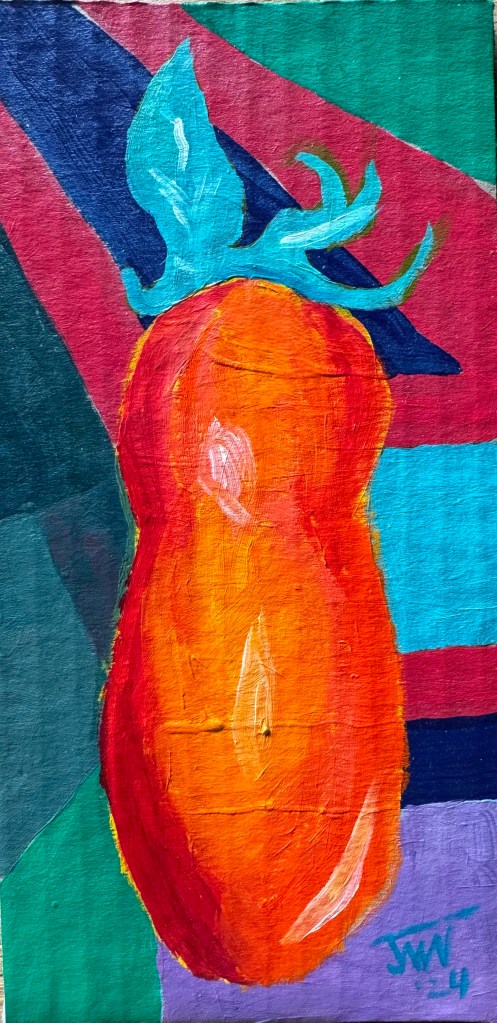
“Semblance of a Pepper,” oil on cardboard, 5 x 7 in. (JMN 2024).
I heard that Iris Murdoch said (or wrote), “Everything that comforts is fake.”
Then I read:
According to the best theories available, matter — everything we can see and feel in the universe — should not exist. Every particle of matter comes into being with a doppelgänger, a particle of antimatter (or “antiparticle”) with equal but opposite properties like charge and spin. Whenever a particle and its antiparticle meet, they annihilate each other. Particles and antiparticles can be made in equal measure, but they eventually find and destroy one another, leaving behind nothing. (Joseph Howlett, “Mining for Neutrinos, and for Cosmic Answers,” New York Times, 9-5-24)
I remembered that Simone Weil said everything we think of as a “human right” (life, liberty, equality, peace, etc.) can be taken away from us. The only inalienable ground we stand upon is awareness of the suffering of others.
Early that same day (Sept. 5, 2024, eighth anniversary of my mother’s death), I saw a cartoon by Gary Lawson. Two portly scientists in white coats, backs to the viewer, stare at a chalkboard filled with equations. In the caption, one of them says, “No doubt about it, Ellington—we’ve mathematically expressed the purpose of the universe. God, how I love the thrill of scientific discovery!” The result of the welter of calculations filling the chalkboard is zero.
Where these several strands lead me is to take issue with Iris Murdoch. Laughter comforts, and is real.
Johnson’s portrait of the cultural theorist Stuart Hall, who died in 2014, sits above her desk. He was an inspiration for and supporter of the Blk Arts Group. Credit… Ekua King.
“I tend to just make a mess.”
(Claudette Johnson)
Artist-blogger OutsideAuthority’s mention of an exhibition of work by Claudette Johnson in Birmingham (England) caused me to discover an article about Johnson’s first solo show in New York last year. These excerpts are from the article.
“When I was younger, I chose pastels as my main medium because they were so quick. I didn’t have to wait for the paint to dry.”
In 2021, Johnson began experimenting with oil paints. She said, “It brings me outside of my comfort zone.” Also, that in her life-size drawings of Black sitters her focus wasn’t on “creating perfect likeness but on capturing a feeling or a presence… Often the heads are cut off, or parts of them are missing, as if you just bumped into the person.”
Johnson often uses bold reds, yellows and blues as a rebellion against the gray and muted palette she loosely associates with the Bloomsbury Group, the influential 19th-century circle of British artists and writers. Credit… Ekua King.
Nowadays, I prepare a primer on the paper or the canvas and then go straight in. I don’t do preparatory sketches. I tend to just make a mess. Sometimes, it’s a lovely, charmed experience and everything’s more or less where it should be and I feel a rhythm and symmetry — and other times, it goes completely awry. [In reading this I realized how hard it is to give in and “just make a mess,” which inhibits (alas) my being a serious painter. It also reminded me of a comment by novelist George Saunders: “The holy estate of a writer is to be a little confused by what you’re doing.” A fetish for control seems to gravitate against the discipline of creativity, which is to be reckless.]
Asked when she knows when a work is done, Johnson said she doesn’t always know. I like her comment that she realizes that “at the point I keep making changes to a work, I need to make a new work.”
Here’s the last question in the interview, and Claudette Johnson’s answer (the link is worth clicking):
What’s your favorite artwork by someone else?
Rembrandt’s “Young Woman Sleeping” (c. 1654). It does everything I want my drawings to do.
(Kadish Morris, “An Artist Returns After a ‘Long Wilderness’,” New York Times, 3-9-23)
“Porrón With Cans,” oil on cardboard, 7 x 9 in. (JMN 2024).
The words of Kate Asche’s poem “[Untitled]” (Poetry, May 2024) enact a sac-like image on the page. Leapfrog the spaces between them and they (the words) hang together as if magnetized, flowing into shattering assertions. A life is lost in this poem. It illustrates the power of conveying an ordeal by skirting emotive language in favor of a dispassionate, grievously minute telling. Or showing?
(In my excerpt, where there’s an ellipsis, imagine incremental spaces which contribute to bulging the poem into its circular aspect on the page.)
the sac itself was … clear and I cleaned it … like a window and in the window … saw my baby our baby … [birdlike mouth open … nasal … area still oversized … like a beak] … eye’s aperture blue-black head thrown … back … and twisted beginning to separate … neck brok en in the contractions’ … violence … […]
The next-to-last-line, fracturing the word “broken” at a syllabic juncture, executes the most violent enjambment possible in poetry. Even the formality of a hyphen is dispensed with.
Detail suggests the speaker has agency in this grave matter, is constrained to follow a procedure, and is painfully observant along the way. Note the pointed fallback from “my” baby to “our” baby. The emphasis on the shared origin of the failed life that’s being let go of recurs in the poem.
There’s much more than what I’ve cited. You have to see the poem to apprehend it. (Be prepared to look up some medical terms.) Surpassingly strange and explicit, it’s a lump-in-throat inducing achievement, graphic in multiple senses. Solid syntax which makes the words cohere across their spacing helps the reader navigate the form factor. The poem transmits indelible ache through language that embraces the unstintingly clinical.
The circle closes; the poem ends:
I handed this … singular life over never saw my child again
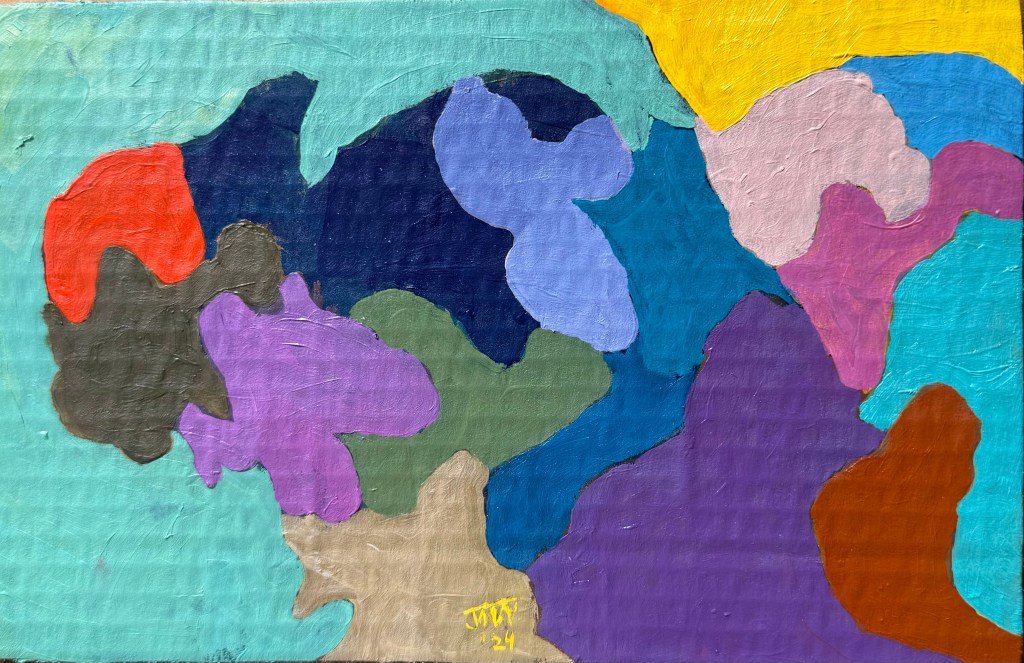
“Gerrymandered Spit,” oil on cardboard, 7 x 9 in., (JMN 2024).
Reading current poems, I notice how rhyme seems mostly a thing of the past. Occasional rhyme and near rhyme can land felicitously nowadays, but when deployed lockstep it’s often noisy and distracting. To some degree the same is true with regular meter. Blank verse can still be persuasive when it doesn’t call attention to itself. Cascading rhymes, on the other hand, tend to yell, “Look at me!”
I indulge in doggerel, a tool of satire, more than I should, and doggerel enlists, for making light of something, or fun of it, those selfsame, singsong qualities which feel quaint in poems. A four-beat line with repeating end-rhymes is a ready mold in which to pour ironizing jello.
I’ve said more than I know, as granddad would tell me. It seems fair to cite an exception — i.e., an instance of rhyme and rhythm used well in modern times. It’s an elegy. I’ve memorized it. It starts:
He disappeared in the dead of winter: The brooks were frozen, the airports almost deserted, And snow disfigured the public statues; […]
Here’s the highly formal ending, part three. Its power is enhanced by contrast with the deceptively informal, lilting discursiveness of the sections that precede.
III. Earth, receive an honoured guest: William Yeats is laid to rest. Let the Irish vessel lie Emptied of its poetry.
In the nightmare of the dark All the dogs of Europe bark, And the living nations wait, Each sequestered in its hate;
Intellectual disgrace Stares from every human face, And the seas of pity lie Locked and frozen in each eye.
Follow, poet, follow right To the bottom of the night, With your unconstraining voice Still persuade us to rejoice;
With the farming of a verse Make a vineyard of the curse, Sing of human unsuccess In a rapture of distress;
In the deserts of the heart Let the healing fountain start, In the prison of his days Teach the free man how to praise.
“Peek-a-Blue,” oil on cardboard, 7 x 9 in. (JMN 2024).
Booing is the most boring crowd noise there is, even when the crowd thinks its noise supports the speaker. The second-most boring crowd noise is chanting, even when the crowd thinks its noise supports the speaker.
An effervescing horde of enthusiasts needs dominating. A sympathetic audience is a self-regarding entity when assembled into spectacle. It wants to be loved, is full of love, doesn’t quite know what to do with its love. The consummate speaker shuts it up, lifts it up, harnesses the love.
The high points of a well-oiled speech are the instants when the horde is stunned into perfect silence, countless faces shocked into radiance, slack with unvarnished amazement. Then it can roar assent to the choice truth that has pierced its restless buzz. But the agile speaker is two steps ahead already. She banks the roar quickly and moves forward, impatient, imperious, impressive.
Such cadences imposed by such a speaker spring from an indefinable mix of art, humility and command. The delivery of message is devoid of bluster, isn’t fawning, emphatically doesn’t court the adoring feedback. Simply earns it.
PS: Sometimes plain words uttered by a gently reasonable voice speak loudest: “…We will finally say goodbye to that hateful man.” (Yusef Salaam).
Former President Clinton is right, of course. The sword of Damocles haunts this assembly.
I wonder if weeping is a kind of emotional breaking of sweat that cleanses clogged spiritual pores? Watching Wednesday’s primetime program on my Macbook, I found myself blotting tears throughout the evening. So did a goodly portion of the conventioneers in Chicago.
The cameras pan constantly across faces of the congregants, a rapturous gallimaufry of humane DNA, a well-meaning cross section of the American persuasion which is a spectacle itself, apart from what’s on stage, that assuages blight and comforts funk.
It’s notable how many public speakers associate speechmaking in a large forum with bellowing, gesticulating and smiling excessively. The good ones — an AOC, a Warnock, an Obama, a Winfrey — know the efficacy of modulation, varied phrasing, strategic pauses, quiet hands and nuanced demeanour. I like seeing the tyros hone their chops at shucking down the corn. Some of them, future leaders, will figure it out.





 EthicalDative
Martha Diamond: ‘Looming Masses, Fleeting Vistas, Overwhelming Immersion’
Martha Diamond’s “New York With Purple No. 3” (2000), oil on linen, at the David Kordansky Gallery in Los Angeles[…] Credit… Martha Diamond Trust, via David Kordansky Gallery. [New York Times caption and illustration]
Martha Diamond’s approach to painting, and her execution, delight me. I dream of achieving something even approximating her studied generality in my own practice. Her subject matter was New York City architecture. I relish the critic’s observation that Diamond wasn’t concerned with “assiduous documentation of the built environment,” but rather with conveying how it felt to her.
Her small studies — preparatory exercises for the large-scale works that follow — are tightly organized, keyhole views onto the grandeur of the city; most are on Masonite boards around 16 or 20 inches tall.
“Study for Yellow Sky,” 1986. Diamond’s methodical studies were consistent with her much larger pieces. Credit…
Martha Diamond Trust, via David Kordansky Gallery. [New York Times caption and illustration]
Here’s the 10-foot-wide painting resulting from “Study for Yellow Sky” (above):
Installation view of “Martha Diamond: Skin of the City.” The painting, with its peachy color, dominates the main gallery. Credit… Jeff McLane, via David Kordansky Gallery. [New York Times caption and illustration]
Underestimating Diamond is a trap for careless viewers. Even when her paintings look casual, or simple, she is solving complex problems. Take the large, squat “Highway,” a seemingly straightforward painting that did not particularly grab me on first appraisal. In time, I understood how Diamond had felt her way around this massive white building, reconstructing it section by section in her wobbly, wide strokes. (She notoriously used only her left hand to paint, because, she once explained, “it’s connected to the part of the brain that sees space, volume, and probably colors better.”) It’s the kind of building one takes for granted; Diamond helps us to see it anew.
“Highway” (1984), oil on linen. […] Credit… Martha Diamond Trust, via David Kordansky Gallery. [New York Times caption and illustration]
Diamond reportedly made these “detail” paintings to work out how to handle particularly tricky sections of a larger composition…
Martha Diamond, “Pass (Detail),” 1981. Credit… Martha Diamond Trust, via David Kordansky Gallery. [New York Times caption and illustration]
(Jonathan Griffin, “In Martha Diamond’s Art, She Took Manhattan,” New York Times, 4-11-24)
(c) 2024 JMN — EthicalDative. All rights reserved