A Good Speech Is a Feat of Crowd Control

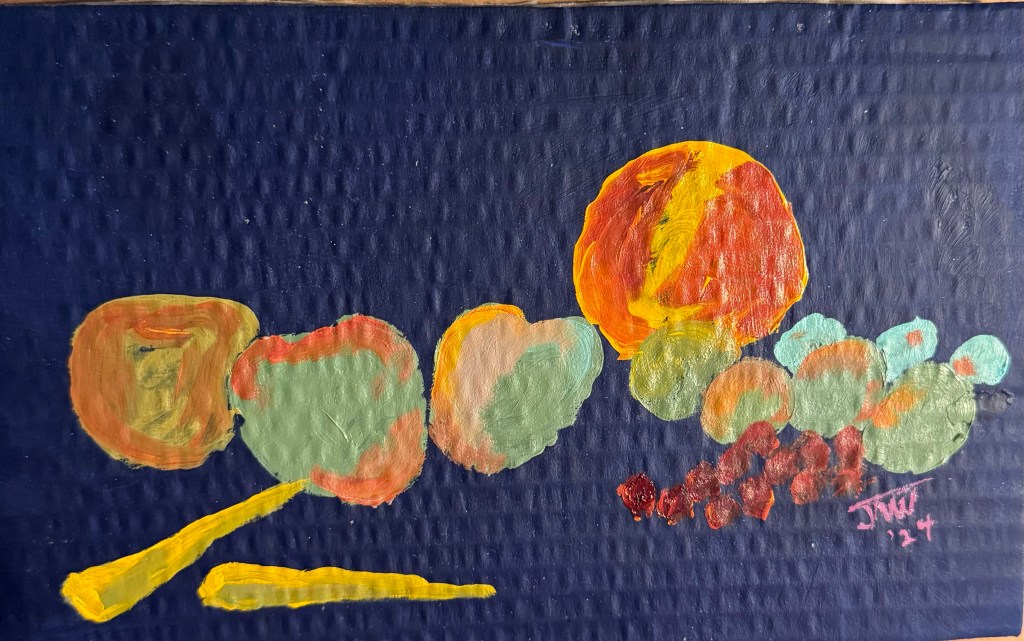
“Peek-a-Blue,” oil on cardboard, 7 x 9 in. (JMN 2024).

Booing is the most boring crowd noise there is, even when the crowd thinks its noise supports the speaker. The second-most boring crowd noise is chanting, even when the crowd thinks its noise supports the speaker. 

An effervescing horde of enthusiasts needs dominating. A sympathetic audience is a self-regarding entity when assembled into spectacle. It wants to be loved, is full of love, doesn’t quite know what to do with its love. The consummate speaker shuts it up, lifts it up, harnesses the love. 

The high points of a well-oiled speech are the instants when the horde is stunned into perfect silence, countless faces shocked into radiance, slack with unvarnished amazement. Then it can roar assent to the choice truth that has pierced its restless buzz. But the agile speaker is two steps ahead already. She banks the roar quickly and moves forward, impatient, imperious, impressive. 

Such cadences imposed by such a speaker spring from an indefinable mix of art, humility and command. The delivery of message is devoid of bluster, isn’t fawning, emphatically doesn’t court the adoring feedback. Simply earns it.

PS: Sometimes plain words uttered by a gently reasonable voice speak loudest: “…We will finally say goodbye to that hateful man.”  (Yusef Salaam). 

(c) 2024 JMN — EthicalDative. All rights reserved

Posted in Commentary | Tagged , , | 2 Comments

Crying for No Obvious Reason

“This is a brutal, tough business.”

(Bill Clinton, speaking to the convention)

Former President Clinton is right, of course. The sword of Damocles haunts this assembly.

I wonder if weeping is a kind of emotional breaking of sweat that cleanses clogged spiritual pores? Watching Wednesday’s primetime program on my Macbook, I found myself blotting tears throughout the evening. So did a goodly portion of the conventioneers in Chicago.

The cameras pan constantly across faces of the congregants, a rapturous gallimaufry of humane DNA, a well-meaning cross section of the American persuasion which is a spectacle itself, apart from what’s on stage, that assuages blight and comforts funk.

It’s notable how many public speakers associate speechmaking in a large forum with bellowing, gesticulating and smiling excessively. The good ones — an AOC, a Warnock, an Obama, a Winfrey — know the efficacy of modulation, varied phrasing, strategic pauses, quiet hands and nuanced demeanour. I like seeing the tyros hone their chops at shucking down the corn. Some of them, future leaders, will figure it out. 

(c) 2024 JMN — EthicalDative. All rights reserved

Posted in Commentary | Tagged , , | 2 Comments

Ciceronian Suasion: ‘Memorable in a Matter of Minutes’


This sketch is several years old. It’s mine, yes, but I don’t remember making it nor what it depicts. My scrawled Arabic says “The fire is under control.” Apropos of who knows what? (JMN)

May we be guided by hope, joy and a fierce moral imagination.
(Rabbi Sharon Brous)

Anyone who watches Buttigieg on Fox News knows he can boil things down with terrific lines, and it’s being memorable in a matter of minutes that is meaningful.
(Patrick Healy)

Mr. Walz has a direct way of speaking that feels authentic and a teacher’s knack for making a message simple and memorable.
(Ted Genoways)

The point of free speech is to open discussion, not to shut it down.
(Bret Stephens)

I strive to be a scribbler for whom terse is best. No surprise as a reader I favor the short lyric. When a lyric’s proper lit, it’s a heat-seeking message rocket. 

Night 2 of the DNC convention reminded me that good oratory is lyrical in being both potent and rare. There were decent stretches of speech, to be sure — Doug Emhoff was graceful, Barack splendid (Now that it’s popular they don’t call it “Obamacare” any more!, he mused).

But the evening’s accolade goes to Michelle Obama. With her content, tone, affect, timing, cogency and polish she owned the moment. In reference to a presidential candidate she said:

Who wants to tell him that the job he’s currently seeking might just be one of those Black jobs? … Most of us will never be afforded the grace of failing forward. We will never benefit from the affirmative action of generational wealth.

“That is a brilliant rhetorical summation of complicated ideas,” writes Tressie McMillan Cottom in her report of the speech. 

(c) 2024 JMN — EthicalDative. All rights reserved

Posted in Commentary, Quotations | Tagged , , | Leave a comment

Of Note at the Convention: A Freer Shade of Free


“Porrón With Pepper,” 6 x 8-1/2 in., oil on cardboard (JMN 2024).

It did my hurt Texas heart a world of good to see Jason Isbell turn up and sing a good song in a classic tux and without a 50-gallon hat on his head. He was, after all, indoors. (I never saw my grandfather, a cowboy, a cattleman, a tough, courteous man, wear his hat indoors. In his culture, staying covered insulted the hat and the room.) Isbell plays his own licks, too. See the ending.

And the Soul Children of Chicago burnt the barn down with their singing of the Anthem. Pure, brisk and sweet with a whack and a punch where it matters.Thank God for some freshness and originality powering up some of our tired tropes.

Hello, Artificial Intelligence! I entered a Google query using correct English: “what song did jason isbell sing at the dnc convention?” Google corrected my query with incorrect English: “Did you mean: what song did jason isbell song at the dnc convention?” It’s a brave new world, ain’t it?

Don’t take my word for it. This is my screen.

I rarely pick up much of the lyric when pop singers sing, and the nasality and drawling of Country-Western isn’t my cup of tea. I wanted to confirm the title of Isbell’s song, though, thinking to cite some tight words from it here. No luck. As ever with minstrelsy, the magic is enmeshed with the melody and chords, with the vocalizing and the occasion. The words exist for the song.

But here’s a thought: Maybe the poetry is in the title of Isbell’s song: “Something More Than Free.” The notion of “freedom” is bandied about like a piece of chewing gum in our culture, spit out when the sweet’s gone, a subterfuge for ego and self-interest run amuck. I hazard that we’re most free when we’re harnessed to something outside ourselves that’s worth pulling.

(c) 2024 JMN — EthicalDative. All rights reserved

Posted in Commentary | Tagged , | 2 Comments

Calling All Cat Ladies

What My Cat Teaches Me

Crouch.
Then
Pounce.

In
That
Order.

(c) 2024 JMN — EthicalDative. All rights reserved
Posted in Anthology | Tagged , , | 12 Comments

A Carton of French Fries Walks Into a Bar

New Yorker cartoon by Schwartz.

This is the latest specimen in The New Yorker’s cartoon caption contest that has run for centuries. I’ve never come close to inventing a caption for an entry in this feature, but it fascinates me for what it often shows of how much of a good cartoon’s payload is packed into the drawing itself. Adding words can feel like gilding the lily. Not that I discourage the contest. The winning caption is always witty and apt. I often wonder if the cartoonist has a caption in mind in the course of drawing? 

I’ve looked at the above cartoon multiple times and have kept laughing. What I see is a cranky French fry carton laden with cargo — a working stiff — who has ducked into his neighborhood watering hole to be poured a pick-me-up shot of Heinz ketchup in a condiment cup by the barkeep. Hitting the sauce is a common failing in his line of work. He’s on his way to… well, being emptied out unceremoniously and discarded. That’s the job. Even though I’m someone who tries to put diffuse, anomalous things into words, I haven’t the foggiest idea for a good caption.

(c) 2024 JMN — EthicalDative. All rights reserved

Posted in Commentary | Tagged , , , | 3 Comments

‘I Said Hello. Then You Said You Said Hello’

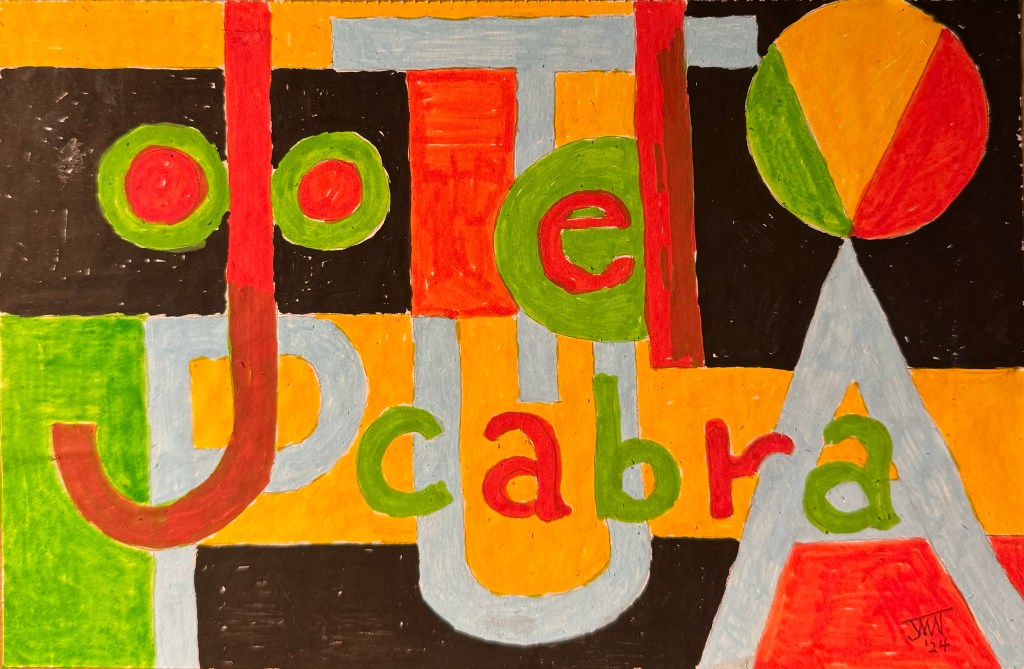
“Ojo de puta cabra,” colored marker on paper (JMN 2024).

I’m guessing you think there’s a typo in my heading. I know! The use of repetition in “The Renaissance,” a poem by Trey Moody (Poetry, May 2024), was a hook for me. The thirteen-line poem starts here:

I said hello. Then you said you said
hello. In this way, we were touching touching
clouds.
[…]

The doing of an act turns into a report of its doing or having been done — sort of. Actions are limned through an after-thoughtful lens — sort of. (I call this the “sort of” technique for understanding a poem.) A self-referential quality in the saying of saying partakes of mannerism in a winning way.

“Touching clouds” touches me. The thing I most wanted to paint as a kid on the hot flat Gulf of Mexi-Coast was clouds. The shrimp boats were picturesque, the curvaceous dunes aroused me, but the clouds drew me — so suffused with ineffable light I despaired of brushing them. 

Rhetorically, note the canny enjambment of the repetitions in the poem. It lends the device both latency — postponing the complement — and the call-to-attention that comes with end of line. The maneuver is carried through to the very end:

[…] Usual, you map the passing time
in the shape of a cumulonimbus. I say how quiet quiet
can be when your face is this close to the painting.

“I say how quiet quiet can be” prepares a delicious reveal: The speaker and spoken-to are in intercourse with painting! That adjective “Usual” is inscrutable to me. What does it modify?

Perversely, I’ve quoted the beginning and the end of the poem. There’s enough going on in the middle to make your head spin. The poem makes enigmatic statements that are striking, abrupt and sort of intelligible, as poetry does.

[…clouds.] Such mannerisms endured throughout
the sixteenth century, when bread was scarce, words
for clouds scarcer. Of course we were younger
then, when all the lakes we wanted belonged
to the aristocracy, so we swam in nothing
but our suffering. As they do, centuries passed.
We kept thinking there were only so many ways
to light a fire. Now, it’s just as likely you’ll call
after a Sunday dip.
[Usual …]

(c) 2024 JMN — EthicalDative. All rights reserved
Posted in Anthology | Tagged , , , | 2 Comments

‘Just About Everyone Needed Therapy’


Hospital staff members, children and patients during a day trip near the Saint-Alban Psychiatric Hospital, circa 1950. Credit… Baldran Collection, Saint-Alban-sur-Limagnole. [New York Times caption and illustration]

“Gathering, touching, connecting — these are Tosquelles’s methods.”

This article highlights an exhibition at the American Folk Art Museum in Manhattan that will end on August 18, 2024: 

Francesc Tosquelles: Avant-Garde Psychiatry and the Birth of Art Brut.

The Catalan doctor Francesc Tosquelles was “a psychiatrist who spent decades dismantling the hard bars between illness and health, pathology and normalcy, artists and everyone else. He drew on Freud and Marx, and also on his experience as a refugee, in exile from Franco’s fascist Spain.”


Auguste Forestier’s sculpture “Untitled (Boat),” 1935-1949, opens the exhibition at the American Folk Art Museum. Credit… CNAC/MNAM, via RMN-Grand Palais/Art Resource, NY. [New York Times caption and illustration]

Against the historical trauma of fascism, war and displacement, Tosquelles built radical psychiatric practices around non-hierarchical relations between patients, doctors and their neighbors… He also encouraged his patients’ creativity, which put him at the confluence of Modernist avant-gardes and Art Brut. All these ideas converged at a psychiatric hospital in Saint-Alban, a small village in southern France, where Tosquelles worked from 1940 to 1962.


Marguerite Sirvins, “Landscape With Boats, Hunters, and Animals,” circa 1944-1955, rayon thread embroidered on fabric. Credit… Musée LaM. [New York Times caption and illustration]

Tosquelles also instructed his colleagues in psychoanalytic concepts and trained local people in basic psychiatry. With fascists on the march and decades of unthinkably brutal war, it seemed clear to Tosquelles that just about everyone needed therapy.  If the affliction is social, he reasoned, the treatment must be too. [My emphasis — JMN]


”Untitled (Known as ‘Myrllen’s Coat’),” circa 1948-1955, a cloak covered in pale blue curls, heart-shaped groups of figures and illegible letters, made by a woman named Myrllen. Credit… Tennessee State Museum, Nashville. [New York Times caption and illustration]

The story behind “Myrllen’s Coat” is poignant: 

Its maker, a woman named Myrllen, reportedly experienced symptoms of schizophrenia, and was one of the first Americans prescribed Thorazine. Her harrowing hallucinations subsided, but so did her desire to sew.

(Travis Diehl, “The Avant-Garde Psychiatrist Who Built an Artistic Refuge,” New York Times, 7-22-24)

(c) 2024 JMN — EthicalDative. All rights reserved

Posted in Commentary, Quotations | Tagged , , | 5 Comments

Break Out the Tiny Fiddle, But Have Some Heart, Too


The IOTD (illustration of the day) is by Ben Wiseman of the New York Times.

She had the effrontery to burden the critics with her good looks. I speak of Yvonne Furneaux. 

In a review of a 1955 production of Jean Giraudoux’s “Ondine,” the august British theater critic Kenneth Tynan wrote Ms. Furneaux off as a “buxom temptress” who was “more impressive in silhouette than in action.” 

The Daily News of New York described her in a 1958 headline as an “English peach.”

The Australian writer and film critic John Baxter noted her “considerable ability to cringe, flinch and moan.”

Furneaux found at length two Italian “lions of cinema,” Fellini and Antonioni, who allowed her acting prowess to blow past the testicular japes triggered by her allure. She’d taken an Oxford degree in modern languages, and spoke five of them. Studied acting at the Royal Academy. Earned roles in Italian, French, West German and Spanish films. Was married to cinematographer Jacques Natteau for 45 years until his death in 2007. Is survived by a son, Nicholas.

Is living well and long the best revenge? Yvonne Elizabeth Scatcherd was born into privilege saddled with looks and talent. But the blessings of beauty and longevity aren’t necessarily without cost. She seems to have shouldered her condition gracefully:  Asked later in life which country had the biggest impact on her, Ms. Furneaux responded: “Italy. Because England taught me everything, but Italy gave me everything.”

(Alex Williams, “Yvonne Furneaux, Cosmopolitan Actress in ‘La Dolce Vita,’ Dies at 98,” 8-2-24)

(c) 2024 JMN — EthicalDative. All rights reserved

Posted in Commentary, Quotations | Tagged , , | Leave a comment

‘More Than 90 Percent of Them Were Loaded’

“Last year the [U.S.] Transportation Security Administration intercepted a record number [of firearms] at airport security checkpoints: 6,737. More than 90 percent of them were loaded when they were discovered.”

(Andrew Keh, “An Olympian’s Awkward Packing List: Toothbrush? Check. Rifle? Check.” New York Times, 7-23-24)

(c) 2024 JMN — EthicalDative. All rights reserved

Posted in Quotations | Tagged | 3 Comments