In a delicious Onion skit a befuddled member of a clueless television news panel ends up saying, “Yeah, I don’t agree with what I said!” It’s a wicked sendup of vacuous cable news, but also sparks a thought: What if … Continue reading →
“Guilty on All Counts,” oil on canvas glued onto acrylic-painted cardboard, 19 x 38 in. (JMN 2013). And God said, “Let there be pigments in tubes.” And there were pigments in tubes. And Eve called them “hues,” and assigned each hue its name, one after the other even as God cracked them out, while Adam, who gave not a fig, marinated in muscle.
“You need to have some sense of awe, mystery and not-knowing-ness to have faith in the possibilities of the world and what God has done.”
IT STIRS What are we seeing? I don’t know, but there it is. It is lights going in directions. They have darknesses in between. Iridescence flares and wanes. A haze appears to drift. Thick here, thin there. Do you see it, too?
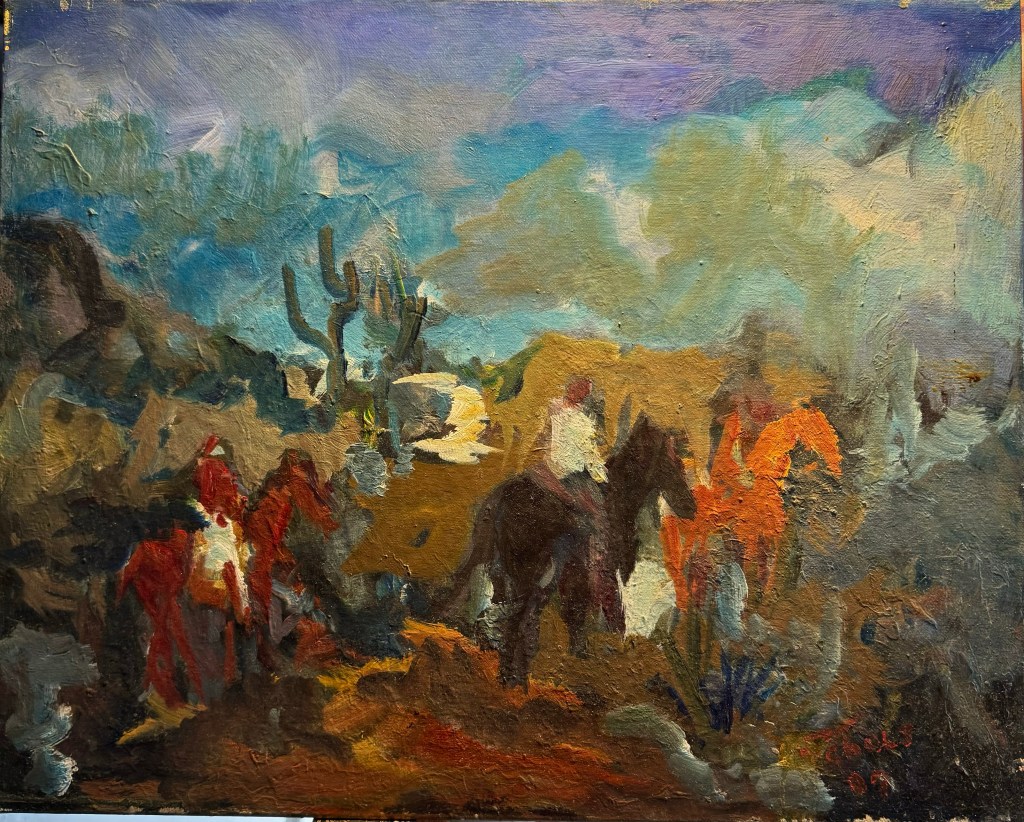
Dad’s painting, not mine. Oil on canvas, 16 x 20 in., (2007).
There must be a type of experience that isn’t uncommon among folk, yet is felt individually as epochal and singular. I classify it as contemplation of a certain prospect from a particular height in circumstances which combine to induce a geyser-burst of sheer animal spirits. A spasm of serene thrill, as it were, in which life and hope and possibility appear all rolled up in one and shimmering in the reachable distance. My moment happened at night on a modest hilltop in the vicinity of Villefranche-sur-Saône with lights winking in the shadowy expanses way off yonder. Breezes, stars, romantic partner, bit of wine, and blood thundering in its arteries. In my telling it sounds like a hackneyed cinematic trope, but Kwame Dawes made my French hilltop moment come surging back, mixed with sweet, stupid tears, in the finale of his poem “Walk ‘Bout.”*
It’s pertinent to mention the Bob Marley line with which Dawes prefaces the poem: Bless my eyes this morning.
Kingston is the poem’s place, haunted by ghosts loitering in the pens… a village of gutters and middens…, where a wheezing boy roams and knocks about, his shoes / worn down by the deformity of an old ankle wound. A turning point for the boy is the sound of reggae, psalming its apocalypse across this city. Until then, he says, I had no language for the holiness / of this Kingston.
That language is supplied by the griot (“It sipple out there”) and the roots man (“It slide out there”) calling me up / to the hills, and me walking, child astray, up Jack’s Hill, aimlessly moving toward a certain absence… from where I see / the city laid out before me, contained by sea and mountain…
Piecemeal summary is inadequate to how the poem masses itself toward its culmination in a kind of terrified joy. Its own “distilled language” is indispensable:
… far enough to become art, glorious enough to calm my terror of predators and temptations, from there, a city requires psalms, songs, and the distilled language. I can’t say I knew this then, not in such clear holy prophecy, but the impregnation of need did happen, the disquiet of the anticipation of an unseen forming, a kind of lamentation long before the amassed dead drew closer to my door. Bless my eyes, oh God, bless my eyes.
The hook, for me, is the elusive specificity, the dark clarity, that starts with the child aimlessly moving toward a certain absence, and rolls forward in prepositional phrases: … but the impregnation of need did happen, / the disquiet of the anticipation of an unseen forming…
I was a mid-twenties child on my French hilltop. Kwame Dawes connects me with a complex hippity-hop. The gap between “a certain absence” and “an unseen forming” — stunning multivalent formulations — is where youth ends and whatever follows it starts.
*Published in the June 2024 issue of Poetry (not yet available on the Poetry Foundation website at this writing.)
Chuck Close, “Michael Ovitz (Unfinished),” 2020-2021, oil on canvas, 72-1/2” × 61-1/2” × 2.” Credit… Chuck Close, via Pace Gallery. [New York Times caption and illustration]
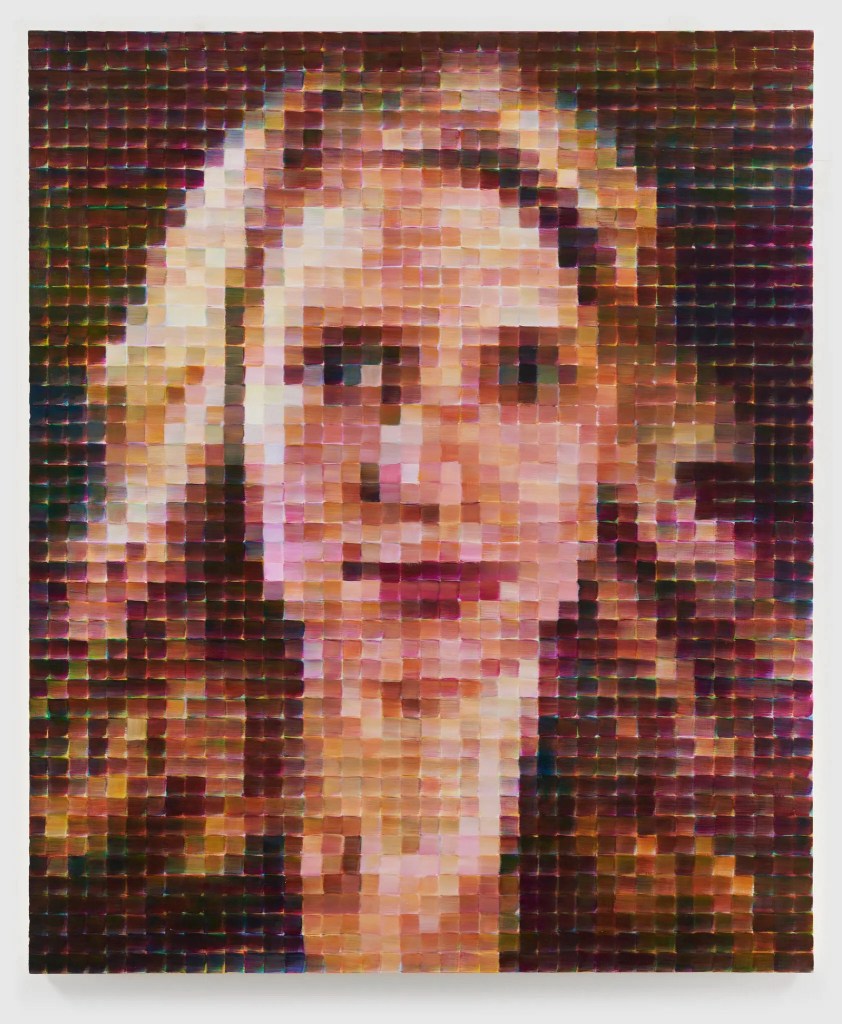
Chuck Close’s approach to painting is intriguing. It’s as if he invented pixellation avant la lettre.
“This new body of work is more abstract, and quieter than any previous ones,” Close told the artist Cindy Sherman in a 2018 interview. “The brushstrokes don’t make shapes or stand for any particular information per se, they just exist as layers of transparent washes of oil colors that I’m trying to treat as watercolors, as I did decades ago.”
Chuck Close, “Claire,” 2020, oil on canvas, 72” × 60.” According to Pace, Close would take a photograph and break it down into single color grids. When making paintings, he translated the color onto the canvas through thin layers of semi-transparent paint in red, yellow, and blue. The grid was created in stages using these three colors individually. Credit… Chuck Close, via Pace Gallery. [New York Times caption and illustration]
(Robin Pogrebin, “Gallery Shows Last Works by Chuck Close. Will It Repair a Reputation,” New York Times, 2-17-24)
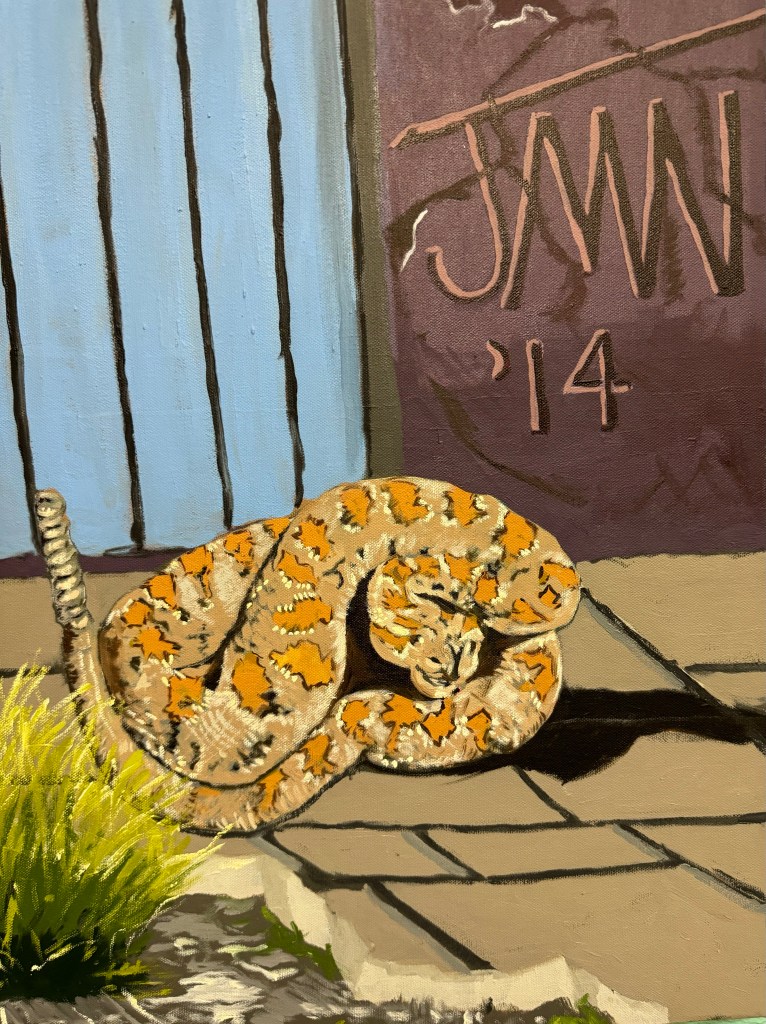
I harbor the goofy notion that we’re infused with a sap common to all that’s animate. You and I have a greater dollop of it than a snake, or a bee (apparently). It remains the case, notwithstanding, that in their skins, but for the do-si-do of starry dust, go we.
I’ve no idea how or why I got more sap than the snake, but the crux is that what makes him and me tick came from the same place. We’re sap-sisters, if you will.
In practical terms, the hokum makes me try not to step on anything that looks alive.
(I’m not a religious person, and if I were alleged to have said any of this I would tempestuously disavow it.)
From Tallahassee to the sea the state of Florida shall be lab-grown meat and climate free.
Sources Dionne Searcey, “‘We Will Save Our Beef’: Florida Bans Lab-Grown Meat,” New York Times, 5-3-24. Coral Davenport, “DeSantis Signs Law Deleting Climate Change From Florida Policy,” New York Times, 5-15-24.
The artist Jonathan Yeo and King Charles III at the unveiling of Mr. Yeo’s [2024] portrait of the king at Buckingham Palace in London on Tuesday. Credit… Pool photo by Aaron Chown. [New York Times caption and illustration]
I warm to Jonathan Yeo’s smoldering rendition of Charles the Third for the fastuous havoc it wreaks on canvas, not to mention expenditure of fiery pigment. It will inflame disdain in all the right quarters, though reportedly not in his highness’s breast.
For dead-eye daring of treatment there’s the barechested blueblood with the princely schnoz and bluebottle on his shoulder. Asked if he thought the painting resembled him, Philip said, “I bloody well hope not.” I like to imagine his comment was proffered through a grin. It could have happened!
Stuart Pearson Wright’s [2003] portrait of Prince Philip. Credit… Kimberly White/Reuters. [New York Times caption and illustration]
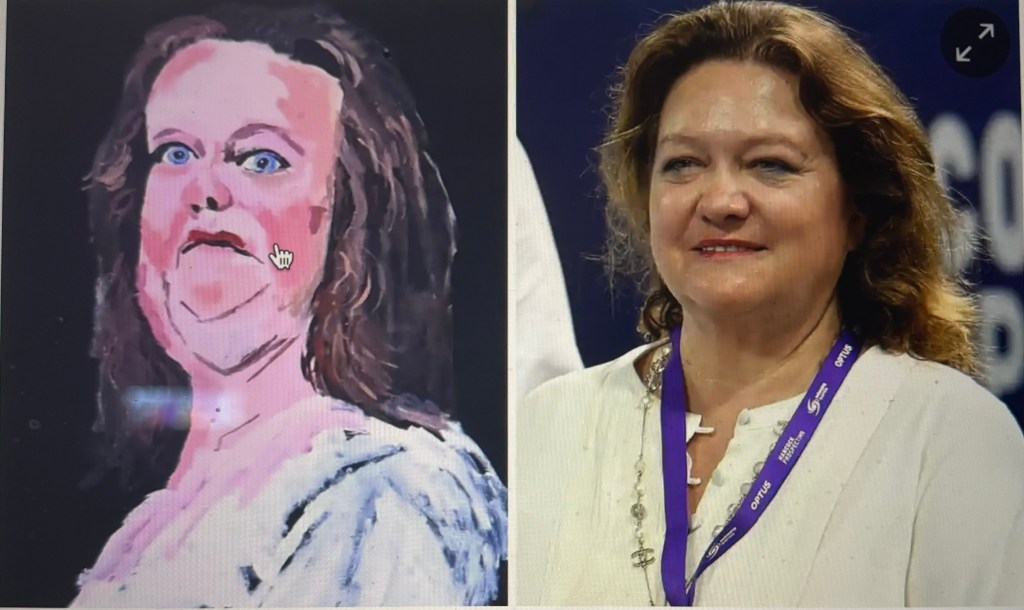
Mining magnate Gina Rinehart reached watercolorist Vincent Namatjira’s eyes in guise displeasing to the billionairess. Australia’s richest woman has demanded that her portrait be removed from the National Gallery of Australia. (It reaches my eyes as an avatar of Rosie O’Donnell.)
Gina Rinehart (right) and a portrait of her by Archibald prize-winning artist Vincent Namatjira. Composite: AAP/Getty Images. [Guardian caption and illustration]
Portraiture of the grand which doesn’t court obloquy is a missed occasion. Namatjira’s paintings are said to be “about changing people’s perspectives by using satirical humour as a commentary on power.” When will the wealthy and entitled catch a decent break!
Sources Emma Bubola, “Too Red, Too Vampiric, Too Sexy: A Brief History of Polarizing Royal Portraits,” New York Times, 4-15-24. Australian Associated Press, “Gina Rinehart Demands National Gallery of Australia Remove Her Portrait,” theguardian.com, 5-15-24.
“Six Persimmons” (detail), a still life of an autumn fruit likely by the monk Muqi and one of Japan’s most revered works of art […] Credit… Okada Ai/Kyoto National Museum. [New York Times caption and illustration]
In a show called The Heart of Zen, “Six Persimmons” was displayed for three short weeks in late 2023 at the Asian Art Museum in San Francisco. It was “painted with ink on paper in the 13th century, probably by a Chinese monk named Muqi, as part of a handscroll that also included ‘Chestnuts’…”
In China, where ink paintings were valued for their order and precision, Muqi and his lumpy fruit went quickly out of style. But in Japan, with its taste for asymmetry and ambiguity, his work sparked a whole school of followers.
… The persimmons’ stems, six crisp, T-shaped handles into the here and now that remind us that the really Zen way to look at a painting is simply to look at it.
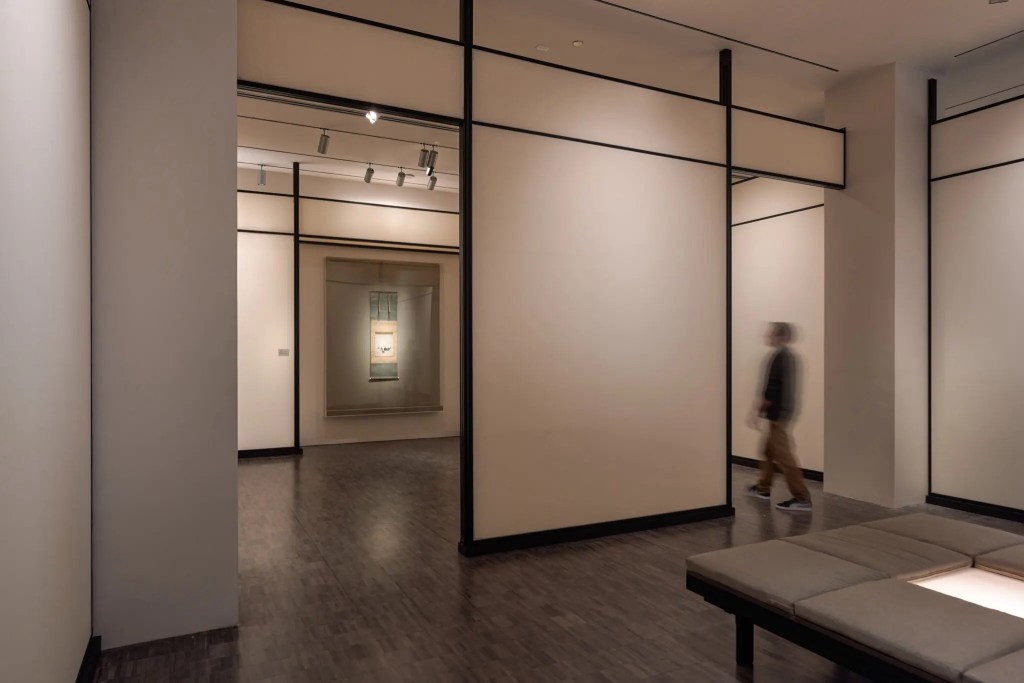
At the Asian Art Museum, “Six Persimmons” is displayed by itself in a gently lit gallery with off-white walls reminiscent of a Japanese temple. Credit… Asian Art Museum. [New York Times caption and illustration]
… The flesh of the persimmons looks to be made from spontaneous puddles of watery ink, rough-edged puddles that capture with precision the very imprecision of human sight. It’s an approach to painting that Europeans reached only 600 years later, if then.
Will Heinrich concludes that “the point of all the simplicity, or minimalism, associated with Zen isn’t really to make anything simple. It’s to…,” but never mind. Isn’t Zen about not looking for a point?
(Will Heinrich, “A Rare Appearance for ‘Six Persimmons,’ a 13th-Century Masterpiece,” New York Times, 11-24-23)
Thoughts and prayers from the legislatures. Thoughts and prayers from the donors. Thoughts and prayers from the councils. Thoughts and prayers from the courts. Thoughts and prayers from the boards. Thoughts and prayers from the embassies. Thoughts and prayers from the churches. Thoughts and prayers from the armories. Thoughts and prayers from artificial intelligence. Thoughts and prayers from air, land and sea. Thoughts and prayers from you and me.
If you say all the words out loud, it works.
This is neither the time nor the place to record that I’m loath to divulge where, but have just encountered Aldous Huxley’s phrase “batrachian grappling.” It will haunt my day.






 EthicalDative
Advertisement
This blog nets it out. You rarely sacrifice more than three minutes to EthicalDative:
Bish, bash, bosh.
<Instant of Appreciative Reflection>
Smash LIKE. You’re done.
PS: A supportive comment can substitute for the canonical <Instant of AR>. Be so kind?
(c) 2024 JMN — EthicalDative. All rights reserved