
-
Recent Posts
Archives
- October 2026
- September 2026
- August 2026
- July 2026
- June 2026
- May 2026
- April 2026
- March 2026
- February 2026
- January 2026
- December 2025
- November 2025
- October 2025
- September 2025
- August 2025
- July 2025
- June 2025
- May 2025
- April 2025
- March 2025
- February 2025
- January 2025
- December 2024
- November 2024
- October 2024
- September 2024
- August 2024
- July 2024
- June 2024
- May 2024
- April 2024
- March 2024
- February 2024
- January 2024
- December 2023
- November 2023
- October 2023
- September 2023
- August 2023
- July 2023
- June 2023
- May 2023
- April 2023
- March 2023
- February 2023
- January 2023
- December 2022
- November 2022
- October 2022
- September 2022
- August 2022
- July 2022
- June 2022
- May 2022
- April 2022
- March 2022
- February 2022
- January 2022
- December 2021
- November 2021
- October 2021
- September 2021
- August 2021
- July 2021
- June 2021
- May 2021
- April 2021
- March 2021
- February 2021
- January 2021
- December 2020
- November 2020
- October 2020
- September 2020
- August 2020
- July 2020
- June 2020
- May 2020
- April 2020
- March 2020
- February 2020
- January 2020
- December 2019
- November 2019
- October 2019
- September 2019
- August 2019
- July 2019
- June 2019
- May 2019
- April 2019
- March 2019
- February 2019
- January 2019
- December 2018
- November 2018
- October 2018
- September 2018
- August 2018
- July 2018
- June 2018
- May 2018
- April 2018
Categories
Meta
Twitter
Tweets by mansfieldnick
‘I Handed This…Singular Life Over’: Kate Asche’s ‘[Untitled]’

The words of Kate Asche’s poem “[Untitled]” (Poetry, May 2024) enact a sac-like image on the page. Leapfrog the spaces between them and they (the words) hang together as if magnetized, flowing into shattering assertions. A life is lost in this poem. It illustrates the power of conveying an ordeal by skirting emotive language in favor of a dispassionate, grievously minute telling. Or showing?
(In my excerpt, where there’s an ellipsis, imagine incremental spaces which contribute to bulging the poem into its circular aspect on the page.)
the sac
itself was … clear
and I cleaned it … like a window
and in the window … saw my baby
our baby … [birdlike
mouth open … nasal … area still
oversized … like a beak] … eye’s aperture blue-black
head thrown … back … and twisted beginning
to separate … neck brok
en in the contractions’ … violence …
[…]
The next-to-last-line, fracturing the word “broken” at a syllabic juncture, executes the most violent enjambment possible in poetry. Even the formality of a hyphen is dispensed with.
Detail suggests the speaker has agency in this grave matter, is constrained to follow a procedure, and is painfully observant along the way. Note the pointed fallback from “my” baby to “our” baby. The emphasis on the shared origin of the failed life that’s being let go of recurs in the poem.
There’s much more than what I’ve cited. You have to see the poem to apprehend it. (Be prepared to look up some medical terms.) Surpassingly strange and explicit, it’s a lump-in-throat inducing achievement, graphic in multiple senses. Solid syntax which makes the words cohere across their spacing helps the reader navigate the form factor. The poem transmits indelible ache through language that embraces the unstintingly clinical.
The circle closes; the poem ends:
I handed this … singular life over
never saw my child
again
(c) 2024 JMN — EthicalDative. All rights reserved
A Good Speech Is a Feat of Crowd Control

Booing is the most boring crowd noise there is, even when the crowd thinks its noise supports the speaker. The second-most boring crowd noise is chanting, even when the crowd thinks its noise supports the speaker.
An effervescing horde of enthusiasts needs dominating. A sympathetic audience is a self-regarding entity when assembled into spectacle. It wants to be loved, is full of love, doesn’t quite know what to do with its love. The consummate speaker shuts it up, lifts it up, harnesses the love.
The high points of a well-oiled speech are the instants when the horde is stunned into perfect silence, countless faces shocked into radiance, slack with unvarnished amazement. Then it can roar assent to the choice truth that has pierced its restless buzz. But the agile speaker is two steps ahead already. She banks the roar quickly and moves forward, impatient, imperious, impressive.
Such cadences imposed by such a speaker spring from an indefinable mix of art, humility and command. The delivery of message is devoid of bluster, isn’t fawning, emphatically doesn’t court the adoring feedback. Simply earns it.
PS: Sometimes plain words uttered by a gently reasonable voice speak loudest: “…We will finally say goodbye to that hateful man.” (Yusef Salaam).
(c) 2024 JMN — EthicalDative. All rights reserved
Crying for No Obvious Reason
“This is a brutal, tough business.”
(Bill Clinton, speaking to the convention)
Former President Clinton is right, of course. The sword of Damocles haunts this assembly.
I wonder if weeping is a kind of emotional breaking of sweat that cleanses clogged spiritual pores? Watching Wednesday’s primetime program on my Macbook, I found myself blotting tears throughout the evening. So did a goodly portion of the conventioneers in Chicago.
The cameras pan constantly across faces of the congregants, a rapturous gallimaufry of humane DNA, a well-meaning cross section of the American persuasion which is a spectacle itself, apart from what’s on stage, that assuages blight and comforts funk.
It’s notable how many public speakers associate speechmaking in a large forum with bellowing, gesticulating and smiling excessively. The good ones — an AOC, a Warnock, an Obama, a Winfrey — know the efficacy of modulation, varied phrasing, strategic pauses, quiet hands and nuanced demeanour. I like seeing the tyros hone their chops at shucking down the corn. Some of them, future leaders, will figure it out.
(c) 2024 JMN — EthicalDative. All rights reserved
Ciceronian Suasion: ‘Memorable in a Matter of Minutes’

This sketch is several years old. It’s mine, yes, but I don’t remember making it nor what it depicts. My scrawled Arabic says “The fire is under control.” Apropos of who knows what? (JMN)
May we be guided by hope, joy and a fierce moral imagination.
(Rabbi Sharon Brous)
Anyone who watches Buttigieg on Fox News knows he can boil things down with terrific lines, and it’s being memorable in a matter of minutes that is meaningful.
(Patrick Healy)
Mr. Walz has a direct way of speaking that feels authentic and a teacher’s knack for making a message simple and memorable.
(Ted Genoways)
The point of free speech is to open discussion, not to shut it down.
(Bret Stephens)
I strive to be a scribbler for whom terse is best. No surprise as a reader I favor the short lyric. When a lyric’s proper lit, it’s a heat-seeking message rocket.
Night 2 of the DNC convention reminded me that good oratory is lyrical in being both potent and rare. There were decent stretches of speech, to be sure — Doug Emhoff was graceful, Barack splendid (Now that it’s popular they don’t call it “Obamacare” any more!, he mused).
But the evening’s accolade goes to Michelle Obama. With her content, tone, affect, timing, cogency and polish she owned the moment. In reference to a presidential candidate she said:
Who wants to tell him that the job he’s currently seeking might just be one of those Black jobs? … Most of us will never be afforded the grace of failing forward. We will never benefit from the affirmative action of generational wealth.
“That is a brilliant rhetorical summation of complicated ideas,” writes Tressie McMillan Cottom in her report of the speech.
(c) 2024 JMN — EthicalDative. All rights reserved
Of Note at the Convention: A Freer Shade of Free

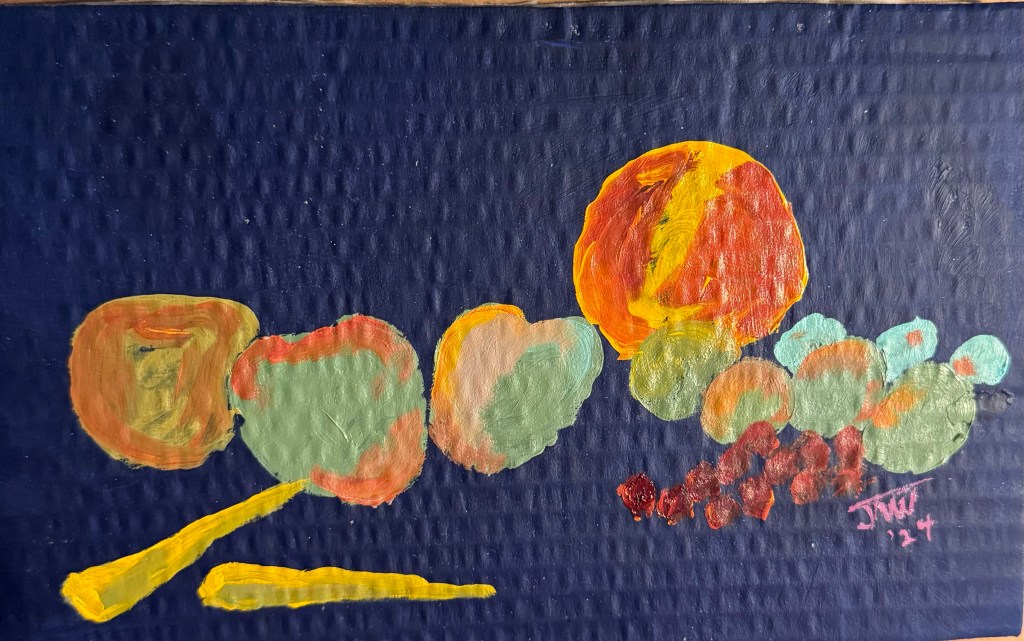
“Porrón With Pepper,” 6 x 8-1/2 in., oil on cardboard (JMN 2024).
It did my hurt Texas heart a world of good to see Jason Isbell turn up and sing a good song in a classic tux and without a 50-gallon hat on his head. He was, after all, indoors. (I never saw my grandfather, a cowboy, a cattleman, a tough, courteous man, wear his hat indoors. In his culture, staying covered insulted the hat and the room.) Isbell plays his own licks, too. See the ending.
And the Soul Children of Chicago burnt the barn down with their singing of the Anthem. Pure, brisk and sweet with a whack and a punch where it matters.Thank God for some freshness and originality powering up some of our tired tropes.
Hello, Artificial Intelligence! I entered a Google query using correct English: “what song did jason isbell sing at the dnc convention?” Google corrected my query with incorrect English: “Did you mean: what song did jason isbell song at the dnc convention?” It’s a brave new world, ain’t it?

I rarely pick up much of the lyric when pop singers sing, and the nasality and drawling of Country-Western isn’t my cup of tea. I wanted to confirm the title of Isbell’s song, though, thinking to cite some tight words from it here. No luck. As ever with minstrelsy, the magic is enmeshed with the melody and chords, with the vocalizing and the occasion. The words exist for the song.
But here’s a thought: Maybe the poetry is in the title of Isbell’s song: “Something More Than Free.” The notion of “freedom” is bandied about like a piece of chewing gum in our culture, spit out when the sweet’s gone, a subterfuge for ego and self-interest run amuck. I hazard that we’re most free when we’re harnessed to something outside ourselves that’s worth pulling.
(c) 2024 JMN — EthicalDative. All rights reserved
Calling All Cat Ladies
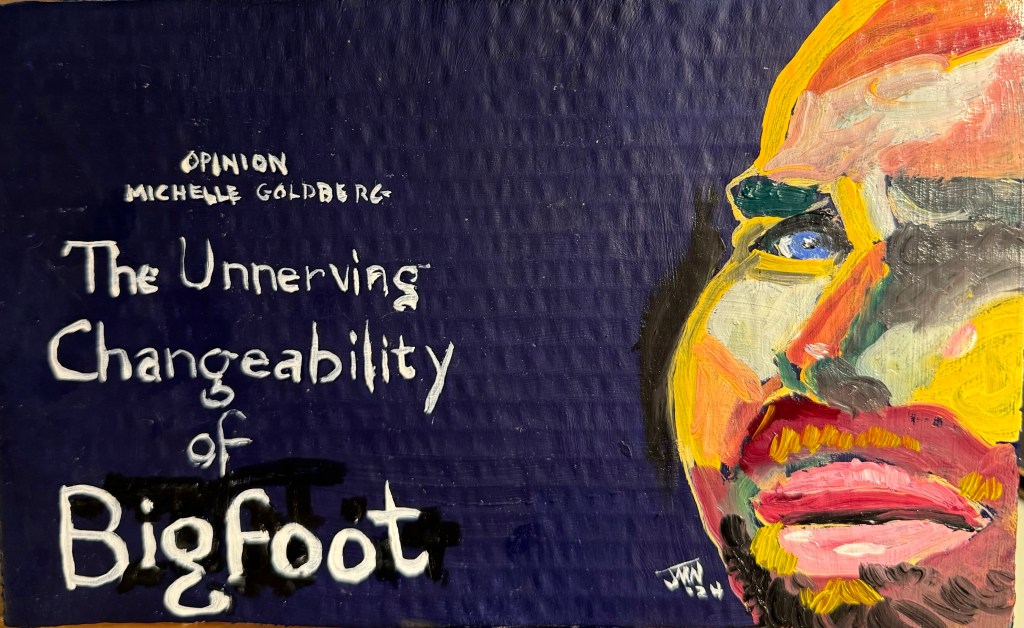
What My Cat Teaches Me
Crouch.
Then
Pounce.
In
That
Order.
(c) 2024 JMN — EthicalDative. All rights reserved
A Carton of French Fries Walks Into a Bar

This is the latest specimen in The New Yorker’s cartoon caption contest that has run for centuries. I’ve never come close to inventing a caption for an entry in this feature, but it fascinates me for what it often shows of how much of a good cartoon’s payload is packed into the drawing itself. Adding words can feel like gilding the lily. Not that I discourage the contest. The winning caption is always witty and apt. I often wonder if the cartoonist has a caption in mind in the course of drawing?
I’ve looked at the above cartoon multiple times and have kept laughing. What I see is a cranky French fry carton laden with cargo — a working stiff — who has ducked into his neighborhood watering hole to be poured a pick-me-up shot of Heinz ketchup in a condiment cup by the barkeep. Hitting the sauce is a common failing in his line of work. He’s on his way to… well, being emptied out unceremoniously and discarded. That’s the job. Even though I’m someone who tries to put diffuse, anomalous things into words, I haven’t the foggiest idea for a good caption.
(c) 2024 JMN — EthicalDative. All rights reserved
‘I Said Hello. Then You Said You Said Hello’
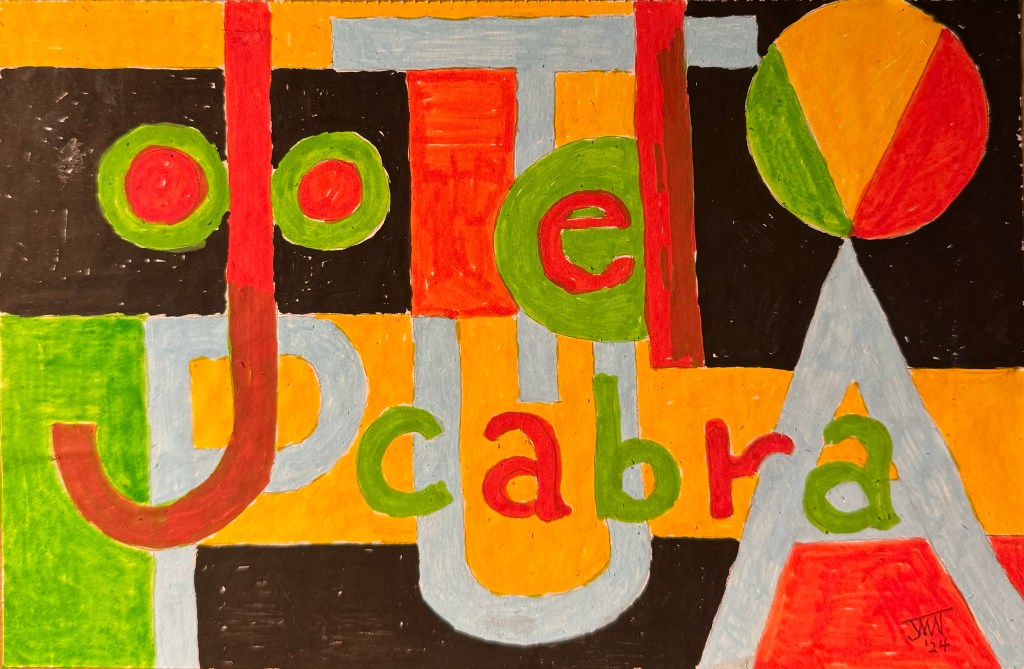
I’m guessing you think there’s a typo in my heading. I know! The use of repetition in “The Renaissance,” a poem by Trey Moody (Poetry, May 2024), was a hook for me. The thirteen-line poem starts here:
I said hello. Then you said you said
hello. In this way, we were touching touching
clouds. […]
The doing of an act turns into a report of its doing or having been done — sort of. Actions are limned through an after-thoughtful lens — sort of. (I call this the “sort of” technique for understanding a poem.) A self-referential quality in the saying of saying partakes of mannerism in a winning way.
“Touching clouds” touches me. The thing I most wanted to paint as a kid on the hot flat Gulf of Mexi-Coast was clouds. The shrimp boats were picturesque, the curvaceous dunes aroused me, but the clouds drew me — so suffused with ineffable light I despaired of brushing them.
Rhetorically, note the canny enjambment of the repetitions in the poem. It lends the device both latency — postponing the complement — and the call-to-attention that comes with end of line. The maneuver is carried through to the very end:
[…] Usual, you map the passing time
in the shape of a cumulonimbus. I say how quiet quiet
can be when your face is this close to the painting.
“I say how quiet quiet can be” prepares a delicious reveal: The speaker and spoken-to are in intercourse with painting! That adjective “Usual” is inscrutable to me. What does it modify?
Perversely, I’ve quoted the beginning and the end of the poem. There’s enough going on in the middle to make your head spin. The poem makes enigmatic statements that are striking, abrupt and sort of intelligible, as poetry does.
[…clouds.] Such mannerisms endured throughout
the sixteenth century, when bread was scarce, words
for clouds scarcer. Of course we were younger
then, when all the lakes we wanted belonged
to the aristocracy, so we swam in nothing
but our suffering. As they do, centuries passed.
We kept thinking there were only so many ways
to light a fire. Now, it’s just as likely you’ll call
after a Sunday dip. [Usual …]
(c) 2024 JMN — EthicalDative. All rights reserved


On Rhyme and a Little Bit of Rhythm
Reading current poems, I notice how rhyme seems mostly a thing of the past. Occasional rhyme and near rhyme can land felicitously nowadays, but when deployed lockstep it’s often noisy and distracting. To some degree the same is true with regular meter. Blank verse can still be persuasive when it doesn’t call attention to itself. Cascading rhymes, on the other hand, tend to yell, “Look at me!”
I indulge in doggerel, a tool of satire, more than I should, and doggerel enlists, for making light of something, or fun of it, those selfsame, singsong qualities which feel quaint in poems. A four-beat line with repeating end-rhymes is a ready mold in which to pour ironizing jello.
I’ve said more than I know, as granddad would tell me. It seems fair to cite an exception — i.e., an instance of rhyme and rhythm used well in modern times. It’s an elegy. I’ve memorized it. It starts:
He disappeared in the dead of winter:
The brooks were frozen, the airports almost deserted,
And snow disfigured the public statues; […]
Here’s the highly formal ending, part three. Its power is enhanced by contrast with the deceptively informal, lilting discursiveness of the sections that precede.
III.
Earth, receive an honoured guest:
William Yeats is laid to rest.
Let the Irish vessel lie
Emptied of its poetry.
In the nightmare of the dark
All the dogs of Europe bark,
And the living nations wait,
Each sequestered in its hate;
Intellectual disgrace
Stares from every human face,
And the seas of pity lie
Locked and frozen in each eye.
Follow, poet, follow right
To the bottom of the night,
With your unconstraining voice
Still persuade us to rejoice;
With the farming of a verse
Make a vineyard of the curse,
Sing of human unsuccess
In a rapture of distress;
In the deserts of the heart
Let the healing fountain start,
In the prison of his days
Teach the free man how to praise.
(“In Memory of W.B. Yeats,” W.H. Auden)
Ancillary reading: Heather Cox Richardson.
(c) 2024 JMN — EthicalDative. All rights reserved