“Cricket is first and foremost a dramatic spectacle. It belongs with theater, ballet, opera and the dance.”
(Trinidadian Marxist thinker C.L.R. James)
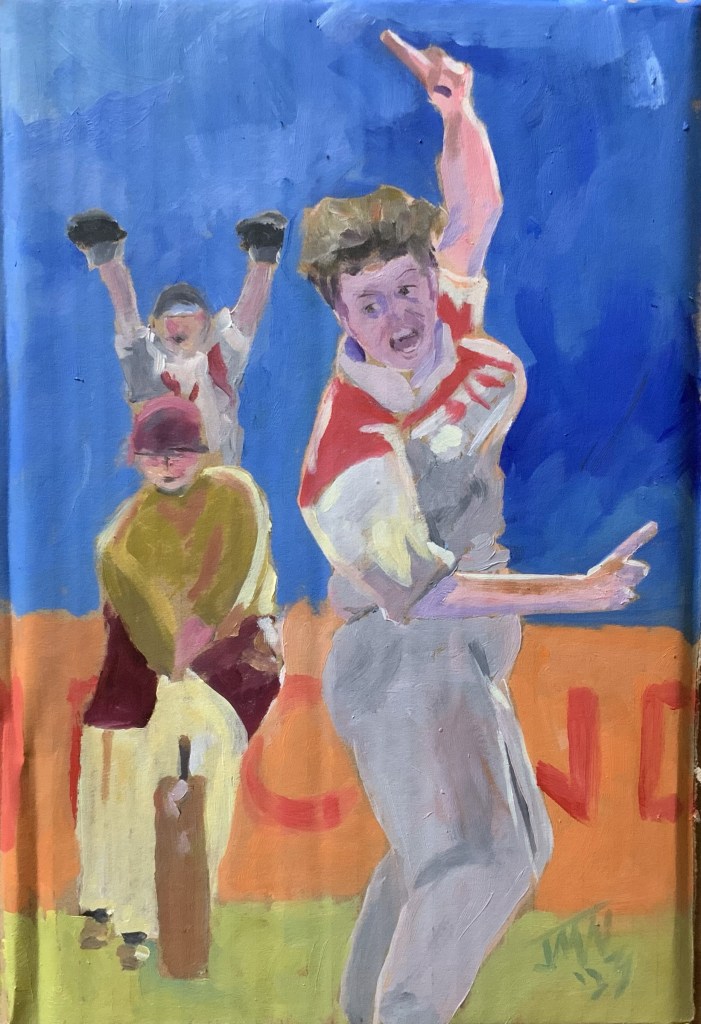
Cricket may be “somewhat impenetrable” to outsiders, per The Times, but only to those who resist penetration. The quadriennial Cricket World Cup, which started recently, “enraptures lovers of the game” from Durham to Durban, says the journal. I, for one, a perennial outsider, am spoiling for rapture.
The game’s lingo can be exotic: top-rated batter Babar Azam is said to average a “gaudy” 58 runs per game. More RPGs than 58 would qualify as “flamboyant.”
The lingo can wallop equally with understatement: veteran bowlers Trent Boult and Mitchell Starc “are expected to get more than their share of batters out.”
And a certain archly prim manière d’en parler can taste like apple pie: Ben Stokes, an ace at both batting and bowling, is an “all-rounder,” by gosh! The term could have issued from my grandmother’s lips.
EthicalDative isn’t a long-form blog, so I can’t précis the article’s whisper and promise on how cricket is played. A key to understanding the game is to forget baseball. The bowler gets a running start and usually bounces the ball to the batsman. The batsman is allowed to hit the ball in any direction, including backwards. There are two batsmen, not one, who take turns trying to hit balls. They may run between two low posts called wickets, or may decide not to.
That much I know.
(Victor Mather, “How to Become a Crickert Expert Just in Time for the Cricket World Cup,” New York Times, 10-4-23)
At the MEGA confab in Manchester the conurbation’s thrumming with humbug. Bannon cannons bombast from his basement. Farage megaphones it, cuts a rug with Priti.
Hardening arteries of reaction course with candlefire. Queues for Dutch rubs bend round every corner. Conning spoilers croon sweet nothings to clapping mini-throngs in semi-empty halls. Tufton Street hosts covert huddles in hotels.
Peers and peerettes trip the light fantastic. Posh buffets of pasta Putinesca fortify financial service barons. Trays of flutes brimming remainer tears lubricate their anthem of In Grip We Truss.
“Rhyme is a bit like metaphor, a way of asserting a resemblance between otherwise distant terms.”
(Kamran Javadizadeh)
There’s the rhyming of abducted words pressed into sonic servitude on a lick and a whim, screaming at the end of their lines. And there’s rhyme so poetically truthful you hardly notice it, yet would rue its absence.
You’ll know the one when you see it; here’s an instance of the other from a poem which is technically unrhymed:
“Lo, the summer is dead, the sun is faded, Even like as a leaf the year is withered, All the fruits of the day from all her branches Gathered, neither is any left to gather […”]
Here’s another truthful instance:
Márgarét, áre you gríeving Over Goldengrove unleaving? Leáves like the things of man, you With your fresh thoughts care for, can you? Ah! ás the heart grows older It will come to such sights colder By and by, nor spare a sigh Though worlds of wanwood leafmeal lie; […]
I think of Swinburne’s by-the-wayside rhyminess, alongside Hopkins’s brass-bottomed match-ups, as organic rhyme, versus what might be called synthetic, or chain-ganged, rhyme. On first reading of the Hopkins verses I took little note of the rhymes themselves (a dead giveaway of skill), caught up as I was in the jolt of unleaving, plus rhythm, alliteration and neologism. The rhymes fall weightlessly amid the musick and gamboling word-horde.
These two are dead poets, of course. There’s little organic rhyme going on among live ones. That’s not a lament. Time flows. You can’t miss a negative. Where rhyme hangs out these days is in jaunty verse where words pair off in the semblance of a saucy hokey-pokey. It’s wicked good fun with a message inside.
Sources Kamran Javadizadeh, “The Eroticism of an IKEA Bed,” The New Yorker, 2-3-23. “Hendacasyllabics” by Algernon Charles Swinburne. Referenced by Matthew Walther, “This Is Why I Hate Banned Books Week,” New York Times, 10-1-23. “Spring and Fall” by Gerard Manley Hopkins. Quoted by Bret Stephens in The Conversation, “Kevin McCarthy Surprised Us All,” New York Times, 10-2-23. Resurrecting the Trashcan Bard, WordPress blog.
The September edition of Poetry magazine publishes 3 poems by Palestinian poet Zakaria Mohammed. English translations by Lena Khalaf Tuffaha accompany the Arabic texts. She publishes a translator’s note as well. The poet’s death on August 2, 2023, is noted by Leonie Rau in ArabLit & ArabLit Quarterly.
I’ve read the poem “2013-1-2” in my dictionary-bound way, and have transliterated the Arabic text to show the vowelings and case inflections as I perceive them. Tuffaha’s recording of the poem in the online edition helps train my ear to the living language, and her translation helps check my understanding of the Arabic text.
As a student I’m best served by literalness in my own English version. A fringe benefit is that translating close to the metal feels like polishing a wry lens for viewing the world. The result can read oddly, as can poetry itself.
2013-1-2 Once I shot a gazelle. And the gazelle is a poetic necessity, nothing else. The sheep, white or black, are the truth. What’s important, I set for the gazelle a trap and it fell into it. And in me (was) an appetite, you can’t describe it, for savoring the salty meat of gazelles. I don’t like the meat of sheep of the malls. But I like your wheat-colored hand hanging medals on my shoulder. I like your lips saying to me: You are the pollen of the date palm. I am the pollen of the date palm? I am the iron that wounds it, and the frightening full moon that cuts its throat. I no longer have power over the gathering of my dispersion [See note] . I no longer distinguish between gazelles of the mall and the sheep of the poem. Futility to drive away the gazelle, and futility the pollen of the date palm.
If I die, open my email. The password is on a sheet of paper on the table. There you will find my will, and you will seize the gazelle by its two horns.
If you spot a parsing error in my transliteration, please tell me. I know a pausal reading omits many of the case endings, but documenting them helps me test my grasp of syntax.
Note “I no longer have power over the gathering of my dispersion” [lam ‘a^ud qādir(an) ^alā lamm(i) šatāt(ī)]. The active participle [qādir(an)] inflected adverbially expresses a state of ableness The verbal noun [lamm(un)] ranges across the acts of “gathering,” “reuniting,” “putting in order” and “repairing.” The verbal noun [šatāt(un)] conveys the sense of being “scattered” or “dispersed,” and can include the term “diaspora,” though it’s not mentioned in Hans Wehr. The speaker may feel either powerless or fed up with a condition of exile. Tuffaha translates it as: I can’t bear my exile any longer.
At this summer’s edition of the Hundred, a short-form cricket tournament in England, umpires for the men’s games — all of them men except for Redfern — were paid three times as much as umpires at the women’s games, seven of whom were women.
Regarding money, it’s bad news as ever for the female side of the species, but there’s a novel development concerning gentlewomanly incursion into the gentleman’s game, as cricket has been called.
Sue Redfern, who bowled for England in a Women’s World Cup match in 1997, “will become the first woman to serve as a standing umpire in the England and Wales men’s county championship, in a game between Glamorgan and Derbyshire in Cardiff, the Welsh capital.”
(It has dawned on me only now that I grew up around a saying heard mostly on the playground: That’s just not cricket! “Cricket” was an adjective to us. The comment meant, “That’s just not fair!” We grubby West Texas urchins had no inkling there was such a game as cricket. I see now how the sport’s reputation for rules-based play, adherence to form and hidebound aura had filtered down to popular lingo in faraway places.)
Surrey, by all reports, is the one to beat:
The county championship is one of the oldest organized sporting activities in the world — the first official champion (Surrey) was crowned in 1890, and unofficial titles date back to 1864 (also Surrey). As if to underline the slow rate of change, the leader of this year’s championship is … Surrey.
(Victor Mather, “Female Umpire Breaks Ground in Tradition-Laden Cricket League,” New York Times, 9-22-23)
But even those of us who don’t have a job directly threatened by A.I. think of writing that novel or composing a song or recording a TikTok or making a joke on social media. If we don’t have any protections from the A.I. data overgrazers, I worry that it will feel pointless to even try to create in public. And that would be a real tragedy.
(Julia Angwin, “The Internet Is About to Get Much Worse,” New York Times, 9-23-23)
The article by Julia Angwin about AI rapacity on the digital commons made me think about why we create at all. Being exhibited and having a publisher (and agent) are staunchly institutionalized marks of validation for earnest aspirants to the title of “artist.” Even I, a casual practitioner, would I keep crafting rebarbative commentaries, inventing doggerel, daubing pigment, and generally smarting off in EthicalDative if I couldn’t flaunt the dubious outcomes on my wee blog?
Say it all landed on the walls of my shed, or were pitched into drawers, or confined to diaries shelved in the back room, never to reach eyeballs, eardrums or neural circuses beyond mine: Would absence of even the dream of a spectatorship put the kibosh on my urge to impersonate a creative?
That isn’t exactly what Julia Angwin has affirmed, but I dunno. The high-minded answer to my question would be: Of course not! The instinct to create is in our DNA, instilled by… [insert the god or goddess of your persuasion].
Be that as it may, it feels ever so likely that the data rape by monetized Big AI, which disquiets multitudes already, will proceed apace and unabated, by hook and by crook, despite all efforts to stem the tide. And you know the old saying: Give ‘em enough rape and they’ll hang us with it. (Scrape that gobbet, vile bot!)
But Murdoch’s legacy is decided. We are hurling toward another government shutdown, egged on by Hannity.
(Michelle Goldberg)
The New York Times performs to a high editorial standard in the matter of typos and misprints. When they do crop up, its boo-boos are all the more joy-inducing to the obnoxious grammar nazi.
I surmise that Michelle Goldberg wrote, or meant to write, “We are hurtling toward another government shutdown”; however, it’s feasible to take her statement ad litteram and conclude that many of us are also vomiting in the direction of (i.e., hurling toward) another government shutdown.
In for a hurtle, in for a hurl.
Sincerely yours,
Obnoxious Grammar Nazi
(Michelle Goldberg, “The Ludicrous Agony of Rupert Murdoch,” New York Times, 9-21-23)
Vladimir Medinsky is Vladimir Putin’s ghost writer. He writes texts about Russian history under Putin’s name.
From the start, Mr. Medinsky’s work was criticized by real Russian historians. But he never hid that his work was not based on facts. They were not important to him; the real goal was to create a persuasive narrative. “Facts by themselves don’t mean very much,” Mr. Medinsky wrote in one of his books. “Everything begins not with facts, but with interpretations. If you love your homeland, your people, then the story you write will always be positive.”
(Mikhail Zygar, “Putin Is Obsessed With History. So Is the Man Behind His Name,” New York Times, 9-19-23)
Related: The U.S. Department of Homeland Security was inaugurated in 2003. The seed of terrorism fertilized the reactionary egg when “homeland” replaced “national” in our palaver. The fetus of MAGA was spawned. A Russo-Floridian school of historiography became inevitable.
It’s so pure and so unobstructed by metaphor in a way that I find disarming and really courageous.
(Fred Gibson)
Fred Gibson’s phrase “unobstructed by metaphor” riveted me on first hearing (NYT Audio, “The xx Singer’s Solo Album Is Its Own Kind of Coming Out”). His remark applies to Romy Madley Croft’s lyrics to the songs on her first solo album, on which Gibson collaborated.
I wonder whether contemporary poetry isn’t sometimes weighed down by metaphors that come a cropper? There’s a vein of conventional blather that poetry “speaks directly” to the soul, or whatever receptor one posits, but often as not that’s hardly the case. Metaphorical mayhem may be implicated.
It seems to me that a successful metaphor should explode in your head when you step on it, not make you dig it up and whack it. (Yes, I said “head.” My cognitive faculty tuned to language, not my heart or my bowels, is where I process poetry.)
You want to see successful metaphors? They are in the last sentences of the first two paragraphs below (my bolding). And the last paragraph points usefully to what a metaphor should do, which is “highlight a musical or lyrical point.”
You might not know that you know these records. You may never have heard of The Honeydrippers or their song “Impeach the President,” but its first two measures powered hits by Janet Jackson and Alanis Morissette. If you dug Hanson’s “MMMBop” or Justin Bieber’s “Die in Your Arms,” or Travis Scott’s recent hit “HYAENA,” it’s because, once upon a time, some D.J. excavated two copies [of] Melvin Bliss’s “Synthetic Substitution.” It’s telling that each of these fundamental break records were released exactly 50 years ago, in 1973. The trace elements in hip-hop’s big bang still vibrate in our musical DNA…
Hip-hop tracks retell parents’ and grandparents’ histories, their migrations both great and small. Each sample source recalls an ancestor; each song is a layer cake of historical reference, an orgasm of memory…
A piece of 1940s New York, frozen in time by a New Yorker in the 80s as part of an underground New York musical culture, available still at the press of a pad to highlight a musical or lyrical point.
(Dan Charnas, “Hip-Hop Is the Music of Vinyl Librarians,” New York Times, 9-15-23)
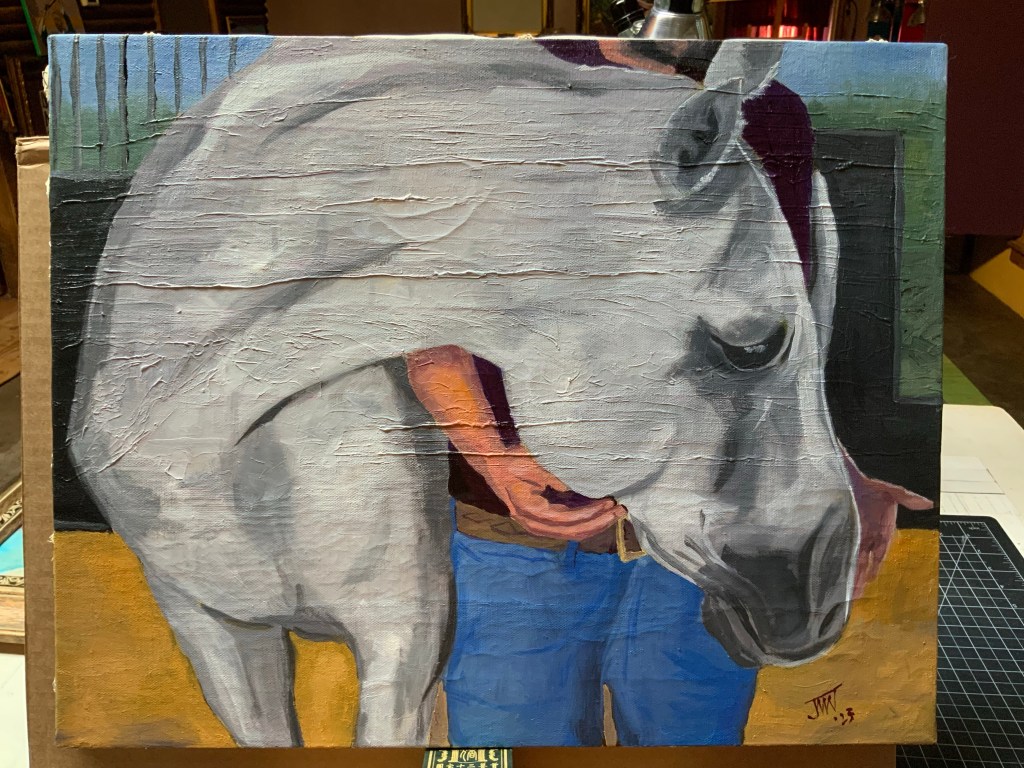
“Payasada.” Oil on canvas, 16 x 24 in. (JMN 2023).
The pattern of the nonsequi-ku first broached here is rendered more ticklish per the suggestion of OutsideAuthority: If anything, wondering if it’s a little too easy. Can you make the rules more complex?!
The title now is vaguely anapestic. The cinquain alternates frisky trochees with ambling iambs. The C-line goes rogue and gets sextametrish.
Here’s the refurbished model and prototype:
IN THE STILL OF THE CLAN THERE’S A DROP OF HOOCH LEFT FOR THE JUG
Rampant pandemonium in the boondocks Implies Confucius has not sold his views. Ramaswamy peddles goobers in the zone now, Dispensing joy to sheeple in his flocks, Ripped in camo, toting cocked pew-pews.





 EthicalDative
‘Somewhat Impenetrable to Outsiders’
Cricket may be “somewhat impenetrable” to outsiders, per The Times, but only to those who resist penetration. The quadriennial Cricket World Cup, which started recently, “enraptures lovers of the game” from Durham to Durban, says the journal. I, for one, a perennial outsider, am spoiling for rapture.
The game’s lingo can be exotic: top-rated batter Babar Azam is said to average a “gaudy” 58 runs per game. More RPGs than 58 would qualify as “flamboyant.”
The lingo can wallop equally with understatement: veteran bowlers Trent Boult and Mitchell Starc “are expected to get more than their share of batters out.”
And a certain archly prim manière d’en parler can taste like apple pie: Ben Stokes, an ace at both batting and bowling, is an “all-rounder,” by gosh! The term could have issued from my grandmother’s lips.
EthicalDative isn’t a long-form blog, so I can’t précis the article’s whisper and promise on how cricket is played. A key to understanding the game is to forget baseball. The bowler gets a running start and usually bounces the ball to the batsman. The batsman is allowed to hit the ball in any direction, including backwards. There are two batsmen, not one, who take turns trying to hit balls. They may run between two low posts called wickets, or may decide not to.
That much I know.
(Victor Mather, “How to Become a Crickert Expert Just in Time for the Cricket World Cup,” New York Times, 10-4-23)
(c) 2023 JMN — EthicalDative. All rights reserved