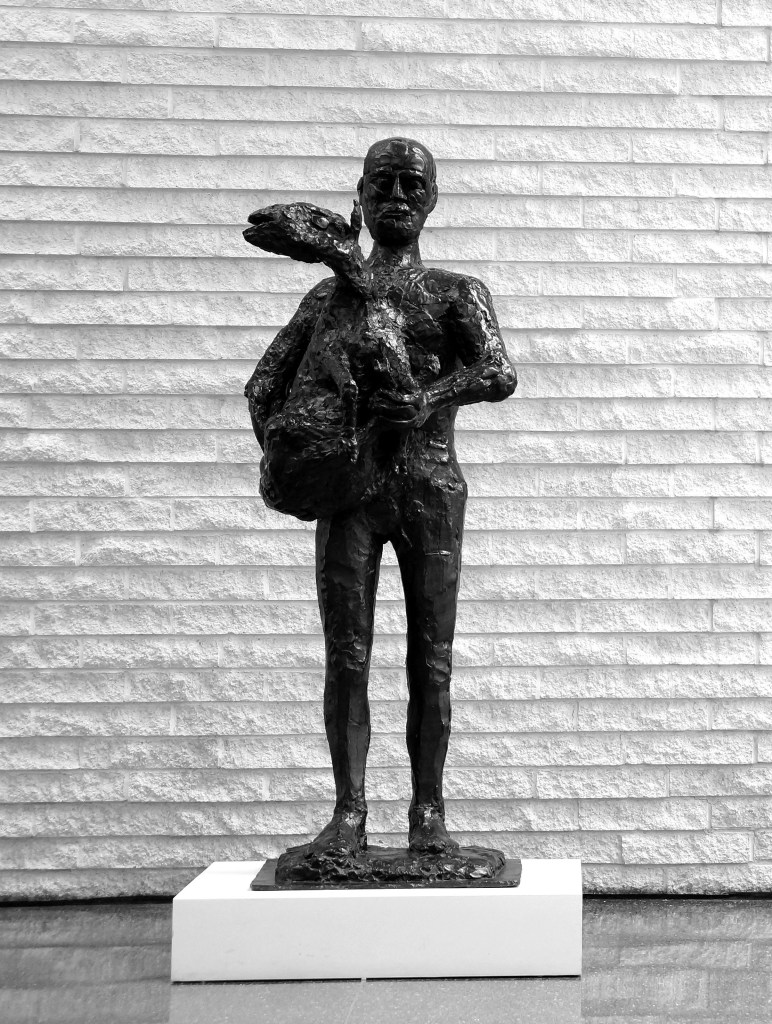
… With this body of a humble, fragile man who, like an offering, carries a lamb in his arms… Picasso deliberately joined the camp of the sick, the degenerate, the precarious (the Jew, the Romani, the disabled, the homosexual, the freemason, the Bolshevik) — the camp of the Other.
(Annie Cohen-Solal, Picasso the Foreigner, translated from the French by Sam Taylor, p. 410)
… Avec ce corps d’un homme humble et fragile qui, comme un offrande, porte un agneau dans les bras… Picasso se place délibérément ici dans le camp de précaire, du malade, du dégéneré (le Juif, le Rom, l’handicapé, l’homosexuel, le franc-maçon, le bolchevique), bref dans le camp de l’autre…
(Annie Cohen-Solal, Un étranger nommé Picasso, p. 455)
(c) 2023 JMN — EthicalDative. All rights reserved




 EthicalDative
‘The Tongue Has No Bones.’ Yeah!
There’s no mistaking a language which can uncork a grave accent, an acute accent, a circumflex accent and a dieresis, all in the space of a single written utterance, as not-French. As I coax these diacritic delicacies from my keyboard in frank extase of Francophilia, my fluent touch-typing slows to a tortoise gait.
French is called the “most Germanic” of the Romance languages, while English, intensely Gallicized, ranks as the most Roman of the Germanic languages. The swirls and eddies of the cross-tonguing, the churn and spurn of embrace, are involving.
Of questionable relevance, who doesn’t know that “yeah” isn’t written “yea”? A substantial few, it seems. Nay to “yea” except when voicing a vote, says the insufferable formalist.
The tongue has no bones is a Moroccan saying. I’m not sure what it means in that culture, but the truth of the organ’s bonelessness is non-negotiable in most circles.
That’s me for now.
(c) 2023 JMN — EthicalDative. All rights reserved