
Ghareeb Iskander is an Iraqi writer who lives in London. HIs book of poems in Arabic, “Gilgamesh’s Snake and Other Poems,” was published by Syracuse University Press in 2016. The English translations are the work of Scottish poet John Glenday and Iskander himself. Their versions command distinct authority, of course. Mine are dictionary-driven and meant to be literal for study purposes (akin to a trot).
Here’s a snippet reflecting the dialog I hope to have with the book. It’s from “Song,” the book’s first poem (my bolding):
My reading in English and Spanish: … He sang the spring — / the flowers that grow / after a long night. / Sang the streets, / did not sing the walls. [Cantaba la primavera — / las flores que crecen / después de una noche larga. / Cantaba las calles, / no cantaba las murallas.]
Published text: … He sang springtime — / the flowers that open themselves / after a long night. / He sang the streets / but he wouldn’t sing the hindering walls.
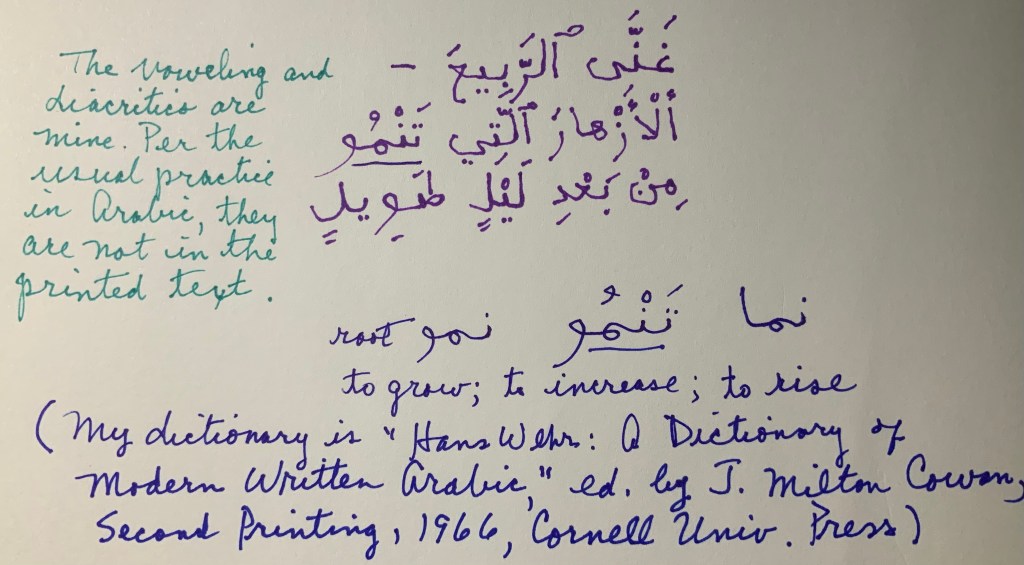
Amplification flows from the instincts and cultural grounding of the translators. It may capture a nuance of the Arabic that escapes me, or that’s missed by my dictionary. Is that the case with open themselves versus grow?

In other cases, certain phrasing may be deemed better suited to English cadence, or else to express what’s tacit in the Arabic. Consider “but he wouldn’t sing the hindering walls.” “Wouldn’t” injects a hint of willfulness into the Arabic’s unmodulated past tense. A wall can protect as well as hinder. Perhaps the connotation contributed by “hindering” foreshadows a context that lies ahead.
David Remnick has written that comparing two translations of The Brothers Karamazov “is to alight on hundreds of subtle differences in tone, word choice, word order, and rhythm.” (“The Translation Wars,” The New Yorker, 10-30-05). What’s worthy of sharing here, now and in future, is the unexpected, where a tyro’s cluelessness collides with inborn savvy. When the poet collaborates in the translation, he serves as a native informant validating shadings and phrasings whose justification may not be immediately discernible, and which readily hold up to sturdy query.
(c) 2022 JMN — EthicalDative. All rights reserved



 EthicalDative
‘Because You See His Teeth, Don’t Assume the Lion Is Smiling’
The comment about the unsmiling lion is attributed to the 10th-century Arabic poet al-Mutanabbi (915 – 965). I heard it on a podcast called “Arabic Qahwa.” The line has a zesty zing to it that marks it as an old saying to be handed down indefinitely on the tongues of hoary elders, delivered with narrowed eyes and sagacious nods.
Old “Chinese” sayings abound in English. I’m not sure they’re all Chinese, or old, or even much said, but I have a favorite:
Whatever its origin, the saying bucks me up by validating a penchant for being ruled by grammar. The fewest words that are right can say enough barely, and leave the rest clearly understood. Excepting poetry, that’s good speech.
(c) 2022 JMN — EthicalDative. All rights reserved