ḍaḥik-nā ḍiḥkaẗ(an) ka-l-ẖamr(i) “We laughed a laughter like the wine.” The phrase is from a poem by Haidar Al Abdullah titled Tarajjal yā ḥiṣān. I like to translate the title as “Make Like a Man, O Horse,” and the phrase more freely as “We spilt laughter like wine.” Their respective published translations by Yaseen Noorani are Go Dismounted Like a Man, Horse and We let out a vinous peal of laughter. (From Tracing the Ether: Contemporary Poetry from Saudi Arabia, ed. Moneera Al-Ghadeer, Syracuse University Press, 2026.)
RULE OF GOLD Treat others like you want to be treated.
RULE OF IRON Believe in Me or else.
RULE OF THUMB Steer into the skid.
TOLERANCES “Every trade works to different tolerances. Steel workers aim to be accurate within half an inch; carpenters a quarter of an inch; sheetrockers an eighth of an inch; and stone workers a sixteenth.” (Burkhard Bilger, “The Art of Building the Impossible,” The New Yorker.)
The Greek derivatives in English spurt from a font of abstruse vocables that gives us, say, “dithyramb” — “a passionate or inflated speech, poem or other writing.” It’s a short hop to coinage such as “pithyramb” — “a passionate or inflated instance of pith” — proffered by… wait for it… a “pithyrambo.”
Take Hemingway, whom many of us cite unread. One of his characters says something like “bankruptcy comes on gradually, then all of a sudden.” A certain Ms. Clausing quoted in The Times pithyrambed it shamelessly:
… Ms. Clausing, the U.C.L.A. economist, warned against assuming that just because Mr. Trump’s policies haven’t harmed the economy yet, they never will. “The long run takes a long time to arrive, and when it comes it comes with astonishing swiftness,” she said.
As we await the long run’s arrival let’s kill some time tinkering with Woody’s ditty:
THIS LAND IS OUR LAND (Call and Response)
This land is our land (That land is our land) From th’ shores of Green Land (To th’ Cuban Eye Land)
From fair New Found Land (Where’er we lay hand) To th’ Hemisphere’s End (Or where our troops land)
Your land is our land (There is our Home Land) (ICE Land is MY Land) (Mar-a-La-GO-Land)
All real estate grand (A place to grandstand) Snooty Switzer-land (Little Saint James Land)
All mine to COM-mand (Kiss thy behind land) The former Rhine Land (All thine to DE-mand)
How do we rue you, cunning tongue? Grant us, sir, spit out a lung. Perdition’s grease fire. Odium’s pimp. Perversity’s pal. Plague’s piece of tail. Malice engorged. Enormity in a suit. Torrent of keening. Badmouth bard. Punch down, PUNCH HARD!
Swervy weaver. Voyeur warrior. Randy prancer. Double downer. Pope of payback. FULMINATOR! Pulling woolster. Sharp practitioner. Dirty trickster. Spurning truther. Crimson wattle. Rights reneger. Dodge disaster. CASTIGATOR!
Hustle’s apostle. Carnage’s barker. Deferment’s dandy. Decency’s bruise. Putter’s potentate. Pageant’s peepster. Casino’s crap shot. Crypto’s mule. Columbia’s thorn. Liberty’s blindfold. Spurred heel. Sultan of feel. Man of steal. HELL OF A DEAL!
Remarks by podcaster Jason Staples have led me to ponder the notion of “original” language relative to scriptures widely known via translation. My attention was drawn to Staples’s comment that the Book of Revelations “has mixed metaphors all over the place.”
… The Greek of Revelations comes off as very clumsy, reads like someone who is not exactly a native Greek speaker, or… well trained… Greek writer. This is someone who probably is multilingual and probably a Semitic speaker of some sort who is writing in this way.
Where Staples gooses the matter to the throaty pitch of a hermeneutical Harley is in asserting that “the messiness of it is also part of the design.”
And I think there are certain places where the grammar and so on is clumsy in ways that force you to kind of have to grapple with that aspect of it. I think the messiness of it is also part of the design, even, that forced you to deal with those mixed metaphors…
The rhetoricians will have a Greek term filtered through Latin for argument premised on convictedness drawing foreordained conclusion qualified by contingent disclaiming. Still, I’m attracted to the venture of tilting with refractory text through a grammatical lens as a discipline that courts illumination.
There’s that moment where the thunder — he hears “the thunders” — and he’s told, “Don’t write that down! Seal that up!” And that in some ways is I think the book communicating that, like, look, there’s a lot about this stuff that you’re just not going to be able to get, and that’s okay. There is a mystery that from the earthly perspective, from this side of heaven, you’re just, you’re not going to really fully understand, you have to get the angle from, you know, from heaven down, you have to get the God’s eye view to understand, to hear what’s going on, and you don’t have that luxury, but don’t worry, it’s under control.
This sort of language stymies communicative logic, but poetically and confessionally it has a grappling aspect not easily discounted.
Ms. Crump after a race at Churchill Downs in 1970. Credit… Associated Press. [New York Times caption and illustration]
“I never worry when I ride.”
(Diane Crump, age 21)
Many male officials considered women to lack the strength and composure to control a thoroughbred as it galloped along at 40 miles an hour.
It was an era in which aspiring female jockeys were often dismissed as “jockettes.” Six male jockeys withdrew from her first race and were replaced. “I didn’t care how the jockeys felt,” Crump told her biographer… “I figured they had to get over it.”
Crump, who later operated a sales service for horse buyers and provided her dachshunds as therapy dogs for the ill and the needy, described herself “as a hardheaded little nobody with a dream that I wouldn’t let die… Galloping a great racehorse gives you a powerful feeling,” she told The Times. “I gave all the horses I rode my heart, and they gave me theirs.”
(Jeré Longman, “Diane Crump, First Woman to Ride in Kentucky Derby, Dies at 77,” New York Times, 1-2-26)
Brylcreem, a little dab’ll do ya, Brylcreem, ya’ll look so debonair. Brylcreem, the gals will pursue ya. Just rub a little of it in yer hair!
Breaking the 4th Wall for a Moment In my experience, being followed (subscribed) here on EthicalDative by a fellow blogger is oftener than not a death knell for ever hearing from that blogger again. Perhaps I’ve been remiss in voicing the pleasure I receive from the not-too-frequent event. I would like to improve my performance in this respect as 2026 dawns. Maybe more “followers” will show up again. I’m keen always to explore a new followship straightaway, seeking common ground and new vistas. Where I find such and am confident I can commit to reading/viewing their output and paying faithful attention, I’m happy to enter into proactive two-way communion. Since I don’t take the commitment to follow lightly, it’s easier to do so for blogs which don’t post with extreme frequency or at great length. This is not to critique such practice, only to confess my own limitations.
This serves also to express gratitude and love to all who do me the honor of reading and looking at my stuff. You are what spirits this barque over the waters!
Can’t remember where, but recently I read that a functioning state must have a “monopoly on violence.” At first I found it shocking. It sounded so reductive. On reflection, it made sense.
A viable state has a military component for national defense and a policing component to counter criminality. Such institutions should be a prudently held state monopoly. Who wants to live in a country where private armies and private police forces exist?
The U.S. is impaired because a large segment of its populace is heavily armed. There are more arms and munitions in private American hands than there are hands. Policing is militarized as a result. Officers face being gunned down while performing their jobs. Life is more dangerous for everyone, including tourists.
Shall we pray for a no-shots-fired January? It would be revolutionary.
Sadly, many of the New York Times’s “best” Illustrations of 2025 are animated, removing them from consideration. Many others are merely garish, or negligible in diverse ways. Not a good year for illustration, but for the craver of artful graphics the following four specimens have legs.




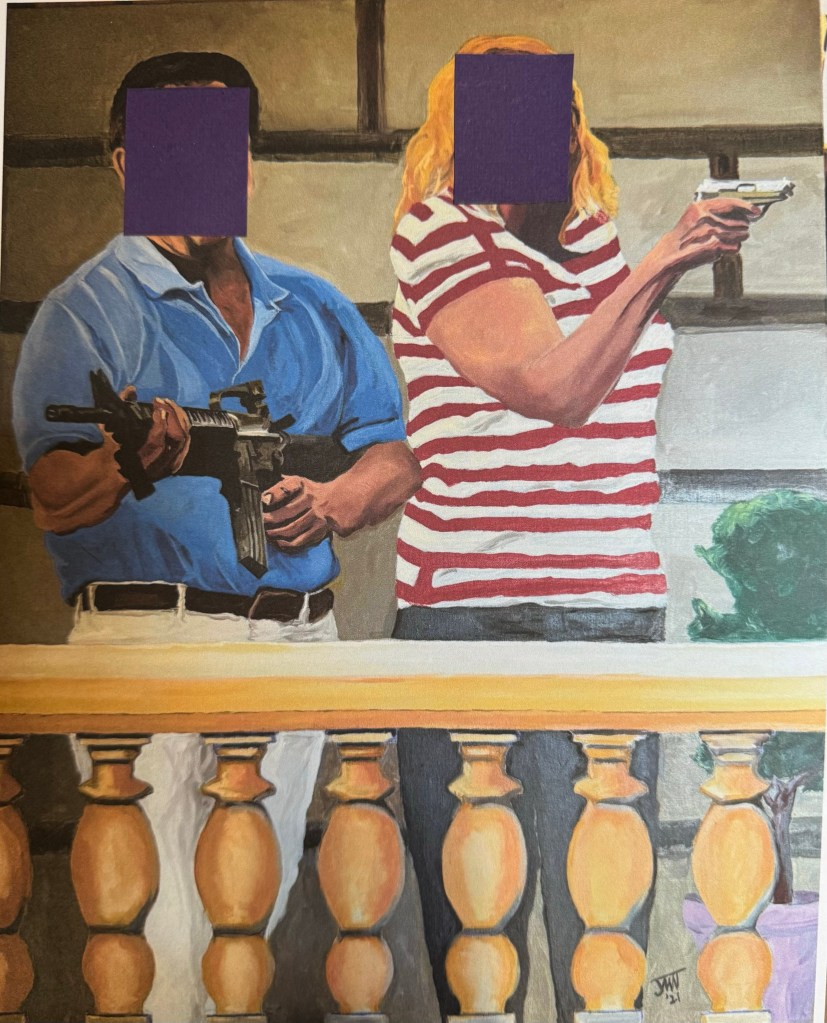






Fire in the Casus Belly
The Secretary of War and the Commander of War mustered the Brass at the Department of War.
First the SOW
Then the COW
Settled the hash
Good and proper
Of the Brass
At the DOW.
B-B-B-BOOM!
K-K-K-POW!
NOBEL FOR PEACE!
N-N-N-NOW!
(c) 2025 JMN — EthicalDative. All rights reserved