

When we beseech we implore screechingly. The act of beseeching is melded with a posture of self abasement in the form 5 Arabic verb taḍarra^u. The Wehr definitions include implore, beg and entreat. Also, to humiliate oneself, which in English connotative usage isn’t the same as having humility or being humble, is it? Does a person in authority demand groveling in exchange for favor? 7.55
“Poetry belongs to all who write, read, sing and sign it.”
(Adrian Matejka)
”A wild and capacious art” is how Adrian Matejka describes it. The editor of Poetry knows whereof he speaks, though I would hazard that other art forms besides poetry — opera, square dance, zither music — “belong” to their respective buffs, too. It’s an orotund assertion with wide application — the opposite of exclusionary.
Poetry spurns elitism, Matejka writes:
It is “for the people,” as June Jordan taught us — despite the exclusionary positions of some critics. This communal posture is what makes poetry open to anyone who wants to engage with it as a writer or as a reader…
Who doesn’t want to be enthused by a communal posture? In the rarefied world of poetry readership, two’s company, three’s a community. Widening the scope of what counts as poetry helps:
Some of the great poet-emcees like Rakim and Chuck D introduced me to the concept of poetry… They showed me… that poetry’s habits are universal and transferrable across mediums… It is malleable, transcending the strictures of its particular, versified container.
Ryan Ruby* states the case less floridly:
All concepts are vague, but at present there is no consensus as to what poetry even is, how to define a poem, or who counts as a poet, which is perhaps why we have settled, a little uneasily, on a manifestly circular definition of poetry: a poem is whatever a person recognized as a poet says is a poem.
* Context Collapse: A Poem Containing a History of Poetry
(c) 2025 JMN — EthicalDative. All rights reserved
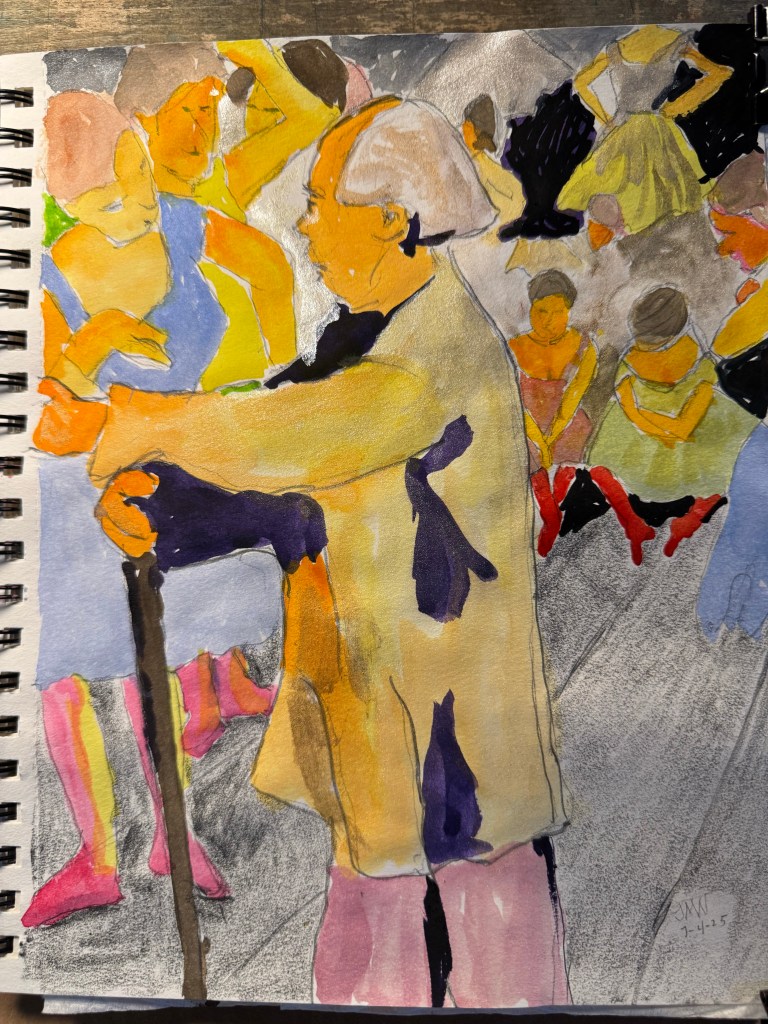


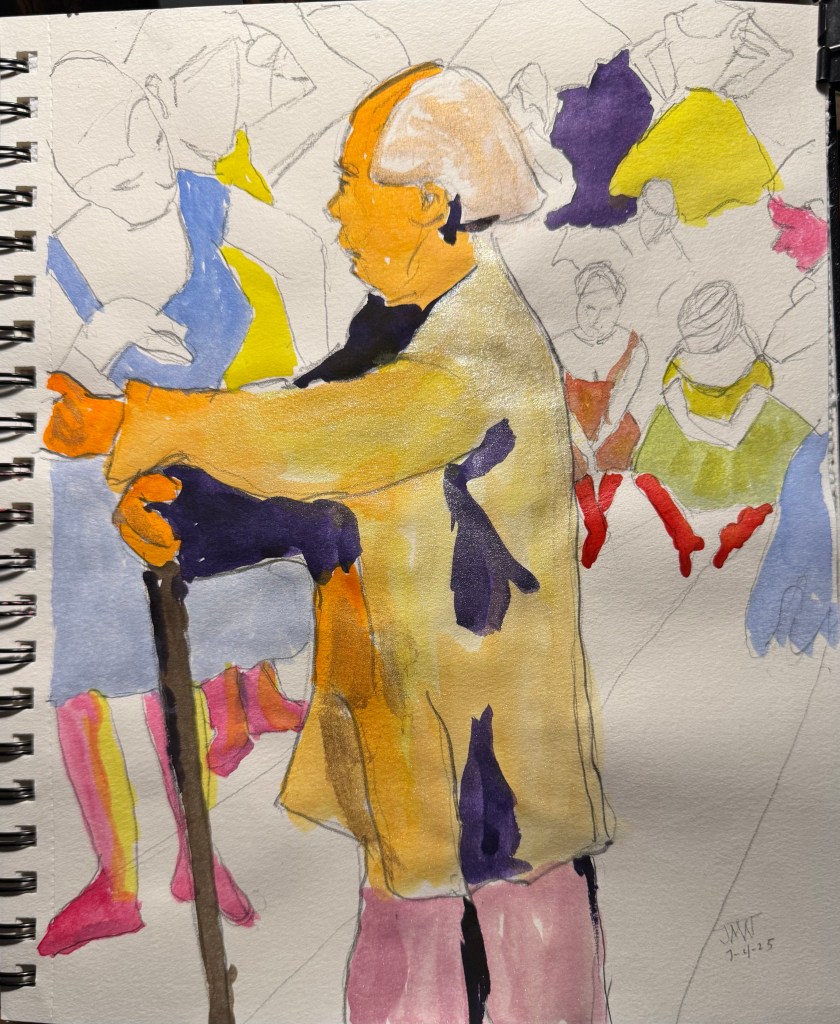
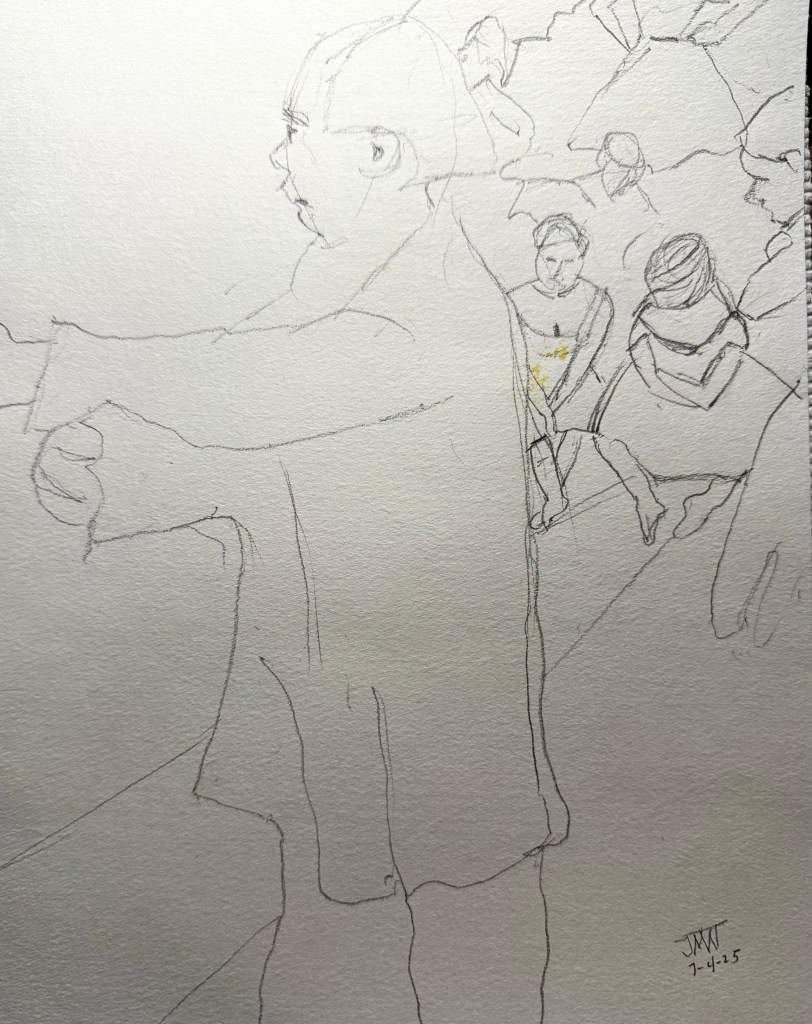


 EthicalDative
‘I Came Into the World Very Young’
“Study for a bust of Mr. Erik Satie painted by himself, with a thought: I came into the world very young during a very old time.” [New York Times caption and illustration, my translation]
I discovered Satie long ago through Gymnopédies and Gnossiennes, and liked the music immediately. I thought of him as a “minor” composer, and I was drawn to perceived niche tastes. I crave even now the unmoored feeling that his music gave me then.
Satie’s “Vexations,” came with instructions to repeat them 840 times, entailing a running time of about 19 hours. Here’s the thing: “Strangely, it resists memorization. Pianists have played it for long stretches, stood up from their instruments and realized they already forgot it.”
“Bohéme” (“The Bohemian”), a portrait of Satie in his studio in Montmartre by his friend Santiago Rusiñol. Credit… Fine Art Images/Heritage Images, via Getty Images. [New York Times caption and illustration]
Vexations! A lovely moniker. It reminds me of my experience with certain poetry: I interact with it as intensely as I can; maybe it marks me somehow, yet it scampers out of range of the retentive faculty.
He would write for performers to play “from the top of yourself” and “full of subtlety, if you believe me.” He seemed fixated on body parts, with instructions like “with tears in your fingers,” “on the tips of your back teeth” or “out of the corner of your hand.”
A performance of Satie’s “Parade,” a collaboration with Cocteau, Picasso and the choreographer Léonide Massine for Sergei Diaghilev’s Ballets Russes. Credit… Jack Vartoogian/Getty Images. [New York Times caption and illustration]
(Joshua Barone, “Satie’s Music Will Always Be Popular. But Will We Ever Understand It?” New York Times, 7-2-25)
(c) 2025 JMN — EthicalDative. All rights reserved