Until We Are They?

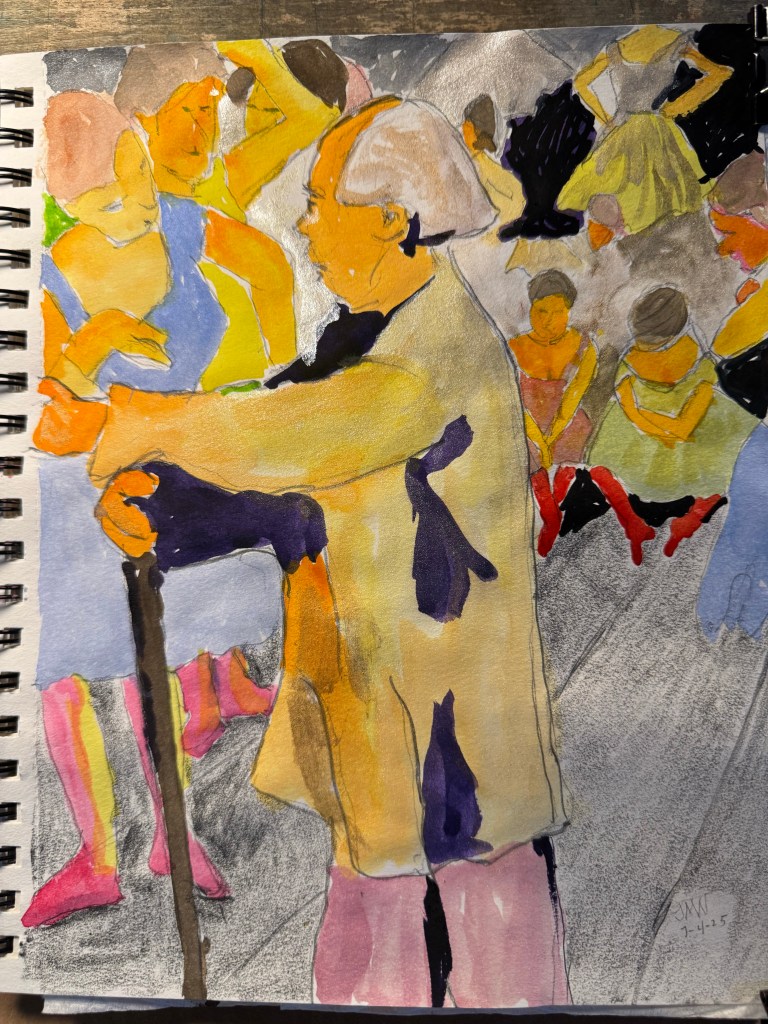
After Degas.

“The evolution of language always encounters resistance, and sometimes outrage.”

(John McWhorter)

A poem by Danez Smith in Poetry, July-August 2025, titled “They/Them” should be read whole but, to be brief, starts:

said short: i feel more like a stud. said
with some nuance: as if i came to
masculinity through the women’s gate,
[…]

and ends:

of course you should address me in the plural.
said short: i am everyone. I am everything.
said shorter: i am.

There’s a focus on shrugging off gender-laden singularity in favor of an anonymizing plural. What language does is “build a room for living.” So talk about me as if about the nexus of “me’s” that comprise who I am, including the one I feel like, the “me” I live in. Give my personhood a “they” address.

Does that re-iterate the case? Where’s the harm, I ask myself, in respecting someone’s wish to be “said” in the plural? “Thou,” after all, by slow degrees got replaced by plural “you” in the mouths of the many as speech habits adapted to social behaviors. 

My impulse to skirt judgment, however, might have me treading water in what evangelical Allie Beth Stuckey calls “toxic empathy,” a misbegotten immersion in the feelings of others which needs tamping down with a dose of biblical tough love in her telling. The argument’s burden is: God made two sexes, separate, distinct, recognizable, immutable, arguably unequal. He said so textually in Hebrew, Greek, Aramaic, perhaps Latin, too. 

The English koine will sort itself on the matter in the fullness of time, as tongues do. Meanwhile, poetry runs rich and rife. Danez Smith sings of mad love in “Dear Time.”

[…]
i tie my time to you, to you who knows most intimately
what is wrong with me, who has seen me at my most naked,

ass out, my toothless ashy soul naked and cold
and shameful in front of god, what a thing, love, i am so happy

to be stupid this way. […]

The speaker’s grandma asks about the speaker’s partner: 

[…] what kinda mexican is he? and I told her
Venezuelan so now I call him Venezuelan-Mexican when I want to be cute
.

Here’s a soaring, unvarnished take on the matriarch’s grandness:

and no this isn’t me canceling my grandma
because you, time, you cancel all grandmas, but she was speaking

within the limits of the language she has, pressing into that wall
for understanding and my grandma isn’t racist she’s difficult and careful

and nosey and serious and simple and a touch cold
and funny and a little mean and she spends her time in the kitchen

cause that work is how she loves us and she’s exactly the kind of poet
i want to be when i arrive deeper and frailer into time.
[…]

Who doesn’t want to be talked about like that when time lowers the boom?

(c) 2025 JMN — EthicalDative. All rights reserved

Posted in Anthology | Tagged , , | 2 Comments

‘Deep Blue Scrap of Lie’

There’s a cleanly spoken, elegant poem in Poetry, May 2025, that lingers in the mind’s eye. It’s called “Infinity Pool” by Vona Groarke. 

You flirt with an arresting occurrence in the liminal paralysis of semi-sleep. It nags. If not worded somehow, in your fully woken state it will have flown the coop. In Vona Groarke’s voice:

I had it in the night, the image,
but lacked the energy or will
to magic my body through
my own fourth wall and lower
myself, spit-spot, into the page.

Memory makes a stab, furrowing its brow. A visual conceit verges on recollection at a “just about” level of evanescence, like the lacery in foam etched on sand by a beached roller.

But I saw, I just about recall,
a blue rectangle not quite blank
held up against blue sky, blue sea
so you weren’t supposed to tell
the edge, the stitching, or the seams.

Say, a collage! The vision has coalesced into color, shape, backdrop: blue, primary hue that confines itself to distances; a shape with sides and corners, perceptibly edgeless; sky, sea.

“Infinity pool” is what it is — a luxuriant spa fixture, feat of engineered tomfoolery, extrapolated to an origami-like reminder pocketed for cherishing. I was stranded in the metaphysical until I caught the drift.

And I am folding it now, this pool,
corner to corner, line to line,
so as to carry about with me
its deep blue scrap of  lie.

Artfully deflating, conclusive irony: 

But carrying folded water
isn’t feasible. You know that.

Who’s “you”? Me? The poem talking to itself? The abrupt interpolation teases. What makes us human is eked out on scraps of lie, on our “knowing” the unreasonable — the ever-loving “hidden” and its haunted relatives. We carry water for our illusions. We feed them hermeneutically. They float somewhere beyond feasible, retrievable in our confabulations. I can’t say enough about “Infinity Pool” by Vona Groarke, or anything really. It’s damn near perfect.

(c) 2025 JMN — EthicalDative. All rights reserved

Posted in Anthology | Tagged , , | 10 Comments

‘I Came Into the World Very Young’


“Study for a bust of Mr. Erik Satie painted by himself, with a thought: I came into the world very young during a very old time.” [New York Times caption and illustration, my translation]

I discovered Satie long ago through Gymnopédies and Gnossiennes, and liked the music immediately. I thought of him as a “minor” composer, and I was drawn to perceived niche tastes. I crave even now the unmoored feeling that his music gave me then.

Satie’s “Vexations,” came with instructions to repeat them 840 times, entailing a running time of about 19 hours. Here’s the thing: “Strangely, it resists memorization. Pianists have played it for long stretches, stood up from their instruments and realized they already forgot it.”


“Bohéme” (“The Bohemian”), a portrait of Satie in his studio in Montmartre by his friend Santiago Rusiñol. Credit… Fine Art Images/Heritage Images, via Getty Images. [New York Times caption and illustration]

Vexations! A lovely moniker. It reminds me of my experience with certain poetry: I interact with it as intensely as I can; maybe it marks me somehow, yet it scampers out of range of the retentive faculty.

He would write for performers to play “from the top of yourself” and “full of subtlety, if you believe me.” He seemed fixated on body parts, with instructions like “with tears in your fingers,” “on the tips of your back teeth” or “out of the corner of your hand.”


A performance of Satie’s “Parade,” a collaboration with Cocteau, Picasso and the choreographer Léonide Massine for Sergei Diaghilev’s Ballets Russes. Credit… Jack Vartoogian/Getty Images. [New York Times caption and illustration]

(Joshua Barone, “Satie’s Music Will Always Be Popular. But Will We Ever Understand It?” New York Times, 7-2-25)

(c) 2025 JMN — EthicalDative. All rights reserved
Posted in Commentary, Quotations | Tagged , , , | 5 Comments

Untie These Hidebound Eyes, Unbind These Hogtied Hands

“It” refers to an exhausted limestone quarry beneath Mont Sainte-Victoire. [Photographed from New York Times illustration].

Jason Farago-rhymes-with-Chicago writes a deep, reflective appreciation of Cézanne’s work, calling Cézanne the first painter he ever loved. 

BC*: For six centuries, ever since some scientifically minded Florentines had developed rules of perspective that made art look more like life, painters had put a premium on convincing illusions. At Cézanne’s breakfast table, starting in the mid-1870s, that all came to an end.

AC: More important than copying or simulating reality was being true to your experience of reality. Your marks, your style, your hand, your eye: These now had primacy and the world outside was secondary… What Cézanne understood is that the eye is not impassive — not a camera with its shutter open… No: The eye flits and darts, looks inwards as well as out… A “convincing” depiction was now just a facile replica. Painting, after Cézanne, becomes a series of strategies to render visible — to viewers, to yourself — whatever truly matters to the artist.

Farago situates painting within the larger context of the things that are worthy of our attention:

… Cézanne taught me how to read Virginia Woolf, with her own idiosyncratic perspectives and spatial ambiguity. / I was learning, year by year, a modern poetics: a theory of art, music, literature predicated on a perpetual break with tradition.

 Regarding breaks with tradition, Farago does modulate:

This century — do you mind if I say this? — has shown that exalting your own voice over established principles doesn’t always end well.

But I tell myself, “Listen to this much, for now, and make truer pictures. Then see what’s next.”

*BC — “Before Cézanne,” etc.

(Jason Farago, “Cézanne and the Hard Facts of Time,” New York Times, 6-30-25)

(c) 2025 JMN — EthicalDative. All rights reserved
Posted in Quotations | Tagged , , , | Leave a comment

Eric’s Song: Triolet La-La-La

After Degas.

“I have never been more proud of our company. Our portfolio is operating flawlessly, and 2025 will mark the strongest year in the remarkable history of the Trump Organization.”
(Eric Trump)

Papa got his swerve on.
(Mojo Monkeys)

A Congress cowed and judges dominated!
B Sing it, children: Papa got his swerve on!
c Hail, sheikhs of Araby and crypto lords!
A Congress cowed and judges dominated!
a L’état c’est moi. Democracy checkmated!
b Eggheads spanked. Press gagged. A hole in one!
A Congress cowed and judges dominated!
B Sing it, children: Papa got his swerve on!

(c) 2025 JMN — EthicalDative. All rights reserved

Posted in Anthology | Tagged | 3 Comments

Death in Venice: Triolet

After Degas.

The problem with the world is there’s only one of it. If something goes wrong there isn’t a backup. It just grinds on, full of the error.
(Luke Allan)

A An Amazon swamps Venice’s lagoon.
B The world, it just grinds on, full of the error.
c Viagra’d boars cavort with slinky sows
A As Amazon swamps Venice’s lagoon.
a Rank in bling, siliconed, yacht-bestrewn,
b The grand old tart supports the jet set’s mirror.
A An Amazon swamps Venice’s lagoon.
B The world, it just grinds on, full of the error.

(c) 2025 JMN — EthicalDative. All rights reserved

Posted in Anthology | Tagged | 2 Comments

‘Technically God Isn’t a “Him”’

After Degas.

‘*Technically God isn’t a “him.” But the English language doesn’t provide a suitable singular, non-gender term for us to use (“it” implies an object or non-sentient being).’


(Mitch Teemley)

Mitch Teemley’s observation touches usefully upon the volatile topic of “they” third persons and “he/she” third persons. English has ready at hand singular “it,” as he notes, but referring to a sentient being as “it” violates the innately sensed contrast between persons-and-pets versus clams-and-thumbtacks. Singularized “they” is the lesser evil.

How to pronominalize the divine (the “all-sentient”?) invites meditation. Cult moves slowly. In another few centuries “He” might become “They.” Meanwhile, believers commanded to preach as well as pray must talk of God in the grammatical third person, if at all. Recast the first line of the Lord’s Prayer as a sermon, replacing “Father” with “God.”

Our God, Who is in heaven, hallowed be <His/Her/Its/Their> name.

Talk of God in any person at all may argue with the literal grain of Wittgenstein’s tart dictum:

Whereof we cannot speak, thereof we must be silent. 

Or with Arthur Eddington’s:

The universe is not just queerer than we suppose; it’s queerer than we CAN suppose.” 

How to speak of what purportedly outstrips our puny faculties by infinitudes? (What do fish say about ocean?) If God’s anything they’re all of it, outside of which and whom or what is inconceivable nonbeing. I’d include in my devotions a line of Elaine Kahn’s poetry which she quotes in her essay “On Shame: In the Realm of Death and Awe” (Poetry, June 2025):

What drives me / is baseless / and therefore / indisputable.

There’s an axiom of — is it logic? — which says, approximately, What needs no proof needs no rebuttal.

(c) 2025 JMN — EthicalDative. All rights reserved

Posted in Commentary | Tagged , , | 2 Comments

Guide for the Perplexed

After Degas.

“… When I don’t know what to do next, I tend to throw everything at it, be as expressive or as minimalist or as detailed as I can, reach for bright colours or keep it monochrome, look intensely or scribble vaguely. It’s a way I can find out what I like and what may work.”


(Outside Authority)

Doff of cap to the art blog of Outside Authority for comments I find helpful in my efforts to draw and paint. I’m learning that I have do it even worse in order possibly to do it better. 

 (c) 2025 JMN — EthicalDative. All rights reserved
Posted in Quotations | Tagged , , | 2 Comments

Spasms of Lunacy: Triolet

After Degas.

There are lessons to be found in these ancient desks where many hearts are gouged.
(Peter Kline)

A There are lessons to be found in these
B Halls where horny boys now dead had trudged.

c The ancient desks where many hearts are gouged —
A There are lessons to be found in these.

a “Last will and testicle” was a bored tease.
b The teacher sat the empty chair and judged.

A Lessons to be found are there in these
B Halls whose horny boys now dead have trudged.

(c) 2025 JMN — EthicalDative. All rights reserved
Posted in Anthology | Tagged , | Leave a comment

‘Ebullient, Rigorous and Boastfully Esoteric’


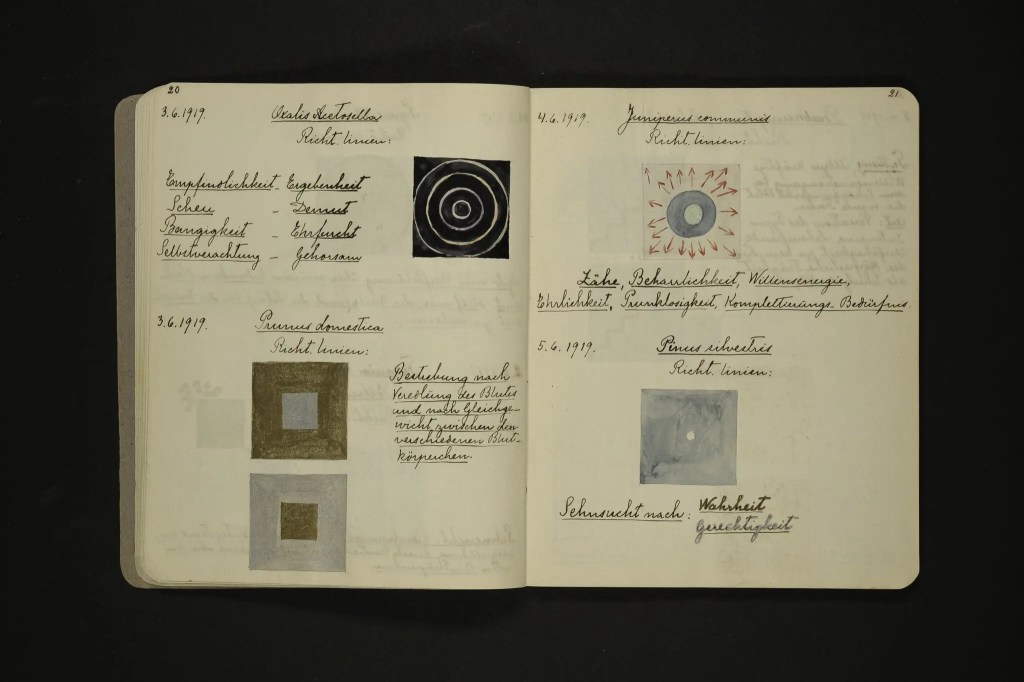
“Flowers, Mosses and Lichens,” conceived 1919–20; artist’s copy completed by 1926. Notebook with watercolor, metallic paint, pencil and ink. Credit… via Hilma af Klint Foundation, Stockholm. [New York Times caption and illustration]

Walker Mimms’s treatment of Hilma af Klint is elegant, lyrical, explicit.


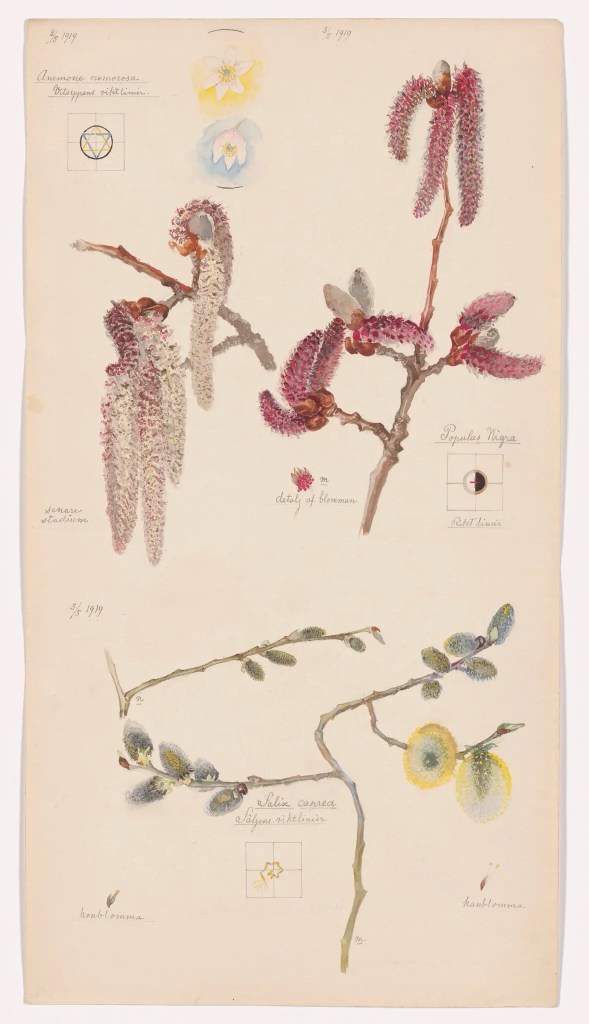
Alongside the careful realism of her herbal specimens, af Klint inscribed diagrams explaining their spiritual lives. For the European thimbleweed, a hot-and-cold Star of David; for the goat willow, a broken hexagram; for the black poplar, a yin-yang bullseye representing its “resistance to unite the astral and the mental.” Credit… Committee on Drawings and Prints Fund and gift of Jack Shear, via Museum of Modern Art, New York. [New York Times caption and illustration]

Ebullient, rigorous and boastfully esoteric, these “Nature Studies,” as she called them, reveal the didactic side of a pioneer in nonliteral art. This is an economical show of some beautiful field exercises, and it suggests the spiritual extremes to which the honorable but often tedious tradition of botanical illustration might be taken.


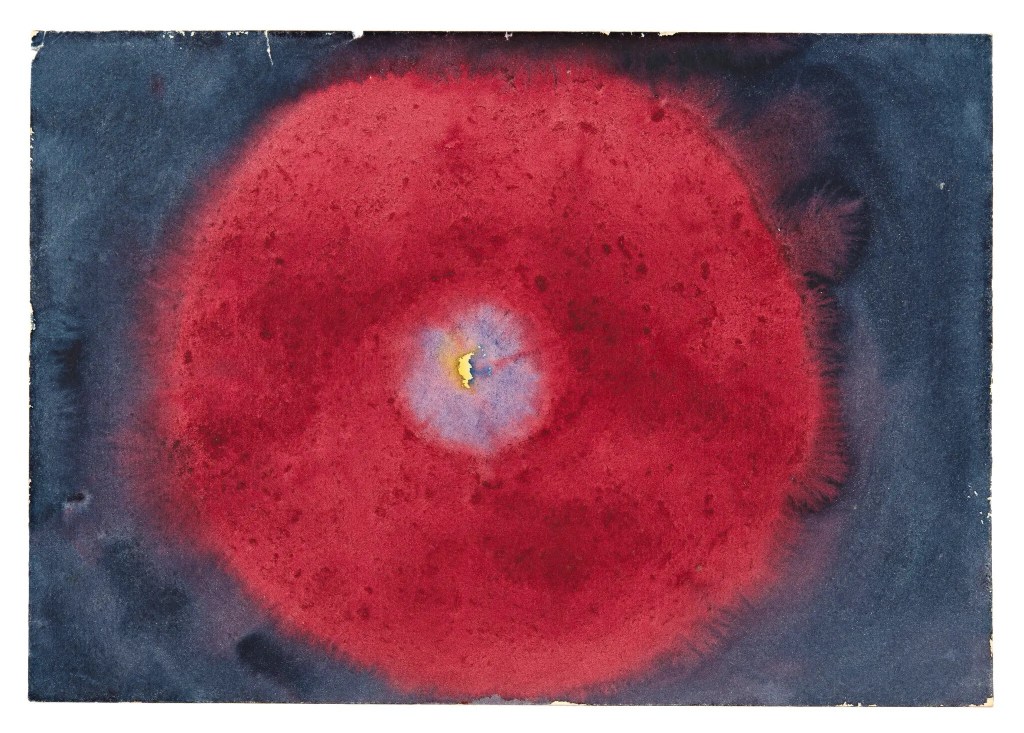
“Birch” from the series “On the Viewing of Flowers and Trees,” 1922, watercolor on paper. Credit… The Hilma af Klint Foundation, Stockholm. [New York Times caption and illustration]

At MoMA, a wall of bright and hasty energy paintings from 1922 wraps the show — wet-on-wet watercolors with only vague kinships to their herbal titles: “Oak,” “Pansy,” “Birch.” After her years transcribing tendrils and anthers, they are sloppy and fun, like cannonball dives into the placid surface of a lake. They are also less interesting. But they are edgy in their way…

(Walker Mimms, “In Her Botanical Paintings Hilma af Klint Hurtles Back to Earth,” 5-15-25)

(c) 2025 JMN — EthicalDative. All rights reserved
Posted in Quotations | Tagged , , | 7 Comments